Questions

3 Marks Question

🎯

Test yourself on this topic

27 questions · timed · auto-graded

Question 13 Marks
Find the smallest four digit number which is divisible by $18, 24$ and $32.$
Answer
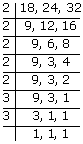
$\therefore L.C.M. = 2 \times 2 \times 2 \times 2 \times 3 \times 3 = 288.$
Multiples of $288$ are :
$288 \times 1 = 288, 288 \times 2 = 576, 288 \times 3 = 864, 288 \times 4 = 1152, ......$
Hence, the smallest four-digit number which is divisible by $18, 24$ and $32$ is $1152.$
View full question & answer
Question 23 Marks
Find the least number which when divided by $6, 15$ and $18$ leave remainder $5$ in each case.
Answer


$\therefore L.C.M. of 6, 15$ and $18 = 2 \times 3 \times 3 \times 5 = 90.$
Hence, the required number is $90 + 5$ i.e. $95.$
View full question & answer
Question 33 Marks
Three tankers contain $403$ litres, $434$ litres and $465$ litres of diesel, respectively. Find the maximum capacity of a container that can measure the diesel of the three containers exact number of times.
Answer
Factors of $403$ are $1, 13, 31$ and $403.$
Factors of $434$ are $1, 2, 7, 14, 31, 62, 217$ and $434.$
Factors of $465$ are $1, 3, 5, 15, 31, 93, 155$ and $465.$
Common factors of $403, 434$ and $465$ are $1$ and $31.$
Highest of these common factors is $31.$
$\therefore H.C.F$ of $403, 434$ and $465$ is $31.$
Hence, the maximum capacity of the container that can measure the diesel of the three containers exact number of times is $31$ litres.
View full question & answer
Question 43 Marks
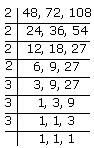
The traffic lights at three different road crossings change after every $48$ seconds, $72$ seconds and $108$ seconds respectively. If they change simultaneously at $7 a.m$., at what time will they change simultaneously again?
Answer

$\therefore L.C.M $. of $48, 72$ and $108 = 2 \times 2 \times 2 \times 2 \times 3 \times 3 \times 3 = 432$
$432$ seconds $= 7$ min $12$ seconds.
Hence, they will change simultaneously again $7$ min $12$ seconds after $7 a.m.$
View full question & answer
Question 53 Marks
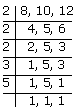
Determine the largest $3-$digit number exactly divisible by $8, 10$ and $12.$
Answer


$\therefore L.C.M.$ of $8, 10$ and $12 = 2 \times 2 \times 2 \times 3 \times 5 = 120.$
Multiple of $120$ are:
$120 \times 1 = 120, 120 \times 2 = 240, $
$120 \times 3 = 360, 120 \times 4 = 480, $
$120 \times 5 = 600, 120 \times 6 = 720, $
$120 \times 7 = 840, 120 \times 8 = 960, $
$120 \times 9 = 1080, ....$
Hence, the largest $3-$digit number exactly divisible by $8, 10$ and $12$ is $960.$
View full question & answer
Question 63 Marks
Determine the smallest 3-digit number which is exactly divisible by $6, 8$ and $12.$
Answer


$\therefore L.C.M. of 6, 8$ and $12 = 2 \times 2 \times 2 \times 3 = 24$
Multiples of $24$ are $24, 48, 72, 96, 120, 144, ...$
Hence, the smallest $3-$digit number which is exactly divisible by $6, 8$ and $12$ is $120.$
View full question & answer
Question 73 Marks
The length, breadth and height of a room are $825\ cm, 675 \ cm$ and $450\ cm$, respectively. Find the longest tape which can measure the three dimensions of the room exactly.
Answer
Factors of $825$ are $1, 3, 5, 11, 15, 25, 33, 55, 75, 165, 275$ and $825.$
Factors of $675$ are $1, 3, 5, 9, 15, 25, 27, 45, 75, 135, 225$ and $675.$
Factors of $450$ are $1, 2, 3, 5, 6, 9, 10, 15, 18, 25, 30, 45, 50, 75, 90, 150, 225$ and $450.$
$\therefore$ Common factors of $825, 675$ and $450$ are $1, 3, 5, 15, 25$ and $75.$
Highest of these common factors is $75.$
Hence, the length of the longest tape which can measure the three dimensions of the room exactly is $75\ cm.$
View full question & answer
Question 83 Marks
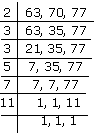
Three boys steps off together from the spot. Their steps measure $63 \ cm, 70\ cm$ and $77\ cm$, respectively. What is the minimum distance each should cover, so that all can cover the distance in complete steps?
Answer


$\therefore L.C.M. of 63, 70$ and $77 = 2 \times 3 \times 3 \times 5 \times 7 \times 11$
$= 6930$
Hence, the minimum distance each should cover so that all cover the distance in complete steps is $6930\ cm.$
View full question & answer
Question 93 Marks
Find the $L.C.M.$ of $9, 45$ in which one number is the factor of the other. What do you observe in the results obtained?
Answer
Prime factorisation of $9$ and $45$ are as follows:
$9 = 3 \times 3$
$45 = 3 \times 3 \times 5$
$ \therefore L.C.M$. of $9$ and $45 = 3 \times 3 \times 5 = 45$
View full question & answer
Question 103 Marks
Find the $L.C.M.$ of $12, 48$ in which one number is the factor of the other. What do you observe in the results obtained?
Answer
Prime factorisation of $12$ and $48$ are as follows:
$12 = 2 \times 2 \times 3$
$48 = 2 \times 2 \times 2 \times 2 \times 3$
$ \therefore L.C.M. of 12$ and $48 = 2 \times 2 \times 2 \times 2 \times 3 = 48$
View full question & answer
Question 113 Marks
Find the $L.C.M.$ of $6, 18$ in which one number is the factor of the other. What do you observe in the results obtained?
Answer
Prime factorisation of $6$ and $18$ are as follows :
$6 = 2 \times 3$
$18 = 2 \times 3 \times 3$
$ \therefore L.C.M.$ of $6$ and $18 = 2 \times 3 \times 3 = 18$
View full question & answer
Question 123 Marks
Find the $LCM$ of the numbers $5, 20$ in which one number is the factor of the other. What do you observe in the results obtained?
Answer
Prime factorisation of $5$ and $20$ are as follows :
$5 = 5$
$20 = 2 \times 2 \times 5$
$ \therefore L.C.M.$ of $5$ and $20$
$= 2 \times 2 \times 5$
$= 20$
View full question & answer
Question 133 Marks
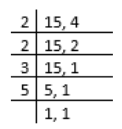
Find the $LCM$ of the numbers: $15$ and $4$
Answer
$LCM $- Least common multiple
The $LCM$ of two numbers is the smallest number that is a multiple of both the numbers, and is obtained as follows:

$LCM = 2 \times 2 \times 3 \times 5 = 60$
View full question & answer
Question 143 Marks
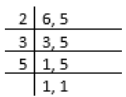
Find the $LCM$ of the numbers: $6$ and $5$
Answer
$LCM$ - Least common multiple
The $LCM$ of two numbers is the smallest number that is a multiple of both the numbers, and is obtained as follows:

$LCM = 2 \times 3 \times 5 = 30$
View full question & answer
Question 153 Marks
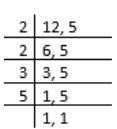
Find the $LCM$ of the numbers: $12$ and $5$
Answer
$LCM$ - Lowest common multiple
The $LCM$ of two numbers is the smallest number that is a multiple of both the numbers, and is obtained as follows:

$LCM = 2 \times 2 \times 3 \times 5 = 60$
View full question & answer
Question 163 Marks
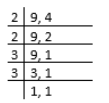
Find the $LCM$ of the numbers: $9$ and $4$
Answer
$LCM$ - Lowest common multiple
The $LCM$ of two numbers is the smallest number that is a multiple of both the numbers, and can be obtained as follows:

$LCM = 2 \times 2 \times 3 \times 3 = 36$
View full question & answer
Question 173 Marks
Renu purchases two bags of fertiliser of weights $75 \ kg$ and $69\ kg$. Find the maximum value of weight which can measure the weight of the fertiliser exact number of times.
Answer
Factors of $75$ are $1, 3, 5, 15, 25$ and $75.$
Factors of $69$ are $1, 3, 23$ and $69.$
$\therefore$ Common factors of $75$ and $69$ are $1$ and $3.$
Highest of these common factors is $3.$
$\therefore H.C.F$. of $75$ and 69 is $3.$
Hence, the maximum capacity of weight which can measure the weight of the fertiliser exact number of times is $3kg.$
View full question & answer
Question 183 Marks
Determine, if $25110$ is divisible by $45.$
[Hint: $5$ and $9$ are co-prime numbers. Test the divisibility of the number by $5$ and $9]$
Answer
Divisibility of $25110$ by $5.$
$ \because$ Number in the unit's place of $25110 = 0$
$ \therefore 25110$ is divisible by $5.$
Divisibility of $25110$ by $9.$
Sum of the digits of the number $25110.$
$= 2 + 5 + 1 + 1 + 0 = 9.$
$\because 9$ is divisible by $9.$
$\therefore 25110$ is divisible by $9.$
As $25110$ is divisible by $5$ and $9$ both and $5$ and $9$ are co-prime numbers, so $25110$ is divisible by $5 × 9 = 45.$
View full question & answer
Question 193 Marks
The product of three consecutive numbers is always divisible by $6$. Verify this statement with the help of some examples.
Answer
Let the three consecutive numbers be n, $(n + 1), ( n + 2).$
The product of these numbers be $n(n + 1)(n + 2).$
We know that the product of three consecutive numbers is always divisible by $3.$
Out of the three consecutive numbers, one will be even. Which means the product is also divisible by $2.$
Hence the product of three consecutive numbers is divisible by $3$ and $2.$
Therefore the product of three consecutive numbers is also divisible by $6.$
$Ex.1$: Take three consecutive number $21, 22$ and $23.$
$21$ is divisible by $3.$
$22$ is divisible by $2.$
$ \therefore 21 \times 22$ is divisible by $3 \times 2 (= 6)$
$ \therefore 21 \times 22 \times 23$ is divisible by $6.$
$Ex.2$: Take three consecutive numbers $47, 48$ and $49.$
$48$ is divisible by $2$ and $3$ both.
$\therefore 48$ is divisible by $2 \times 3 = 6$
$ \therefore 47 \times 48 \times 49$ is divisible by $6.$
View full question & answer
Question 203 Marks
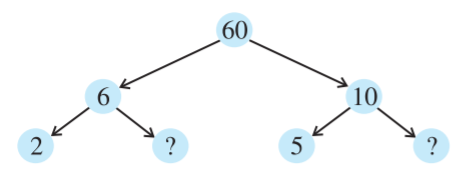
Here are two different factor trees for $60$. Write the missing numbers.
Answer
Lets 'a' be the missing number in the given pattern
So, we have
$2 \times a = 6$
$ \Rightarrow a = \frac{6}{2} = 3$
$ \Rightarrow a = 3$
So, $2 \times 3 = 6 And 5 \times a = 10$
$ \Rightarrow a = \frac{10}{5} = 2$
$ \Rightarrow 5 \times 2 = 10$
Missing numbers are $3$ and $2.$
View full question & answer
Question 213 Marks
Find the $LCM$ of $24$ and $90.$
Answer
Clearly, The prime factorizations of $24$ and $90$ are:
$24 = 2 \times 2 \times 2 \times 3$
$90 = 2 \times 3 \times 3 \times 5$
In the above prime factorizations the maximum number of times the prime factor $2$ occurs is three for $24.$ Similarly, the maximum number of times the prime factor $3$ occurs is two for $90.$
The prime factor $5$ occurs only once in $90.$
Therefore, $LCM$ of $24$ and $90 = (2 \times 2 \times 2) \times (3 \times 3) \times 5 = 360$
View full question & answer
Question 223 Marks
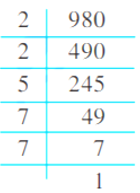
Find the prime factorisation of $980.$
Answer
Here, we shall proceed as below:
We divide the number $980$ by $2, 3, 5, 7$ etc. in this order repeatedly, So long as the quotient is divisible by that number.
Thus, the prime factorization of $980$ comes out to be: $2 \times 2 \times 5 \times 7 \times 7$
View full question & answer
Question 233 Marks
Find the common multiples of $3, 4$ and $9.$
Answer
Multiples of $3$ are:
$3, 6, 9, 12, 15, 18, 21, 24, 27, 30, 33, 36, ....$
Multiples of $4$ are:
$4, 8, 12, 16, 20, 24, 28, 32, 36, 40,...$
Multiples of $9$ are:
$9, 18, 27, 36, 45, 54, 63, 72, 81, ...$
Therefore, the common multiples of $3, 4$ and $9$ are: $36, 72, 108, ...$
View full question & answer
Question 243 Marks
Find the common factors of $75, 60$ and $210.$
Answer
Factors of $75$ are given by $1, 3, 5, 15, 25$ and $75.$
Factors of $60$ are given by $1, 2, 3, 4, 5, 6, 10, 12, 15, 30$ and $60.$
Factors of $210$ are given by $1, 2, 3, 5, 6, 7, 10, 14, 15, 21, 30, 35, 42, 70, 105$ and $210.$
Thus, common factors of $75, 60$ and $210$ are $1, 3, 5$ and $15.$
View full question & answer
Question 253 Marks
Find the factors of $36.$
Answer
Here we have
$36 = 1 \times 36$
$36 = 2 \times 18$
$36 = 3 \times 12$
$36 = 4 \times 9$
$36 = 6 \times 6$
We Stop here, because both the factors $(6)$ are same.
Thus, the required factors are $1, 2, 3, 4, 6, 9, 12, 18$ and $36.$
View full question & answer
Question 263 Marks
Find the $LCM$ of $40, 48$ and $45.$
Answer
The prime factorizations of $40, 48$ and $45$ are given as follows:
$40 = 2 \times 2 \times 2 \times 5$
$48 = 2 \times 2 \times 2 \times 2 \times 3$
$45 = 3 × 3 × 5$
The prime factor $2$ appears maximum number of times which is four, in the prime factorisation of $48$, the prime factor $3$ occurs maximum number of two times in the prime factorisation of $45$, The prime factor $5$ appears one time in the prime factorisations of 40 and $45,$ we take it only once.
Therefore, we have required $LCM = (2 \times 2 \times 2 \times 2) \times (3 \times 3) \times 5 = 720$
View full question & answer
Question 273 Marks
Write all the factors of $68.$
Answer
Here we have
$68 = 1 \times 68$
$68 = 2 \times 34$
$68 = 4 \times 17$
$68 = 17 \times 4$
Stop here, as $4$ and $17$ have already occurred.
Thus, the factors of $68$ are $1, 2, 4, 17, 34$ and $68.$
View full question & answer