MCQ 11 Mark
An angle of $75^\circ $ is drawn using a pair of compass and ruler by bisecting ___.
- A
$60^\circ $
- ✓
$60^\circ $ and $90^\circ $
- C
$0^\circ $ and $90^\circ $
- D
$120^\circ $ and $180^\circ $
AnswerCorrect option: B. $60^\circ $ and $90^\circ $
$60^\circ $ and $90^\circ $
View full question & answer→MCQ 21 Mark
Lines $a, b, p, q, m, n$ and $x$ have $a$ point $P$ common to all of them. What is the name of $P?$
AnswerA point common to multiple lines is called a point of concurrence as the lines are concurrent lines.
View full question & answer→MCQ 31 Mark
Rohan thinks he knows how to bisect angles and follows following steps to construct $45^\circ $ angle.
Step $1$: Construct an angle of $90^\circ $
Step $2$: Bisect the $90^\circ $ angle.
Step $3$: Bisect one of the angles obtained in step $2$.
- A
Step $1$
- B
Step $2$
- ✓
Step $3$
- D
Step $2$ and $3$
AnswerCorrect option: C. Step $3$
Step $3$
View full question & answer→MCQ 41 Mark
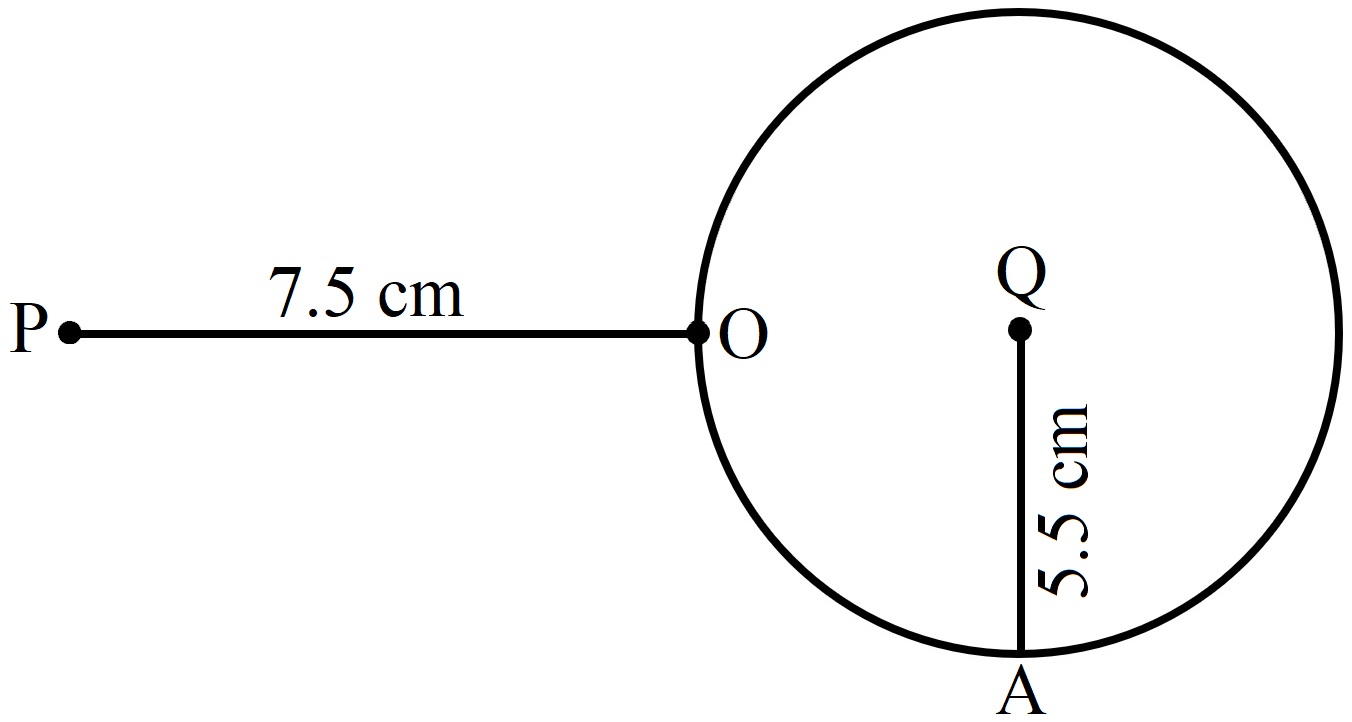
If $O$ is a point on the circle and $P$ is a point in the exterior of the circle. Length of $\overline{\text{OP}}=7.5$cm and radius of the circle is $5.5\ cm$. What will be the length of $\overline{\text{OP}},$ if $Q$ is the centre?
- A
$5.5\ cm$
- ✓
$3\ cm$
- C
$7.5\ cm$
- D
$13.5\ cm$
AnswerCorrect option: B. $3\ cm$
$OQ + OP = 5.5 + 7.5 = 13\ cm$
View full question & answer→MCQ 51 Mark
Identify the condition when a triangle can be constructed?
- ✓
One side and two acute angles are given.
- B
A side and an acute angle are given.
- C
Two obtuse angles are given.
- D
All given sides are equal.
AnswerCorrect option: A. One side and two acute angles are given.
One side and two acute angles are given.
View full question & answer→MCQ 61 Mark
Mark $(\checkmark)$ against the correct answer in the following:
$\frac{3}{2}$ right angles = .......
- A
$115^\circ $
- ✓
$135^\circ $
- C
$230^\circ $
- D
$270^\circ $
AnswerCorrect option: B. $135^\circ $
$32$ right angles $= 32 \times 90^\circ = 135^\circ $
$32$ right angles $= 32 \times 90^\circ = 135^\circ $
View full question & answer→MCQ 71 Mark
To construct a perpendicular to a line $(L)$ from a point $(P)$ outside the line, steps are given in jumbled form. Identify the fourth step from the following
$(1)$ Draw line $PQ$
$(2)$Draw a line $L$ and consider point $P$ outside the line
$(3)$Take $P$ as a center, draw $2$ arcs on line $L$ and name it as points $A$ and $B$ respectively
$(4)$Taking $A$ and $B$ as a center one by one and keeping the same distance in compass
draw the arcs on other side of the line. The point where these arcs intersect name that point as $Q$
AnswerThe correct sequence is: Step
$(1)$ Draw a line $L$ and consider a point $P$ outside the line.
$(2)$ Take $P$ as center and draw two arcs on line $L$ ans name the points $A$ and $B$ respectively.
$(3)$ Taking $A$ and $B$ as centres one by one and keeping the same distance in compass, draw the arcs on other side of the line .
$(4)$ The point where these arcs intersect name that as $Q$
$(5)$ Draw line $PQ$ So the fourth step is $1$
View full question & answer→MCQ 81 Mark
With the help of a ruler and a compass, it is possible to construct an angle of:
- A
$37.5^\circ$
- B
$40^\circ$
- ✓
$22.5^\circ$
- D
AnswerCorrect option: C. $22.5^\circ$
Using a ruler and compass it is possible to construct an angle of $22.5^\circ$
Step $1$: construct an angle of $90^\circ$
Step $2$: Draw angle bisector to get an angle of $45^\circ$
Step $3$: Again draw angle bisector to get an angle of $22.5^\circ$So option $C$ is correct.
View full question & answer→MCQ 91 Mark
A few lines in a plane have a point in common. What type of lines can they be?
- A
- B
- C
- ✓
Either $[a]$ or $[c]$
AnswerCorrect option: D. Either $[a]$ or $[c]$
If the lines are only two, then they are intersecting lines.
If there are more than two lines, then they are concurrent lines.
View full question & answer→MCQ 101 Mark
Identify the uses of a ruler.
- A
To draw a line segment of a given length
- B
To draw a copy of a given segment.
- C
To draw a diameter of a circle.
- ✓
AnswerA ruler is used to draw a line segment of a given length, to draw the copy of a given segment, and to draw a diameter of a circle.
Thus, all the given options are correct.
View full question & answer→MCQ 111 Mark
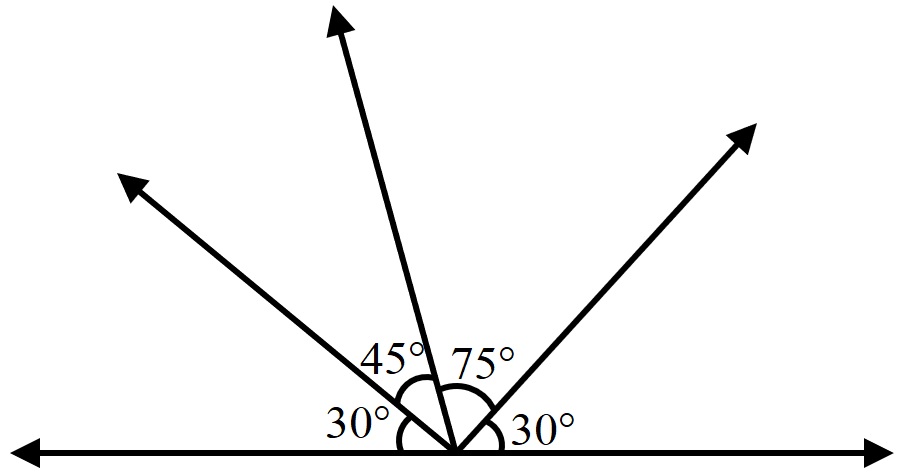
The number of obtuse angles is:
MCQ 121 Mark
The steps of construction of an $\angle\text{AOB}=45^\circ$ is given in jumbled order below:
$1.$ Place compass on intersection point.
$2.$ Place ruler on start point and where arc intersects perpendicular line.
$3.$ Adjust compass width to reach start point.
$4.$ Construct a perpendicular line.
$5.$ Draw $45$ degree line.
$6.$ Draw an arc that intersects perpendicular line.
$7.$ The third step in process is:
AnswerCorrect sequence is:
$1.$ Construct a perpendicular line
$2.$ Draw an arc that intersect the perpendicular line.
$3.$ Adjust the compass width to reach the start point .
$4.$ Place compass on intersection point.
$5.$ Place ruler on start point and where the arc intersects the perpendicular line.
$6.$ Draw $45$ degree line.
View full question & answer→MCQ 131 Mark
$P$ and $Q$ are the end points of a line segment $\overline{\text{PQ}}.$ If $R$ is any point on $\overline{\text{PQ}}.$ which of the given statements may be true?
- A
$PR = QR$
- B
$PR$ $QR$
- C
$PR$ $QR$
- ✓
Answer
Given that $R$ is any point on $\overline{\text{PQ}},$ $R$ may be Icoser to $P$ or $Q$ or exactly in between $P$ and $Q.$
Hence $PR = QR$ or $PR < QR$ or $PR > QR$ may be true. View full question & answer→MCQ 141 Mark
Choose the correct option in which a triangle $CANNOT$ be constructed with the given lengths of sides.
- A
$3\ cm, 13\ cm, 15\ cm$
- B
$6\ cm, 6\ cm, 6\ cm$
- ✓
$9\ cm, 6\ cm, 2\ cm$
- D
$13\ cm, 6\ cm, 8\ cm$
AnswerCorrect option: C. $9\ cm, 6\ cm, 2\ cm$
Difference of $2$ sides,
$[9 − 6 = 3]$
is greater than third side, whereas it should be lesser.
View full question & answer→MCQ 151 Mark
If $\angle{\text{ABC}}=60^\circ$ and $\angle{\text{ABX}}=30^\circ$ in what ratio does $\overrightarrow{\text{BX}}$ divide $\angle{\text{ABC}}$?
Answer$\angle{\text{ABC}}=60^\circ$ and $\angle{\text{ABX}}=30^\circ\Rightarrow\overrightarrow{\text{BX}}$ is the bisector of $\angle{\text{ABC}}\Rightarrow\overrightarrow{\text{BX}}$ divides $\angle{\text{ABC}}$ in the ratio $1:1$.
View full question & answer→MCQ 161 Mark
Through a line in a plane, number of lines that can be drawn is______.
MCQ 171 Mark
With the help of a ruler and a compass it is not possible to construct an angle of.
- A
$37.5^\circ$
- ✓
$40^\circ$
- C
$22.5^\circ$
- D
AnswerCorrect option: B. $40^\circ$
$\rightarrow $$37.5^\circ$ can be constructed by bisecting $150^\circ$ twice which can be done by compass.
$\rightarrow $$\angle $$22.5^\circ$ is the bisector of $90^\circ$ which can be also constructed using compass.
$\rightarrow $$\angle $$67.5^\circ$ is the bisector of $135^\circ$ whcih can also be drawn using compass.
But $40^\circ$ can not be drawn using ruler and compass.
So option $B$ is correct.
View full question & answer→MCQ 181 Mark
Which of the following is an obtuse angle?
- A
$30^\circ $
- B
$60^\circ $
- C
$87^\circ $
- ✓
$123^\circ $
AnswerCorrect option: D. $123^\circ $
$123^\circ $
View full question & answer→MCQ 191 Mark
Which property has been used to construct the triangle in $Q$ $33$?
- A
$RHS$ property
- B
$SSS$ property
- C
$SAS$ property
- ✓
$ASA$ property
AnswerCorrect option: D. $ASA$ property
It is important to identify the segments on which angle can be constructed.
Since given angle is $\angle{\text{C}}$ hence the segment will be $BC$.
View full question & answer→MCQ 201 Mark
With the help of ruler and compass, it is not possible to construct an angle of:
- A
$60^\circ$
- B
$15^\circ$
- ✓
$38^\circ$
- D
AnswerCorrect option: C. $38^\circ$
$60^\circ$ can be easily constructed by making a single arc on a supplementary angle using a compass.
$15^\circ$ can be constructed by bisecting $60^\circ$ twice.
$135^\circ$ can be constructed by first drawing an angle of $90^\circ$ and bisecting its obtuse side.
So $38^\circ$ can not be constructed using rule and compass.
View full question & answer→MCQ 211 Mark
$\angle{\text{PQR}}=\angle{\text{XYZ}}.$ If $\overrightarrow{\text{QM}}$ bisects $\angle{\text{PQR}},$ $\overrightarrow{\text{YN}}$ bisects $\angle{\text{XYZ}},$ which of the following statements are true?
$I.\ \angle{\text{PQM}}+\angle{\text{NYZ}}=\angle{\text{PQR}}$
$II.\ \angle{\text{MQR}}+\text{XYN}=\angle{\text{XYZ}}$
$III.\ \angle{\text{PQM}}=2\angle{\text{PQR}}$
$IV.\ \angle{\text{XYZ}}=2\angle{\text{MQR}}$
AnswerCorrect option: D. $(i), (ii)$ and $(iv)$ only
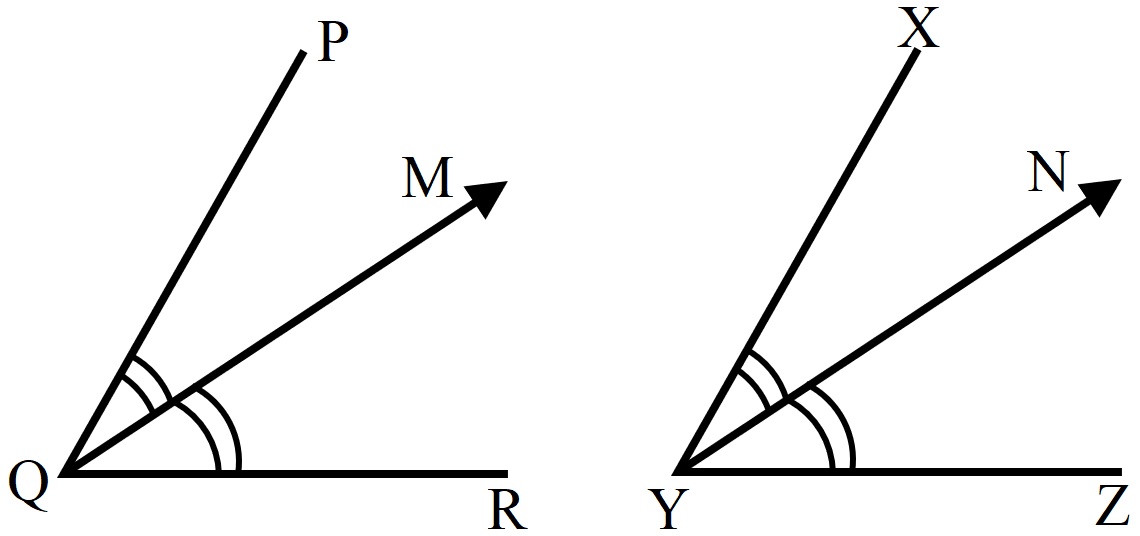
Given $\angle{\text{PQR}}=\angle{\text{XYZ}},\overrightarrow{\text{QM}}$ bisects $\angle{\text{PQR}},$ and $\overrightarrow{\text{YN}}$ bisects $\angle{\text{XYZ}},$ respectively.
$\Rightarrow\angle{\text{PQM}}+\angle{\text{MQR}}=\angle{\text{XYN}}=\angle{\text{NYZ}}$
$\Rightarrow\angle{\text{PQM}}+\angle{\text{MQR}}=\angle{\text{PQR}}$ s true.
$\angle{\text{MQR}}=\angle{\text{XYN}}=\angle{\text{XYZ}}$ is true $\angle{\text{PQM}}=2\angle{\text{PQR}}$ is false as $\angle{\text{PQM}}=\frac{1}{2}\angle{\text{PQR}}$.
$\angle{\text{XYZ}}=2\angle{\text{MQR}}$ is true since $2\angle{\text{MQR}}=\angle{\text{PQR}}=\angle{\text{XYZ}}$
Hence $(i), (ii)$ and $(iv)$ are true. View full question & answer→MCQ 221 Mark
$\text{p}|\text{q}$ $C$ and $D$ are two points on $p$ and $M$ and $N$ are two points on $q$, such that $M$ and $N$ are exactly opposite to $C$ and $D$ respectively. Identify the true statement.
AnswerCorrect option: C. Both $[a]$ and $[b]$
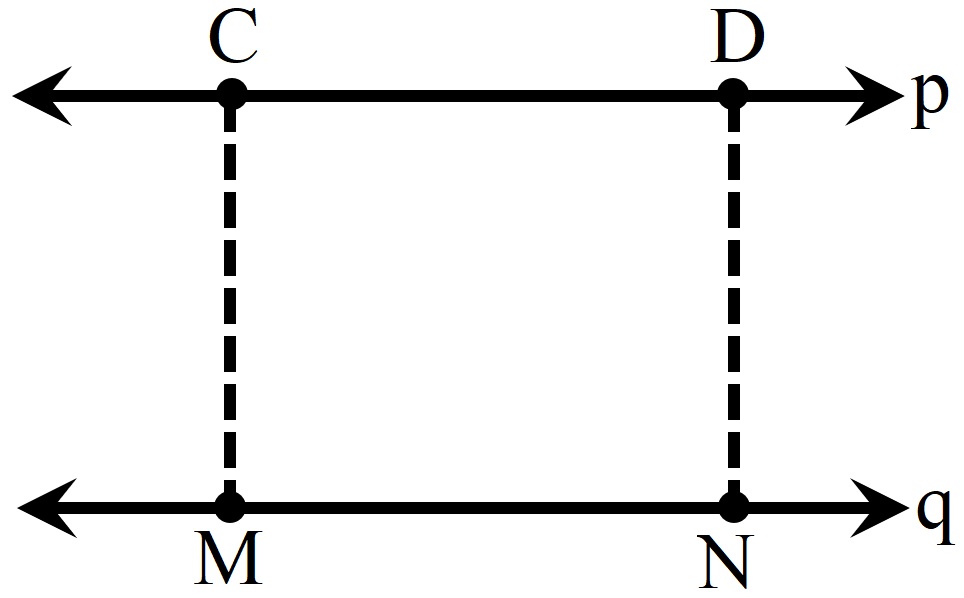
From the figure and the given data, clearly, $CDNM$ is a rectangle.
Also $ \overline{\text{CM}}=\overline{\text{DN}}$ as the distance between two parallel lines is the same throughout.
View full question & answer→MCQ 231 Mark
A perpendicular is drawn to a line segment $\overline{\text{MN}}$ at $N$ using protractor and point $P$ is marked on perpendicular, then _______.
- A
$\overline{\text{MP}}\perp\overline{\text{NP}}$
- B
$\overline{\text{MN}}\parallel\overline{\text{NP}}$
- C
$\overline{\text{MN}}\parallel\overline{MP}$
- ✓
$\overline{\text{MN}}\perp\overline{\text{Np}}$
AnswerCorrect option: D. $\overline{\text{MN}}\perp\overline{\text{Np}}$
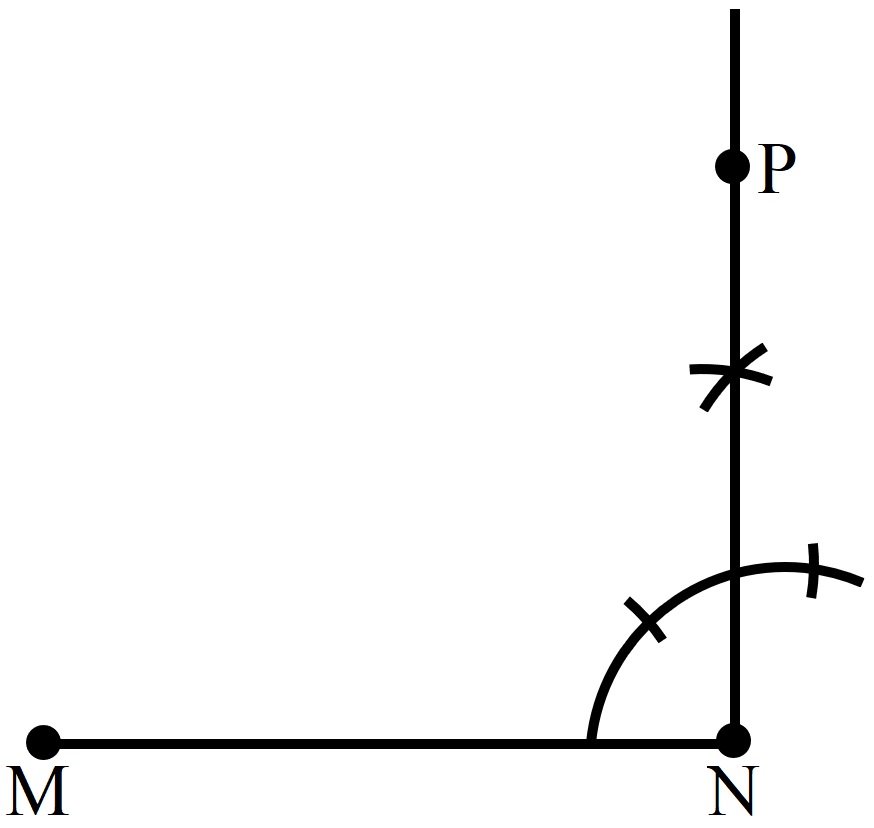
$\therefore \overline{\text{MN}}\perp\overline{\text{NP}}$ View full question & answer→MCQ 241 Mark
Sumit constructed an angle of $90^\circ $ and trisected it. Measure of two angles taken together will be:
- A
$20^\circ $
- B
$40^\circ $
- ✓
$60^\circ $
- D
AnswerCorrect option: C. $60^\circ $
$60^\circ $
View full question & answer→MCQ 251 Mark
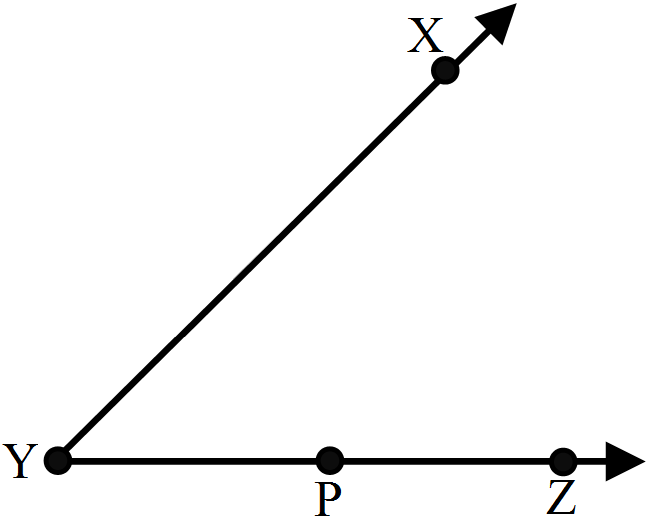
In Fig. $\angle\text{XYZ}$ cannot be written as:
- A
$\angle\text{Y}$
- ✓
$\angle\text{XYZ}$
- C
$\angle\text{ZYX}$
- D
$\angle\text{XYP}$
AnswerCorrect option: B. $\angle\text{XYZ}$
Since, $\angle\text{XYZ}$ can be written as $\angle\text{Y},\angle\text{ZYX},\angle\text{XYP}$ and $\angle\text{PYX.}$
So, $\angle\text{XYZ}$ cannot be written as $\angle\text{ZXY}.$
View full question & answer→MCQ 261 Mark
Lines $p$ and $q$ have a point $M$ in common. Identify the correct statement.
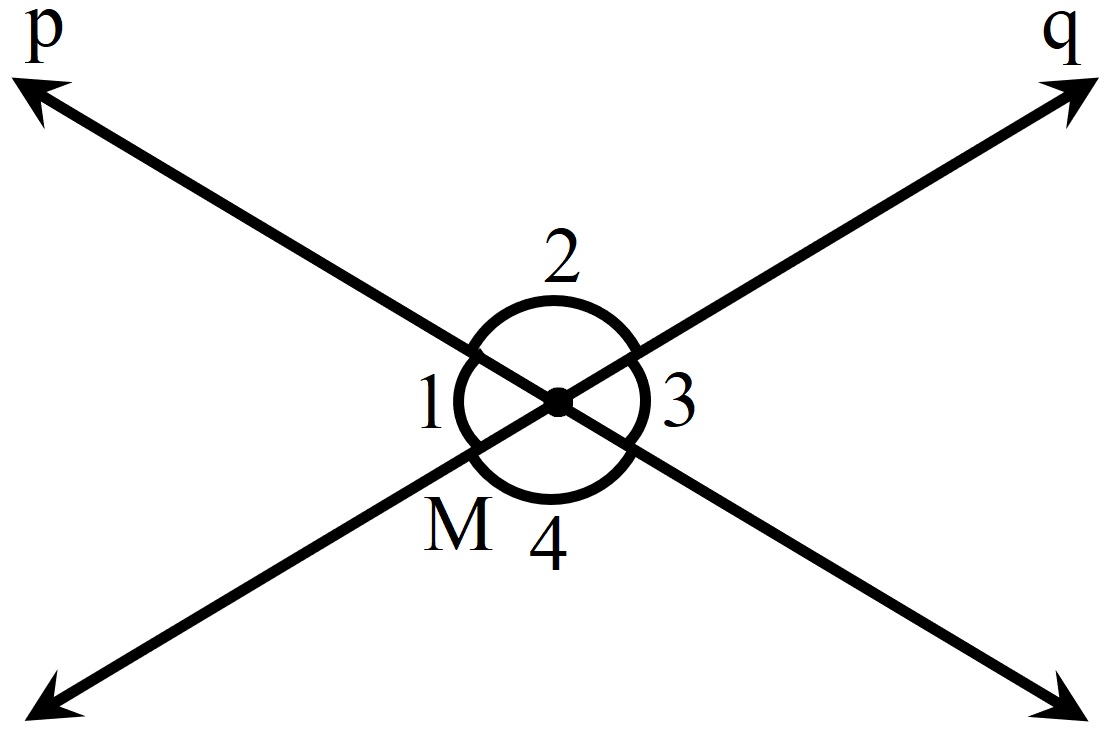
- ✓
$\angle1=−3$
- B
$\angle2=−3$
- C
$\angle3=\angle4$
- D
$\angle1=\angle2$
AnswerCorrect option: A. $\angle1=−3$
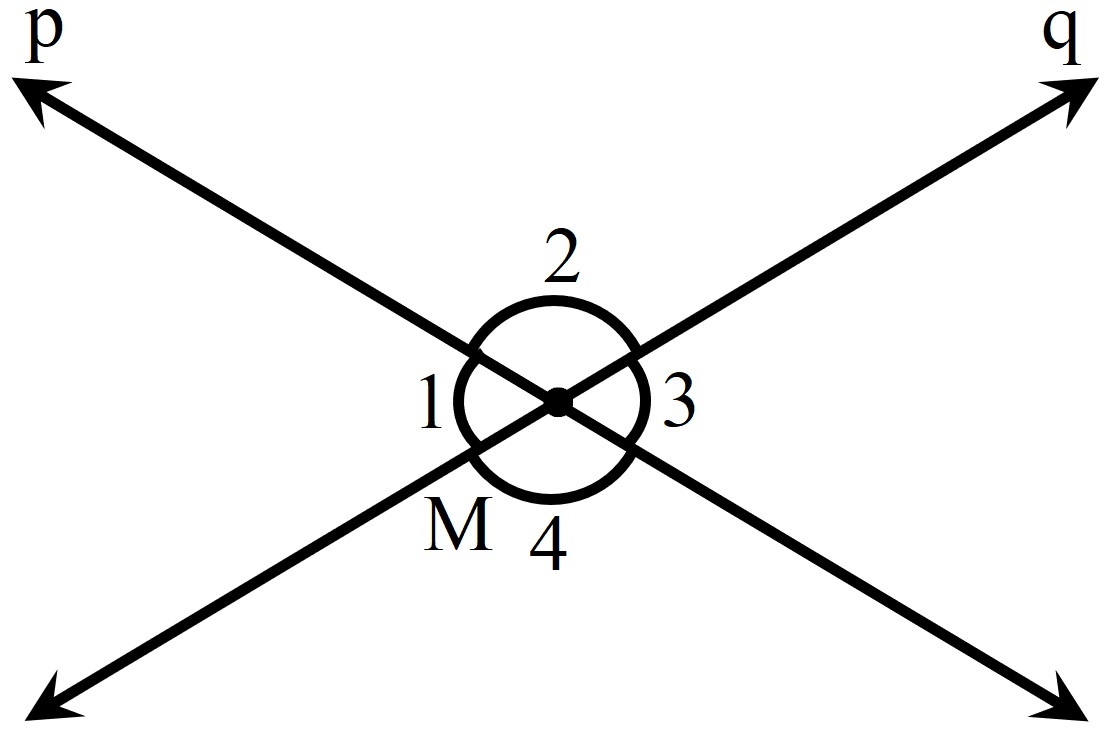
From the given figure and data, it is clear that $p$ and $q$ are intersecting lines.
So, the vertically opposite angles are equal.
Hence $ \angle1=\angle3.$
View full question & answer→MCQ 271 Mark
How many lines can be drawn passing through a given point?
AnswerInfinitely many points can be drawn passing through a given point.
View full question & answer→MCQ 281 Mark
$\text{l}\parallel\text{m}$ $P$ and $Q$ are points on land m respectively such that ${\text{PQ}}\perp{\text{l}}$. $R$ is a point on a line n in the same plane such that $\overline{\text{PQ}}=\overline{\text{QR}}$. Which of the following is true?
AnswerCorrect option: C. Both $[a]$ and $[b]$
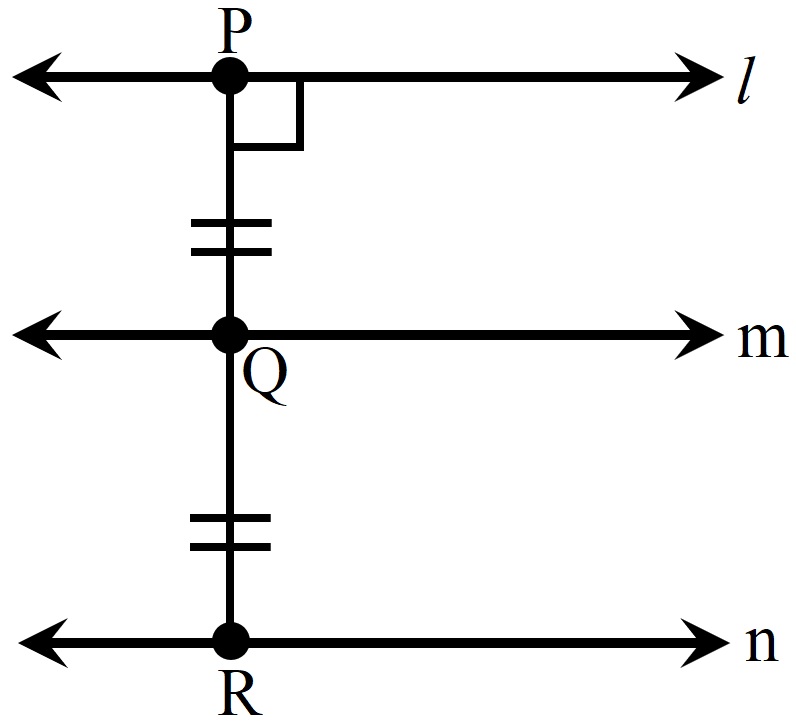
Clearly, from the given data and the figure, ${\text{l}}\parallel{\text{n}}\text{ and}{\text{ m}}\parallel{\text{n}}$ View full question & answer→MCQ 291 Mark
To construct a perpendicular to a line $(L)$ from a point $(P)$ outside the line, steps are given in jumbled form.Identify the third step from the following.
$1)$ Draw line $PQ.$
$2)$ Draw a line $L$ and consider point $P$ outside the line.
$3)$ Take $P$ as a center, draw $2$ arcs on line L and name it as points $A$ and $B$ respectively.
$4)$ Taking $A$ and $B$ as a center one by one and keeping the same distance in compass, draw the arcs on other side of the plane.The point where these arcs intersect name that point as $Q$.
AnswerThe correct sequence is:
Step $1$. Draw a line $L$ and consider a point $P$ outside the line.
Step $2$. Take $P$ as center and draw two arcs on line $L$ ans name the points $A$ and $B$ respectively.
Step $3$.Taking $A$ and $B$ as centres one by one and keeping the same distance in compass , draw the arcs on other side of the plane .The point where these arcs intersect name that as $Q$
Step $4$. Draw line $P$Q So the third step is $4$ Option $A$ is correct.
View full question & answer→MCQ 301 Mark
The last step in the process is:
AnswerCorrect sequence is :
$1.$ Draw a line $PQ$ and take a point $A$ anywhere outside the line.
$2.$ Place the pointed end of the compass on $A$ and with an arbitrary radius, mark two points $D$ and $E$ on line $PQ$ with the same radius.
$3.$ From points $D$ and $E$, mark two intersecting arcs on either side of $PQ$ and name them $R$ and $S$.
$4.$ Join $R − S$ passing through $A$.
So the last step is $1$.
View full question & answer→MCQ 311 Mark
Given $PQ = 6\ cm, QR = 55\ cm$ and $RP = 55\ cm$, what type of a triangle can be constructed?
- ✓
An acute angled triangle.
- B
An obtuse angled triangle
- C
- D
AnswerCorrect option: A. An acute angled triangle.
Since $QR = RP \Rightarrow $ it is isosceles $\triangle\text{le} $ and an isosceles $\triangle\text{le}$ is always acute $\angle\text{led}$
View full question & answer→MCQ 321 Mark
To draw an angle of $150^\circ$ using a pair of compass and ruler_____ .
- ✓
Bisect angle between $120^\circ$ and $180^\circ$
- B
Bisect angle between $60^\circ$ and $120^\circ$
- C
Bisect angle between $0^\circ$ and $160^\circ$
- D
AnswerCorrect option: A. Bisect angle between $120^\circ$ and $180^\circ$
$\Rightarrow $ To draw an angle of $150^\circ$ using a pair of compass and Bisect angle between $120^\circ$and $180^\circ$.
$\Rightarrow $ The difference angle between $120^\circ$ and $180^\circ$ is $60^\circ$.
So, when we bisect angle of $60^\circ$ we get $30^\circ$ angles each.
$\Rightarrow $ So, $120^\circ$ + $30^\circ$= $150^\circ$
View full question & answer→MCQ 331 Mark
In the adjoining figure line $L\ ||$ line $M$ and line $N$ is the transversal. Which of the following line is one of the pairs of alternative angles?
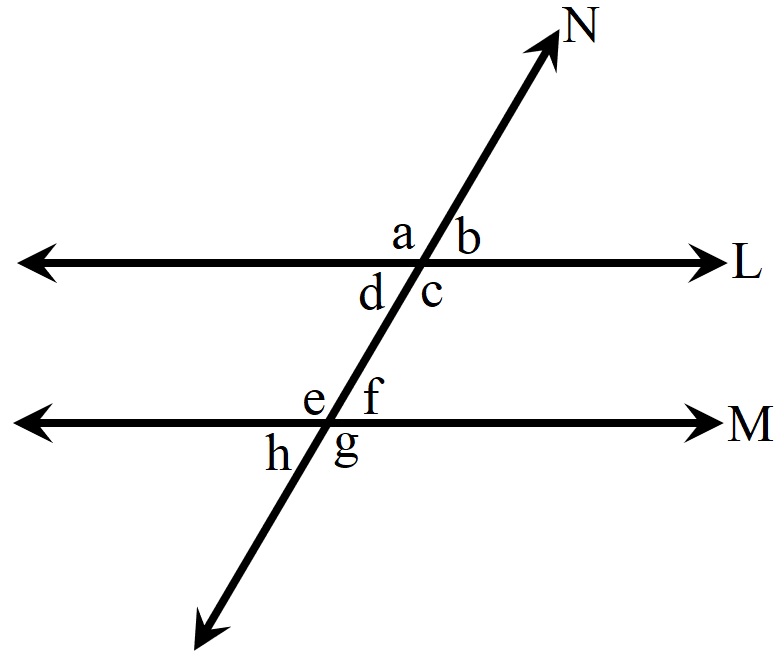
- A
$\angle{\text{a }}\text{&}\angle{\text{e}}$
- ✓
$\angle{\text{d }}\text{&}\angle{\text{F}}$
- C
$\angle{\text{b }}\text{&}\angle{\text{f}}$
- D
$\angle{\text{d }}\text{&}\angle{\text{e}}$
AnswerCorrect option: B. $\angle{\text{d }}\text{&}\angle{\text{F}}$
$\angle{\text{d }}$ and $\angle{\text{F}}$
View full question & answer→MCQ 341 Mark
To construct a perpendicular to a line $(L)$ from a point $(P)$ outside the line, steps are given in jumbled form.Identify the first step from the following.
$1)$ Draw line $PQ.$
$2)$ Draw a line $L$ and consider point $P$ outside the line.
$3)$Take $P$ as a center, draw $2$ arcs on line $L$ and name it as points $A$ and $B$ respectively.
$4)$Taking $A$ and $B$ as a center one by one and keeping the same distance in compass, draw the arcs on other side of the plane.The point where these arcs intersect name that point as $Q$.
AnswerThe correct sequence is:
Step $1$. Draw a line $L$ and consider a point $P$ outside the line.
Step $2$. Take $P$ as center and draw two arcs on line $L$ ans name the points $A$ and $B$ respectively.
Step $3$.Taking $A$ and $B$ as centres one by one and keeping the same distance in compass , draw the arcs on other side of the plane .The point where these arcs intersect name that as $Q$
Step $4$. Draw line $PQ$ So the first step is $2$ Option $C$ is correct.
View full question & answer→MCQ 351 Mark
Measures of the two angles between hour and minute hands of a clock at $9\ O’$ clock are:
- A
$60^\circ , 300^\circ $
- ✓
$270^\circ , 90^\circ $
- C
$75^\circ , 285^\circ $
- D
$30^\circ , 330^\circ $
AnswerCorrect option: B. $270^\circ , 90^\circ $
The positions of hour and minute hands of a clock at $9\ O’$ clock are represented in the following figure.
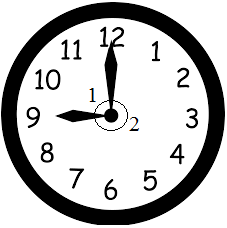
Clearly, $\angle1=90^\circ$
And $\angle2=\ \text{Reflex}\ \text{of}\ \angle1=360^\circ-90^\circ=270^\circ$
Note: A reflex angle is more than $180^\circ $ but less than $360^\circ $. For any acute angle $\theta,$ its reflex angle is $(360^\circ-\theta).$ View full question & answer→MCQ 361 Mark
Mark $(\checkmark)$ against the correct answer in the following:
Two planes intersect:
AnswerWhen the common points of two planes intersect, they form a line.
View full question & answer→MCQ 371 Mark
$X$ is the midpoint of $\overline{\text{AB}}.$If $\overline{\text{AX}}=9.3\text{cm}$ what is the measure of $\overline{\text{AB}}$?
- A
$4.65\ cm$
- ✓
$18.6\ cm$
- C
$9.3\ cm$
- D
$18\ cm$
AnswerCorrect option: B. $18.6\ cm$
$18.6\ cm$
View full question & answer→MCQ 381 Mark
Identify the pair of parallel lines.
$i.$ Lines $m$ and $n$ have two points in common.
$ii.$ Lines $p$ and $q$ do not have any point in common.
$iii.$ Lines $p$ and $q$ have a point $X$ in common.
- A
$(i)$ and $(ii)$ only
- ✓
$(ii)$ only
- C
$(ii)$ and $(iii)$ only
- D
$(i), (ii)$ and $(iii)$
AnswerCorrect option: B. $(ii)$ only
Parallel lines do not have any point in common.
View full question & answer→MCQ 391 Mark
The third step in the process will be:
AnswerCorrect sequence of steps is :
Step $1$: Draw segment $AB$ and take a point $P$ on it.
Step $2$: From point $P$, mark two equidistant points from $P$ on line $AB$, and name them $C$ and $D$
Step $3$ : From points $C$ and $D$ mark two intersecting arcs on either side of the line $AB$.
Name the intersection point as $E$
Step $4$: Join $E$ and $P. EP$ is the required perpendicular.
So the third step is !!So option $A$ is correct.
View full question & answer→MCQ 401 Mark
Which of the following is done to draw an angle of $150^\circ $ using compasses and a ruler?
- ✓
Bisecting $120^\circ $ and $180^\circ $ angles.
- B
Bisecting $60^\circ $ and $120^\circ $ angles.
- C
Bisecting $0^\circ $ and $60^\circ $ angles.
- D
Bisecting a $360^\circ$ angle.
AnswerCorrect option: A. Bisecting $120^\circ $ and $180^\circ $ angles.
Bisecting $120^\circ $ and $180^\circ $ angles.
View full question & answer→MCQ 411 Mark
$\overrightarrow{\text{BA}}\perp\overrightarrow{\text{XY}}$ Which of the following statements are incorrect?
$i.\ \angle{\text{ABX}}+\angle{\text{ABY}}=180^\circ$
$ii.\ \angle{\text{ABX}}=2{\text{right angle}}$
$iii\ \angle{\text{ABY}}=90^\circ$
$iv.\ \angle{\text{XBY}}=90^\circ$
- A
$(i)$ and $(ii)$ only
- ✓
$(ii)$ and $(iv)$ only
- C
$(ii)$ and $(iii)$ only
- D
$(i)$ and $(iv)$ only
AnswerCorrect option: B. $(ii)$ and $(iv)$ only
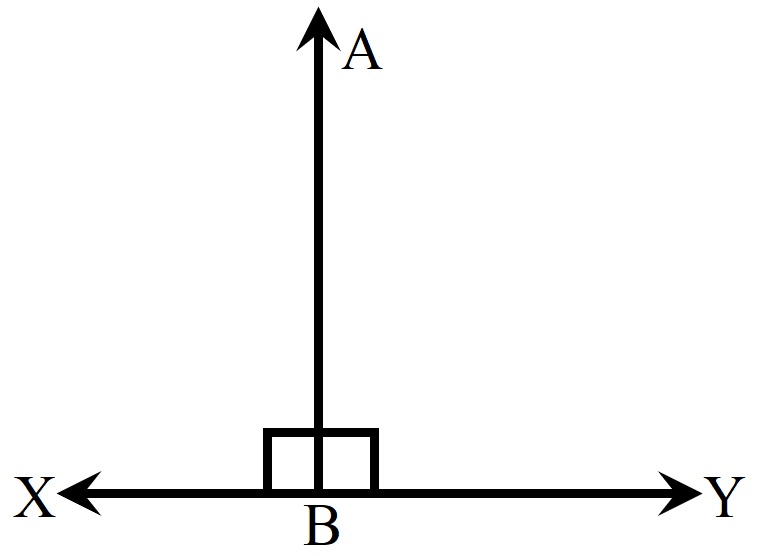
Since $\overrightarrow{\text{BA}}\perp\overrightarrow{\text{XY}}$
$\angle{\text{ABY}}=90^\circ$ and $\angle{\text{XBY}}=90^\circ$
$\therefore\angle{\text{ABX}}+\angle{\text{ABY}}=180^\circ$ is true.
$\angle{\text{ABX}}=90^\circ\Rightarrow\angle{\text{ABX}}=2$ right angles is false. $\angle{\text{ABY}}=90^\circ$ is true.
$\angle{\text{XBY}}=90^\circ$ is false since $\angle{\text{ABY}}=\angle{\text{XBA}}+\angle{\text{ABY}}=180^\circ$. View full question & answer→MCQ 421 Mark
$\triangle\text{PQR}$ is constructed with all its angles measuring $60^\circ $ each. Which of the following is correct?
- ✓
$\triangle\text{PQR}$ is an equilateral triangle.
- B
$\triangle\text{PQR}$ is isosceles triangle.
- C
$\triangle\text{PQR}$ is a scalene triangle.
- D
$\triangle\text{PQR} $ is a right angled triangle.
AnswerCorrect option: A. $\triangle\text{PQR}$ is an equilateral triangle.
$\triangle\text{PQR}$ is an equilateral triangle.
View full question & answer→MCQ 431 Mark
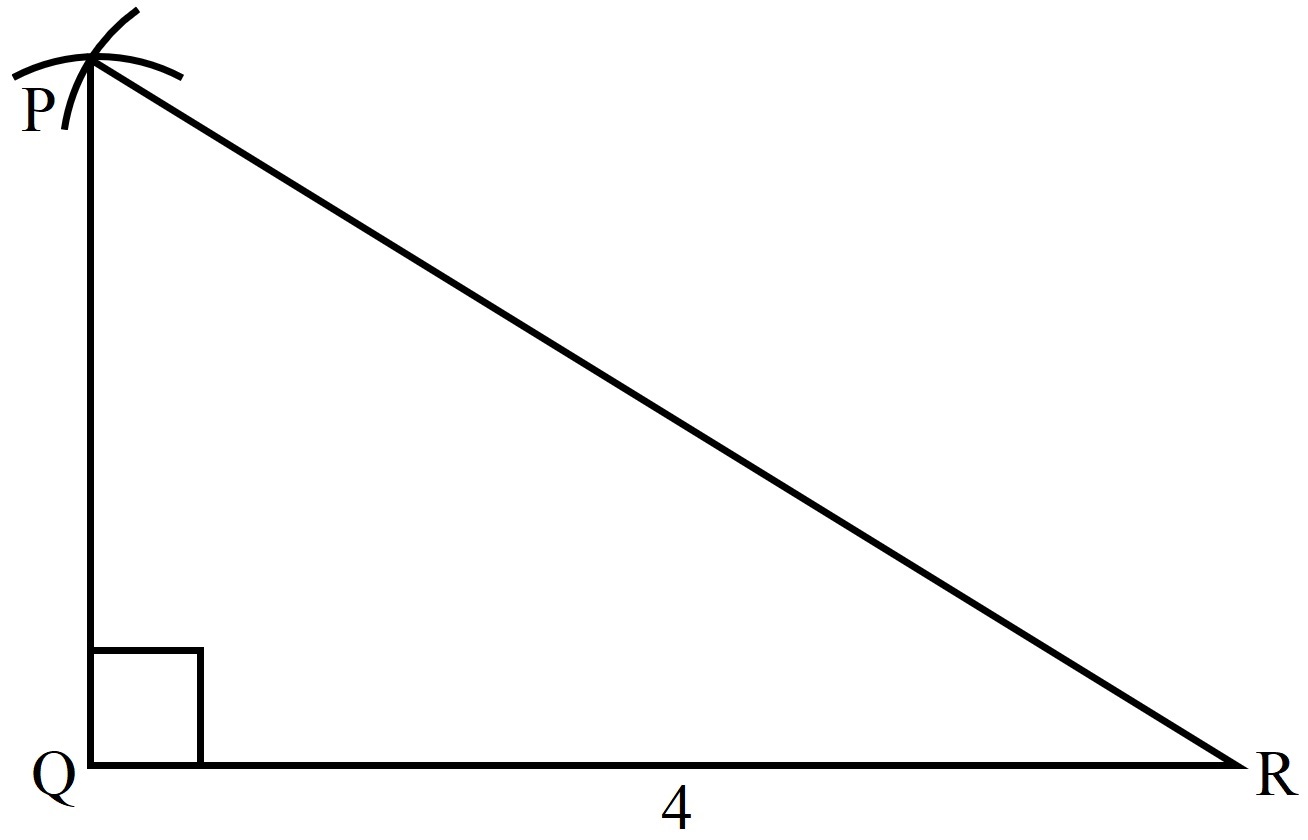
Given $AB = 3\ cm, AC = 5.2\ cm$, and $\angle\text{B} = 35^∘.$ $\angle\text{ABC}$ cannot be uniquely constructed, with $AC$ as base, why?
AnswerCorrect option: D. The vertex $A$ coincides with the vertex $C$.
Use $RHS$ property to Contruct the Ale as. Shown:
View full question & answer→MCQ 441 Mark
A triangle$ \triangle\text{PQR}$ with $ \angle\text{Q} = 90^∘,$$QR = 4\ cm$ and $PR = 5cm$ is constructed. What would be the measure of $PQ$?
- ✓
$2\ cm$
- B
$6\ cm$
- C
$7\ cm$
- D
$3\ cm$
AnswerCorrect option: A. $2\ cm$
$2\ cm$
View full question & answer→MCQ 451 Mark
There is a rectangular sheet of dimension $\big(2\text{m-1}\big)\times\big(2\text{n-1}\big),$ (where $m > 0, n > 0$). It has been divided into square of unit area by drawing lines perpendicular to the sides. Find number of rectangles having sides of odd unit length?
AnswerTotal no. of horizontal line $= 2m$ Total no. of vertical lines $= 2n$ $($$\because$ Each line is at unit distance and hence, total no. of lines = Distance/lenght $+1).$
To form a square from three lines,we mustselect one even and one odd numbered horizontal and vertical line
$\therefore$ Ways possible of selecting such squares $=(\text{c}_{1}^\text{m})\times(\text{c}_{1}^\text{m})\times$ $(\text{c}_{1}^\text{n}\times\text{c}_{1}^\text{n})=$ $\text{c}_{1}^\text{m}\times\text{c}_{1}^\text{m}\times\text{c}_{1}^\text{n}\times\text{c}_{1}^\text{n}=$ $\text{m}^2\times\text{n}^2=\text{m}^2\text{n}^2$
View full question & answer→MCQ 461 Mark
Which of the following steps is $INCORRECT$ while constructing an angle of $60^\circ $?
Step $1:$ Draw a line $EF$ and mark a point $O$ on it.
Step $2:$ Place the pointer of the compass at $O$ and draw an arc of convenient radius which cuts the line $EF$ at point $P$.
Step $3:$ With the pointer at $A$ (as centre) now draw an arc that passes through $O$.
Step $4:$ Let the two arcs intersect at $Q$. Join $OQ$. We get $\angle{\text{QOP}}$ whose measure is $60^\circ $ .
AnswerCorrect option: C. Only Step - $3$
Step-3 is incorrect it should be written as: with the pointer at $P$ (as centre) now draw an arc that passes through $0$.
View full question & answer→MCQ 471 Mark
$\overrightarrow{\text{MN}}$ is the perpendicular bisector of $\overleftrightarrow{\text{AB}}$ Which of the given statements is correct?
$i.\ \angle{\text{ANM}}+\angle{\text{MNB}}=90^\circ$
$ii.\ \overline{\text{AN}}=\overline{\text{NB}}$
$iii.\ \overline{\text{AN}}=2\overline{\text{NB}}$
$iv.\ \angle{\text{MNB}}=\frac{1}{2}\angle{\text{ANM}}$
- A
$(i)$ and $(iii)$ only
- B
$(ii)$ and $(iv)$ only
- ✓
$(i)$ and $(ii)$ only
- D
$(ii)$ and $(iii)$ only
AnswerCorrect option: C. $(i)$ and $(ii)$ only
$\overrightarrow{\text{NM}}\perp\overleftrightarrow{\text{AB}}$ and $\overrightarrow{\text{NM}}$ divides $\overleftrightarrow{\text{AB}}$ into two congruent parts.
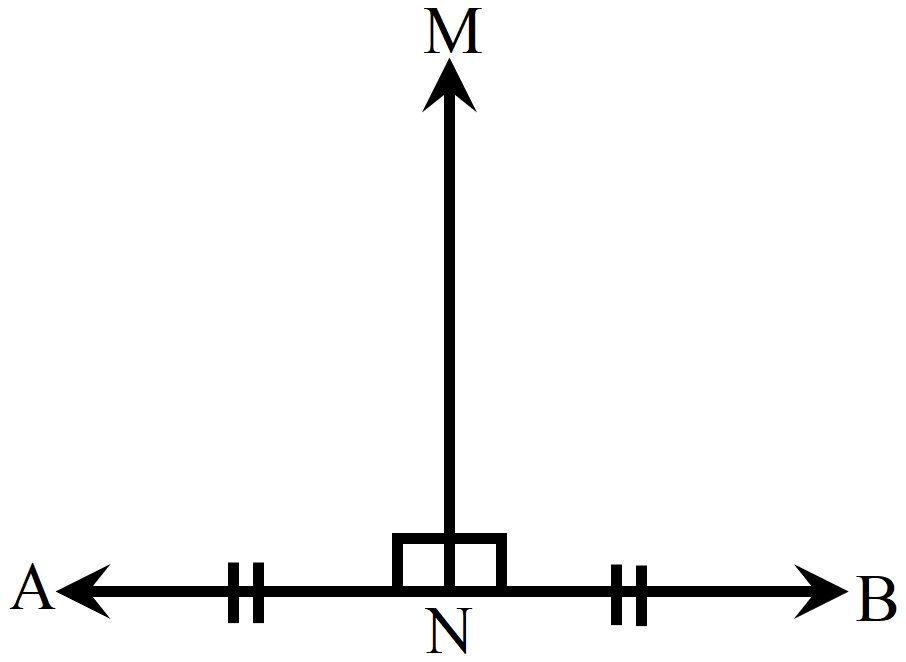
Clearly $\angle{\text{ANM}}+\angle{\text{MNB}}=90^\circ$ is true.
$\overline{\text{AN}}=\overline{\text{NB}}$ is true since $\overrightarrow{\text{NM}}\perp\overleftrightarrow{\text{AB}}$ $\overline{\text{AN}}=2\overline{\text{NB}}$ is false, and $\angle{\text{MNB}}=\frac{1}{2}\angle{\text{ANM}}$ is false.
Thus, only $(i)$ and $(ii)$ are correct. View full question & answer→MCQ 481 Mark
How do you draw a $90^\circ $ angle?
- ✓
By drawing a perpendicular to a line from a point lying on it.
- B
By bisecting a $120^\circ $ angle.
- C
By bisecting a $60^\circ $ angle.
- D
By drawing multiples of $45^\circ $ angle.
AnswerCorrect option: A. By drawing a perpendicular to a line from a point lying on it.
By drawing a perpendicular to a line from a point lying on it.
View full question & answer→MCQ 491 Mark
If the sum of two angles is greater than $180^\circ $, then which of the following is not possible for the two angles?
- A
One obtuse angle and one acute angle.
- B
One reflex angle and one acute angle.
- C
- ✓
AnswerBecause sum of two right angles is equal to $180^\circ .$
Note:
An acute angle is less than $90^\circ .$
A right angle is equal to $90^\circ .$
An obtuse angle is more than $90^\circ $ but less than $180^\circ .$
A reflex angle is more than $180^\circ $ but less than $360^\circ .$
View full question & answer→MCQ 501 Mark
If the sum of two angles is equal to an obtuse angle, then which of the following is not possible?
- A
One obtuse angle and one acute angle.
- B
One right angle and one acute angle.
- C
- ✓
AnswerBecause sum of two right angles is equal to $180^\circ $.
View full question & answer→