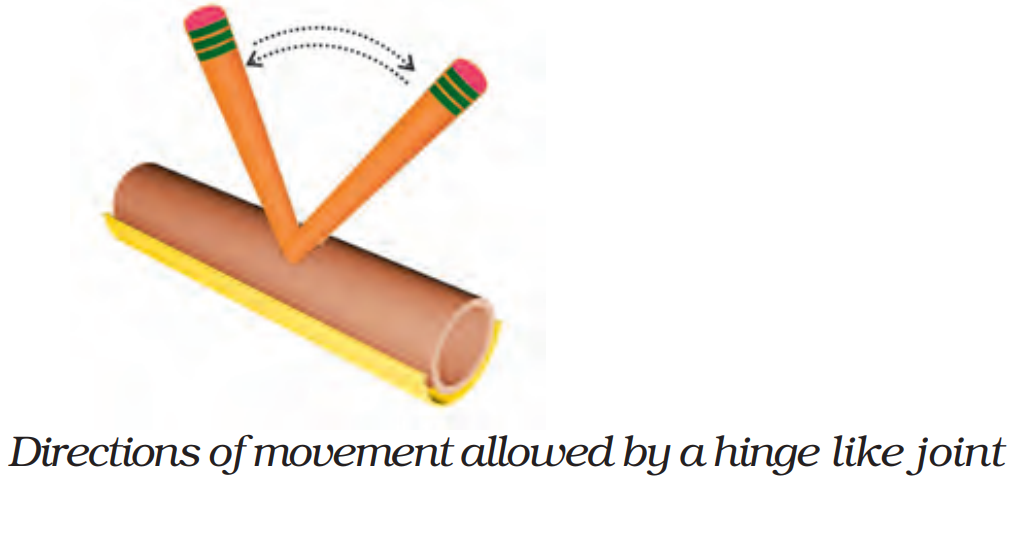
Activity.Let us look at the kind of movement allowed by a hinge. Make a cylinder with cardboard or thick chart paper, as shown in figure. Attach a small pencil to the cylinder by piercing the cylinder at the centre, as shown. Make a hollow half cylinder from cardboard such that the rolled up cylinder cati fit inside it easily. The hollow half cylinder with the rolled up cylinder sitting inside it, allows movement like a hinge. Try to move the rolled up cylinder. How does it move?
How is this movement different from what we saw with our constructed ball and socket joint?
Answer
It moves only at one plane, up to 180°.
In ball and socket joint, the movement is circular in all the directions.
Activity.Observe an earthworm moving on soil in a garden. Gently lift it and place it on a piece of blotting or filter paper. Observe its movement. Then place it on a smooth glass plate or any slippery surface. Observe its movement now.
Is it different from that on paper? In which of the above two surfaces do you find that the earthworm is able to move easily?
Answer
Earthworm’s movement on paper will be more smooth and easy as compared to movement on a glass plate.
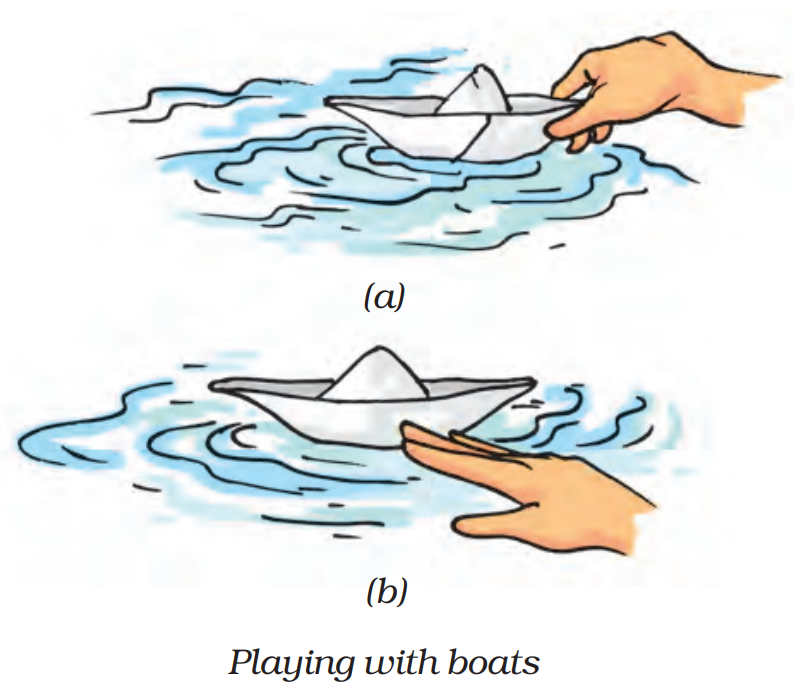
Activity.Make a paper boat. Put it in water and push it with one narrow end pointing forward.
Did it go into the water easily? Now hold the boat sideways and push it into the water from the broad side. Are you able to make the boat move in water when you push it from this side?
Answer
Yes, it went into the water easily because a boat has a spindle-shaped streamlined body like a fish, which helps it move easily in water.
Try to eat your food without moving the lower jaw. Do you find this difficult to do?
Answer
Without moving the lower jaw, we cannot chew the food. Without chewing, we cannot engulf the food into food pipe. It would be difficult to digest unchewed food.
The earthworm eats its way through the soil. Its body then throw away the undigested part of material that is eats. This activity of earthworm makes soil more useful for plants.
Which important organ is fully protected inside the bones of the skull (head)?
Answer
The bones of the skull form the structure similar to a box. The bones are joined with strong joints. It is not easy to break them. The bones of the skull protect the most important organ, i.e., the brain.
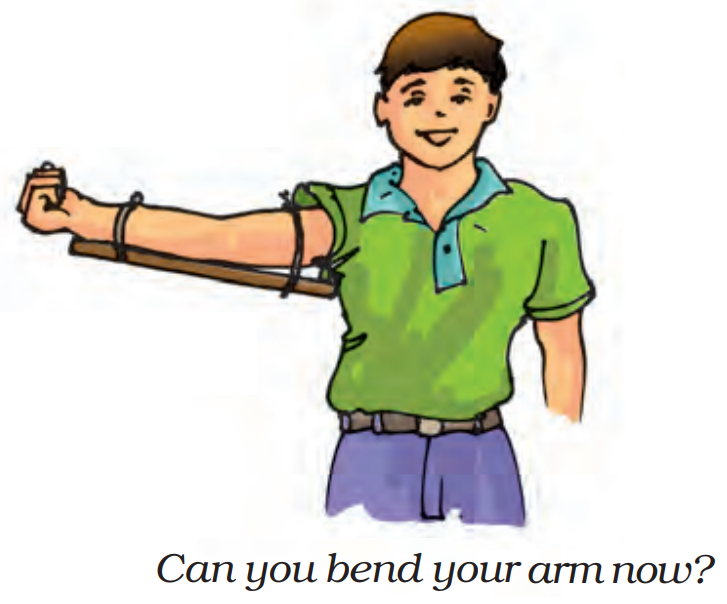
Activity.Place a scale length-wise on your arm so that your elbow is in the centre.
Ask your friend to tie the scale and your arm together. Now, try to bend your elbow.
Are you able to do it?
Under its body, earthworm has a large number of tiny bristles projecting out. The bristles are connected with the muscles and they help to get a good grip on the ground.
No, all animals do not have bones. Bones are present only in the backboned animals. Even among the backboned animals, the skeleton of sharks are made entirely of cartilage.
The jellyfish, leeches and worms have no hard structure to support their bodies.
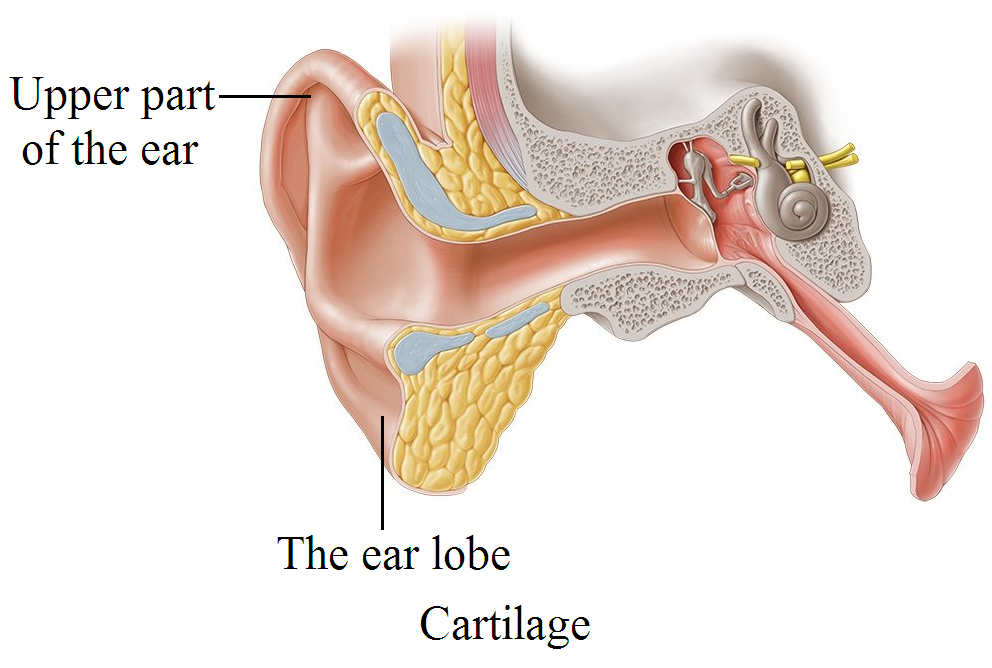
These are some additional parts of the skeleton that are not as hard as the bones and which can be bent. For example, the upper part of our ear has cartilage.
The bones on top of the skull form the structure similar to the structure of teeth. They are joined strongly with one another. So these bones are also fixed. These bones do not move.
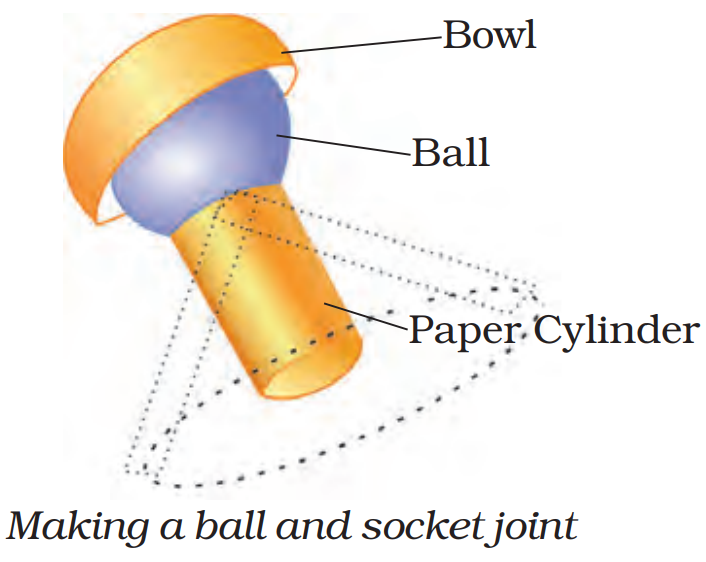
Activity.Roll a strip of paper into a cylinder. Make a small hole in an old rubber or plastic ball (under supervision) and push the paper cylinder into it as shown in figure. You can also stick the cylinder on the ball. Put the ball in a small bowl.
Does the all rotate freely inside the bowl? Does the paper cylinder also rotate?
Answer
No, the ball does not rotate freely inside the bowl due to friction. Paper cylinder also rotates with the ball.