Questions · Page 1 of 5

[1 Marks Each] M.C.Q.

Take a timed test

50 questions · auto-graded multiple-choice test.

MCQ 11 Mark
Which of the following can be considered as a fast change?
  • A
    Growth of child.
  • B
    Germination of seed.
  • Bursting of cracker.
  • D
    Cooking of food.
Answer
Correct option: C.
Bursting of cracker.
View full question & answer
MCQ 21 Mark
Which of these is not a physical change?
  • A
    Sulphur dissolved in carbon disulphide.
  • B
    Resin dissolved in alcohol.
  • The fermentation of cane juice.
  • D
    The glowing of an electric bulb.
Answer
Correct option: C.
The fermentation of cane juice.
Fermentation of cane juice is a chemical change.
View full question & answer
MCQ 31 Mark
Heating of wax in a pan is a:
  • Reversible change.
  • B
    Irreversible change.
  • C
    Permanent change.
  • D
    None of these.
Answer
Correct option: A.
Reversible change.
It is a reversible change. The melted wax again gives solid wax on cooling.
View full question & answer
MCQ 41 Mark
The new substance formed during or after a chemical reaction is:
  • A
    Catalyst.
  • B
    Inhibitor.
  • Product.
  • D
    Reactant.
Answer
Correct option: C.
Product.
Product.
View full question & answer
MCQ 51 Mark
Which among the following is not an example of a reversible change?
  • A
    Dissolving sugar in water.
  • Changing of wheat to flour.
  • C
    Folding up of a paper.
  • D
    Melting of coal tar.
Answer
Correct option: B.
Changing of wheat to flour.
View full question & answer
MCQ 61 Mark
A change that results in formation of new substances and can't be reversed easily is know as a:
  • A
    Physical changes.
  • Chemical changes.
  • C
    Reversible changes.
  • D
    None of these.
Answer
Correct option: B.
Chemical changes.
Chemical changes.
View full question & answer
MCQ 71 Mark
Which of the following is a natural, non-periodic change?
  • A
    The heart beat of a human being.
  • B
    The low and high tides.
  • The eruption of volcanoes.
  • D
    The sunrise and sunset.
Answer
Correct option: C.
The eruption of volcanoes.
The eruption of volcanoes is a natural, non- periodic change.
View full question & answer
MCQ 81 Mark
Direction: Read the passages given below and answer the questions that follow Passage. Mohan was boiling water in a pan for making tea. His brother Ram came there and observed that during boiling of water some bubbles are formed. He told his brother Mohan that boiling of water is a chemical change as gas is evolved in this process. But Mohan argued that this is not a chemical change. According to you what is the gas that is observed by Ram?
  • A
    Oxygen.
  • Water vapours.
  • C
    Carbon dioxide.
  • D
    No gas is formed.
Answer
Correct option: B.
Water vapours.
During boiling of water, water vapours are formed.
View full question & answer
MCQ 91 Mark
Which of the following changes cannot be reversed?
  • Milk to paneer.
  • B
    Cold milk to hot milk.
  • C
    Yam to knitted sweater.
  • D
    Wet clothes to dry clothes.
Answer
Correct option: A.
Milk to paneer.
Paneer is a new substance and cannot be converted into milk.
View full question & answer
MCQ 101 Mark
Which among the following is incorrect statement?
  • A
    Rusting of iron is irreversible change.
  • B
    Ripening of fruits is a chemical change.
  • Breaking of glass is a reversible change.
  • D
    All the above.
Answer
Correct option: C.
Breaking of glass is a reversible change.
View full question & answer
MCQ 111 Mark
Which of the following cannot be reversed?
  • Boiling of an egg.
  • B
    Folding of paper.
  • C
    Knitting of sweater.
  • D
    Melting of wax.
Answer
Correct option: A.
Boiling of an egg.
Boiling of an egg.
View full question & answer
MCQ 121 Mark
To fix up the fractured bone a paste made of plaster of parts $(POP)$ is used as a coating over the bandage on the fractured bone. After some time the plaster becomes hard and dry. This change in $POP$ can be classified:
  • A
    Physical change.
  • Permanent change.
  • C
    Change of state of mater.
  • D
    None of these.
Answer
Correct option: B.
Permanent change.

It is a permanent change as we cannot get back $POP$ once it is dried.

View full question & answer
MCQ 131 Mark
While lighting a candle, Paheli observed the following changes:
  1. Wax was melting.
  2. Candle was burning.
  3. Size of the candle was reducing.
  4. Melted wax was getting solidified.
Of the above, the changes that can be reversed are:
  • $(i)$ and $(ii)$
  • B
    $(ii)$ and $(iii)$
  • C
    $(iii)$ and $(iv)$
  • D
    $(i)$ and $(iv)$
Answer
Correct option: A.
$(i)$ and $(ii)$

Melting of wax and solidification of melted wax, both can be seen in case of lighting a candle.

View full question & answer
MCQ 141 Mark
Anaerobic bacteria digest animal waste and produce biogas $($change$-A).$ The biogas is then burnt as fuel $($change$-B).$ The following statements pertain to these changes. Choose the correct one.
  • A
    Process $A$ is a chemical change.
  • B
    Process $B$ is a chemical change.
  • Both processes $A$ and $B$ are chemical changes.
  • D
    None of these processes is a chemical change.
Answer
Correct option: C.
Both processes $A$ and $B$ are chemical changes.

Both digestion of animal waste by anaerobic bacteria and formation of biogas are chemical changes as new product is formed in both the changes.

View full question & answer
MCQ 151 Mark
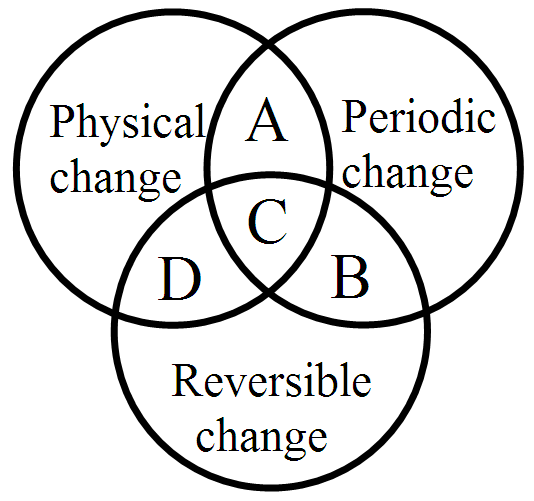
Direction: Read the passages given below and answer the questions that follow Passage.

of the following represent $'C':$
  • Solar eclipse.
  • B
    Raining.
  • C
    Formation of rainbow.
  • D
    Growth of a plant.
Answer
Correct option: A.
Solar eclipse.

Solar eclipse is a physical change that is periodic as well as reversible.

View full question & answer
MCQ 161 Mark
Consider the following phenomena:
  1. Forest fire.
  2. Growth of plants.
  3. Low and high tides.
  4. Occurrence of a rainbow.
  5. Earthquakes.
  6. Opening of a morning glory flower.
Which of the above phenomena can be classified as periodic changes?
  • A
    $(i), (ii)$ and $(iii)$
  • B
    $(i), (ii)$ and $(v)$
  • C
    $(iv), (v)$ and $(vi)$
  • $(iii)$ and $(vi)$
Answer
Correct option: D.
$(iii)$ and $(vi)$

Periodic changes are the changes which keep repeating themselves after a regular period of time. So, low and high tides and opening of a morning glory flower are the examples of periodic changes.

View full question & answer
MCQ 171 Mark
Making of curd from milk is which kind of change?
  • A
    Unwanted change.
  • B
    Reversible change.
  • Irreversible change.
  • D
    No change.
Answer
Correct option: C.
Irreversible change.
View full question & answer
MCQ 181 Mark
Which of the following is an endothermic reaction?
  • A
    The formation of curd from milk.
  • B
    The production of gas when quicklime is added to water.
  • C
    The opening of a soda bottle with production of gas.
  • The freezing of water.
Answer
Correct option: D.
The freezing of water.
The formation of curd from milk becomes faster if we use hot milk. It means that heat energy is absorbed by milk in the formation of curd. It is an endothermic reaction.
View full question & answer
MCQ 191 Mark
The questions in this segment consists of two statements, one labelled as 'Assertion $A$' and the other labelled as 'Reason $R$'. You are to examine these two statements carefully and decide if the Assertion A and Reason $R$ are individually true and if so, whether the reason is a correct explanation of the assertion. Select your answers to these items using codes given below.
Assertion $A$: Explosion of a bomb is an exothermic change.
Reason $R$: Large amount of heat energy is released during explosion of bomb.
  • Both $A$ and $R$ are true and $R$ is the correct explanation of $A.$
  • B
    Both $A$ and $R$ are true but $R$ is not the correct explanation of $A.$
  • C
    $A$ is true but $R$ is false.
  • D
    $A$ is false but $R$ is true.
Answer
Correct option: A.
Both $A$ and $R$ are true and $R$ is the correct explanation of $A.$
View full question & answer
MCQ 201 Mark
Match the column $I$ with column $II $ and choose the correct option from the codes given below:
S.No.
Column $I$
 
Column $II$
$P$
Digestion of food in our body.
$(i)$
Fast change.
$Q$
Earthquake.
$(ii)$
Natural, desirable change.
$R$
Falling of stone.
$(iii)$
Natural, undesirable change.
$S$
Change of seasons.
$(iv)$
Slow change.
  • A
    $P-(iv), Q-(ii), R-(iii), S-(i)$
  • B
    $P-(iii), Q-(iv), R-(ii), S-(i)$
  • C
    $P-(ii), Q-(i), R-(iv), S-(iii)$
  • $P-(iv), Q-(iii), R-(i), S-(ii)$
Answer
Correct option: D.
$P-(iv), Q-(iii), R-(i), S-(ii)$
View full question & answer
MCQ 211 Mark
When carbon dioxide and water combines they form glucose, this is an example of ___________ change.
  • A
    Physical.
  • Chemical.
  • C
    Reversible.
  • D
    Undesirable.
Answer
Correct option: B.
Chemical.
Chemical.
View full question & answer
MCQ 221 Mark
Few changes are given below. Mark the correct option from the codes given below.
  1. Milk is set to form curd.
  2. Batter is steamed to form idlis.
  3. Water is boiled to form steam.
  4. Salt is dissolved in water to form solution.
  • A
    $(i)$
    $(ii)$
    $(iii)$
    $(iv)$
    Physical
    Physical
    Chemical
    Chemical
  • B
    $(i)$
    $(ii)$
    $(iii)$
    $(iv)$
    Physical
    Chemical
    Physical
    Chemical
  • $(i)$
    $(ii)$
    $(iii)$
    $(iv)$
    Chemical
    Chemical
    Physical
    Physical
  • D
    $(i)$
    $(ii)$
    $(iii)$
    $(iv)$
    Physical
    Chemical
    Chemical
    Physical
Answer
Correct option: C.
$(i)$
$(ii)$
$(iii)$
$(iv)$
Chemical
Chemical
Physical
Physical
A change in which a substance undergoes a change in its physical properties is called a physical change. It is generally reversible and in such a change, no new substance is formed. For example, boiling of water, dissolving of salt in water, melting an ice cube. A change in which one or more new substances are formed by means of a chemical reaction is called a chemical change. It is generally irreversible. For example, setting of milk into curd, making idlis, rusting of iron, cooking of food, etc.
View full question & answer
MCQ 231 Mark
Choose the correct alternative to complete the given analogy.
Change in period in a school : Periodic change : : ___________ : Non periodic change.
  • A
    Heart beating.
  • B
    Formation of day and night.
  • Forest fire.
  • D
    Change in phases of moon.
Answer
Correct option: C.
Forest fire.
Forest fire is non periodic change while all other are periodic changes.
View full question & answer
MCQ 241 Mark
When a woolen yam is knitted to get a sweater, the change can be classified as:
  • Physical change.
  • B
    Chemical change.
  • C
    Exothermic change.
  • D
    Endothermic change.
Answer
Correct option: A.
Physical change.
It is a physical change. Yam can be obtained back from sweater.
View full question & answer
MCQ 251 Mark
Select the one that is not a chemical change:
  • A
    Dissolution of ammonia in water.
  • B
    Dissolution of carbon dioxide in water.
  • Dissolution of oxygen in water.
  • D
    None of these.
Answer
Correct option: C.
Dissolution of oxygen in water.
Dissolution of oxygen in water is not a chemical change as no new substance is formed in it. (In case of dissolution of ammonia in water ammonium hydroxide is formed. In case of dissolution of carbon dioxide in water anew substance, carbonic acid, is formed).
View full question & answer
MCQ 261 Mark
Directions: Match column$-I$ with Column$-II$ and select the correct answer using the code given below the columns.
S.No.
Column-$I$
 
Column-$II$
$A.$
Melting
$(p)$
Change of state from liquid to solid.
$B.$
Condensation
$(q)$
Change of state from liquid to gas.
$C.$
Evaporation
$(r)$
Change of state from solid to liquid.
$D.$
Freezing
$(s)$
Change of state from gas to liquid.
  • A
    $A \rightarrow (p), B \rightarrow (q), C \rightarrow (r), D \rightarrow (s)$
  • B
    $A \rightarrow (s), B \rightarrow (r), C \rightarrow (q), D \rightarrow (p)$
  • $A \rightarrow (r), B \rightarrow (s), C \rightarrow (q), D \rightarrow (p)$
  • D
    $A \rightarrow (q), B \rightarrow (p), C \rightarrow (s), D \rightarrow (r)$
Answer
Correct option: C.
$A \rightarrow (r), B \rightarrow (s), C \rightarrow (q), D \rightarrow (p)$
View full question & answer
MCQ 271 Mark
The change of a ball of dough to a rolled out roti is a:
  • Physical change.
  • B
    Chemical change.
  • C
    Periodic change.
  • D
    None of these.
Answer
Correct option: A.
Physical change.
It is a physical change because we can get back the ball of dough from a rolled out roti.
View full question & answer
MCQ 281 Mark
Iron blade of spade is made slightly smaller than the wooden handle because:
  • A
    Iron ring contracts on heating.
  • Iron ring expands on heating.
  • C
    Iron ring remains the same on heating.
  • D
    Wooden handle expands on heating.
Answer
Correct option: B.
Iron ring expands on heating.
View full question & answer
MCQ 291 Mark
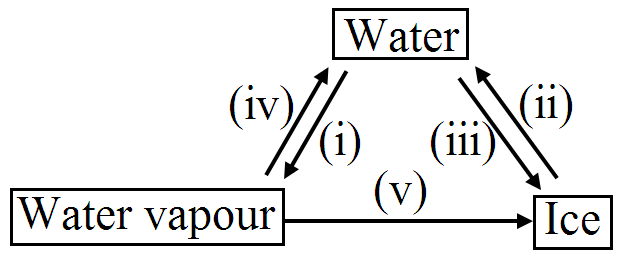
Observe the given figure carefully and choose the correct statement:
  • A
    Processes $(iii)$ and $(iv)$ involve absorption of heat energy.
  • Process $(v)$ involves condensation and freezing.
  • C
    Processes $(i)$ and $(iii)$ evolve heat energy.
  • D
    Process $(v)$ absorbs a lot of heat energy.
Answer
Correct option: B.
Process $(v)$ involves condensation and freezing.

Processes $(i)$ and $(ii)$ involve absorption of heat while processes, $(iii), (iv)$ and $(v)$ involve evolution of heat.

View full question & answer
MCQ 301 Mark
Which of the following is not a man-made change?
  • Change of day and night.
  • B
    Burning of fuels.
  • C
    Drying of clothes.
  • D
    Tearing of paper.
Answer
Correct option: A.
Change of day and night.
View full question & answer
MCQ 311 Mark
A potter shapes pots out of clay $($Process $1).$ He then bakes the pots in an oven $($Process $2)$. Which of the following statements is correct?
  • A
    Process $1$ is a reversible, physical change while process $2$ is an irreversible, physical change.
  • B
    Process $1$ is an irreversible, physical change while process $2$ is an irreversible, chemical change.
  • Process $1$ is a reversible, physical change while process $2$ is an irreversible, chemical change.
  • D
    None of these.
Answer
Correct option: C.
Process $1$ is a reversible, physical change while process $2$ is an irreversible, chemical change.
View full question & answer
MCQ 321 Mark
The brown colored deposition on an iron box when kept in humid air for some days is called:
  • A
    Dust.
  • Rust.
  • C
    Argon.
  • D
    All the above.
Answer
Correct option: B.
Rust.
Rust.
View full question & answer
MCQ 331 Mark
Artificial ripening of fruit is a:
  • A
    Reversible change.
  • B
    Periodic change.
  • Irreversible change.
  • D
    Fast change.
Answer
Correct option: C.
Irreversible change.
Artificial ripening is an irreversible change as this process cannot be reversed.
View full question & answer
MCQ 341 Mark
Direction: Read the passages given below and answer the questions that follow Passage.

What term is used to describe the phase change of a solid to a liquid?
  • A
    Freezing.
  • Melting.
  • C
    Boiling.
  • D
    None of the above.
Answer
Correct option: B.
Melting.
Melting involve phase change of solid to liquid.
View full question & answer
MCQ 351 Mark
Which kind of change it will be, if a sac of cement gets wet completely and left in open?
  • Irreversible change.
  • B
    Reversible change.
  • C
    Biological change.
  • D
    Desirable change.
Answer
Correct option: A.
Irreversible change.
View full question & answer
MCQ 361 Mark
Identify the periodic change from the following:
  • A
    The growth of plants.
  • B
    The occurrence of storms.
  • C
    The occurrence of floods.
  • The revolution of the earth.
Answer
Correct option: D.
The revolution of the earth.
The revolution of the earth is a periodic change.
View full question & answer
MCQ 371 Mark
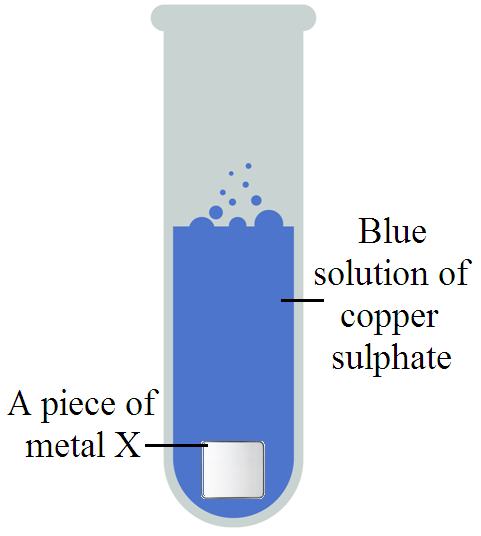
A metallic piece $(X)$ is dropped into copper sulphate solution. After some time, the blue colour of the solution changes to green. The change which has occurred is:
  • A
    Physical and reversible change.
  • B
    Physical and irreversible change.
  • C
    Chemical and reversible change.
  • Chemical and irreversible change.
Answer
Correct option: D.
Chemical and irreversible change.

Metal $(X), $ iron reacts with blue colored solution of copper sulphate and forms a new substance (green colored solution of iron sulphate) and cannot be converted back to the original solution. Thus, it is an irreversible and chemical change.

View full question & answer
MCQ 381 Mark
Inflating a balloon is a/ an __________ change.
  • A
    Irreversible.
  • B
    Chemical.
  • Reversible.
  • D
    Periodic.
Answer
Correct option: C.
Reversible.
Reversible.
View full question & answer
MCQ 391 Mark
The melting of wax is an example of:
  • A
    Physical change.
  • B
    Chemical change.
  • C
    Reversible change.
  • Both $(a)$ and $(c).$
Answer
Correct option: D.
Both $(a)$ and $(c).$
View full question & answer
MCQ 401 Mark
Which change among the following changes is not included in a reversible change?
  • A
    Change it state.
  • Change of position.
  • C
    Change in internal structure.
  • D
    Change of color.
Answer
Correct option: B.
Change of position.
Change in internal structure.
View full question & answer
MCQ 411 Mark
Exothermic changes are changes in which:
  • A
    Heat is absorbed.
  • Heat is liberated.
  • C
    Both $(a)$ and $(b).$
  • D
    Either $(a)$ or $(b).$
Answer
Correct option: B.
Heat is liberated.
Heat is liberated.
View full question & answer
MCQ 421 Mark
While making chapatti, Radhika observed the following changes, which among the following is a reversible change?
  • A
    Changing of flour into dough.
  • Rolling of chapatti.
  • C
    Baking of chapatti.
  • D
    Eating a chapatti.
Answer
Correct option: B.
Rolling of chapatti.
View full question & answer
MCQ 431 Mark
An aeroplane was cut out from a rectangular sheet of paper. The change involved is a:
  • A
    Physical change.
  • B
    Temporary change.
  • Irreversible change.
  • D
    None of these.
Answer
Correct option: C.
Irreversible change.
It is an irreversible change.
View full question & answer
MCQ 441 Mark
During burning of paper which of the following acts as reactant?
  • A
    Flame.
  • B
    Ash.
  • Paper.
  • D
    None of these.
Answer
Correct option: C.
Paper.
In a chemical process original substance is called reactant. Here paper is a reactant.
View full question & answer
MCQ 451 Mark
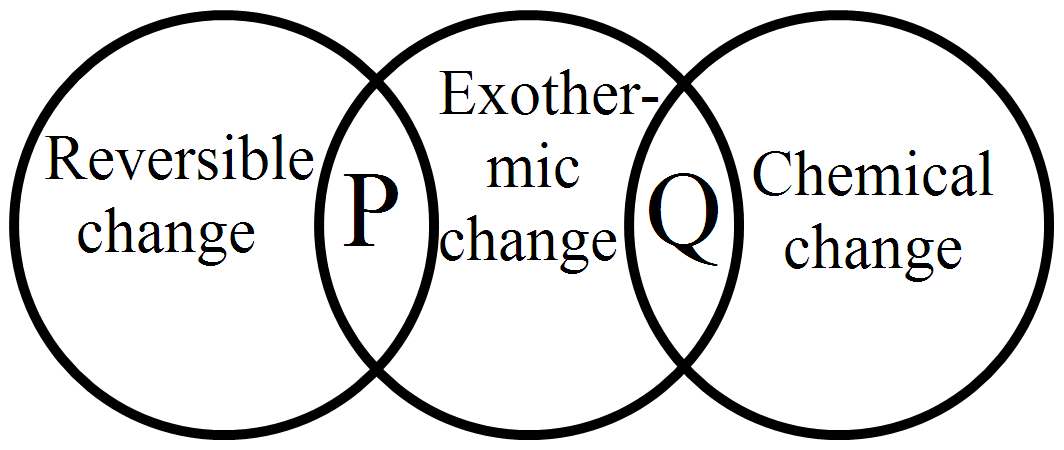
Directions: Look at the following diagram and answer the following question.

Which of the following represents $'P'$?
  • Freezing of water into ice.
  • B
    Burning of coal.
  • C
    Cooking of food.
  • D
    Bursting of cracker.
Answer
Correct option: A.
Freezing of water into ice.

Freezing of water into ice is an exothermic and reversible change.

View full question & answer
MCQ 461 Mark
Direction: Read the passages given below and answer the questions that follow Passage Mohan was boiling water in a pan for making tea. His brother Ram came there and observed that during boiling of water some bubbles are formed. He told his brother Mohan that boiling of water is a chemical change as gas is evolved in this process. But Mohan argued that this is not a chemical change. What kind of change takes place after formation of tea?
  • A
    Physical change.
  • Chemical change.
  • C
    Reversible change.
  • D
    Both $(a)$ and $(b).$
Answer
Correct option: B.
Chemical change.
Formation of tea is chemical change as this results in formation of new product that has different molecules than initial substance i.e., water.
View full question & answer
MCQ 471 Mark
In general, metals:
  • Expand on heating.
  • B
    Contract on heating.
  • C
    Are not affected by heating.
  • D
    All the above.
Answer
Correct option: A.
Expand on heating.
Expand on heating.
View full question & answer
MCQ 481 Mark
Direction: Read the passage (s) given below and answer the questions that follow Passage For changing milk into curd we add a small quantity of curd into milk. The milk is stirred and is set aside for a few hours at a warm place. In a few hours the milk changes into curd. The change of milk into curd is a:
  • Slow change.
  • B
    Fast change.
  • C
    Exothermic change.
  • D
    Endothermic change.
Answer
Correct option: A.
Slow change.
It is a slow change. The change occurs in few hours.
View full question & answer
MCQ 491 Mark
Which one of the following statements is correct?
Statement $1$: Increasing of our body temperature is a reversible change.
Statement $2$: Dissolution of gasses like oxygen and carbon dioxide in water is irreversible changes.
  • Statement $1.$
  • B
    Statement $2.$
  • C
    Both statements are correct.
  • D
    Both statements are incorrect.
Answer
Correct option: A.
Statement $1.$
Statement $1.$
View full question & answer
MCQ 501 Mark
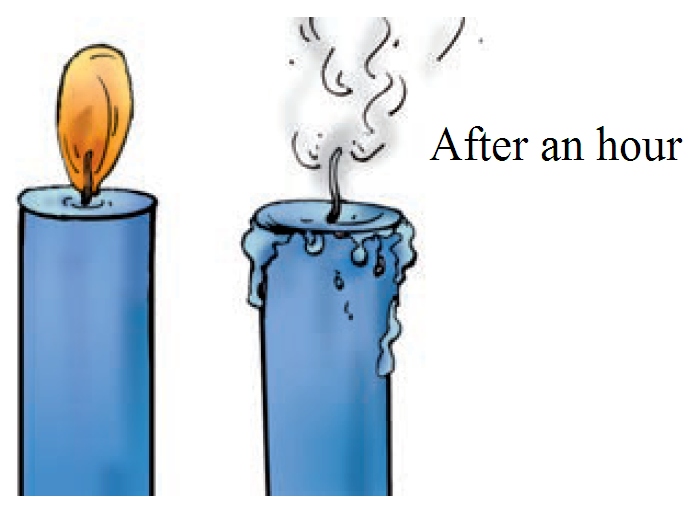
Look at the picture given below. What kind of change is shown in the picture? Choose the correct option.
  • A
    Irreversible change, melted wax cannot be solidified again.
  • Reversible change, melted wax can be solidified again.
  • C
    Periodic change, candle melts after an interval of an hour.
  • D
    Chemical change, melting of candle wax results in change in composition of candle.
Answer
Correct option: B.
Reversible change, melted wax can be solidified again.
Given picture shows reversible change as melted wax can be solidified again.
View full question & answer
[1 Marks Each] M.C.Q. - Science STD 6 Questions - Vidyadip