Questions

[3 Marks Each] QUE-ANS

Take a timed test

7 questions · self-marked practice — reveal the answer and mark yourself.

Question 13 Marks
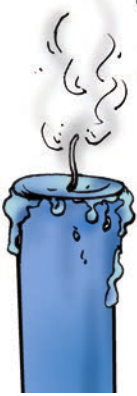
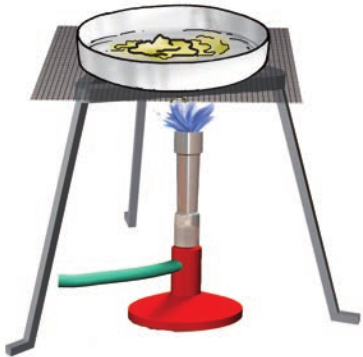
Look at which shows three situation:
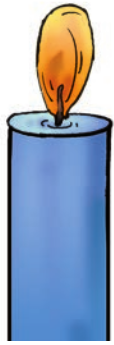
  1. A burning candle.
  2. An extinguished candle.
  3. Melting wax.


Which of these shows a reversible change and why?
Answer
Melting of wax in:
  1. And an extinguished candle.
  2. Ahow chemical irreversible change.
  3. Which on cooling, changes back to solid wax but burning candle.
Note: The burning of wax produces carbon dioxide gas water vapour and soot, which all go into air. We cannot combine all the products of burning of wax to get back the original candle. So burning of candle is an irreversible change.
View full question & answer
Question 23 Marks
Which of the following changes cannot be reversed?
  1. Blowing of a balloon.
  2. Folding a paper to make a toy aeroplane.
  3. Rolling a ball of dough to make roti.
  4. Baking cake in an oven.
  5. Drying a wet cloth.
  6. Making biogas from cow dung.
  7. Burning of a candle.
Answer
Changes that cannot be reversed are as follows:
  1. Baking cake in an oven.
  1. Making biogas from cow dung.
  2. Burning of a candle.
View full question & answer
Question 33 Marks
What are the differences between reversible changes and irreversible changes?
Answer
The differences between reversible changes and irreversible changes:
S.No.
Reversible changes
Irreversible changes
$1.$
A change which can be undone or reversed.
A change which cannot be undone or reversed.
$2.$
It is a temporary change.
It is a permanent change.
$3.$
Melting and folding are examples of it.
Burning and cooking of food are examples of it.
View full question & answer
Question 43 Marks
Boojho’s sister broke a white dove, a symbol of peace, made of Plaster of Paris $(POP)$. Boojho tried to reconstruct the toy by making a powder of the broken pieces and then making a paste by mixing water. Will he be successful in his effort? Justify your answer.
Answer
Boojho will not be successful because making of toy from Plaster of Paris $(POP)$ is a change that cannot be reversed. Plaster of Paris, immediately sets to a hard mass on adding water to it. So, the setting of plaster of Paris on mixing water is an irreversible chemical change.
View full question & answer
Question 53 Marks
A potter working on his wheel shaped a lump of clay into a pot. He then baked the pot in an oven. Do these two acts lead to the same kind of changes or different? Give your opinion and justify your answer.
Answer
These two acts are of different kinds. Making a lump of clay into a pot is a reversible change. This is because the wet clay pot can be converted back into the original clay.
The baking of clay pot in an oven is an irreversible change. This is because the baked clay pot cannot be changed back into the original clay.
View full question & answer
Question 63 Marks
A drawing sheet changes when you draw a picture on it. Can you reverse this
change?
Answer
If we draw a picture on a drawing sheet with a pencil, we can get back the original drawing sheet by erasing the drawing with an eraser. In this case, the change can be reversed.
However, if we draw with a pen, then the original drawing sheet cannot be obtained back because we cannot erase ink. Hence, in this case, the change cannot be reversed.
View full question & answer
Question 73 Marks
A thick coating of a paste of Plaster of Paris $(POP)$ is applied over the bandage on a fractured bone. It becomes hard on drying to keep the fractured bone immobilised. Can the change in $POP$ be reversed?
Answer
When water is added to plaster of Paris $(POP)$, it changes to another substance and on drying it hardens. Once the $POP$ has hardened, its shape cannot be changed. Therefore, the change in POP cannot be reversed.
View full question & answer