Questions

[5 Marks Each] QUE-ANS

Take a timed test

9 questions · self-marked practice — reveal the answer and mark yourself.

Question 15 Marks
In which season is cotton planted? What is its course of growth?
Answer
It is planted early in the spring. Cotton plants grow steadily and soon become bushes of $3$ to $6$ feet high. After about 2 months, they bear white or yellowish flowers which turn pink or red after a few days. The petals of the flowers fall, leaving behind tiny green seeds. This later grows into spherical-shaped structure of the size of a walnut, which is called cotton boll. As the cotton bolls grow steadily, the seeds and the fibres grow inside. On maturing, the green bolls begin to turn brown. On complete maturation, they become ready to burst open, exposing the white fibres. As the fibres dry in the sun, they become fluffy.
View full question & answer
Question 25 Marks
Match the articles given in Column $I$ with the articles of Column $II$.
 
$COLUMN\ I$
 
$COLUMN\ II$
$a$
Sweater
$i$
Cotton
$b$
Cotton bolls
$ii$
Wool
$c$
Dhoti
$iii$
Ginning
$d$
Gunny bags
$iv$
Jute
Answer
 
$COLUMN\ I$
 
$COLUMN\ II$
$a$
Sweater
$ii$
Wool
$b$
Cotton bolls
$iii$
Ginning
$c$
Dhoti
$i$
Cotton
$d$
Gunny bags
$iv$
Jute
View full question & answer
Question 35 Marks
Describe the two main processes of making fabric from yarn.
Answer
The two main processes of making fabric from yarn are weaving and knitting. Weaving It is a process of making fabric (or cloth) by arranging two sets of yarns passing in one direction with other yarns at right angle to them. In other words, two sets of yarns are woven to make a fabric. Weaving of fabric is done on looms. The looms are either hand operated or power operated. Knitting It is a process of making a fabric by interlocking loops of single yarn with knitting needles or machines. Knitting fabrics are made of a single yarn running throughout the fabric. Socks and many other clothing items are made of knitted fabrics.
View full question & answer
Question 45 Marks
What is done in the process of spinning? Name any device used for spinning.
Answer
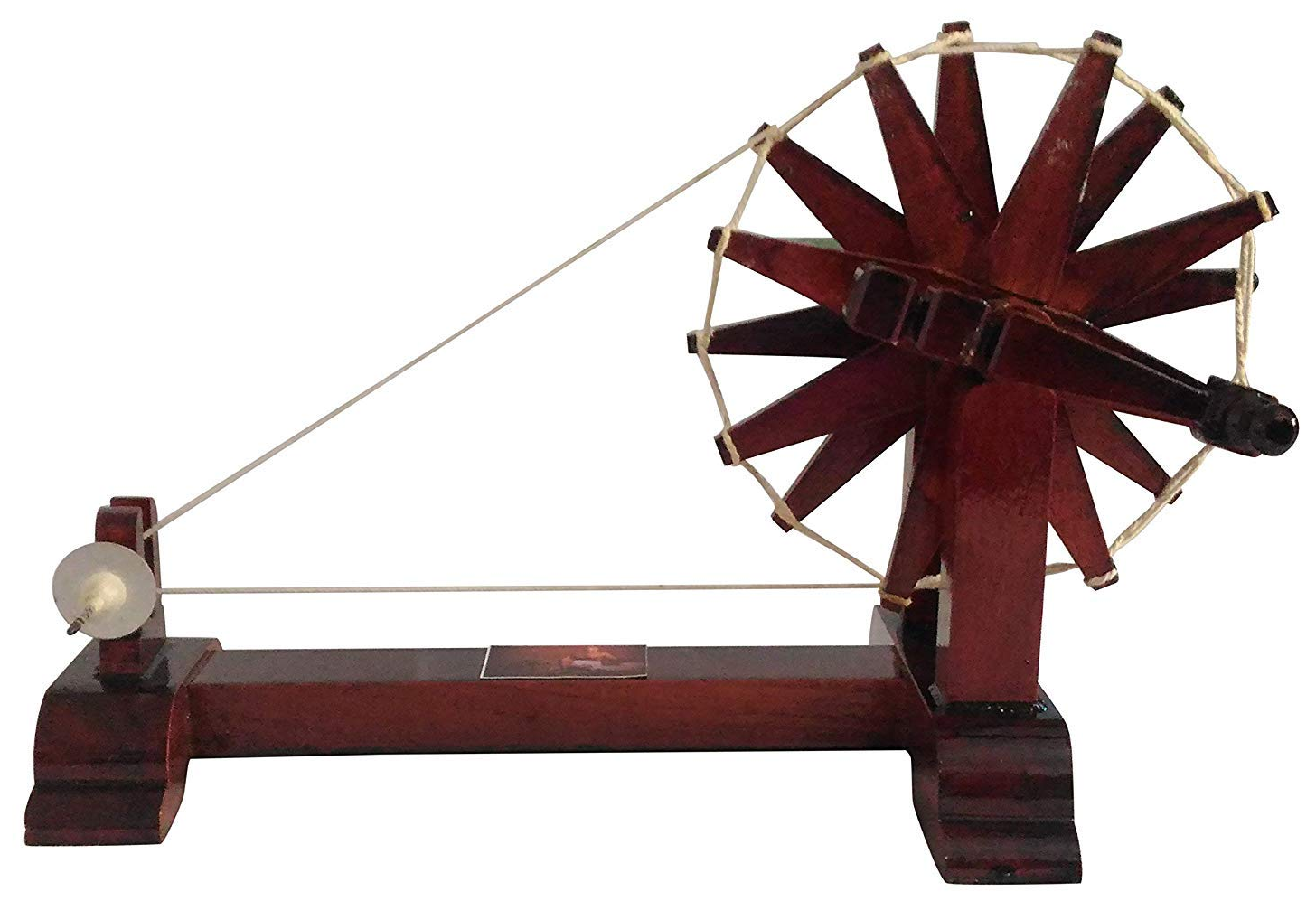
The process of making yarn from fibres is called spinning. In this process, fibres from a mass of cotton wool are drawn out and twisted. This brings the fibres together to form a yarn. a device used for spinning is charkha.
View full question & answer
Question 55 Marks
A cotton shirt, before it reaches you, completes a long journey. Elaborate this journey starting from cotton bolls.
Answer
Cotton is the most important in all plant fibres, used to make clothes. Cotton shirt can be prepared by following steps:
$\text{Cotton bolls}\xrightarrow{\ \ \ \ \text{Ginning}\ \ \ \ }\text{Cotton fibre}\xrightarrow{\ \ \text{Spinning} \ \ \ }\\\text{Cotton yarn}\xrightarrow{\ \ \text{Weaving}\ \ \ \ }\text{Cotton fabric}\xrightarrow{\ \ \ \text{Sewing}\ \ \ }\text{Cotton shirt}$
The making of cotton shirt is a long process. From cotton bolls, cotton is usually picked up from the plants in the fields usually by hand. Fibres are then separated from the seeds by combing. This process is called ginning
In spinning processes, the fibres from a mass of cotton wool are drawn out and twisted. This brings the fibres together to form a long and twisted thread called ‘yarn’. In weaving process, cotton fabric is made by arranging two sets of cotton yarns at right angles to one another. Weaving is done on looms. Now, on sewing this cotton fabric by needle on sewing machine we get the cotton shirt.
View full question & answer
Question 65 Marks
What are the uses of cotton?
Answer
Cotton has a variety of uses. Some uses of cotton are given below:
  1. Cotton or cotton in combination with other fibres is used in manufacture of textiles.
  2. Cleaned cotton is used as an absorbent in hospitals.
  3. Unspun cotton is used, as fillers in mattresses, pillows and quilts.
  4. Cotton is used as a main raw material in manufacturing of rayon and in paper industry.
  5. Due to high water absorption property, clothes made from cotton are extensively used as mops in household and for cleaning machines in industries.
View full question & answer
Question 75 Marks
Match the terms given in Column $I$ with the statements given in Column $II$.
 
$Column\ I$
 
$Column\ II$
$a$
Weaving
$i$
A single yarn used to make a fabric.
$b$
Knitting
$ii$
Combing of cotton fibres to remove seeds.
$c$
Spinning
$iii$
Yarns are made from these thin strands.
$d$
Ginning
$iv$
These are spun from fibres and then used to make fabrics.
$e$
Fibre
$v$
Process of arranging two sets of yarns together to make a fabric.
$f$
Yarn
$vi$
Process of making yarn from fibres.
Answer
 
Column $I$
 
Column $II$
$a$
Weaving
$v$
Process of arranging two sets of yarns together to make a fabric.
$b$
Knitting
$i$
A single yarn used to make a fabric.
$c$
Spinning
$vi$
Process of making yarn from fibres.
$d$
Ginning
$ii$
Combing of cotton fibres to remove seeds.
$e$
Fibre
$iii$
Yarns are made from these thin strands.
$f$
Yarn
$iv$
These are spun from fibres and then used to make fabrics.
View full question & answer
Question 85 Marks
Explain various steps in the manufacture of cotton fabric from cotton.
Answer
Important steps in the manufacture of cotton fibres are as described below:
  1. Cotton is hand picked from the plants.
  2. Ginning: The picked cotton is taken to godowns where the seeds are pulled out of the cotton by steel combs.
  3. Bailing: Ginned cotton is compressed tightly into bundles weighing approximately $200$ $kg$ called bales.
  4. Raw cotton from bales is cleaned from straw and dried leaves, combed and straightened and finally converted into rope like strand called sliver.
  5. Spinning: To make this strand into yam strong enough for wearing, it is pulled and twisted.
  6. Yarn is wound on big reels called ‘bobbins’. These bobbins of yam are subjected to weave for making cloth.
  7. Weaving: Weaving from yam is done in the looms.
  8. Bleaching and dyeing: Fabric made in the loom is grey in colour. The fabric is now bleached and dyed at a finishing plant.
View full question & answer
Question 95 Marks
Match the following items given in Column $A$ with that in Column $B$:
 
S.No.
Column $A$
S.No.
Column $B$
$(a)$
Jute is obtained from.
$(i)$
Charkha.
$(b)$
Fibre from retted jute are extracted by.
$(ii)$
Sliver.
$(c)$
Separation of fibres from jute stem.
$(iii)$
Bales.
$(d)$
Compressed bundles of cotton.
$(iv)$
Retting.
$(e)$
Cotton is collected from cotton plants by.
$(v)$
Hand picking.
$(f)$
Separation of cotton from seeds.
$(vi)$
Silk and wool.
$(g)$
Loose rope of cotton fibres.
$(vii)$
Stem of‘putson.
$(h)$
Animal fibres.
$(viii)$
Hands with jerks and pulls.
$(i)$
Suitable for wearing in kitchen.
$(ix)$
Ginning.
$(j)$
Used to spin yams.
$(x)$
Cotton clothes.
Answer
S.No.
Column $A$
S.No.
Column $B$
$(a)$
Jute is obtained from.
$(vii)$
Stem of ‘putson’.
$(b)$
Fibre from retted jute are extracted by.
$(viii)$
Hands with jerks and pulls.
$(c)$
Separation of fibres from jute stem.
$(iv)$
Retting.
$(d)$
Compressed bundles of cotton.
$(iii)$
Bales.
$(e)$
Cotton is collected from cotton plants by.
$(v)$
Hand picking.
$(f)$
Separation of cotton from seeds.
$(ix)$
Ginning.
$(g)$
Loose rope of cotton fibres.
$(ii)$
Sliver.
$(h)$
Animal fibres.
$(vi)$
Silk and wool.
$(i)$
Suitable for wearing in kitchen.
$(x)$
Cotton clothes.
$(j)$
Used to spin yams.
$(i)$
Charkha.
View full question & answer