Questions

[1 Marks Each] QUE - ANS

Take a timed test

65 questions · self-marked practice — reveal the answer and mark yourself.
Question 11 Mark
Why we cannot see our image in the mirror in complete dark room?
Answer
We cannot see our image in the mirror in complete dark room because there is no light to reflect.
View full question & answer
Question 31 Mark
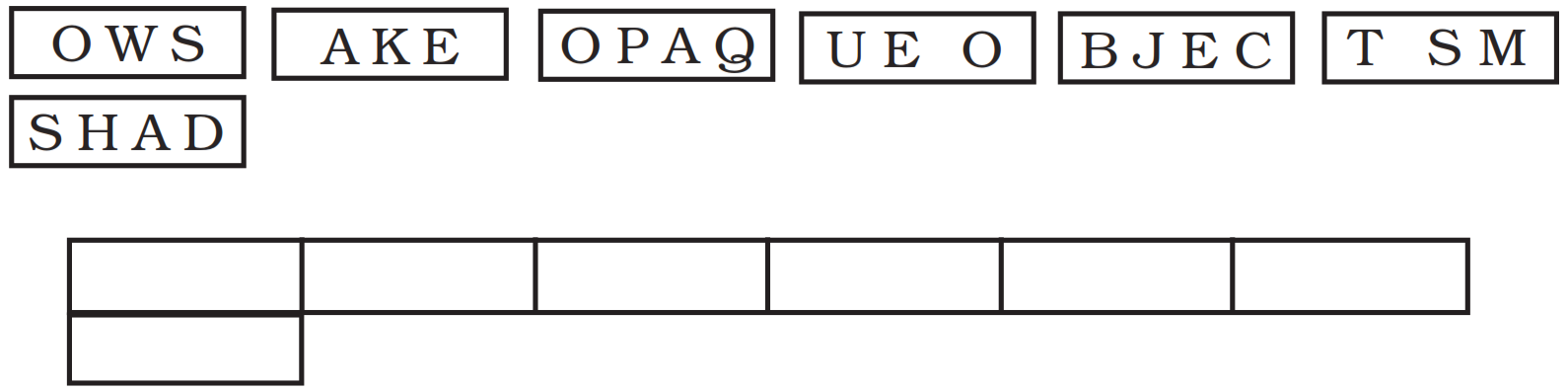
Rearrange the boxes given below to make a sentence that helps us understand opaque objects.
Answer

Opaque objects make shadows.
View full question & answer
Question 41 Mark
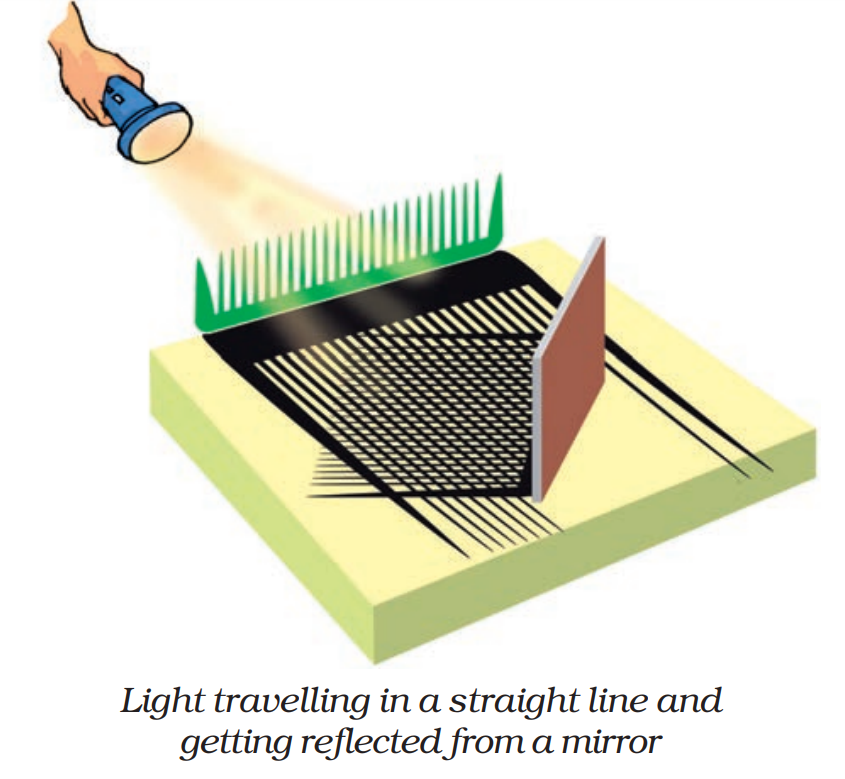
Activity.Fix a comb on one side of a large thermocol sheet and fix a mirror on the other side as shown in the figure. Spread a dark-coloured sheet of paper between the mirror and the comb. Keep this in sunlight or send a beam of light from a torch through the comb.
What do you observe? Do you get a pattern similar to that shown in figure?
Answer
Light travels in straight line and gets reflected from the mirror. Yes, we get a pattern similar to that shown in the figure.
View full question & answer
Question 51 Mark
What do we need in order to see a shadow?
Answer
We need
  • A source of light,
  • An opaque object in the way of light, and
  • A screen;
View full question & answer
Question 61 Mark
Does the direction of shadow change during the day? Does the length of shadow also change from season to season?
Answer
Yes, the direction of shadow changes as the sun changes its position during the day. The length of the shadow also changes from season to season.
View full question & answer
Question 81 Mark


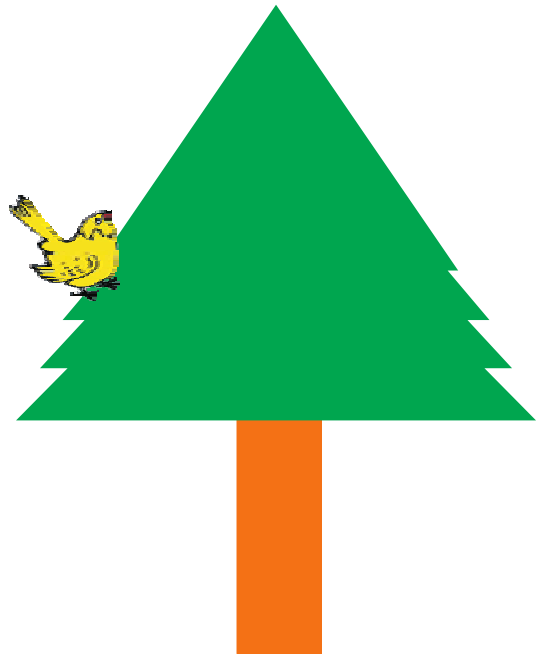
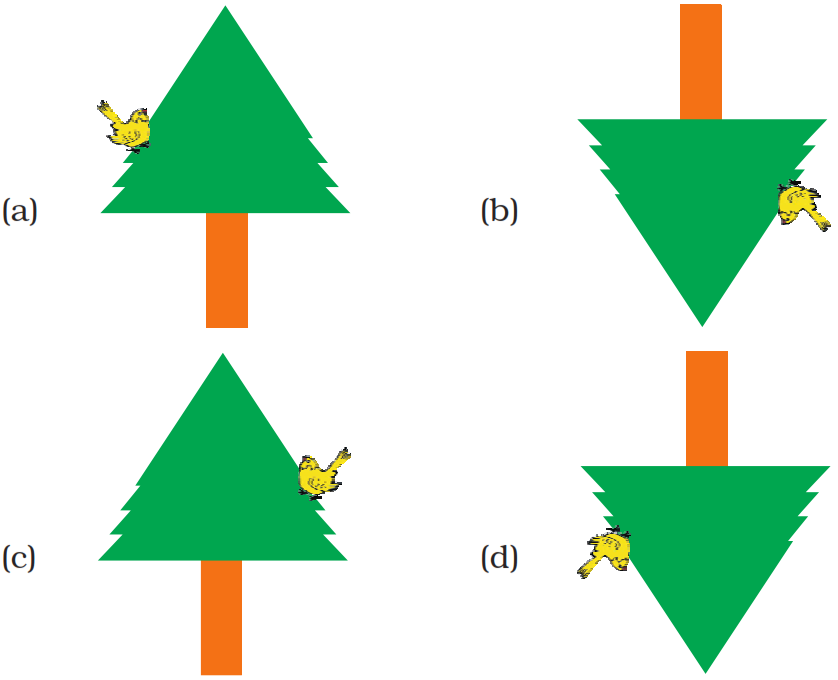
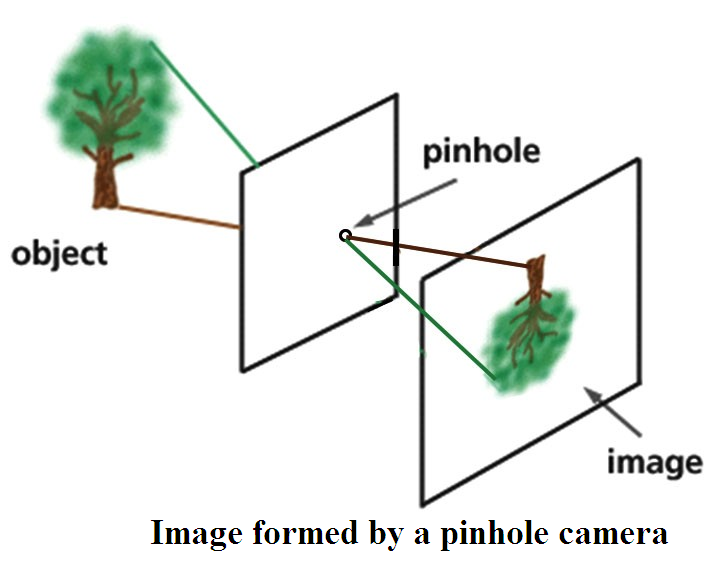
A student observes a tree given in Fig. through a pin hole camera. Which of the diagrams given in Fig. $(a)$ to $(d)$, depicts the image seen by her correctly?
Answer


Explanation:
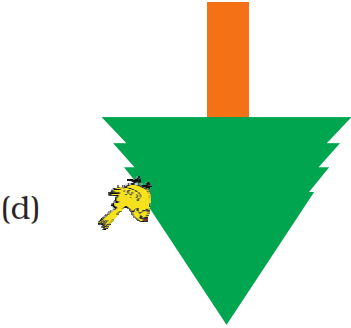
Option $(d)$ is the correct image seen by her because a pinhole camera always forms upside down (i.e. inverted) image.
View full question & answer
Question 91 Mark
How are moon and planets visible to us, though they are not luminous?
Answer
Because they reflect light from the sun.
View full question & answer
Question 101 Mark
What are transparent objects?
Answer
Those objects which allow light rays to pass through them completely are called transparent objects. One can see clearly through these objects.
View full question & answer
Question 111 Mark
What is umbra and penumbra?
Answer
Umbra is the dark region behind object facing light which does not receive light at all.
Penumbra is the less dark part of shadow. It is the outer part of shadow.
View full question & answer
Question 121 Mark
On what factor does the proportion of light that enters an object depend?
Answer
Optical nature of the object.
View full question & answer
Question 131 Mark
How will you convert a transparent glass sheet into a translucent sheet? Suggest any two ways to do it.
Answer
By smearing a thin layer of oil we may convert a transparent glass sheet into a translucent sheet.
By covering one side of the glass sheet by butter paper.
View full question & answer
Question 151 Mark
Fill in the blanks with appropriate words:
In a plane mirror, our left hand looks like right hand. This phenomenon is called ______.
Answer
In a plane mirror, our left hand looks like right hand. This phenomenon is called lateral inversion.
View full question & answer
Question 161 Mark
Why is the moon not considered as a luminous body?
Answer
Moon is a non-luminous body because it shines by reflecting the sunlight falling on it.
View full question & answer
Question 181 Mark
What type of object is said to be transparent?
Answer
If we are able to see clearly through an object, it is said to be transparent.
View full question & answer
Question 191 Mark
What is reflection?
Answer
When a ray of light falls on a smooth and shiny surface, the whole of light is sent back in the same medium. It is called reflection. Mirrors do not allow even a small amount of light to pass through them. Mirrors show regular and complete reflection.
View full question & answer
Question 211 Mark
What are luminous and non-luminous objects?
Answer
Luminous objects: Objects that give out or emit light of their own, e.g., sun, torch, light, bulbs, etc.
Non-luminous objects: Objects that do not give out light of their own, e.g., the moon, chair, shoe, pen, etc.
View full question & answer
Question 221 Mark
Define eclipse.
Answer
Eclipse is a shadow formed in space that makes the sun or the moon invisible for some time.
View full question & answer
Question 231 Mark
What are translucent objects?
Answer
There are some objects through which we can see but not clearly. Such objects are known as translucent objects.
View full question & answer
Question 241 Mark
Can you think of a situation where we can see the path of the light?
Answer
In a dark room, we can see with torch light which goes straight. Similarly, dust particles become visible when light enters the room through fine hole.
All these examples indicate that light travels in straight line.
View full question & answer
Question 251 Mark
Why is the image formed in a pinhole camera inverted?
Answer
In a pinhole camera, image formed is inverted because the object is between radius of curvature and focus.
View full question & answer
Question 271 Mark
Why do we need a shiny surface for reflection?
Answer
The extent of reflection depends upon the shine and smoothness of the surface. More is the shine and smoothness of the surface, more will be the reflection. That is why mirrors reflect most of the light falling on it. Hence, for reflection, shiny surfaces are required.
View full question & answer
Question 281 Mark
Define ‘Mirror’.
Answer
A smooth shining surface, which rebounds the light back in same or in different direction is called a mirror.
View full question & answer
Question 291 Mark
Why is silvered glass used as a mirror?
Answer
The silvered glass has a smooth surface and the smoothness helps in forming clear image. Silvering makes it shiny and the shiny surface helps in reducing the absorption.
View full question & answer
Question 301 Mark
Why we should not look directly at sun?
Answer
We should not look directly at sun because that could be extremely harmful for the eyes.
View full question & answer
Question 311 Mark
Why we cannot see objects through $T$ shaped or $N$ shaped pipe?
Answer
We cannot see objects through $T$ shaped or $N$ shaped pipe because light travels through straight line.
View full question & answer
Question 331 Mark
Fill in the blanks with appropriate words:
Light travels in a ______.
Answer
Light travels in a straight line.
View full question & answer
Question 361 Mark
What do we need to see an object?
Answer
To see an object, we need source of light, eyes and object. When light emitted by luminous body falls on an object, it is reflected back and received by our eyes. Then we see that object.
View full question & answer
Question 381 Mark
Why is the shadow of an aeroplane flying high in the sky not seen on the ground?
Answer
This is because the size of a flying aeroplane is very small with respect to the ground.
View full question & answer
Question 391 Mark
If moon is non luminous, how it appears bright in night?
Answer
Moon appears bright in night because it reflects sun light that falls on it.
View full question & answer
Question 401 Mark
What type of objects does not cast shadow and why is that?
Answer
Transparent and some translucent objects do not cast shadow because light passes through them.
View full question & answer
Question 421 Mark
Define pinhole camera.
Answer
It is a device which forms a photograph like image of a bright object on a screen.
View full question & answer
Question 431 Mark
Give examples of two substances through which light does not pass?
Answer
Wood and bricks are the substances through which light does not pass.
View full question & answer
Question 451 Mark
Sometimes, you are able to see the Sun or the Moon behind the clouds. What can you say about the ability of such clouds to transmit light?
Answer
We may say that clouds behave as translucent object.
View full question & answer
Question 471 Mark
Moon is a non-luminous object. How does it shine at night?
Answer
Moon reflects the light of the sun at night.
View full question & answer
Question 481 Mark
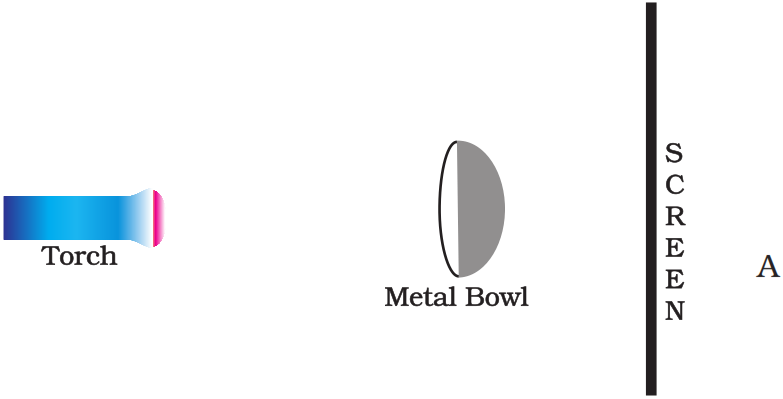
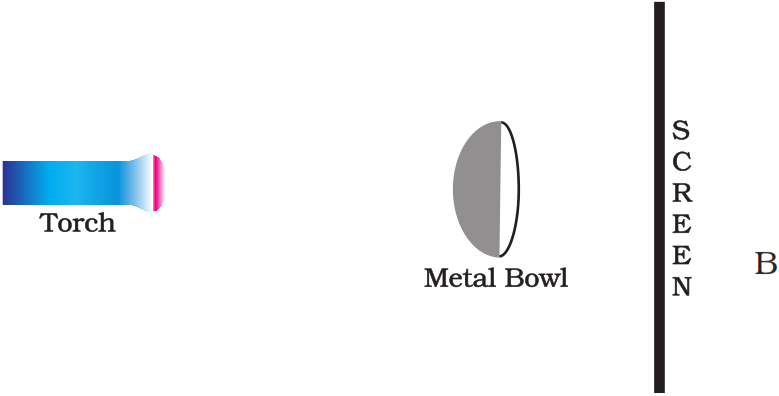
Look at the figure given in Fig.


Will there be any difference in the shadow formed on the screen $A$ and $B$?
Answer
No, there will not be any difference because the length and breadth of an object are same in both the cases.
View full question & answer
Question 491 Mark
Why polished surface cause glares in our eyes?
Answer
Polished surface cause glares in our eyes because they produce regular reflection of light.
View full question & answer
Question 501 Mark
What are luminous objects?
Answer
Objects that give out or emit light of their own are known as luminous objects.
View full question & answer
Question 511 Mark
What happens when light falls on a mirror?
Answer
Mirror is silvered on one side, so it does not allow the light to pass through it. It reflects almost whole of the light falling on it.
View full question & answer
Question 521 Mark
Define luminous body.
Answer
The objects which emit light of their own are called luminous bodies, e.g., the sun, the stars, etc.
View full question & answer
Question 531 Mark
Close your eyes while looking towards bright sunshine. Now, cover the eyes with your palm still keeping them closed. Do you notice any difference? On the basis of this experience, state whether your eyelids are transparent, translucent or opaque.
Answer
On the basis of the experience, we observe our eyelids are opaque.
View full question & answer
Question 551 Mark
How can a transparent sheet be converted into a translucent sheet?
Answer
By greasing the paper with oil or fat.
View full question & answer
Question 561 Mark
What change in the path of light takes place when light falls on a shiny surface? What is this called?
Answer
The light comes back in the same plan when light falls on a shiny surface. This is known as reflection of light.
View full question & answer
Question 581 Mark
What materials can be used to make a pinhole camera? How can it be used?
Answer
Pinhole camera can be made with simple material like cardboard, tracing paper etc. It can be used to image the sun and brightly lit objects.
View full question & answer
Question 601 Mark
What do you mean by scattering of light?
Answer
When a beam of light falls on a rough surface, it is turned back in different directions, it is called scattering of light.
View full question & answer
Question 611 Mark
Why is shadow formed when an opaque object comes in path of light?
Answer
Light travels in a straight line and when opaque object obstructs it, shadow is formed.
View full question & answer
Question 621 Mark
Classify the following into transparent, opaque and translucent objects:
Wax, spectacles, a heap of salt, a stone, dense smoke, wood, skin, balloon, rubber, membrane of a tabla, blood and milk.
Answer
Transparent objects are Spectacles.
Opaque objects are A stone, wood, a heap of salt, dense smoke, and membrane of tabla.
Translucent objects are Blood, milk, wax, skin, balloon, rubber.
View full question & answer
Question 641 Mark
Define opaque objects with example.
Answer
Those materials which do not allow light to pass through them, are called opaque objects. Examples wood, stone, etc.
View full question & answer
Question 651 Mark
Whether a shadow is two-dimensional or three-dimensional?
Answer
Shadow is not just the two-dimensional outline that you see on the ground. All the space behind the opaque object up to some distance behind it seems to be filled with the shadow.
View full question & answer