Question 13 Marks
The cost of a flower vase got increased by $12\%.$ If the current cost is $Rs. 896,$ what was its original cost$?$
AnswerLet the original cost be $Rs. x$
Now, the cost of flower vase is increased by $12\%$
So, $x + 12\%$ of $x = Rs. 896$
$\Rightarrow\text{x}+\frac{12}{100}\text{x}=896$
$\Rightarrow\frac{112\text{x}}{100}=896$
$\text{x}=\frac{896\times100}{112}$
$\therefore\text{x}=\text{Rs. } 800$
Hence, original lost of flower vase is $Rs. 800.$
View full question & answer→Question 23 Marks
The simple interest on a certain sum for $8$ year at $12\%$ per annum is $Rs. 3120$ more than the simple interest on the same sum for $5$ year at $14\%$ per annum. Find the sum.
AnswerGiven, $\mathrm{I}_1-\mathrm{I}_2= Rs. 3120 ,$
$T_1=8 \text { year, } R_1=12 \%$
$T_2=5 \text { year, } R_2=14 \%$
$\text { and } P_1=P_2=P$
According to the question, $\mathrm{I}_1-\mathrm{I}_2=3120$
$\Rightarrow \frac{\mathrm{P}_1 \times \mathrm{R}_1 \times \mathrm{T}_1}{100}-\frac{\mathrm{P}_2 \times \mathrm{R}_2 \times \mathrm{T}_2}{100}=3120$
$\Rightarrow \frac{\mathrm{P} \times 12 \times 8}{100}-\frac{\mathrm{P} \times 14 \times 5}{100}=3120$
$\Rightarrow \frac{\mathrm{P}}{100}[12 \times 8-14 \times 5]=3120$
$\Rightarrow \mathrm{P}[96-70]=3120 \times 100$
$\Rightarrow 20 \mathrm{P}=312000$
$\Rightarrow \mathrm{P}=\frac{312000}{26}$
$\therefore \mathrm{P}=\text { Rs. } 12000$
Hence, the sum is $Rs. 12000.$
View full question & answer→Question 33 Marks
By selling a chair for $Rs. 1440$, a shopkeeper loses $10\%$. At what price, did he buy it$?$
AnswerGien, $SP = Rs. 1440$ and loss $= 10\%$
We know that, $\text{Loss}\%=\frac{\text{Loss}}{\text{CP}}\times100\%$
$\Rightarrow\text{Loss}\%=\frac{\text{CP}-\text{SP}}{\text{CP}}\times100\% [ \therefore$ Loss $= CP - SP]$
$\Rightarrow10=\frac{\text{CP}-1440}{\text{CP}}\times100$
$\Rightarrow\frac{10}{100}\text{CP}=\text{CP}-1440$
$\Rightarrow\text{CP}-\frac{10}{100}\text{CP}=1440$
$\Rightarrow\frac{9}{10}\text{CP}=1440$
$\Rightarrow\text{CP}=\frac{1440\times10}{9}$
$\therefore\text{CP}=\text{Rs. }1600$
Hence, the cost price of chair is $Rs. 1600$
View full question & answer→Question 43 Marks
In an entertainment programme, $250$ tickets of $Rs. 400$ and $500$ tickets of $Rs.100$ were sold. If the entertainment tax is $40\%$ on ticket of $Rs. 400$ and $20\%$ on ticket of $Rs. 100,$ then find how much entertainment tax was collected from the
AnswerIt is given that, $250$ tickets of $Rs.400$ were sold,
Therefore, total amount received by selling these tickets $= 250 × 400= Rs. 100000$
Similarly, amount received by selling $500$ tickets of $Rs.100 = 500 × 100= Rs. 50000$
It is also given that, $40\%$ and $20\%$ of entertainment tax is on $Rs. 400$ and $Rs. 100$ tickets, respectively.
So, total entertainment tax collected.
$= 40\%$ of total amount recevied by sellingtickets of $Rs. 400 + 20\%$ of total amount received by selling tickets of $Rs. 100$
$= 40% of 100000 + 20\%$ of $50000$
$=\frac{40}{100}\times100000+\frac{20}{100}\times50000$
$=40000+10000$
$=\text{Rs. }50000$
Hence, the total collected entertainment tax was $Rs. 50000$
View full question & answer→Question 53 Marks
Chalk contains $10\%$ calcium, $3\%$ carbon and $12\%$ oxygen. Find the amount of carbon and calcium (in grams) in $2\frac{1}{2}\text{kg}$ of chalk.
AnswerWe have, Percentage of calcium in chalk $= 10\%$
Percentage of carbon in chalk $= 3\%$
Percentage of oxygen in chalk $= 12\%$
$\therefore$ Weight of chalk $=2\frac{1}{2}\text{kg}=\frac{5}{2}\text{kg}$
$=2.5\times1000\text{g}=2500\text{gm} [ \therefore 1\ kg = 1000\ g]$
$\therefore$ Amount of caincium in chalk $= 3\%$
$2500\ ag =\frac{3}{100}\times2500=25\times3=75\text{g}$
$\therefore$ Amount of caincium in chalk $= 10\%$ of $2500\ g$
$=\frac{10}{100}\times2500=10\times25=250\text{g}$
Hence, amount of carbon and calcium are $75\ g$ and $250\ g.$ espctively.
View full question & answer→Question 63 Marks
A memorial trust donates $Rs. 500000$ to a school, the interest on which is to be used for awarding $3$ scholarships to students obtaining first three positions in the school examination every year. If the donation earns an interest of $12\%$ per annum and the values of the second and third scholarships are $Rs. 20000$ and $Rs. 15000$ respectively, then find out the value of the first scholarship.
AnswerDonation amount $= Rs. 500000$
Rate of interest for each year $= 12\%$ per annum
Time period $= 1$ year
Interest received afer $1$ year $=\frac{500000\times12\times1}{100}$
$=5000\times12=\text{Rs. }60000$
Scholarship amount for second position $= Rs. 20000$
Scholarship amount for third position $= Rs. 15000$
$\therefore$ Remaining amount for first position $= 60000 - (20000 + 15000) $
$= 60000 - 35000 = Rs. 25000$
View full question & answer→Question 73 Marks
Ambika got $99\%$ marks in Mathematics, $76\%$ marks in Hindi, $61\%$ in English, $84\%$ in Science and 95% in Social Science. If each subject carries $100$ marks, then find the percentage of marks obtained by Ambika in the aggregate of all the subjects.
AnswerIt is given that, each subject carries $100$ marks.
$\therefore$ Ambika got marks in
Mathematics $= 99$
Hindi $= 76$
English $= 61$
Social science $= 95$
Now, aggregate percentage of marks $=\frac{\text{Marks obtained by Anbika}}{\text{Total marks}}\times100\%$
$=\frac{(99+76+61+84+95)}{500}\times100\%$
$=\frac{415}{5}=83\%$
View full question & answer→Question 83 Marks
Nancy obtained $426$ marks out of $600$ and the marks obtained by Rohit are $560$ out of $800.$ Whose performance is better$?$
AnswerNancy got marks $= 426$ out of $600.$
Percentage marks $=\frac{426}{600}\times100\%=71\%$
Rohit got marks $= 560$ out of 800.
Percentage marks $=\frac{560}{800}\times100\%=70\%$
Hence, Nancy's perfromance is better, since she got $1\%$ more than Rohit.
View full question & answer→Question 93 Marks
Radhika borrowed $Rs. 12000$ from her friends. Out of which $Rs. 4000$ were borrowed at $18\%$ and the remaining at $15\%$ rate of interest per annum. What is the total interest after $3$ year$?$
AnswerFor first yar interest, we have
$\mathrm{P}_1=\text { Rs. } 4000, \mathrm{R}_1=18 \% \text { and } \mathrm{T}_1=3 \text { year }$
$\therefore \mathrm{I}_1=\frac{\mathrm{P}_1 \times \mathrm{R}_1 \times \mathrm{T}_1}{100}$
$\therefore \mathrm{I}_1=\frac{4000 \times 18 \times 3}{100}=\text { Rs. } 2160$
For second year interest,
$\mathrm{P}_2=12000-4000=\text { Rs. } 8000$
$\mathrm{R}_2=15 \% \text { and } \mathrm{T}_2=3 \text { year }$
$\therefore \mathrm{I}_2=\frac{\mathrm{P}_2 \times \mathrm{R}_2 \times \mathrm{T}_2}{100}$
$\therefore \mathrm{I}_2=\frac{8000 \times 15 \times 3}{100}=\text { Rs. } 3600$
Hence, after $3$ year, total interst $=\mathrm{I}_1+\mathrm{I}_2=2160+3600= Rs. 5760$
View full question & answer→Question 103 Marks
A man travelled $60\ km$ by car and $240\ km$ by train. Find what per cent of total journey did he travel by car and what per cent by train?
AnswerDistance covered by car $= 60\ km$
Distance covered by train $= 240\ km$
$\therefore$ Total journey $= 60 + 240 =300\ km$
Let $x\%$ of total journey is travellied by car.
Then, $x\%$ of $300 = 60$
$\Rightarrow\frac{\text{x}}{100}\times300=60$
$\Rightarrow\text{x}=\frac{60\times100}{300}$
$\Rightarrow\text{x}=20\%$
Let $y\%$ of total journey is travilled by train.l
Then, $x\%$ of $300 = 240$
$\Rightarrow\frac{\text{y}}{100}\times300=240$
$\Rightarrow\text{y}=\frac{240\times100}{300}$
$\Rightarrow\text{y}=80\%$
Hence, $20\%$ distance is traveilled by car and $80\%$ distance is travelled by train.
View full question & answer→Question 113 Marks
$Rs. 9000$ becomes $Rs. 18000$ at simple interest in $8$ year. Find the rate per cent per annum.
AnswerGiven, $P = Rs. 9000,$
$A = Rs. 18000$ and
$T = 8$ eyar As we kno,$ A = P + I$
$\Rightarrow\text{I}=\text{A}-\text{P}=18000-9000$
$\Rightarrow\text{I}=\text{Rs. }9000$
Now, $\text{I}=\frac{\text{P}\times\text{R}\times\text{T}}{100}$
$\Rightarrow\text{R}=\frac{\text{I}\times100}{\text{P}\times\text{T}}=\frac{9000\times100}{9000\times8}$
$\therefore\text{R} =12.5\%%$
hence, the rate of interest per annum is $12.5\%$
View full question & answer→Question 123 Marks
The simple interest on a certain sum for $2.5$ year at $12\%$ per annum is $Rs. 300$ less than the simple interest on the same sum for $4.5$ year at $8\%$ per annum. Find the sum.
AnswerGiven that, $P_1=x, R_1=12 \%$ and $T_1=2.5$ year
$\frac{5}{2}$ year and $P_2=x, R_2=8 \%$ and $T_2=4.5$ year $=\frac{9}{2}$ year
According to the question,
$\mathrm{I}_2-\mathrm{I}_1=300$
$\Rightarrow \frac{\mathrm{P}_2 \times \mathrm{R}_2 \times \mathrm{T}_2}{100}-\frac{\mathrm{P}_1 \times \mathrm{R}_1 \times \mathrm{T}_1}{100}=300$
$\Rightarrow \frac{\mathrm{x} \times 8 \times 9}{2 \times 100}-\frac{\mathrm{x} \times 12 \times 5}{2 \times 100}=300$
$\Rightarrow 72 \mathrm{x}-60 \mathrm{x}=300 \times 200$
$\Rightarrow 12 \mathrm{x}=60000$
$\therefore \mathrm{x}=\text { Rs. } 5000$
Hence, the sum/ principal is $Rs. 5000.$
View full question & answer→Question 133 Marks
The population of a village is $8000.$ Out of these, $80\%$ are literate and of these literate people, $40\%$ are women. Find the ratio of the number of literate women to the total population.
AnswerWe have, total populatuion $= 8000$
Literate people $= 80\%$ of literate people $=\frac{80}{100}\times800=6400$
Literate women $= 40\%$ of literate people $=\frac{40}{100}\times6400=2560$
Ratio of literate of women to total population $= 2560 : 8000 =\frac{2560}{320}:\frac{8000}{320}=8:25$
Hence, the ration of women to total population is $8 : 25$
View full question & answer→Question 143 Marks
Sachin and Sanjana are calculating $23\%$ of $800.$
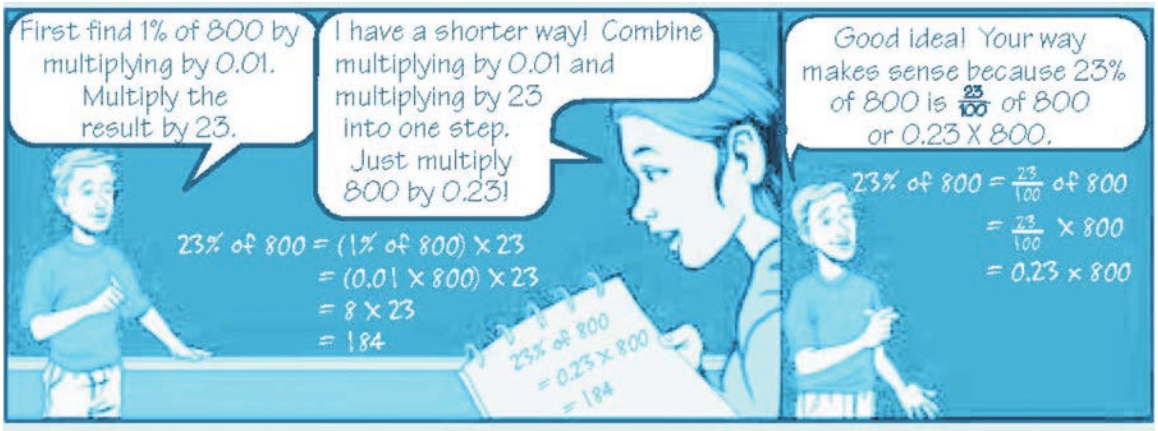
Now, calculate $52\%$ of $700$ using both the ways described above. Which way do you find easier? AnswerFirst way:
$52\%$ of $700 = (1\%$ of $700) \times 52$
$=\Big(\frac{1}{100}\times700\Big)\times52$
$=(0.01\times700)\times52$
$=7\times52$
$=364$
Second way:
$52\%$ of $700 =\frac{52}{100}\times700=052\times700$
$=364$
So, second way, we have to find easier.
View full question & answer→Question 153 Marks
In an examination, there are three papers each of $100$ marks. A candidate obtained $53$ marks in the first paper and $75$ marks in the second paper. How many marks must the candidate obtain in the third paper to get an overall of $70\%$ marks$?$
AnswerLet $x$ be the marks of candidate in third papre.
Then, total marks secured in all three papers $= 53 + x$
Total marks of three papers $= 100 + 100 + 100 = 300$
$\therefore$ Percentage of marks
$=\Big(\frac{\text{Total marks secued}}{\text{Total marks}}\Big)\times100\%$
$=\frac{53+75+\text{x}}{300}\times100\%$
But it given that, he obtainedoverall of $70\%$ marks
$\therefore\frac{53+75+\text{x}}{300}\times100=70$
$\Rightarrow\frac{128+\text{x}}{3}=70$
$\Rightarrow128+\text{x}=210$
$\Rightarrow210-128$
$\therefore\text{x}=82$
Hence, he must seure $82$ marks in the third paper to get an overall of $70\%$ marks.
View full question & answer→Question 163 Marks
In a debate competition, the judges decide that $20\%$ of the total marks would be given for accent and presentation. $60\%$ of the rest are reserved for the subject matter and the rest are for rebuttal. If this means $8$ marks for rebuttal, then find the total marks.
AnswerLet $x$ be the total marks Marks given for accent and presentation $= 20\%$ of $\text{x}=\frac{20}{100}\times\text{x}=\frac{\text{x}}{5}$
Remaining marks $=\text{x}-\frac{\text{x}}{5}=\frac{4\text{x}}{5}$
Marks reserved for subject matter $= 60\%$ of rest marks $=\frac{60}{100}\times\frac{4\text{x}}{5}=\frac{12\text{x}}{25}$
Now, remaining marks $=\frac{4\text{x}}{5}-\frac{12\text{x}}{25}=\frac{20\text{x}-12\text{x}}{25}=\frac{8\text{x}}{25}$
Accordig to the question, $\frac{8\text{x}}{25}=8$
$\Rightarrow\text{x}=\frac{8\times25}{8}=25$
Hence, total marks are $25.$
View full question & answer→Question 173 Marks
Medha deposited $20\%$ of her money in a bank. After spending $20\%$ of the remainder, she has $Rs. 4800$ left with her. How much did she originally have$?$
AnswerLet medha has originally $Rs. x$
Money depotied in bank $= 20\%$ of $\text{x}=\frac{20}{100}\times\text{x}=\text{Rs. }\frac{1}{5}\text{x}$
Remaining money $=\text{x}-\frac{1}{5}\text{x}=\text{Rs. }\frac{4}{5}\text{x}$
Money spent $= 20\%$ of remaining money
$=\frac{20}{100}\times\frac{4}{5}\text{x}=\frac{1}{5}\times\frac{4}{5}\text{x}=\text{Rs. }\frac{4}{25}\text{x}$
Now, maney left
$=\frac{4}{5}\text{x}-\frac{4}{25}\text{x}=\text{Rs. }\frac{16}{25}\text{x}$
But given that, money $= Rs. 4800$
Accorrding to the question,
$\frac{16}{25}\text{x}=4800$
$\Rightarrow\text{x}=\frac{4800\times25}{16}$
$\Rightarrow\text{x}=\text{Rs. }7500$
Hence, Medha has $Rs. 7500$ in original.
View full question & answer→Question 183 Marks
Bhavya earns $Rs. 50000$ per month and spends $80\%$ of it. Due to pay revision, her monthly income increases by $20\%$ but due to price rise, she lias to spent $20\%$ more. Find her new savings.
AnswerGiven, Bhavya earns per month $= Rs. 50000$
She spends per month $= 80\%$ of $50000 =\frac{80}{100}\times50000=\text{Rs. }4000$
Then, her per month savings $= 50000 - 40000 = Rs. 10000 [\therefore$ saving $=$ total income $-$ expenditure$]$
Also, given inrement in mothly incom $= 20\%$ of $50000 =\frac{20}{100}\times50000 = \text{Rs. }10000$
$\therefore$ Bhavya's new income $= 50000 + 10000 = Rs. 60000$
Increase in expendilture $= 20\%$ of $40000$
$=\frac{20}{100}\times40000=\text{Rs. }8000$
So, new expenditure $= 40000 + 8000 = Rs. 48000$
Now, Bhavya's $= 60000 - 48000 = Rs. 12000$
View full question & answer→Question 193 Marks
A person wanted to sell a scooter at a loss of $25\%.$ But at the last moment, he changed his mind and sold the scooter at a loss of $20\%.$ If the difference in the two $SP’s$ is $Rs. 4000,$ then find the $CP$ of the scooter.
AnswerLet cost priceof the scooter be $Rs. x.$
If he sells the scooter at a loss of $25\%,$
then $SP = x - 25\%$ of x $=\text{x}-\frac{25}{100}\text{x}=\text{Rs. }\frac{75}{100}\text{x}$ and if he sells the scooter at a loss of $20\%,$
then $SP = x - 20\%$ of x $=\text{x}-\frac{20}{100}\text{x}=\frac{80}{100}\text{x}$
It is given that the difference inthe two $SP's$ is $Rs. 4000$.
$\therefore\frac{80}{100}\text{x}-\frac{75}{100}\text{x}=4000$
$\Rightarrow\frac{80\text{x}-75\text{x}}{100}=4000$
$\Rightarrow\frac{5\text{x}}{100}=4000$
$\Rightarrow\text{x}=\frac{4000\times100}{5}=\text{Rs. }80000$
Hence, cost price of scooter is $Rs. 80000.$
View full question & answer→Question 203 Marks
A tea merchant blends two varieties of tea in the ratio of $5 : 4.$ The cost of first variety is $Rs. 200$ per kg and that of second variety is $Rs. 300$ per kg. If he sells the blended tea at the rate of $Rs. 275$ per kg, then find out the percentage of his profit or loss.
AnswerGiven, ratio of blended two varieties of tea $($green tea : lemon tea$) = 5 : 4$
Cost of green tea $= Rs. 200$ per kg
Cost of lemon tea $= Rs. 300$ per kg
SP of blended tea $= Rs. 275$ per kg
According to the ratio,
Let green tea be $5x\ kg$ and lemon tea be $4x\ kg.$
Then, cost of green tea $= 5x \times 200 = Rs. 1000x$
Cost of lemon tea $= 4x \times 300 = Rs. 1200x$
Total $CP = 1000x + 1200x = Rs. 2200x$
Total quantity $= 4x + 5x = 9x\ kg$
So, for $9x\ kg$,
$\therefore SP$ of biended tea $= 175 \times 9x = Rs. 2475x$
$\because\text{CP}>\text{SP}$
So, there is profit on blended tea.
Profit $= SP - CP$
$= 2475\text{x} - 2200\text{x} = \text{Rs.} 275\text{x}$
$\text{Profit}\%=\frac{\text{Profit}}{\text{CP}}\times100\%$
$=\frac{275\text{x}}{2200\text{x}}\times100\%$
$=\frac{275}{22}=12.5\%$
Hence, there is $12.5\%$ profit on blended tea (new variety).
View full question & answer→Question 213 Marks
In a furniture shop, $24$ tables were bought at the rate of $Rs. 450$ per table. The shopkeeper sold $16$ of them at the rate of $Rs. 600$ per table and the remaining at the rate of $400$ per table. Find her gain or loss per cent.
AnswerAs per the given informattion in question, Cost price
$(CP)$ of per table $= Rs. 450$
Number of tables $= 24$
So,cost price of $24$ tables $= 24 \times 450 = Rs. 10800$
Since, $16$ tables sold at the rate of $Rs. 600.$
$\therefore$ Selling price of $16$ tables $= 16 \times 600 = Rs. 9600$
$\therefore$ Remaining tables $= 24 - 16 = 8$
Since, $8$ tables sold at the rate of $Rs. 400.$
Selling price $(SP)$ for $8$ table $8 \times 400 = Rs. 3200$
Total selling price $= 9600 + 3200 = Rs.12800$
$\therefore$ Profit or gain $= SP - CP = 12800 = Rs. 2000$
Now, $\text{gain}=\frac{\text{Gain}}{\text{Cost price}}\times100\%$
$=\frac{2000}{10800}\times100\%$
$=\frac{2000}{18}\%=10.51\%$
Hence, her gain is $18.51\%$
View full question & answer→