Question 15 Marks
In figure, $AB \| DC$ and $AB = DC.$
$i.$ Is $\triangle\text{ACD}\cong\triangle\text{CAB}?$
$ii.$ State the three pairs of matching parts used to answer $(i).$
$iii.$ Which angle is equal to $\angle\text{CAD}?$
$iv.$ Does it follow from $(iii)$ that $AD \| BC?$
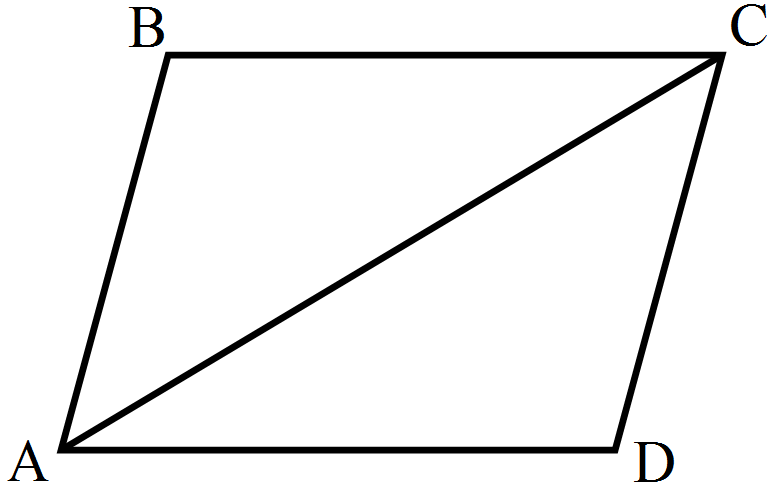
$i.$ Is $\triangle\text{ACD}\cong\triangle\text{CAB}?$
$ii.$ State the three pairs of matching parts used to answer $(i).$
$iii.$ Which angle is equal to $\angle\text{CAD}?$
$iv.$ Does it follow from $(iii)$ that $AD \| BC?$
Answer
View full question & answer→$i.$ Yes by $\text{SAS}$ condition of congruency, $\triangle\text{DCA}\cong\triangle\text{BAC}$.
$ii.$ We have used $\text{AB = DC, AC = CA}$ and $\angle\text{DCA}=\angle\text{BAC}$.
$iii. \angle\text{CAD}=\angle\text{ACB}$ since the two triangles are congruent.
$iv.$ Yes this follows from $AD \| BC$ as alternate angles are equal. lf alternate angles are equal the lines are parallel.
$ii.$ We have used $\text{AB = DC, AC = CA}$ and $\angle\text{DCA}=\angle\text{BAC}$.
$iii. \angle\text{CAD}=\angle\text{ACB}$ since the two triangles are congruent.
$iv.$ Yes this follows from $AD \| BC$ as alternate angles are equal. lf alternate angles are equal the lines are parallel.