MCQ 11 Mark
The weights of $9$ apples are $50, 60, 65, 62, 67, 70, 64, 45, 48$ grams Their mean weight is:
- A
$60.5$ gram
- B
$60$ gram
- ✓
$59$ gram
- D
$62$ gram
AnswerCorrect option: C. $59$ gram
Mean $ =\frac{ {\text{Total weight of 9 apples}}}{\text{total no of apples}}$
$\frac{50+60+65+62+67+70+64+45+48}{9} \Rightarrow\frac{531}{9} = 59$
View full question & answer→MCQ 21 Mark
Three years ago the average age of the family of $5$ members was $17$ years A baby having been born the average age of the family is the same today What is the baby today$?$
- A
$4$ years
- B
$3$ years
- ✓
$2$ years
- D
$1$ year
AnswerCorrect option: C. $2$ years
Given three year ago the average age of $5$ family member is $17$ year.
Then present age of six members family $= 17 × 6 = 102$ yearsAnd present age of five members
family $= (17 + 3) × 5 = 100$ years so age of baby to day $= 102 - 100 = 2$ years.
View full question & answer→MCQ 31 Mark
There are $7$ observations in the data and their mean is $11$. If each observation is multiplied by $2,$ then the mean of new observations is:
AnswerMean $= 11$
Number of observations $= 7$
Sum of observations $= 11 × 7 = 77$
Sum of new observations $= 2 × 77 = 154$
Mean of new observations $=\frac{154}{7}=22$
Hence, the correct option is $(c).$
View full question & answer→MCQ 41 Mark
If the mean of $x$ and $\frac{1}{\text{x}}$ is $M,$ then the mean of $x^2$ and $\frac{1}{\text{x}{^{2}}}$ is:
- A
$M^2$
- B
$2M^2+ 1$
- ✓
$2M^2 -1$
- D
$\frac{\text{m}^{2}}{4}$
AnswerCorrect option: C. $2M^2 -1$
C. $2M^2 -1$
View full question & answer→MCQ 51 Mark
If the range of $14, 12, 17, 18, 16, x$ is $20$ and $x > 0,$ the value of $x$ is:
AnswerRange is the difference between the smallest value and largest value of the data set.
given data set is $14, 12, 17, 18, 16, x$ and Range is given as $20$ In the given set the smallest value is $12$ and the largest value is $18.$
$\therefore$ the range is $18 - 12 = 6 \neq$ hence, $18$ is not the largest value. Variable $x$ is the largest value.
$\therefore$ range is $x - 12 = 20$
$\Rightarrow x = 20 + 12 = 32$
View full question & answer→MCQ 61 Mark
A bag contains $4$ green balls, $4$ red balls and $2$ blue balls. If a ball is drawn from the bag, the probability of getting neither green nor red ball is:
- A
$\frac{2}{5}$
- B
$\frac{1}{2}$
- C
$\frac{4}{5}$
- ✓
$\frac{1}{5}$
AnswerCorrect option: D. $\frac{1}{5}$
The probability of getting neither green nor red ball is equal to the probability of getting blue balls.
Number of blue balls $= 2$
Total number of balls $= 4 + 4 + 2 = 10$
Therefore
Probability of getting neither green nor red ball $=\frac{2}{10}=\frac{1}{5}$
Hence, the correct option is $(d).$
View full question & answer→MCQ 71 Mark
The range of observations $2, 3, 5, 9, 8, 7, 6, 5, 7, 4, 3$ is:
AnswerB. $7$
Solution:
Largest and Smallest term in the given observation are $x_l= 2$ and $x_m = 9$ hence Range of the given distribution is $= x_m - x_l = 7$
View full question & answer→MCQ 81 Mark
The mean of prime numbers between $20$ and $30$ is:
AnswerThe prime numbers between $20$ and $30$ are $23, 29$ mean of the data set is the average of values in the data set.
$\therefore$ the mean of the prime numbers is $\frac{23 + 9}{2} = \frac{52}{2} = {36}$
View full question & answer→MCQ 91 Mark
If the range of the scores $18, 13, 14, 42, 22, 26, x$ is $44\ (x > 0),$ then the sum of the digits of $x$ is:
AnswerRange $=$ largest score $-$ smallest score Smallest score $= 13$ and range is $44,$ so $x$ is must be largest score. sum of digits of $x$ is $5 + 7 = 12.$
View full question & answer→MCQ 101 Mark
In a school, only $2$ out of $5$ students can participate in a quiz. What is the chance that a student picked at random makes it to the competition?
- A
$20\%$
- ✓
$40\%$
- C
$50\%$
- D
$30\%$
AnswerCorrect option: B. $40\%$
Total number of outcomes = Total number of students $= 5$
Number of possible outcomes = Students participating in a quiz $= 2$
$\therefore\text{Probability}=\frac{\text{Number of possible outcomes}}{\text{Total number of outcomes}}=\frac{2}{5}$
to To find percentage, we havemultiply it by hundred $=\frac{2}{5}\times100=40\%$
View full question & answer→MCQ 111 Mark
For which state the average number of candidates selected over the years is the maximum$?$
- ✓
- B
$\text{H.P}$
- C
$\text{U.P}$
- D
AnswerThe average number of candidates selected over the given period for various states are:
For Delhi $= \frac{94 + 48 + 82 + 90 + 70}{5} = \frac{385}{5} = 76.8$
For $\text{U.P} \frac{78 + 85 + 48 + 70 + 80}{5} = \frac{361}{5} = 72.2$
For Punjab $\frac{85 + 70 + 65 + 84 + 60}{5} = \frac{364}{5} = 72.8$
For Haryana $\frac{75 + 75 + 55 + 60 + 75}{5} = \frac{340}{5} = 68$
Clearly, this average is maximum for Delhi.
View full question & answer→MCQ 121 Mark
If the mean of $6, 8, 5, x$ and $4$ is $7,$ then the value of $x$ is $.......$
AnswerGiven, mean $= 7$ and data is $6, 8, 5, x, 4$
$\therefore \frac{6+8+5+\text{x}+{4}}{{5}} = 7$
$\Rightarrow{\text{x+23}} = 35$
$\Rightarrow{\text{x}} = 12$
View full question & answer→MCQ 131 Mark
Find the mean of $22, 16, 19, 12, 26, 32, 87, 58:$
AnswerGiven observations $22, 16, 19, 12, 26, 32, 87, 58$ No. of observations 8 sum of observations.
$22 + 16 + 19 + 12 + 26 + 32 + 87 + 58 = 272$
Mean is given as $\frac{272}{8} = {34}$
View full question & answer→MCQ 141 Mark
From the given table, the number of students who got $60$ or more than $60$ marks is .......
|
Marks (class - interval)
|
No. of students
|
|
$30-40$
|
$12$
|
|
$40-50$
|
$13$
|
|
$50-60$
|
$04$
|
|
$60-70$
|
$15$
|
|
$70-80$
|
$06$
|
AnswerTotal Number of Students $= 12 + 13 + 4 + 15 + 6 = 50$ Number of Students who got $60$ or more than $60$ Marks $=$ Number of Students lying in $60 - 70$ and $70 - 80$ Interval $= 15 + 6 = 21$
View full question & answer→MCQ 151 Mark
The mean of five numbers is $4.$ If $1$ is added to each other, then the new mean is:
AnswerMean of five numbers $= 4$
Sum of five numbers $= 5 × 4 = 20$
$\text{New mean}=\frac{\text{Sum of observations}}{\text{Number of observations}}$
$=\frac{20+1+1+1+1+1}{5}$
$=\frac{25}{5}$
$=5$
Thus, the new mean is $5$
Hence, the correct option is $(b).$
View full question & answer→MCQ 161 Mark
Taras three bowling scores in a tournament were $167, 178,$ and $186.$ What was her average score for the tournament$?$
AnswerThree bowling scores of tournament are $167, 178$ and $186.$
average score will be $ = \frac{167+178+186}{3} = {177}$
View full question & answer→MCQ 171 Mark
The monthly fees for single rooms at $5$ colleges are $370, 310, 380, 340,$ and $310,$ respectively. What is the mean of these monthly fees?
AnswerThe mean is same like average. Add all and then divide by the number of colleges. Average
$ = \frac{(370+310+380+340+310)}{5} = \frac{1710}{5} = {342}$
$\therefore$ the mean of these monthly fees is $342.$
View full question & answer→MCQ 181 Mark
Find the $A.M$ of the series $1, 2, 4, 8, 16, .....,2n.$
- ✓
$\frac{{2}^{\text{n+1}}-{1}}{\text{n+1}}$
- B
$\frac{{2}^{\text{n+2}}-{1}}{\text{n}}$
- C
$\frac{{2}^{\text{n}}-{1}}{\text{n+1}}$
- D
$\frac{{2}^{\text{n}}-{1}}{\text{n}}$
AnswerCorrect option: A. $\frac{{2}^{\text{n+1}}-{1}}{\text{n+1}}$
Consider the given series. $1, 2, 4, 8, 16, ..... ,2n.$
$ A.M = \frac{1+2+4+8+16+ ..... +2{\text{n}}}{\text{n+1}}$
$ A.M =\frac{ {2}^{0}+{2}^{1}+{2}^{2}+{2}^{3}+{2}^{4}+ ...... +{2}{\text{n}}}{\text{n+1}}$
$A.M = \frac{ \frac{{1}({2}^{\text{n+1}} -1)}{2-1}}{\text{n+1}}$
$A.M = \frac{{2}^{\text{n+1}}-{1}}{\text{n+1}}$
View full question & answer→MCQ 191 Mark
The average of $11, 12, 13, 14$ and $x$ is $13.$ The value of $x$ is $........$
AnswerThe average of $11, 12, 13, 14$ and $x$ is $13$
$\therefore\frac{11+12+13+14+{\text{x}}}{{5}} = 13$
$\therefore 50+{\text{x}} = 65{\text{x}} = 15$
View full question & answer→MCQ 201 Mark
Let $x, y, z$ be three observations. The mean of these observation is:
- A
$\frac{\text{x }\times{\text { y }}\times{ \text{ z }}}{3}$
- ✓
$\frac{\text{x + y + z}}{3}$
- C
$\frac{\text{x - y - z}}{3}$
- D
$\frac{\text{x }\times{\text { y }}+{ \text{ z }}}{3}$
AnswerCorrect option: B. $\frac{\text{x + y + z}}{3}$
We know that mean $ = \frac{\text{sum of observation}}{\text{number of observation}}$
$\therefore$ mean $ = \frac{{\text{x + y + z}}}{3}$
View full question & answer→MCQ 211 Mark
Which of the following is correct$?$
- A
Mode $= 2$ Median $- 3$ Mean
- B
Mode $= 3$ Median $-$ Mean
- C
Mode $-$ Mean $= 3 ($Median $-$ Mean$)$
- ✓
Mode $-$ Median $=$ Median $-$ Mean
AnswerCorrect option: D. Mode $-$ Median $=$ Median $-$ Mean
The relation between Mean, Median and Mode is Mode $-$ Mean $= 3 ($Median $-$ Mean$).$
Hence, the correct option is $(d).$
View full question & answer→MCQ 221 Mark
The numbers $3, 5, 6$ and $4$ have frequencies of $x, x + 2, x - 8$ and $x + 6$ respectively If their mean is $4$ then the value of $x$ is:
Answer$\Rightarrow 16x = 18x - 14$
$\Rightarrow x = 7$
View full question & answer→MCQ 231 Mark
In a bundle of $20$ sticks, there are $4$ sticks each of length $1\ m\ 50\ cm,$ $10$ sticks each of length $2\ m$ and each of the rest of length $1\ m.$ What is the average length of the sticks in the bundle$?$
- A
$1.2\ m$
- B
$1.5\ m$
- ✓
$1.6\ m$
- D
$1.8\ m$
AnswerCorrect option: C. $1.6\ m$
$ = \frac{4\times1.5+10\times2+6\times1}{20}$
$ = \frac{32}{20} = {1.6}{\text{m}}$
View full question & answer→MCQ 241 Mark
What is the average amount of interest per year which the company had to pay during this period$?$
- A
$Rs. 32.43$ lakhs
- B
$Rs. 33.72$ lakhs
- C
$Rs. 34.18$ lakhs
- ✓
$Rs. 36.66$ lakhs
AnswerCorrect option: D. $Rs. 36.66$ lakhs
Average amount of interest paid by the Company during the given period.
$ = \frac{\text{ Rs. } \big[23.4 + 32.5 + 41.6 + 36.4 + 49.4\big]}{5} \text{lakhs}$
$ =\frac{ \text{ Rs. }\big[183.3\big]}{5}\text{lakhs}$
$= Rs. 36.66$ lakhs
View full question & answer→MCQ 251 Mark
$........$ may or may not be the appropriate measure of central tendency:
Answer Consider the example of the marks obtained by $5$ studentsin class: $2, 3, 4, 98, 100.$
Now the average marks of class are $41.$
$4$ but does this mean that all class has passed.
hence, the average or mean may not represent the central tendency.
View full question & answer→MCQ 261 Mark
The mean of a data is $15$ and the sum of the observations is $195.$ The number of observations is:
Answer Mean of data $= 15$
Sum of observations $= 195$
$\text{Mean}=\frac{\text{Sum of observations}}{\text{Number of observations(n)}}$
$\Rightarrow15=\frac{195}{\text{n}}$
$\Rightarrow\text{n}=\frac{195}{15}=13$
Thus, the number of observations is $13$
Hence, the correct option is $(a).$
View full question & answer→MCQ 271 Mark
If the mean of $5, 7, x, 10, 5$ and $7$ is $7,$ then $x =$
Answer Here, the observations are $5, 7, x, 10, 5$ and $7$
$\text{Mean}=\frac{\text{Sum of observations}}{\text{Number of observations}}$
$\Rightarrow7=\frac{5+7+\text{x}+10+5+7}{6}$
$\Rightarrow\text{x}+34=42$
$\Rightarrow\text{x}=42-34=8$
Hence, the correct option is $(c).$
View full question & answer→MCQ 281 Mark
What is the average of squares of consecutive odd numbers between $1$ and $13?$
Answer The consecutive odd numbers from $1$ to $13 = 3, 5, 7, 9, 11$
thus required average.
$\frac{ = {3}^{2} + {5}^{2} +{7}^{2}+{9}^{2}+{11}^{2}} {5}$
$ = \frac{9+25+49+81+121}{5} = \frac{285}{5} ={57}$
View full question & answer→MCQ 291 Mark
There are $2$ aces in each of the given set of cards placed face down. From which set are you certain to pick the two aces in the first go?
Answer
From third set, we are certain to pick the two aces in the first go because it has only $2$ cards and it is given that every set has $2$ aces. View full question & answer→MCQ 301 Mark
Find the $A.M.$ of numbers $7, 6, 5, 9, 8, 0, 7:$
Answer$A.M$ of numbers $ = \frac{\text{sum of these number }}{\text{their number}}$
$ = \frac{7 + 6 + 5 + 3 + 8 + 6 + 7}{7} = \frac{42}{7} = {6}$
View full question & answer→MCQ 311 Mark
The mean for the data $6, 7, 10, 12, 13, 4, 8, 12$ is:
AnswerA. $9$
Solution:
We have, $x_i = 6, 7, 10, 12, 13, 4, 8, 12$
$\therefore {\text{mean}} = \frac{{\text{sum of all the observations}}}{\text{total number of observations}}$
$ = \frac{6 + 7 + 10 + 12 + 13 + 4 + 8 + 12}{8}$
$ = \frac{72}{8} = {9}$
View full question & answer→MCQ 321 Mark
The arithmetic mean of the set of observations $1, 2, 3, ..... n$ is:
AnswerCorrect option: A. $\frac{\text{n+1}}{2}$
Since, Mean $ = {\frac{1+2+3+ ...... +{\text{n}}}{\text{n}}}$
$\Rightarrow$ Mean $= \frac{[\text{n}({\text{n+1}})]}{2}$
$ = [{\frac{1+2+3+ ...... +{\text{n}}}{\text{n}}}= \frac{\text{n}({\text{n+1}})}{2}]$
$\Rightarrow$ Mean $= \frac{\text{n}({\text{n+1}})}{2{\text{n}}}$
$\Rightarrow$ Mean $= \frac{\text{n+1}}{2}$
View full question & answer→MCQ 331 Mark
If the mean of observations $x, x + 2, x + 4, x + 6$ and $x + 8$ is $11,$ find the value of $x:$
AnswerMean of observations $x, x + 2, x + 4, x + 6, x + 8$ is $11$
Mean $ =\frac{ \text{Sum}}{\text{Number of observation}}$
Mean $ = \frac{\text{x+x+2+x+4+x+6+x+8}}{5} = {11}$
$\frac{\text{5x+20}}{5} = {11}$
$x + 4 = 11$
$x = 7$
View full question & answer→MCQ 341 Mark
Let $x$ be the mean of $x_1,$ $x_2, ... ,x_n$ and $y$ the mean of . If $z$ is the mean of $x_1,$ , $x_2,$ , ... ,$x_n,$ $y_1,$ $y_2,$, ... ,$y_n,$ then $z$ is equal to:
AnswerCorrect option: B. $\frac{\text{x + y}}{2}$
$x$ is the mean of $x_1,$ , $x_2,$ , ... ,$x_n,$ then
$\text{x} = \frac{\text{x}_{1}+\text{x}_{2} + ......+\text{x}_{\text{n}}}{\text{n}}$
$y$ is the mean of $y_1,$ $y_2,$ .... ,$y_n,$ then
$ \text{y} = \frac{\text{y}_{1}+\text{y}_{2} + ......+\text{y}_{\text{n}}}{\text{n}}$
$z$ is the mean of $x_1,$ , $x_2,$ , ... ,$x_n,$ $y_1,$, $y_2,$ .... ,$y_n,$
$\text{z} =\frac{ \text{x}_{1}+\text{x}_{2} + ....+\text{x}_{\text{n}}+\text{y}_{1}+\text{y}_{2}+....+\text{y}_{\text{n}}}{{2}{\text{n}}}$
$\text{z} = \frac{\text{x+y}}{2}$
View full question & answer→MCQ 351 Mark
The mean of first $8$ natural numbers is:
AnswerThe first natural numbers are $1, 2, 3, 4, 5, 6, 7, 8$
$\frac{ 1 + 2 + 3 + 4 + 5 + 6 + 7 + 8 } {8} = \frac{36}{8} = 4.5 $
View full question & answer→MCQ 361 Mark
The mean of $x, x + 3, x + 6, x + 9$ and $x + 12$ is:
- ✓
$x + 6$
- B
$x + 3$
- C
$x + 9$
- D
$x + 12$
AnswerCorrect option: A. $x + 6$
By definition,
$\text{Average} =\frac{ \text{x}+(\text{x+3})+({\text{x+6}})+({\text{x+9}})+({\text{x+12}})}{5}$
$\frac{{5}+{30}}{5} = {\text{x+6}}$
View full question & answer→MCQ 371 Mark
The average of eight numbers is $38.4$ and the average of seven of them is $39.2$ What is the eighth number$?$
- A
$0.8$
- B
$32.8$
- ✓
$34.8$
- D
$33.8$
AnswerCorrect option: C. $34.8$
Sum of eight numbers $= 38.4 \times 8 = 307.2$
$\therefore$ Total sum = Average \times Number of items
sum of seven numbers $= 39.2 \times 7 = 274.4$
$\therefore$ Eight number $= 307.2 - 274.4 = 32.8$
View full question & answer→MCQ 381 Mark
The arithmetic mean of the squares of first $n$ natural numbers is:
AnswerCorrect option: B. $\frac{{\text{(n+1}}) ({2}{\text{n+1})}}{6}$
Arithmetic mean of squares of first $n$ natural number is,
$ =\frac{ {1}^{2}+{2}^{2}+{3}^{2}+{4}^{2} +.......+{\text{n}}^{2}}{\text{n}}$
$ = \frac{\sum{\text{n}}^{2}}{\text{n}}$
$ = \frac{\text{n}({\text{n+1}})({2}{\text{n+1})}}{{6}{\text{n}}}$
$ =\frac{ ({\text{n+1}})({2}{\text{n+1}})}{6}$
View full question & answer→MCQ 391 Mark
Which of the following is not changed for the observations?
$31, 48, 50, 60, 25, 8, 3x, 26, 32: ($Where $x$ lies between $10$ and $15)$
Answer If $x = 10$ then the observation $3x = 30$
and if $x = 15$ then the observation $3x = 45$
with values between $30$ to $45,$ the Mean, Median and Quartile Deviation will change.
but the range will not change as the highest value among the set of observations $48$
and least value is $8$ and does not depend on the value of $x$
View full question & answer→MCQ 401 Mark
Which of the following has the same mean, median and mode$?$
- A
$6, 2, 5, 4, 3, 4, 1$
- B
$4, 2, 2, 1, 3, 2, 3$
- C
$2, 3, 7, 3, 8, 3, 2$
- ✓
$4, 3, 4, 3, 4, 6, 4$
AnswerCorrect option: D. $4, 3, 4, 3, 4, 6, 4$
$(a).$ Data $($in ascending order$) \rightarrow 1, 2, 3, 4, 4, 5, 6$
Here, $n = 7 ($odd$)$
Median $=$ Value of $\Big(\frac{\text{n+1}}{2}\Big)^\text{th}$ observation $=$ Value of $\Big(\frac{8}{2}\Big)^\text{th}$ observation $= 4$
$\text{Mean}=\frac{\text{Sum of observation}}{\text{n}}$
$=\frac{1+2+3+4+4+5+6}{7}$
$=\frac{25}{7}$
$=3.57$
Mode $=$ Most frequent observation $= 4$
Hence,
Mean $\neq$ Median $=$ Mode
$(b).$ Data $($in ascending order$) \rightarrow 1, 2, 2, 2, 3, 3, 4$
Here, $n = 7 ($odd$)$
Median $=$ Value of $\Big(\frac{\text{n+1}}{2}\Big)^\text{th}$ observation $=$ Value of $\Big(\frac{7+1}{2}\Big)^\text{th}$ observation $= 2$
$\text{Mean}=\frac{\text{Sum of observation}}{\text{n}}$
$=\frac{1+2+2+2+3+3+4}{7}$
$=\frac{17}{7}$
$=2.428$
Mode $=$ Most frequent observation $= 2$
Hence,
Mean $\neq$ Median $=$ Mode
$(c).$ Data $($in ascending order$) \rightarrow 2, 2, 3, 3, 3, 7, 8$
Here, $n = 7 ($odd$)$
Median $=$ Value of $\Big(\frac{\text{n+1}}{2}\Big)^\text{th}$ observation $=$ Value of $\Big(\frac{7+1}{2}\Big)^\text{th}$ observation $= 3$
$\text{Mean}=\frac{\text{Sum of observation}}{\text{n}}$
$=\frac{2+2+3+3+3+7+8}{7}$
$=\frac{28}{7}$
$=4$
Hence,
Mean $\neq$ Median $=$ Mode
$(d).$ Data $($in ascending order$) \rightarrow 3, 3, 4, 4, 4, 4, 6$
Here, $n = 7 ($odd$)$
Median $=$ Value of $\Big(\frac{\text{n+1}}{2}\Big)^\text{th}$ observation $=$ Value of $\Big(\frac{7+1}{2}\Big)^\text{th}$ observation $= 4$
$\text{Mean}=\frac{\text{Sum of observation}}{\text{n}}$
$=\frac{3+3+4+4+4+4+6}{7}$
$=\frac{28}{7}$
$=4$
Hence,
Mean $=$ Mode $=$ Median View full question & answer→MCQ 411 Mark
The mean of $96, 104, 121, 134, 142, 149, 153$ and $161$ is $132.5$
If true then enter $1$ and if false then enter $0:$
Answer The given observations are: $96, 104, 121, 134, 142, 149, 153$ and $161$
Mean $ = \frac{\text{Sum}}{\text{Total}}$
Mean $ = \frac{96+104+121+134+142+149+153+161}{8}$
Mean $= 132.5$
View full question & answer→MCQ 421 Mark
The Arithmetic mean of $10$ number is $-7.$ If 5 is added to every number, then the new Arithmetic mean is:
Answermean $ = \frac{\text{Sum}}{\text{Total}} = {-7}\frac{\text{Sum}}{10}$
$= −7$ sum$= -705$ is added to every $10$ no. mean $ = \frac{-70 + 50}{10} $
$= -2$ since Total added $= 50$
View full question & answer→MCQ 431 Mark
The mean of $100$ items was found to be $30.$ If two observation were wrongly taken as $32$ and $12$ instead of $23$ and $11$, find the correct mean:
- A
$29.4$
- B
$29.5$
- C
$29.8$
- ✓
$29.9$
AnswerCorrect option: D. $29.9$
The total no. of observations are $100$ The mean of those observations are $30$
So The sum of observations is $30 \times 100 = 3000$ the wrong observations are $32$ and $12$ those are to be subtracted from sum of observations
So, $3000 - 32 - 12 = 2956$ the correct observations are $23$ and $11$ those are to be added
so, $2956 + 23 + 11 = 2990$ the mean is given by.
$ = \frac{2990}{100} = {29.9}$
View full question & answer→MCQ 441 Mark
The mean of first six natural numbers is:
Answer First six natural numbers are: $1, 2, 3, 4, 5, 6$
$\text{mean} = \frac{\text{sum}}{\text{number of observations}} = \frac{{ 1 }+ { 2 }+{ 3 } +{ 4 }+{ 5 }+{ 6 }} {{6}} = 3.5$
View full question & answer→MCQ 451 Mark
Find the mean of $36, 40, 32, 48, 44:$
AnswerNo. of observations 5 sum of observations $36 + 40 + 32 + 48 + 44 = 200$ mean $\frac{200}{5} = {40}$
View full question & answer→MCQ 461 Mark
The average maximum temperature for $7$ days from the $12th$ September to $18th$ September is $35^\circ C$ and that for $7$ days from $13th$ to $19th$ September is $34^\circ C.$ From this we can conclude that:
- A
Maximum temperature on $19th$ is $1^\circ C$ less than that for $12th$ September
- B
Maximum temperature on $12th$ is $1^\circ C$ less than that for $19th$ September
- ✓
Maximum temperature on $19th$ is $7^\circ C$ less than that for $12th$ September
- D
AnswerCorrect option: C. Maximum temperature on $19th$ is $7^\circ C$ less than that for $12th$ September
The average maximum temp from $12th$ sept to $18th$ sept is $35$ and The average maximum temp from $13th$ sept to $19th$ sept is $34$ then total temp from $12th$ sept to $18th$ sept $= 35 \times 7 = 245$ and total temp from $13th$ sept to $19th$ sept $= 34 \times 7 = 238$ then diff $= 245 - 238 = 7$ so Maximum temperature on $12th$ is $7^\circ $ less than that for $19th$ September. $77$
View full question & answer→MCQ 471 Mark
A boat costs $x$ dollars, and this cost is to be shared equally by a group of people. In terms of $x,$ how many dollars less will each person contribute if there are $4$ people in the group instead of $3?$
AnswerCorrect option: A. $\frac{\text{x}}{12}$
If there are three people each pays $\frac{\text{x}}{3}$
if there are four people each pays $\frac{\text{x}}{4}$
the difference $ = \frac{\text{x}}{3} - \frac{\text{x}}{4} = \frac{{4}{\text{x-3x}}}{12} = \frac{\text{x}}{12} $
View full question & answer→MCQ 481 Mark
The mean of three numbers is $40.$ All the three numbers are different natural numbers. If lowest is $19,$ what could be highest possible number of remaining two numbers$?$
AnswerMean of three numbers $= 40$ and lowest number $= 19...[$given$]$
Let the three observations be $19, x$ and $y,$ respectively.
$\text{Mean}=\frac{\text{Sum of all observations}}{\text{Total number of observations}}$
$\Rightarrow40=\frac{19+\text{x}+\text{y}}{3} [ \because$ mean $= 40,$ given$]$
$\Rightarrow3\times40=19+\text{x}+\text{y}$
$\Rightarrow120=19+\text{x}+\text{y}$
$\Rightarrow\text{x}+\text{y}=120-19$
$\Rightarrow\text{x}+\text{y}=101\ ...(\text{i})$
Since, $19$ is the lowest observation.
Hence, for highest possible value of remaining two numbers, one must be $20.$
Let $x = 20$
From Eq$.(i),$ we get
$20 + y = 101$
$⇒ y = 101 - 20$
$⇒ y = 81$
View full question & answer→MCQ 491 Mark
The mean of $33, 53, 32, 35, 47$ is:
- ✓
$40$
- B
$56$
- C
$55$
- D
$6^6 -6!$
AnswerGiven observations $33, 53, 32, 35, 47$ no. of observations is $5$ sum of observations is
$33 + 53 + 32 + 35 + 47 = 200$ mean is $\frac{200}{5} = {40}$
View full question & answer→MCQ 501 Mark
Find the mean of the data $10, 15, 17, 19, 20$ and $21:$
AnswerData observations are$: 10, 15, 17, 19, 20$ and $21$
mean $ = \frac{\text{Sum}}{\text{Number}}$
mean $ = \frac {10+15+17+19+20+21}{6}$
mean $ = \frac{102}{6} = 17$
Since, the number of observations are even, the median will be the mean of the two middle observations:
median $ = \frac{{3}^{\text{rd}} + {4}^{\text{th}}}{2}$
median $= \frac{{17} +{19}}{2}$
median $= {18}$
View full question & answer→MCQ 511 Mark
The average age of husband, wife and their child $3$ years ago was $27$ years and that of wife and the child $5$ years ago was $20$ years. The present age of the husband is:
- A
$35$ years
- ✓
$40$ years
- C
$50$ years
- D
AnswerCorrect option: B. $40$ years
Sum of the present ages of husband, wife and child $= (27 \times 3 + 3 \times 3)$ years $= 90$ years.
sum of the present ages of wife and child $= (20 \times 2 + 5 \times 2)$ years $= 50$ years.
$\therefore$ husbands present age $= (90 - 50) = 40$ years.
View full question & answer→MCQ 521 Mark
If the average marks of three batches of $55, 60$ and $45,$ students respectively is $50, 55$ and $60,$ then what are the average marks of all the students?
- A
$43.5879$
- B
$65.7824$
- ✓
$54.6875$
- D
$34.2278$
AnswerCorrect option: C. $54.6875$
Total marks of first batch $= 55 \times 50 = 2750$
total marks of second batch $= 60 \times 55 = 3300$
total marks of third batch $= 45 \times 60 = 2700$
total number of students in three batch $= 55 + 60 + 45 = 160$
$\therefore$ average marks of all the students $ = \frac{2750+3300+2700}{160} = \frac{8750}{160} = 54.6875$
View full question & answer→MCQ 531 Mark
The range of the data $: 21, 6, 17, 18, 12, 8, 4, 13$ is:
AnswerHere,
Highest observation $= 21$
Lowest observation $= 4$
Range = Highest observation - Lowest observation
$= 21 - 4 = 17$
View full question & answer→MCQ 541 Mark
There are $10$ cards numbered from $1$ to $10.$ A card is drawn randomly. The probability of getting an even numbered card is:
- A
$\frac{1}{10}$
- B
$\frac{1}{5}$
- ✓
$\frac{1}{2}$
- D
$\frac{2}{5}$
AnswerCorrect option: C. $\frac{1}{2}$
The number on the cards are $1, 2, 3, 4, 5, 6, 7, 8, 9, 10,$
The even numbers on the cards are $2, 4, 6, 8, 10,$
$\therefore $ Probability of getting an even numbered card $=\frac{\text{Number of even numbered card}}{\text{Number of cards with numbers from 1 to 10}}=\frac{5}{10}=\frac{1}{2}$
Hence, the correct option is $(c).$
View full question & answer→MCQ 551 Mark
The average of $0.3, 0.03$ and $0.003$ is $......$
AnswerCorrect option: C. $0.111$
$\text{Average} = \frac{0.3+0.03+0.003}{3}$
$ = \frac{0.333}{3} = 0.111$
View full question & answer→MCQ 561 Mark
The mean of $10$ observations is $15.$ If one observation $15$ is added, then the new mean is:
AnswerSum of $10$ observations $= 10 × 15 = 150$
Sum of $11$ observations $= 150 + 15 = 165$
Number observations $= 11$
Mean of $11$ observations $= \frac{165}{11}=15$
Thus, the new mean is $15$
Hence, the correct option is $(d).$
View full question & answer→MCQ 571 Mark
The mean of the distribution, in which the values of $X$ are $1, 2 ,...,$ n the frequency of each being unity is:
AnswerCorrect option: C. $\frac{(\text{n+1})}{2}$
Required mean $ = \frac{1+2+3+ ......... +}{\text{n}}$
$ = \frac{\text{n}}{2} = \frac{(2+(\text{n-1}).(1)}{2} = \frac{{\text{n}}+{1}}{2}$
View full question & answer→MCQ 581 Mark
AnswerCorrect option: D. Computed by summing all the data values and dividing the sum by the number of items
$\text{mean} = \frac{\text{Total of sample values}}{\text{sample size}}$
View full question & answer→MCQ 591 Mark
A dice is rolled. The probability of getting an even prime is:
- ✓
$\frac{1}{6}$
- B
$\frac{1}{3}$
- C
$\frac{1}{2}$
- D
$\frac{5}{6}$
AnswerCorrect option: A. $\frac{1}{6}$
The possible numbers on a dice are $1, 2, 3, 4, 5, 6.$
There is only one even prime number which is $2.$
$\therefore$ Probability of getting an even prime $ =\frac{\text{Number of even prime numbers}}{\text{Number of all possible outcomes on the dice}}=\frac{1}{6}$
Hence, the correct option is $(a).$
View full question & answer→MCQ 601 Mark
The median of the data $9, 12, 11, 10, 8, 9, 11$ is:
Answer Arranging the given data in increasing order, we get
$8, 9, 9, 10, 11, 11, 12$
As the number of observations is odd $(7),$ the median is the middle term which is $10$
Hence, the correct option is $(a).$
View full question & answer→MCQ 611 Mark
The average (arithmetic mean) of a particular set of seven numbers is $12.$ When one of the numbers is replaced by the number $6,$ the average of the set increases to $15.$ What is the number that was replaced$?$
AnswerThe average of a set of numbers is the sum of the numbers divided by the number of numbers
i.e. average $ = \frac{\text{Sum of all 7 number}}{\text{No. of number(N)}}$
Sum of all $7$ numbers $=$ average $ ×N = 12 × 7 = 84$
Similarly, the sum of the new set of numbers is $= 15 × 7 = 105$
Now, suppose that the seven numbers are $a, b, c, d, e, f, g$ and the g gets replaced by $6.$
Then we have, $a + b + c + d + e + f + g = 84 ....... (1)$
$⇒ a + b + c + d + e + f + 6 = 105$
$⇒ a + b + c + d + e + f = 99 ....... (2)$
Plugging the vlaue from $(2)$ in $(1),$ we get $99 + g = 84 g = -15$
$\therefore$ the number that was replaced was $-15.$
View full question & answer→MCQ 621 Mark
$M= 1, 2, 3, 4, 5, 6, 7.$
Each number in set $N$ is generated by dividing each number in set $M$ by $2.$ Calculate the arithmetic mean of numbers in $N:$
- A
$1$
- B
$\frac{3}{2}$
- C
$\frac{7}{4}$
- ✓
$2$
AnswerGiven,
$M = 1, 2, 3, 4, 5, 6, 7$ Each number in set $N$ is generated by dividing each number in set M by $2$
$N = 0.5, 1, 1.5, 2, 2.5, 3, 3.5$ Arithmetic mean of numbers of set N is
$ = \frac{0.5+1+1.5+2+2.5+3+3.5}{7} = \frac{14}{7} = {2}$
View full question & answer→MCQ 631 Mark
The mean of $x, y, z$ is y, then $x + z =$
Answer The question tells us that the mean of $x, y$ and $z$ is $y.$
$\text{i.e.} = \frac{\text{x+y+z}}{3} = \text{y}$
$\text{i.e.} = \text{x+z} = 2\text{y}$
View full question & answer→MCQ 641 Mark
The class mark of the class $90 - 120$ is:
Answer$\text{class marks} = \frac{\text{upperlimit + lower limit}}{2}\Rightarrow \frac{120+90}{2} = \frac{210}{2} = {105}$
View full question & answer→MCQ 651 Mark
The weights of $9$ apples are $50, 60, 65, 62, 67, 70, 64, 45, 48$ grams. Their mean weight is:
- A
$60.5$ gram
- B
$60$ gram
- ✓
$59$ gram
- D
$62$ gram
AnswerCorrect option: C. $59$ gram
Given weights of $9$ apples are $50, 60, 65, 62, 67, 70, 64, 45, 48$ grams.
then total weight of $9$ apples $= 50 + 60 + 65 + 62 + 67 + 70 + 64 + 45 + 48 = 531$
then mean $ = \frac{531}{9} = {59}{\text{ gram}}$
View full question & answer→MCQ 661 Mark
The mean of first seven even natural numbers is:
AnswerThe first seven even natural numbers are: $2, 4, 6, 8, 10, 12, 14$
$\text{Mean}=\frac{\text{Sum of observations}}{\text{Number of observations}}$
$=\frac{2+4+6+8+10+12+14}{7}$
$=\frac{56}{7}$
$=8$
Thus, the mean of first seven even natural number is $8$
Hence, the correct option is $(b).$
View full question & answer→MCQ 671 Mark
The median of $11$ observations is $10.$ The number of possible observations in the data which are less than $10$ is:
Answer Median divides the data into two equal parts. Since, the number of observations is $11,$ so after arranging in increasing or decreasing order, the number of observations to the left of the median is five.
Thus, the required number of observations is $5$
Hence, the correct option is $(a).$
View full question & answer→MCQ 681 Mark
Khilona earned scores of $97, 73$ and $88$ respectively in her first three examinations. If she scored $80$ in the fourth examination, then her average score will be:
- A
Increased by $1$
- B
Increased by $1.5$
- C
Decreased by $1$
- ✓
Decreased by $1.5$
AnswerCorrect option: D. Decreased by $1.5$
$\text{Average score}=\frac{\text{Sum of scores in all exams}}{\text{Total number of exams}}$
$\therefore$ Average score in first three examination $=\frac{97+73+88}{3}=\frac{258}{3}=86$
Also, average score in four examination $=\frac{97+73+88+80}{4}=\frac{338}{4}=84.5$
Hence, average score is decreased by $(86 - 84.5) = 1.5$
View full question & answer→MCQ 691 Mark
The marks obtained by a student of class $X$ in first and second unit test are $35$ and $21$ respectively. Find the minimum marks he should get in the annual examination to have an average of at least $30$ marks:
- A
$x ≤ 34$
- ✓
$x ≥ 34$
- C
$x > 34$
- D
$x < 34$
AnswerCorrect option: B. $x ≥ 34$
Let the marks for annual marks be $x.$
Given: - Marks of first unit test $= 35$
Marks of second unit test $= 21$ average of $3$ marks $= 30$
$\Rightarrow \frac{{\text{x}} + { 35 } +{ 21 }} {3} = {30}$
$\Rightarrow x + 35 + 21 = 90$
$\Rightarrow x + 56$
$\Rightarrow x = 34$ Marks he should get is $x = 34$
View full question & answer→MCQ 701 Mark
The heights (in cm) of $8$ girls of a class are $140, 142, 135, 133, 137, 150, 148$ and $138$ respectively. Find the mean height of these girls:
- A
$137.375$
- B
$139.375$
- ✓
$140.375$
- D
$143.375$
AnswerCorrect option: C. $140.375$
Mean is the average of the values of the data set. Given the height of the girls are
$140, 142, 135, 133, 137, 150, 148, 138$ The total number of girls is $8$
$\therefore$ mean $ = \frac{140+142+135+133+137+150+148+138}{8}$
$\Rightarrow $ mean $ = \frac{1123}{8} = {140.375}$
View full question & answer→MCQ 711 Mark
When $10$ is subtracted from each of the given observation, the mean is reduced by $60\%.$ If $5$ is added to all the given observation, then what will be the mean$?$
AnswerLet the mean be $\bar{\text{x}}$ According to the question,
$\bar{\text{x}} - {10} = {60}{\text{%}} \text{ of } \bar{\text{ x}}$
$\bar{\text{x}} = {25}$
Now, each observation is increased by $5.$
$\therefore$ New mean $ = \bar{\text{x}}+5$
$= 25 + 5 = 30.$
View full question & answer→MCQ 721 Mark
The number of trees in different parks of a city are $33, 38, 48, 33, 34, 34, 33$ and $24.$ The mode of this data is:
AnswerWe have, $33, 38, 48, 33, 34, 34, 33$ and $24.$
On arranging the data in ascending order, we get $24, 33, 33, 33, 34, 34, 38$ and $48.$
Here, $33$ occurs more frequently, i.e. $3$ times.
Mode of data $= 33$
Note: Mode is the observation that occurs most frequently in the data.
View full question & answer→MCQ 731 Mark
The mean of ten items is $x$ and if each item is increased by $4,$ then its mean will be $........$
- ✓
$x + 4$
- B
$4x$
- C
$10x$
- D
$10 + x$
AnswerCorrect option: A. $x + 4$
We know $x$
Thus $= 10x$ If each term is increased by $4,$ new sum $=$ sum $+ 10 × 4$
new sum $= 10x + 40$ New mean
$ = \frac{{10}{\text{x}}+{40}}{10}$ new mean $= x + 4$
View full question & answer→MCQ 741 Mark
The mean of the following natural numbers $1, 2, 3 ...... 10$ is:
Answer Mean $ = \frac{1 + 2 + 3 + 4 + 5 + 6 + 7 + 8 + 9 + 10}{10} = {5.5}$
View full question & answer→MCQ 751 Mark
If the average of $3, 4,$ and $x$ is $2,$ then find $x:$
AnswerGiven, the average of $3, 4,$ and $x$ is $2$
we have to find $x$
$\Rightarrow \frac{{3+4+}{\text{x}}}{3} = 2$
$\Rightarrow{7}+{\text{x}} = {6}$
$\text{x} = -{1}$
View full question & answer→MCQ 761 Mark
If the mode of $22, 21, 23, 24, 21, 20, 23, 26, x$ and $26$ is $23,$ then $x =$
AnswerArranging the numbers $22, 21, 23, 24, 21, 20, 23, 26$ and $26$ in increasing order, we get
$20, 21, 21, 22, 23, 23, 24, 26, 26$
Here, the frequencies $21, 23$ and $24$ is $2$
So, for $23$ to be the mode of the data, the value of $x$ should be $23$
Hence, the correct option is $(c).$
View full question & answer→MCQ 771 Mark
The mean of first five prime numbers is:
AnswerThe first five prime numbers are: $2, 3, 5, 7, 11$
$\text{Mean}=\frac{\text{Sum of observations}}{\text{Number of observations}}$
$=\frac{2+3+5+7+11}{5}$
$=\frac{28}{5}$
$=5.6$
Thus, the mean of first five prime number is $5.6$
Hence, the correct option is $(a).$
View full question & answer→MCQ 781 Mark
The mean of first six multiples of $5$ is:
- A
$3.5$
- B
$18.5$
- ✓
$17.5$
- D
$30$
AnswerCorrect option: C. $17.5$
The first six multiples of $5$ are: $5, 10, 15, 20, 25, 30$
$\text{Mean}=\frac{\text{Sum of observations}}{\text{Number of observations}}$
$=\frac{5+10+15+20+25+30}{6}$
$=\frac{105}{6}$
$=17.5$
Thus, the mean of first six multiples of $5$ is $17.5$
Hence, the correct option is $(c).$
View full question & answer→MCQ 791 Mark
$2, 10, m, 12, 4$
A group of $5$ integers is shown above. If the average (arithmetic mean) of the numbers is equal to $m,$ find the value of $m:$
Answer We know the average of a group of numbers is the sum of the numbers divided by the number of numbers,
we can make an equation:
$\Rightarrow \frac{{2+10+}{\text{m}}{+12+4}}{5} = {\text{m}}$
$\Rightarrow{28}+\text{m} = {5}{\text{m}}$
$\Rightarrow {\text{m}} - {5}{\text{m}} = -{28}$
$\Rightarrow -{4}{\text{m}} = -{28}$
$\Rightarrow{\text{m}} = {7}$
View full question & answer→MCQ 801 Mark
If the mean of $x$ and $\frac{1}{\text{x}}$ is $M,$ then the mean of $x^2$ and $\frac{1}{\text{x}^{2}}$ is:
- A
$m^2$
- B
$\frac{\text{m}^{2}}{4}$
- ✓
$2m^2 - 1$
- D
$2m^2+ 1$
AnswerCorrect option: C. $2m^2 - 1$
C. $2m^2 -1$
View full question & answer→MCQ 811 Mark
The mean of $a, b, c, d$ and $e$ is $28.$ If the mean of $a, c$ and $e$ is $24,$ what is the mean of $b$ and $d?$
Answer$\frac{{\text{a}} + {\text{b}} + {\text{c}} + {\text{d}} + {\text{e}}}{5} = {28}$
$\frac{{\text{a}} + {\text{c}} + {\text{e}}}{3} = 24$
$\frac{{\text{b + }}{\text{d}}} {2} = ?\Rightarrow\text{a} + {\text{b}} + {\text{c}} + {\text{d}}+{\text{e}} = {140}$
$ = \text{a} + {\text{c}}+ {\text{e}} = 72$
$\Rightarrow\text{b} + {\text{d}} = {68}$
$\therefore \frac{{\text{b}} + {\text{d}}}{2} = {34}$
View full question & answer→MCQ 821 Mark
The mean of the first $n$ natural numbers is:
AnswerCorrect option: B. $\frac{\text{n+1}}{2}$
We know that sum of first $n$ natural numbers is $\frac{\text{n}({\text{n+1})}}{2}$
So mean of the first $n$ natural numbers
$ = \frac{\text{sum of natural numbers}}{\text{number}} $
$=\frac{ \text{n}({\text{n}}+{1})}{{2}{\text{n}}} $
$=\frac{ ({\text{n}}+{1})}{{2}}$
View full question & answer→MCQ 831 Mark
The mean of $5$ numbers is $20.$ If one number is excluded their mean is $15.$ Then the excluded number is:
Answer$\frac{\text{Sum}}{\text{Total}} = {20}$
$\frac{\text{Sum}}{5}= {20}$
Sum $= 100$
Let no. excluded be $x$
$\frac{\text{New sum}}{\text{Total}} = {15}$
New Sum $= 60$
Excluded $N = 100 - 60 = 40$
View full question & answer→MCQ 841 Mark
Mean of $14, 17, 11, 13, 26, 21, 31$ and $19:$
AnswerSum of number $= 152$
Required mean $ = \frac{152}{8} = {19}$
View full question & answer→MCQ 851 Mark
In a monthly test the marks obtained in mathematics by $16$ students of a class are as follows
$0, 0, 2, 2, 3, 3, 3, 4, 5, 5, 5, 5, 6, 6, 7, 8$
The arithmetic mean of the marks obtained is:
AnswerSince mean $ = \frac{0+0+2+2+3+3+3+4+5+5+5+5+6+6+7+8+}{16}$
$\Rightarrow $ mean $ = \frac{64}{16}$
$\Rightarrow $ mean $ = {4}$
View full question & answer→MCQ 861 Mark
Find the mean of $31, 45, 84, 23, 67:$
AnswerGiven data $31, 45, 84, 23, 67$ the sum of observations $31 + 45 + 84 + 23 + 67 = 240$
the mean $\frac{240}{5} = {48}$
View full question & answer→MCQ 871 Mark
The mean of the series $a, a + d, a + 2d, .... ,a + 2nd$ is:
- A
$a + (n - 1)d$
- ✓
$a + nd$
- C
$a + (n + 1)d$
- D
AnswerCorrect option: B. $a + nd$
Required mean $ =\frac{ \text{a+}(\text{a+d})+(\text{a+2d})+ ..... +{(\text{a+2nd}})}{\text{2n+1}}$
$ = \frac{{\text{2n+1}}}{2} = \frac{{\text{2a}+(\text{2n+1}-1)\text{d}}}{\text{2n+1}} = \text{a + nd}$
View full question & answer→MCQ 881 Mark
Find the mean of $16, 29, 60, 18, 27:$
AnswerThe given data is $16, 29, 60, 18, 27$ the sum of observations is $16 + 29 + 60 + 18 + 27 = 150$
the mean is given as $\frac{150}{5} = {30}$
View full question & answer→MCQ 891 Mark
A dice is tossed $80$ times and number $5$ is obtained $14$ times. The probability of not getting the number $5$ is:
- A
$\frac{7}{40}$
- B
$\frac{7}{80}$
- ✓
$\frac{33}{40}$
- D
AnswerCorrect option: C. $\frac{33}{40}$
Probability of getting $5=\frac{14}{80}=\frac{7}{40}$
Therefore
Probability of not getting $5=1-\frac{7}{40}=\frac{33}{40}$
Hence, the correct option is $(c).$
View full question & answer→MCQ 901 Mark
Let $x, y, z$ be three observations. The mean of these observations is:
- A
$\frac{\text{x}\times\text{y}\times\text{z}}{3}$
- ✓
$\frac{\text{x}+\text{y}+\text{z}}{3}$
- C
$\frac{\text{x}-\text{y}-\text{z}}{3}$
- D
$\frac{\text{x}\times\text{y}+\text{z}}{3}$
AnswerCorrect option: B. $\frac{\text{x}+\text{y}+\text{z}}{3}$
Here $x, y$ and $z$ be three observations.
We know that, $\text{Mean}=\frac{\text{Sum of observations}}{\text{Number of observations}}$
$=\frac{\text{x+y+z}}{3}$
View full question & answer→MCQ 911 Mark
Some integers are marked on a board. What is the range of these integers$?$
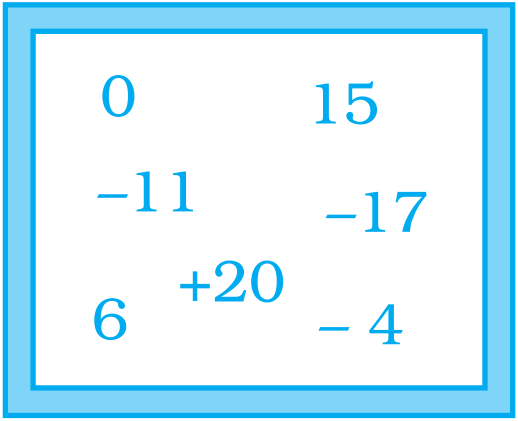
Answer Here, highest observation $= +20$ and lowest observation $= -17$
As we know,
Range $=$ Highest observation $–$ Lowest observation $= +20 - (-17) = 20 + 17 = 37$
View full question & answer→MCQ 921 Mark
The average age of a group of eight is same as it was $3$ years ago, when a young member is substituted for an old member the incoming member is younger to the outgoing member by:
- A
$11$ years
- ✓
$24$ years
- C
$28$ years
- D
$16$ years
AnswerCorrect option: B. $24$ years
$24$ years
View full question & answer→MCQ 931 Mark
The mode of the unimodular data $7, 8, 9, 8, 9, 10, 9, 10, 11, 10, 11, 12$ and $x$ is $10.$ The value of $x$ is:
Answer Arranging the data in ascending order, we get
$7, 8, 8, 9, 9, 9, 10, 10, 10, 10, 11, 11, 12$
Here, $10$ has the maximum frequency $(4)$
Hence, the correct option is $(a).$
View full question & answer→MCQ 941 Mark
The arithmetic mean of $6, 10, x$ and $12$ is $8$ The value of $x$ is:
Answer $\text{A.M} = \frac{\sum\text{x}}{\text{n}}\Rightarrow{8} = \frac{6+10+{\text{x}}+12}{4}$
$\Rightarrow{32} = {6+10} + {\text{x}} + {12} \Rightarrow = {32}-{28}$
$\Rightarrow{\text{x}} = {4}$
View full question & answer→MCQ 951 Mark
$\frac{\text{N(E)}}{\text{N(S)}}$ is the formula of:
Answer Probability of occurrence of event $E$ is $P(E) = \frac{\text{N(E)}}{\text{N(S)}}$
Where $n(E)$ is no. of cases favorable to event $E$ and $n(S)$ is total no. of cases.
View full question & answer→MCQ 961 Mark
The average of $2, 4, 6, 8, 10$ is:
Answer $\text{Average} = \frac{2+4+6+8+10}{5} = {6}$
View full question & answer→MCQ 971 Mark
The mean of $p, q$ and $r$ is same as the mean of $q, 2r$ and $s.$ Then which of the following is correct$?$
- A
$p = q = r$
- B
$q = r = s$
- C
$q = r$
- ✓
$p = r + s$
AnswerCorrect option: D. $p = r + s$
Mean of $p, q$ and $r =$ Mean of $q, 2r$ and $s$
$\frac{\text{p+q+r}}{3}=\frac{\text{q+2r+8}}{3}$
$\Rightarrow\text{p + q + r}=\text{q + 2r }+8$
$\Rightarrow\text{p}=\text{r + s}$
Hence, the correct option is $(d).$
View full question & answer→MCQ 981 Mark
The mean weight of $21$ students is $21\ kg.$ If a student weighing $21\ kg$ is removed from the group, then the mean of of the remaining students is:
- A
$20\ kg$
- ✓
$21\ kg$
- C
$19\ kg$
- D
$18\ kg$
AnswerCorrect option: B. $21\ kg$
Mean weight $= 21\ kg$
Number of students $= 21$
Sum of weights of $21$ students $= 21 × 21 = 441$
Sum of weights of $20$ students left $= 441 - 21 = 420$
Mean of remaining students $=\frac{420}{20}=21\text{kg}$
Hence, the correct option is $(b).$
View full question & answer→MCQ 991 Mark
Find the mean of $35, 34, 25, 52, 27, 23, 24, 36:$
Answer Given data $35, 34, 25, 52, 27, 23, 24, 36$ No of observations $8$ sum of observations $35 + 34 + 25 + 52 + 27 + 23 + 24 + 36 = 256$
Mean is $\frac{256}{8} = {8}$
View full question & answer→MCQ 1001 Mark
There are $100$ cards numbered from $1$ to $100$ in a box. If a card is drawn from the box and the probability of an event is $\frac{1}{2},$ then the number of favourable cases to the event is:
Answer Here, $\frac{50}{100}=\frac{1}{2}$
So, if the the probability of an event is $\frac{1}{2},$ then the number of favourable cases has to be $50.$
Hence, the correct option is $(d).$
View full question & answer→MCQ 1011 Mark
If Mode $= 195.2,$ Median $= 198.4,$ then the approximately value of mean is:
Answer Mode $= 3$ median $- 2$ mean (by The Empirical relation)
$\Rightarrow 195.2 = 3 (198.4) - 2$ mean
$\Rightarrow 195.2 = 595.2 - 2$ mean
$\Rightarrow 2$ mean $= 595.2 - 195.2$
$\Rightarrow 2$ mean $= 400$
$\therefore$ mean $= 200$
View full question & answer→MCQ 1021 Mark
In an examination, $40\%$ of the candidates wrote their answer in Hindi and the others in English. The average marks of the candidates written in Hindi is $74$ and the average marks of the candidates written in English is $77.$ What is the average marks of all the candidates?
- A
$75.5$
- ✓
$75.8$
- C
$76.0$
- D
$76.8$
AnswerCorrect option: B. $75.8$
Let there be $100$ students who took the examination.
The number of students who wrote answers in Hindi and in English are thus $40$ and $60$ respectively.
$\therefore$ average marks of all the candidates
$= (40 × 74 + 60 × 77) ÷ 100$
$= 7580 ÷ 100 = 75.8$
View full question & answer→MCQ 1031 Mark
Mean of $25$ observations was given as $78.4$ Later it was found out that $96$ was misread as $69.$ Find the correct mean:
- A
$79.84$
- ✓
$79.48$
- C
$79.54$
- D
$79.45$
AnswerCorrect option: B. $79.48$
$ n = 25$
$u = 78.4 ($initial wrong mean$)$
$x = n × u = 25 × 78.4 = 1960$
Now $69$ was read as $96,$ so
$= 1960 - 96 + 69 = 1987$
$\therefore {\text{u'}} = \frac{1987}{25}$
thus $u = 79.48$
View full question & answer→MCQ 1041 Mark
The ages of $5$ children are $13, 15, 11, 9$ and $8$ years respectively. The average age is:
- A
$10.2$
- B
$12.2$
- ✓
$11.2$
- D
$11$
AnswerCorrect option: C. $11.2$
Average is the sum of the data values divided by the total values. Given that $13, 15, 11, 9, 8$ are the ages of $5$ children.
$\therefore$ average age $ = \frac{13 + 15 + 11 + 9 + 8}{5} = \frac{56}{5} = {11.2}$
View full question & answer→MCQ 1051 Mark
The mean of $994, 996, 998, 1000$ and $1002$ is:
- A
$992$
- B
$1004$
- ✓
$998$
- D
$999$
AnswerGiven observations: $994, 996, 998, 1000, 1002$
$\text{mean} = \frac{\text{sum}}{\text{number of observations}}$
$\text{mean} = \frac{{994+996+998+1000+1002}}{5}$
$\text{mean} = \frac{4990}{5}$
$\text{mean} = 998$
View full question & answer→MCQ 1061 Mark
The mean of a set of seven numbers is $81.$ If one of the number is discarded, then the mean of the remaining numbers is $78.$ The value of discarded number is$?$
View full question & answer→MCQ 1071 Mark
The difference between the greatest and least value of the observations is known as:
AnswerThe difference between the greatest and least value of the observations is defined as range.
View full question & answer→MCQ 1081 Mark
Mean of $41, 39, 48, 52, 46, 62, 54, 40, 96, 52, 98, 49, 42, 52, 60$ is $54.8:$
Answer$\text{Mean} = \frac{\text{sum all number}}{\text{number of number}}$
$\therefore{\text{mean}} = \frac{41 + 39+48+52+46+62+52+40+96+52+98+49+42+52+60}{15} = 55.4$
View full question & answer→MCQ 1091 Mark
A student got marks in $5$ subjects in a monthly test is given below:
$2, 3, 4, 5, 6$
in these obtained marks, $4$ is the.
Answer Mean $ = \frac{2 + 3 + 4 + 5 +6}{5} = \frac{20}{5} = {4}$
Median is the middle most number $= 4$
View full question & answer→MCQ 1101 Mark
The mean of discrete observations $y_1, y_2 ,..., y_n$ is given by:
- A
$\frac{\displaystyle\sum_{\text{i=1}}^{\text{n}}\text{y}_{\text{i}}}{\displaystyle\sum_{\text{i=1}}^{\text{n}}\text{f}_{\text{i}}}$
- B
$\frac{\displaystyle\sum_{\text{i=1}}^{\text{n}}\text{y}_{\text{i}}\text{f}_{\text{i}}}{\text{n}}$
- ✓
$\frac{\displaystyle\sum_{\text{i=1}}^{\text{n}}\text{y}_{\text{i}}}{\text{n}}$
- D
$\frac{\displaystyle\sum_{\text{i=1}}^{\text{n}}\text{y}_{\text{i}}}{\displaystyle\sum_{\text{i=1}}^{\text{n}}{\text{i}}}$
AnswerCorrect option: C. $\frac{\displaystyle\sum_{\text{i=1}}^{\text{n}}\text{y}_{\text{i}}}{\text{n}}$
It is fundamental concept that mean of $nn$ discrete observation $y_1, y_2, y_3 ,.... y_n$ is
calculated by formula $ = \frac{{\text{y}_1}+{\text{y}_2}+{\text{y}_3}+ ...... +{\text{y}_\text{n}}}{\text{n}} = \frac{\displaystyle\sum_{\text{i=1}}^{\text{n}}\text{y}_{\text{i}}}{\text{n}}$
View full question & answer→MCQ 1111 Mark
$12, a, 6, 8, 2, 14.$
The average (arithmetic mean) of the numbers listed above is $6.$ Calculate the value of $a:$
AnswerWe know that average of a bunch of numbers is the sum of the numbers divided by how many numbers in the bunch.
We can set up an equation for the average from the given question,
$\Rightarrow \frac{12+{\text{a}}+6+8+2+14}{6} = {6}$
$\Rightarrow\frac{{42}+{\text{a}}}{6} = {6}$
$\Rightarrow{42}+{\text{a}} = {36}$
$\text{a} = -{6}$
View full question & answer→MCQ 1121 Mark
The mean of first five natural numbers is:
AnswerThe first five natural numbers are: $1, 2, 3, 4, 5$
$\text{Mean}=\frac{\text{Sum of observations}}{\text{Number of observations}}$
$=\frac{1+2+3+4+5}{5}$
$=\frac{15}{5}$
$=3$
Thus, the mean of first five natural number is $3$
Hence, the correct option is $(c).$
View full question & answer→MCQ 1131 Mark
The average of the four even numbers between $31$ and $39$ is:
AnswerAverage is the sum of the data values divided by the total values.
the $4$ even numbers between $31$ and $39$ are $32, 34, 36, 38$.
$\therefore$ average of even numbers between $31$ and $39$
$ = \frac{39 + 34 + 36 + 38}{4} = \frac{140}{4} = {35}$
View full question & answer→MCQ 1141 Mark
A set of consecutive positive integers beginning with $1$ is written on the blackboard A student came and erased one number. The average of the remaining numbers is ${35}\frac{7}{17}$ What was the number erased$?$
AnswerAfter one value is removed:
Since all of the values are Integers, the sum here must be an integer. Sum $= ($number$) × ($average$).$
Since the average $ = {35}\frac{7}{17},$ and the sum must be an integer, the number of integers must be a multiple of $17.$
For any evenly spaced set,
average = median. After one of the consecutive integers is removed, most of the remaining set will still be evenly spaced.
As a result, the average of the remaining set $ ={37}\frac{7}{17}$ will still be close to the median. Implication: The number of integers $= 4 × 17 = 68$ with the result that $ = {35}\frac{7}{17},$
will be close to the median of the 68 mostly consecutive integers.
$\therefore{\text{sum}} = {68}\times{35}\frac{7}{17} = {2408}$
Original set:
Since $68$ integers remain after one of the integers is removed, the original set contains $69$ integers. Sum of the first n positive integers $ = \frac{(\text{n})({\text{n+1}})}{2}$
$\therefore{\text{sum}} = {69}\times\frac{70}{2} = {2415}.$
Removed integer = original sum - sum after one integer is removed $= 2415 - 2408 = 7.$
View full question & answer→MCQ 1151 Mark
The difference between the highest and the lowest observations in a data is its:
AnswerThe difference between the highest and the lowest observations in a data is its range.
View full question & answer→MCQ 1161 Mark
The mean of first $5$ whole numbers is:
AnswerMean $ = \frac{\text{Sum of observation}}{\text{Total}} = \frac{{5}\times{4}}{2(5)} = 2$ Sum of $1st\ 5$ whole no.
$ = \frac{5(4)}{2} = {10}$
$(0, 1, 2, 3, 4)$ First $5$ whole no.
View full question & answer→MCQ 1171 Mark
The arithmetic mean of $5$ numbers is $27.$ lf one of the number is excluded the mean of the remaining number is $25.$ Find the excludednumber:
AnswerSum of $5$ numbers $= 27 \times 5 = 135$ when one of the numbers is excluded.
sum of remaining $4$ numbers $= 4 \times 25 = 100$ Excluded number $= 135 - 100 = 35.$
View full question & answer→MCQ 1181 Mark
The average of $20$ numbers is zero. Of them, at the most, how many may be greater than zero$?$
AnswerLet the $20$ numbers be $a_1, a_2, .... ,a_{20}$
Given that average of $20$ numbers is zero.
$\therefore\frac{ {\text{a}}_1+{\text{a}}_2+...+{\text{a}}_{20}}{20}$
$⇒ a_1 + a_2 + ... +a_{20}=0$
$⇒ a_1 + a_2 + ... +a_{19}= -a_{20}$
$\therefore$ at the most $19$ numbers can be greater than zero.
View full question & answer→MCQ 1191 Mark
A man bought $5$ shirts at $Rs. 450$ each, $4$ trousers at $Rs. 750$ each and $12$ pairs of shoes at $Rs. 750$ each. What is the average expenditure per article$?$
- ✓
$Rs. 678.57$
- B
$Rs. 800$
- C
$Rs. 900$
- D
$Rs. 1000$
AnswerCorrect option: A. $Rs. 678.57$
Total amount spent on shirts is $5 \times 450 = 2250$
amount on trousers is $4 \times 750 = 3000$ and on shoes $12 \times 750 = 9000$
hence total amount spent is $2250 + 3000 + 9000 = 14250$
so average per article is $\frac{14250}{21} = 678.57$
View full question & answer→MCQ 1201 Mark
The average of first $4$ prime numbers is$?$
AnswerCorrect option: B. $4.25$
Average is the sum of the data values divided by the total values.The first $4$ prime numbers are $2, 3, 5, 7$
$\therefore$ average of first $4$ prime numbers $ = \frac{2 + 3 + 5 + 7}{4} = \frac{17}{4} = {4.25}$
View full question & answer→MCQ 1211 Mark
The average weight of $16$ boys in a class is $50.25\ kg$ and that of the remaining $8$ boys is $45.15\ kg.$ Find the average weights of all the boys in the class:
- A
$47.55\ kg$
- B
$48\ kg$
- ✓
$48.55\ kg$
- D
$49.25\ kg$
AnswerCorrect option: C. $48.55\ kg$
Required average
$ = \frac{\big(50.25\times{16} + 45.15 \times{8}\big)}{16 + 8}$
$ =\frac{ \big(804 + 361.20\big)}{24}$
$ = \frac{1165.20}{24}$
$ = {48.55}$
View full question & answer→MCQ 1221 Mark
Rahuls mean score in $5$ tests was $84.$ His mean score in the first $4$ of these tests was $87.$ Calculate his score in the fifth test:
AnswerGiven, Rahul and $34$ mean score in $5$ test was $84$. And his means score in the first $4$ test of these test was $87.$ Then total score in $5$ tests $= 84 × 5 = 420$ And total score in $4$ tests $= 87 × 4 = 348$ So, the score in fifth test $= 420 - 348 = 72.$
View full question & answer→MCQ 1231 Mark
If the mean of $2, 4, 6, 8, x, y$ is $5,$ then find the value of $x + y?$
Answer$\text{mean}\frac{\text{sum of the terms}}{\text{total number of terms}}$
$\Rightarrow \frac{{2+4+6+8+}{\text{x+y}}}{6} = {5}$
$\frac{{20+}{\text{x+y}}}{6} = {5}$
$20 + x + y = 5 (6)$
$x + y = 30 - 20 = 10$
View full question & answer→MCQ 1241 Mark
The average of $33.5, 30.4, 25.6, 31.5$ and $29$ is:
- A
$28.5$
- ✓
$30$
- C
$29.7$
- D
$30.4$
Answer$ = \frac{33.5+30.4+25.6+31.5+29}{5} = \frac{150}{5} = {30}$
View full question & answer→MCQ 1251 Mark
Brian got grades of $92, 89$ and $86$ on his first three math tests. What grade must he get on his final test to have an overall average of $90?$
AnswerLet the grade he got on final test be $x$ The average of all four grades is $90.$
So, we have $ = \frac{{92+89+86+}{\text{x}}}{4} = {90}$
$\Rightarrow x = 360 - 267 = 93$
View full question & answer→MCQ 1261 Mark
Let mean of weight of $10$ students is $235\ kgs,$ if weight of each student increase $3\ kgs$, than their new mean in kgs is:
AnswerSince the weight of each student increases by $3\ kgs,$ their mean will also increase by $3\ kgs,$ hence new mean becomes $235 + 3 = 238\ kg$
View full question & answer→MCQ 1271 Mark
If the average of $x$ and $y$ is $50,$ and the average of $y$ and $z$ is $80,$ what is the value of $z - x?$
Answer The sum of two numbers is twice their average.
$x + y = 100 $
$y + z = 160$
$x = 100 - y $
$z = 160 - y$
substitute these expressions for $z$ and $x : z - x = (160 - y) - (100- y) = 160 - y - 100 + y= 160 - 100 = 60$
alternatively, pick smart numbers for $x$ and $y.$
Let $x = 50$ and $y = 50 ($this is an easy way to make their average equal to $50).$
since the average of $y$ and $z$ must be $80,$ you have $z = 110$
$\therefore z - x = 110 - 50 = 60$
View full question & answer→MCQ 1281 Mark
In a colony, the mean age of all the males is $15$ years, and the mean age of all females is $19$ years. Find the condition that must be true about the mean age m of the combined group of male and female in colony:
- A
$M = 17$
- B
$M > 17$
- C
$M < 17$
- ✓
$15 < M < 19$
AnswerCorrect option: D. $15 < M < 19$
Given is that mean age of all males is $15$ years and age of all females is $19$ years in a colony, when we find the mean age mm of the combined group of males and females in colony, we can conclude that mean age will be more than $15$ but less than. so $15 < m < 19$
View full question & answer→MCQ 1291 Mark
The mean of first $10$ natural number is:
- A
$\frac{5}{2}$
- ✓
$\frac{11}{2}$
- C
$\frac{13}{2}$
- D
${5}$
AnswerCorrect option: B. $\frac{11}{2}$
We know that Mean $ = \frac{\text{sum of observations}}{\text{total numer of observations}}$
$\therefore$ Mean of $10$ natural numbers $ = \frac{\text{sum of 10 natural number}}{10}$
We know that the sum of $′n′$ natural numbers $ = \frac{\text{n}{(\text{n+1})}}{2}$
$\therefore$ Sum of $10$ natural numbers $ = \frac{{10}\times{11}}{2} = {55}$
Mean of natural numbers $ = \frac{55}{10} = \frac{11}{2}$
View full question & answer→MCQ 1301 Mark
The average of first $50$ natural numbers is:
- A
$12.25$
- B
$21.15$
- C
$25$
- ✓
$25.5$
AnswerCorrect option: D. $25.5$
The first $50$ natural numbers are $1, 2, 3, ..... ,50$
We know that, the sum of first nn natural numbers is $ = \frac{\text{n}({\text{n+1}})}{2}$
$\therefore$ sum of first $50$ natural numbers is $\frac{{50}{(51)}}{2} = {25}(51) = {1275}$
the average of first $50$ natural numbers is $\frac{1275}{50} = {25.5}$
View full question & answer→MCQ 1311 Mark
The average of four consecutive even numbers is $15.$ The $2nd$ highest number is:
AnswerLet the numbers be $x - 2, x, x + 2, x + 4$ according to the question,
$ = \frac{\text{x-2+x+x+2+x+4}}{4} = {15}$
$4x + 4 = 60$
$4x = 56$
$⇒ x = 14$
hence, the second highest number $i.e. x + 2 = 14 + 2 = 16$
View full question & answer→MCQ 1321 Mark
In a coconut grove $(x + 2)$ trees yield $60$ nuts per year, $x$ trees yield $120$ nuts per year and $(x - 2)$ trees yield $180$ nuts per year. If the average yield per year per tree be $100$ then find $x:$
Answer$\frac{\text{(x + 2)}\times{60}+\text{x}\times{120}+\text{(x - 2)}\times{180}}{{\text{x + 2}}+{\text{x + x}}-{2}} = {100}$
$\frac{{60}\text{x}+{120}+{120}{\text{x}}+{180}{\text{x}} - {360}}{\text{3x}} = {100}$
$360x - 240 = 300x$
$60x = 240$
$x = 4$
View full question & answer→MCQ 1331 Mark
The mean of first odd $n$ natural numbers is:
AnswerSeries of $n$ odd natural numbers will be: $1, 3, 5, .... n$
sum of the series $ = \frac{\text{n}}{2} (2\times{1} + (\text{n - 1})\times{2}) = {\text{n}}^{2}$
mean of the series $ = \frac{\text{n}^{2}}{\text{n}} = \text{n}$
View full question & answer→MCQ 1341 Mark
On tossing a coin, the outcome is:
AnswerWhen we toss a coin, two outcomes are possible, $i.e.$ head or tail.
View full question & answer→MCQ 1351 Mark
The captain of a cricket team of $11$ members is $26$ years old and the wicket keeper is $3$ years older. If the ages of these two are excluded, the average age of the remaining players is one year less than the average age of the whole team. what is the average age of the team$?$
- ✓
$23$ years
- B
$24$ years
- C
$25$ years
- D
AnswerCorrect option: A. $23$ years
Let the average age of the whole team by $x$ years.
$\therefore 11x - (26 + 29) = 9(x - 1)$
$⇒ 11x - 9x = 46$
$⇒ 2x = 46$
$⇒ x = 23.$
So, average age of the team is $23$ years.
View full question & answer→MCQ 1361 Mark
A man spends equal amount on purchasing three kind of pens at the rate $Rs. 5$ per pen, $Rs. 10$ per pen and $Rs. 20$ per pen. The average cost of one pen is:
AnswerCorrect option: C. $\text{Rs. }\frac{60}{7}$
Let the man spends $Rs. x$ on purchasing each kind of pens at their respective rates. Total cost $= x + x + x = 3x$
Now, number of pens bought of $Rs. 5$ will be $\frac{\text{x}}{5}$
Number of pens bought of $Rs. 10$ will be $\frac{\text{x}}{10}$
Number of pens bought of $Rs. 20$ will be $\frac{\text{x}}{20}$
So, total number of pens bought $ = \frac{\text{x}}{5}+\frac{\text{x}}{10}+\frac{\text{x}}{20}$
Average cost $ =\frac{ \text{Total cost}}{\text{No. of total pens}}= \frac{ \text{x+x+x}}{\frac{\text{x}}{5}+\frac{\text{x}}{10}+\frac{\text{x}}{20}}$
$ = \frac{{3}}{\frac{1}{5}+\frac{1}{10}+\frac{1}{20}} = \frac{60}{7}$
View full question & answer→MCQ 1371 Mark
If the mean of $x, x + 2, x + 4, x + 6, x + 8$ is $20$ then $x$ is:
Answer $\text{Mean} = \frac{\text{x + x + 2 + x + 4 + x + 6 + x + 8}}{8} $
$= 205x = 80x = 16$
View full question & answer→MCQ 1381 Mark
The mean of first $726$ natural numbers is $363.5$ If true then enter $1$ and if false then enter $0:$
Answer First $726$ natural numbers $= 1, 2, 3, 4 .... 726$
sum of $726$ numbers $= 1 + 2 + 3 + 4 .... 72$
this forms an $AP,$ with first term $= 1,$ last term $= 726$ and number of terms $= 1$
$\text{sum of AP} = \frac{\text{n}}{{2}} (\text{a + 1})$
$\text{sum of AP} = \frac{726}{2} (1+726)$
$\text{sum of AP} =263901$
$\text{mean} = \frac{\text{sum}}{\text{number of turns}} = \frac{263901}{726} = 363.5$
View full question & answer→MCQ 1391 Mark
The mean of $13$ observations is $14.$ If the mean of the first $7$ observations is $12$ and that of the last $7$ observations is $16,$ then the $7^{th}$ observation is .......
AnswerB. $14$
Solution:
Sum of all observations $= 13 × 14 = 182$ Sum of the first $7$ observations $= 7 × 12 = 84$
sum of the last $7$ observations $= 7 × 16 = 112$
sum of the first $7$ observations $+$ Sum of the last $7$ observations
$=$ sum of total terms $+ 7^{th}$ terms
$⇒ 84 + 112 = 182 + 7^{th}$ term
$\therefore$ $7^{th}$ term $= 196 - 182 = 14$
View full question & answer→MCQ 1401 Mark
The mean of the factors of $24$ is:
- A
$\frac{12}{5}$
- B
$\frac{9}{5}$
- ✓
$\frac{15}{2}$
- D
$\frac{17}{5}$
AnswerCorrect option: C. $\frac{15}{2}$
The factor of $24$ are $1, 2, 3, 4, 6, 8, 12, 24$
$\therefore{\text{A.M}} = \frac{\sum{\text{x}}}{\text{n}}$
$\Rightarrow\frac{1+2+3+4+6+8+12+24+}{8}\Rightarrow\frac{60}{8} = \frac{15}{2}$
View full question & answer→MCQ 1411 Mark
$12 - n, 12, 12 + n.$
What is the average (arithmetic mean) of the $3$ quantities in the list above$?$
- A
${4}$
- ✓
${12}$
- C
${18}$
- D
${4}+\frac{\text{n}}{3}$
AnswerCorrect option: B. ${12}$
Given $3$ Quantities: $12 - n, 12, 12 + n$ Average of the above $3$ Quantities
$ = \frac{\text{sum of the above 3 quantities}}{\text {number of quantities}} $
$ = \frac{{12 }-{\text{n}} +12+12+{\text{n}}}{3}$
$ = \frac{{12}\times{3}}{3} = {12}$
$\therefore$ average of the Quantities listed above is $12.$
View full question & answer→MCQ 1421 Mark
Average of the first six even numbers is:
Answer $\frac{2+4+6+8+10+12+}{6} = \frac{42}{6} = 7$
View full question & answer→MCQ 1431 Mark
If the mean of $n$ observations is $12$ and the sum of the observations is $132,$ then the value of $n$ is:
AnswerMean of n observations $= 12$
Sum of observations $= 132$
$\text{Mean}=\frac{\text{Sum of observations}}{\text{Number of observations}}$
$\Rightarrow12=\frac{132}{\text{n}}$
$\Rightarrow\text{n}=\frac{132}{12}=11$
Thus, the value of $n$ is $11$
Hence, the correct option is $(c).$
View full question & answer→MCQ 1441 Mark
There are $10$ marbles in a box which are marked with the distinct numbers from $1$ to $10.$ A marble is drawn randomly. The probability of getting prime numbered marble is:
- A
$\frac{1}{2}$
- ✓
$\frac{2}{5}$
- C
$\frac{9}{3}$
- D
$\frac{3}{10}$
AnswerCorrect option: B. $\frac{2}{5}$
The numbers marked on the marbles are $1, 2, 3, 4, 5, 6, 7, 8, 9,$ and $10.$
Here, the prime numbers (favourable outcomes) are $ 2, 3, 5,$ and $7.$
$\therefore$ Number of favourable outcomes $= 4$
Therefore
Probability of getting prime numbered marble $=\frac{4}{10}=\frac{2}{5}$
Hence, the correct option is $(b).$
View full question & answer→MCQ 1451 Mark
The average of three numbers is $60.$ The first is $1/ 4th$ of the sum of the other two. The first number is:
AnswerLet $a,b$ and $c$ are three numbers $ = \frac{\text{a + b + c}}{3} = {60}$
$a + b + c = 180$
and $a = \frac{1}{4} \text{(b+c)} = \frac{1}{4} (180) - {\text{a}}$
$4a = 180 - a$
$\text{a} = \frac{180}{5} = {36}$
View full question & answer→MCQ 1461 Mark
The arithmetic mean of the cubes of first four natural numbers is:
AnswerThe first four natural numbers are $1, 2, 3, 4$
$\text{A.M} = \frac{\sum{\text{x}}}{\text{n}} = \frac{{1}^{3} +{2}^{3} + {3}^{3}+{4}^{3}}{4}$
$\frac{1+4+27+64}{4} = \frac{100}{4} = {25}$
View full question & answer→MCQ 1471 Mark
The probability of getting a red card from a well shuffled pack of cards is:
- A
$\frac{1}{4}$
- ✓
$\frac{1}{2}$
- C
$\frac{3}{4}$
- D
$\frac{1}{3}$
AnswerCorrect option: B. $\frac{1}{2}$
There are $52$ cards in a standard deck. There are four different suits Diamonds (red), Clubs (black), Hearts (red), and Spades (black) each containing $13$ cards.
$\therefore $ Number of red cards $($favourable outcomes$) = 13 + 13 = 26$
Therefore
Probability of getting a red card $=\frac{26}{52}=\frac{1}{2}$
Hence, the correct option is $(b).$
View full question & answer→MCQ 1481 Mark
Find the average of first $100$ positive numbers:
AnswerCorrect option: C. $50.5$
We know that sum of $1$ to $n$ numbers $ = \frac{\text{n}(\text{n+1})}{1}$
Then sum of $1$ to $100 = \frac{{100}(100+1)}{2} = \frac{{100}\times{101}}{2} = \frac{10100}{2} = 5050$
Then average of $1$ to $100$ positive numbers $ = \frac{5050}{100} = 50.5$
View full question & answer→MCQ 1491 Mark
The mean of $25, 37, 84$ is.
Answer Given observations $25, 37, 84$ No .of observations $3$ The mean of
observation $\frac{25+37+84}{3}=\frac{146}{3}=48.6$
View full question & answer→MCQ 1501 Mark
The mean of five numbers is $27.$ If one of the numbers is excluded, the mean gets reduced by $2.$ Find the excluded number:
Answer Mean of $5$ number $= 27.$ If $1$ of the numbers is excluded,
$\therefore M′ = M - 2$
$= 27 - 2$
$= 25 × 4$
$= 100M = 27 × 5$
$= 135$ Excluded number $= 135 - 100 = 35.$
View full question & answer→MCQ 1511 Mark
Mean of $130, 126, 68, 50, 1$ is:
AnswerRequired mean $ = \frac{130+126+68+50+1}{5} = \frac{375}{5} = {75}$
View full question & answer→MCQ 1521 Mark
The mean of $20$ observations is $12.5$ by error one observation was noted $-15$ instead then the correct mean is:
- A
$11.75$
- B
$11$
- ✓
$14$
- D
$13.25$
Answer Mean of $20$ observation $= 12.5$
sum of $20$ observations $= 12.5 × 20 = 250$
Wrong observation is $-15$ Correct observation is $15$ So,
sum of $20$ observation correctly $= 250 + 15 + 15 = 280$
first $15$ is to eliminate the wrong observation and the other $15$ for adding the correct observation in the data.
correct mean $ = \frac{280}{20} = {14}$
View full question & answer→MCQ 1531 Mark
There are $50$ numbers. Each number is subtracted from $53$ and the mean of the numbers so obtained is found to be $3.5.$ The mean of the given numbers is:
- A
$46.5$
- B
$49.5$
- C
$53.5$
- ✓
$56.5$
AnswerCorrect option: D. $56.5$
Total numbers $= 50$
Mean of numbers after subtracting $53$ from each $= 3.5$
Sum of numbers after subtracting $53$ from each $= 3.5 × 50 = 175$
Sum of the original numbers $= 175 + 53 × 50 = 2825$
Mean of the original numbers $ = \frac{2825}{50} = {56.5}$
View full question & answer→MCQ 1541 Mark
In a class test, in mathematics, $10$ students scored $75$ marks, $12$ students scored $60$ marks, $8$ scored $40$ marks and $3$ scored $30$ marks. The mean of their score is (approximately) .......
- ✓
$57$ marks
- B
$56$ marks
- C
$15$ marks
- D
$54$ marks
AnswerCorrect option: A. $57$ marks
Total marks obtained by all students $= 10 \times 75 + 12 \times 60 + 8 \times 40 + 3 \times 30 = 1880$
The total number of students $= 10 + 12 + 8 + 3 = 33$ Average of their score
$ = \frac{1880}{33} = 56.96969697 ($aproximately$)$
View full question & answer→MCQ 1551 Mark
The following number of goals were scored by a team in a series of $10$ matches $2, 3, 4, 5, 0, 1, 3, 3, 4, 3$
Find mean & amp: median
- ✓
Mean $= 2.8$ and median $= 3$
- B
Mean $= 2.8$ and median $= 3.8$
- C
Mean $= 2$ and median $= 3$
- D
Mean $= 3.2$ and median $= 3$
AnswerCorrect option: A. Mean $= 2.8$ and median $= 3$
A. Mean $= 2.8$ and median $= 3$
Solution:
Arranging the given data in ascending order, we get $0, 1, 2, 3, 3, 3, 3, 4, 4, 5$ Number of observations $= 10$
$\text{mean} = \frac{\text{sum of observations}}{\text{number of observations}}$
$\Rightarrow{\text{mean}} = \frac{0 +1+2+3+3+3+3+4+4+5}{10}$
$\Rightarrow{\text{mean}} =\frac{28}{10} = {2.8}$
Median = Mean of $5^{th}$ and $6^{th}$ observations in ordered data
$\Rightarrow{\text{mean}} = \frac{3+3}{2} = {3}$
View full question & answer→MCQ 1561 Mark
Which measures of central tendency get affected if the extreme observations on both the ends of a data arranged in descending order are removed?
AnswerMean is defined as follows:
$\text{Mean}=\frac{\text{Sum of observation}}{\text{Number of observations}}$
So, if we remove the extrema values that both sum and total number of observations will change.
Hence, mean wiii aiso change.
Mode is that observation which occurs the most.
So, if extreme value of those values which occurs mostly than mode can affect it they are removed.
Median is the mid value.
So, if extreme values are removed than the mid value remains same.
Hence, median will not change.
View full question & answer→MCQ 1571 Mark
If the sum of $10$ observations is $95,$ then their mean is:
Answer Sum of $10$ observations $= 95$
$\text{Mean}=\frac{\text{Sum of observations}}{\text{Number of observations}}$
$=\frac{95}{10}$
$=9.5$
Thus, the mean is $9.5$
Hence, the correct option is $(a).$
View full question & answer→MCQ 1581 Mark
A coin is tossed $100$ times and head is obtained $59$ times. The probability of getting a tail is:
- A
$\frac{59}{100}$
- ✓
$\frac{41}{100}$
- C
$\frac{29}{100}$
- D
$\frac{43}{100}$
AnswerCorrect option: B. $\frac{41}{100}$
Number of all possible outcomes $= 100$
Number of head obtained $= 59$
Number of tail obtained $($favourable outcomes$) = 100 - 59 = 41$
Therefore
Probability of getting a tail $\frac{41}{100}$
Hence, the correct option is $(b).$
View full question & answer→MCQ 1591 Mark
The average age of two brothers is $9$ years. It is increased by $9$ years when their mothers age is also included then the age of mother is:
- A
$35 $ years
- ✓
$36$ years
- C
$37$ years
- D
$38$ years
AnswerCorrect option: B. $36$ years
Given the average age of two brothers is $9$ years
then total age $= 9 \times 2 = 18$ years
If mothers age included the average age $= 9 + 9 = 18$ years
then total age of mother and two brothers $= 18 \times 3 = 54$ years
so age of mother $= 54 - 18 = 36$ years.
View full question & answer→MCQ 1601 Mark
If the median of $10, 12, x, 6, 18$ is $10,$ then which of the following is correct$?$
- A
$6\leq\text{x}\leq10$
- B
$x < 6$
- C
$x > 18$
- ✓
Either $(a)$ or $(b)$
AnswerCorrect option: D. Either $(a)$ or $(b)$
Arranging the numbers $10, 12, 6, 18$ in ascending order, we get
$6, 10, 12, 18$
Thus, for $10$ to be the median of the data, $x < 6$ or $6\leq\text{x}\leq10$
Hence, the correct option is $(d).$
View full question & answer→MCQ 1611 Mark
The mean of $56, 15, 48, 49, 52, 57, 30, 51, 42, 50$ is:
Answer Given data is $56, 15, 48, 49, 52, 57, 30, 51, 42, 50$ No. of observations $10$ sum of observations is
$56 + 15 + 48 + 49 + 52 + 57 + 30 + 51 + 42 + 50 = 450$
mean of the data is $\frac{450}{10} = {45}$
View full question & answer→MCQ 1621 Mark
If the mean of observations $7, 8, 9, 11$ and $x$ is $10,$ then $x =$
Answer Given: the mean of the observations $7, 8, 9, 11$ and $x$ is $10$
Mean of observations $=\frac{\text{Sum of observations}}{\text{Number of observations}}$
$\Rightarrow10=\frac{7+8+9+11+\text{x}}{5}$
$\Rightarrow35 + \text{x} = 50$
$\Rightarrow\text{x} = 50 - 35 = 15$
Thus, the value of $x$ is $15$
Hence, the correct option is $(b).$
View full question & answer→MCQ 1631 Mark
The mean of a set of $10$ numbers is $20$ Is each number is first multiples by $2$ and then increased by $5$ then what is the mean of new numbers$?$
Answer Given the mean of $10$ numbers is $20$ Then total of numbers $= 20$
times $10 = 200$
If each number multiples by $2$ and add $5$
then total of new numbers $= 20 \times 2 \times 10 + 5 \times 10 = 450$
$\frac{450}{10} = 45$
View full question & answer→MCQ 1641 Mark
If the mean of $9, 10, 15, x, 6, 8$ and $12$ is $11.$ The median of the observations is:
AnswerThe mean of $9, 10, 15, x, 6, 8$ and $12$ is $11$
$\therefore\text{Mean}=\frac{\text{Sum of observations}}{\text{Number of observations}}$
$\Rightarrow11=\frac{9+10+15+\text{x}+6+8+12}{7}$
$\Rightarrow\text{x}+60=77$
$\Rightarrow\text{x}=77-60=17$
So, the observations are $9, 10, 15, 17, 6, 8$ and $12$
Arranging the the observations in increasing order, we get
$9, 10, 15, 17, 6, 8, 12$ or $6, 8, 9, 10, 12, 15, 17$
Thus, the median is $10$
Hence, the correct option is $(b).$
View full question & answer→MCQ 1651 Mark
The sum of five numbers is $555.$ The average of first two numbers is $75$ and the third number is $115.$ What is the average of the last two numbers$?$
AnswerLet the five numbers be $A, B, C, D, E$
Given, $A + B + C + D + E = 555$
$\frac{\text{A+B}}{2}$ = 75
$\Rightarrow A + B = 150$ and $C = 115$
$\therefore 150 + 115 + D + E = 555$
$\Rightarrow D + E = 555 -265 = 290$
$\Rightarrow $ Required Average $\frac{\text{D+E}}{2} = \frac{290}{2}= 145$
View full question & answer→MCQ 1661 Mark
The arithinetic mean of $5, 6, 8, 9, 12, 13, 17$ is:
AnswerMean $ =\frac{ \text{Sum of observations}}{\text{Total number of observations}} = \frac{5+6+8+9+12+13+17}{7} = \frac{70}{7} = {10}$
View full question & answer→MCQ 1671 Mark
An unbiased coin is tossed once, the probability of getting head is:
- ✓
$\frac{1}{2}$
- B
$1$
- C
$\frac{1}{3}$
- D
$\frac{1}{4}$
AnswerCorrect option: A. $\frac{1}{2}$
Tossing a coin, either we get a head $(H)$ or a tail $(T).$
So, the probability of getting a head is $\frac{1}{2}$
Hence, the correct option is $(a).$
View full question & answer→MCQ 1681 Mark
In a class of $100$ students there are $70$ boys whose average marks in a subject are $75.$ If the average marks of the complete class is $72,$ then what is the average of the girls$?$
AnswerNumber of boys $= 70$
Average marks of boys $= 75$
Total marks of boys $= 70 \times 75 = 5250$
Total marks of the class $= 72 \times 100 = 7200$
Total marks of girls $= 1950$
Average of the girls $ = \frac{1950}{30} = {65}$
View full question & answer→MCQ 1691 Mark
The Arithmetic mean of all the factors of $24$ is:
Answer$\Rightarrow $ Factors of $2$ are $1, 2, 3, 4, 6, 8, 12, 24$
$\Rightarrow $ The observations are $1, 2, 3, 4, 6, 8, 12, 24$
$\therefore$ Number of observations = 8 Arithmetic mean $ = \frac{\text{Sum of observations}}{\text{Number of observations}}$
$\therefore$ Arithmetic mean$ = \frac{1 + 2 + 3 + 4 + 6 + 8 + 12 + 24}{8}$
$\therefore$ Arithmetic mean$ = \frac{60}{8}$
$\therefore$ Arithmetic mean $=7.5$
View full question & answer→MCQ 1701 Mark
In a Zonal athletic long jump meet the distances jumped by $10$ atheletes are $205\ cm, 200\ cm, 275\ cm, 260\ cm, 259\ cm, 199\ cm, 252\ cm, 239\ cm, 228\ cm$ and $281\ cm.$ Find the arithmetic mean of the jumps:
- A
$212.4\ cm$
- B
$222.5\ cm$
- C
$230.8\ cm$
- ✓
$239.8\ cm$
AnswerCorrect option: D. $239.8\ cm$
Distances jumped by $10$ athletes $($in $cm) 205, 200, 275, 260, 259, 199, 252, 239, 228$ and $281$
Mean $ = \frac{205+200+275+260+259+199+252+239+228+281}{10}$
Mean $ = \frac{2398}{10}$
Mean $= 239.8$
View full question & answer→MCQ 1711 Mark
The average of the five odd numbers between $18$ and $28$ is:
Answer Given odd numbers between $18$ and $28$ are $19, 21, 23, 25, 27.$
$\text{Average} = \frac{19+21+23+25+27}{5} = \frac{115}{5} = 23$
View full question & answer→MCQ 1721 Mark
The mean of the value of $1, 2, 3 ...... n$ with respective frequency $a, 2x, 3x ...... nx$ is:
AnswerCorrect option: B. $\frac{\text{2n + 1}}{3}$
Mean $ = \frac{{1 }\times{ \text{ x + 2 }}\times{ 2 }{\text{ x + 3 }}\times{ 3}{\text{x}} ...... }{\text{x + 2x + 3x .....}}$
$ = \frac{{1 }\times{ \text{ x + 2 }}\times{ 2 }{\text{ x + 3 }}\times{ 3}{\text{x}} ...... }{{\text{x}}({1+2+3 ......})}$
$=\frac{\frac{\text{n(n+1})({2}\text{n+1})}{6}} {\frac{\text{n(n+1})}{2}}$
Mean $\Rightarrow \frac{\text{n(n+1})({2}\text{n+1})}{6} \times \frac{\text{n(n+1})}{2}$
Mean $ = \frac{\text{2n+1}}{3}$
View full question & answer→MCQ 1731 Mark
Mean of $10$ values is $32.6.$ If another values is included the mean becomes $31.$ The included value is:
AnswerIncluded value $31 \times 11 - 32.6 \times 10 = 15$
View full question & answer→MCQ 1741 Mark
The mean of $10, 15, 19, 30, 43, 69$ and $x$ is $x.$ Then the median is:
Answer The mean of $10, 15, 19, 30, 43, 69$ and $x$ is $x.$
$\therefore\text{Mean}=\frac{\text{Sum of observations}}{\text{Number of observations}}$
$\Rightarrow\text{x}=\frac{10+15+19+30+43+69+\text{x}}{7}$
$\Rightarrow\text{x}+186=7\text{x}$
$\Rightarrow\text{x}=\frac{186}{6}=31$
Thus, the observations are $10, 15, 19, 30, 43, 69$ and $31$
Arranging the numbers $10, 15, 19, 30, 43, 69$ and $31$ in increasing order, we get
$10, 15, 19, 30, 31, 43, 69$
Thus, the median is $30$
Hence, the correct option is $(c).$
View full question & answer→MCQ 1751 Mark
The mean of all factors of $10$ is:
AnswerFactors of $10$ are: $1, 10, 2, 5$
$\text{mean of factors of 10} = \frac{\text{sum}}{\text{count of number}}$
$\text{mean} = \frac{1+10+2+5}{4}$
$\text{mean} = \frac{18}{4}$
$\text{mean} = 4.5$
View full question & answer→MCQ 1761 Mark
Out of $5$ brands of chocolates in a shop, a boy has to purchase the brand which is most liked by children. What measure of central tendency would be most appropriate if the data is provided to him$?$
AnswerMode is the most appropriate central tendency because it is the observation that occurs most frequently.
Here, by the measurement of mode, we can find out the chocolates which is most liked by children.
View full question & answer→MCQ 1771 Mark
The mean of $x + 3, x + 5, x + 7, x + 9$ and $x + 11$ is:
- A
$2x + 7$
- B
$x + 8$
- ✓
$x + 7$
- D
AnswerCorrect option: C. $x + 7$
The observations are: $x + 3, x + 5, x + 7, x + 9, x + 11$
$\text{Mean} = \frac{\text{Sum}}{{\text{Number of observations}}} = \frac{\text{x+3,x+5,x+7,x+9,x+11}}{5}$
$ = \frac{5\text{x+}{35}}{5} = \text{x+7}$
View full question & answer→MCQ 1781 Mark
The mean of $6, 8, 10, 12, 14, 16, 18:$
Answer Given data $6, 8, 10, 12, 14, 16, 18$
the sum of observations is $6 + 8 + 10 + 12 + 14 + 16 + 18 = 84$
mean is given as $\frac{84}{7} = {7}$
View full question & answer→MCQ 1791 Mark
The average of $100$ numbers is $44.$ The average of these $100$ numbers and four other numbers is $50.$ What is the average of the four new numbers$?$
Answer Sum of $100$ numbers $= 100 × 44 = 4400$
Sum of $104$ numbers $= 104 × 50 = 5200$
Sum of $4$ numbers $= 5200 - 4400 = 800$
$\therefore$ Average of four new numbers $ = \frac{800}{4} = 200$
View full question & answer→MCQ 1801 Mark
The median of the data $3, 4, 5, 6, 7, 3, 4$ is:
Answer We know that, median is the middle most observation.
For finding the median of the data firstly,
we arrange the data in ascending order, i.e. Ascending order
$i.e\ 3, 3, 4, 4, 5, 6, 7.$
$n = 7 ($odd$)$
$\therefore$ Median $=$ Value of $\Big(\frac{\text{n+1}}{2}\Big)^{\text{th}}$
observation = Value of $\Big(\frac{7+1}{2}\Big)^{\text{th}}$ observation
$= 4th$ observation $= 4$
View full question & answer→MCQ 1811 Mark
Find the average of the expressions $2x + 4, 5x - 1$ and $-x + 3:$
- A
$x + 2$
- B
$x - 2$
- ✓
$2x + 2$
- D
$2x - 2$
AnswerCorrect option: C. $2x + 2$
Average of the expression $= \frac{\text{sum of expression}}{\text{total number of expressions}}$
$\Rightarrow \frac{{2}{\text{x}}+4+{5}{\text{x}} - 1 -{\text{x}} +{3}}{3}$
$\Rightarrow \frac{{6}{\text{x}}+{6}}{3}$
$\Rightarrow\frac{{3}({2}{\text{x}}+{2})}{3} = {2}{\text{x}}+{2}$
View full question & answer→MCQ 1821 Mark
In the previous question, what is the probability of picking up an ace from set $(d)?$
- A
$\frac{1}{6}$
- ✓
$\frac{2}{6}$
- C
$\frac{3}{6}$
- D
$\frac{4}{6}$
AnswerCorrect option: B. $\frac{2}{6}$
$\text{Probability}=\frac{\text{Number of possible outcomes}}{\text{Total number of outcomes}}$
Total number of cards in set $(d) = 6$
Number of possible outcomes $= 2 [\because 2$ aces in every set, given$]$
So, probability $=\frac{2}{6}$
View full question & answer→MCQ 1831 Mark
Find the mean of first $8$ whole numbers:
AnswerFirst $8$ whole numbers are $0, 1, 2, 3, 4, 5, 6, 7$
Mean $ = \frac{0+1+2+3+4+5+6+7}{8} = \frac{28}{8} = {3.5}$
View full question & answer→MCQ 1841 Mark
The average of $5, 0, 6, \frac{1}{4} $ and ${\text{ }}{8}\frac{3}{4}$ is:
Answer$\frac{5+0+6+}{5}\frac{1}{4}+8\frac{3}{4}$
$ = \frac{20}{5} = {4}$
View full question & answer→MCQ 1851 Mark
If the mean of observations $20, 42, 35, 45$ and $x$ is $37,$ then $x =$
AnswerGiven: the mean of the observations $20, 42, 35, 45$ and $x.$
Mean of observations $=\frac{\text{Sum of observations}}{\text{Number of observations}}$
$\Rightarrow37=\frac{20+42+35+45+\text{x}}{5}$
$\Rightarrow142+\text{x}=185$
$\Rightarrow\text{x}=185-142=43$
Thus, the value of $x$ is $43$
Hence, the correct option is $(a).$
View full question & answer→MCQ 1861 Mark
Mean of a set of observations is the value which:
- A
- B
Divides observations into two equal parts
- ✓
Is a representative of a whole group
- D
Is the sum of observations
AnswerCorrect option: C. Is a representative of a whole group
It is a representative of a whole group. mean refers to an average that describes the central tendency of data.
$\therefore$ It represents whole group.
View full question & answer→MCQ 1871 Mark
A family consists of two grandparents, two parents and three grandchildren. The average age of the grandparents is $67$ years, that of the parents is $35$ years and that of the grandchildren is $6$ years. What is the average age of the family$?$
- A
${28}\frac{4}{7}{\text{ years}}$
- ✓
${31}\frac{5}{7}{\text{ years}}$
- C
${32}\frac{5}{7}{\text{ years}}$
- D
AnswerCorrect option: B. ${31}\frac{5}{7}{\text{ years}}$
Required average $ = \Big(\frac{{67}\times{2+35+}\times{2+6}\times{3}}{2+2+3}\Big) = \Big(\frac{134+70+18}{7}\Big) = \frac{227}{7}$
$ = {31}\frac{5}{7}{\text{ years}}$
View full question & answer→MCQ 1881 Mark
Find the average of $201, 204, 207, 210, 213:$
AnswerAverage of Number $ = \frac{\text{sum of all number}}{\text{total number of number}}$
$\frac{201+207+210+213+204}{5} = > \frac{1035}{5} = {207}$
View full question & answer→MCQ 1891 Mark
The median of the data $5, 7, 9, 10, 11$ is:
AnswerThe data in arranging order is: $5, 7, 9, 10, 11$
As the number of observations is odd $(5),$ the median is the middle term which is $9$
Hence, the correct option is $(b).$
View full question & answer→MCQ 1901 Mark
Directions: In the following questions, the Assertions $(A)$ and Reason(s) $(R)$ have been put forward. Read both the statements carefully and choose the correct alternative from the following:
Assertion: The marks of $20$ students in a test were as follows: $5, 6, 8, 9, 10, 11, 11, 12, 13, 13, 14, 14, 15, 15, 15, 16, 16, 18, 19, 20.$ The mean is $13.$
Reason: $\text{Mean} = \frac{\text{sum of marks}}{\text{number of students}} = \frac{260}{20} =13.$
- ✓
Both Assertion and Reason are correct and Reason is the correct explanation for Assertion.
- B
Both Assertion and Reason are correct and Reason is not the correct explanation for Assertion.
- C
Assertion is true but the reason is false.
- D
Both assertion and reason are false.
AnswerCorrect option: A. Both Assertion and Reason are correct and Reason is the correct explanation for Assertion.
Both Assertion and Reason are correct and Reason is the correct explanation for Assertion.
View full question & answer→MCQ 1911 Mark
Sachin scored $80$ and $120$ runs respectively in the two innings of a cricket match. What would have been his average score in each innings$?$
Answer$ \Rightarrow $ Runs scored by Sachin in fist innings $= 80$
$\Rightarrow $ Runs scored by Sachin in fistinnings $= 120$
$\Rightarrow $ Total runs scored in two innings by Sachin $= 80 + 120 = 200$
$\Rightarrow $ Average scored of Sachin in each innings
$ = \frac{200}{2} = {100}$
View full question & answer→MCQ 1921 Mark
Which measure of central tendency best represents the data of the most popular politician after a debate?
AnswerMode is the most frequent observation in a data.
So, the measure of central tendency best represents the data of most popular politician after a debate.
View full question & answer→MCQ 1931 Mark
The $A.M.$ of a set of $50$ numbers is $38.$ If two numbers of the set, namely $55$ and $45$ are discarded, the $A.M.$ of the remaining set of numbers is;
- A
$36$
- B
$36.5$
- ✓
$37.3$
- D
$38.5$
AnswerCorrect option: C. $37.3$
Mean of remaining set $= \frac{{50}\times 38 - ( 45+55)}{50 - 2} = \frac{1800}{48} = {37.5}$
View full question & answer→MCQ 1941 Mark
The mode of the data $9, x, 6, 3, 4, 9, 8, 6, 4, 6$ is $6.$ Which of the following cannot be the value of $x:$
AnswerArranging the data $9, 6, 3, 4, 9, 8, 6, 4, 6$ in ascending order, we get
$3, 4, 4, 6, 6, 6, 8, 9, 9$
Since the mode of the data is $6,$ so the value of $x$ cannot be $4$ or $9.$
Hence, the correct option is $(d).$
View full question & answer→MCQ 1951 Mark
If $6, p, 12, 8$ and $9$ mean of the data is $9$ then $p = ?$
AnswerArithmetic mean, $A = \frac{\text{S}}{\text{N}} = \frac{6+{\text{p}}+12+8+9}{5} = {9}$
$\frac{{35+}{\text{p}}}{5} = {9}$
$35 + p = 45$
$p = 45 - 35 = 10$
View full question & answer→MCQ 1961 Mark
The average of $11, 12, 13, 14,$ and $x$ is $13.$ The value of $x$ is:
Answer$\frac{{11}+{12}+{13}+{14}\text{ - x}}{5} = {13}$
$x = 65 - 50$
$x = 15$
View full question & answer→MCQ 1971 Mark
A train travels first $300\ km$ at an average rate of $30\ km$ per hour and further travels the same distance at an average rate of $60\ km$ per hour then the average speed over the whole distance is:
- A
$35\ km$ per hour
- ✓
$40\ km$ per hour
- C
$42\ km$ per hour
- D
$45\ km$ per hour
AnswerCorrect option: B. $40\ km$ per hour
If a train covers a certain distance at $x\ kmph$ and equal distance at $y\ kmph$ than average speed $ =\frac{2\text{xy}}{\text{x+y}}$
here $x = 30\ km$ per hour
$y = 60\ km$ per hour
$\therefore$ average speed $\frac{2\times60\times30}{30+60}$
$\Rightarrow\frac{360}{90} = 40\ km $ per hour
View full question & answer→MCQ 1981 Mark
The mean monthly salary of the $12$ employees of a firm is $Rs. 1450.$ If one more person joins the firm who gets $Rs. 1645$ per month, what will be the mean monthly salary of $13$ employees$?$
- ✓
$Rs. 1465$
- B
$Rs. 1954$
- C
$Rs. 2175$
- D
$Rs. 2569$
AnswerCorrect option: A. $Rs. 1465$
Mean salary of $12$ employees $= Rs. 1450$
Sum of salary of $12$ employees $= 12 × 1450 = Rs. 17400$
a new employee joins the firm and he gets, $Rs. 1645$
hence, new sum of salary $= 17400 + 1645 = 19045$
new mean $ = \frac{10045}{13} = {1465}$
the new mean salary of all the employees is $Rs. 1465$
View full question & answer→MCQ 1991 Mark
The arithmetic mean of the first $n$ odd numbers is:
- ✓
$\text{n}$
- B
$\frac{\text{n}}{2}$
- C
$\frac{\text{n - 1}}{2}$
- D
$\frac{\text{n + 1}}{2}$
AnswerCorrect option: A. $\text{n}$
First $n$ odd natural numbers are $1, 3, 5, ..., (2n - 1)$
so, the required mean $ = \frac{1+3+5+ .... +({2}{\text{n-1})}}{\text{n}}$
$ = \frac{\text{n}}{2}\frac{[{1+2}{\text{n-1]}}} {\text{n}} = \frac{{\text{n}}^{2}}{\text{n}} = {\text{n}}$
View full question & answer→MCQ 2001 Mark
A man drives his car to his office at the rate of $40\ km/$ hour and returns along the same route at the rate of $60\ km/$ hour his average speed in km/ hour for the entire round trip is:
AnswerLet the distance of his office $= x\ km$
$\therefore$ Required Average speed
$ = \frac{\text{Total Distance}}{\text{Total time taken}} = \frac{\text{x}}{40} + \frac{\text{x}}{60} = {48}\frac{\text{km}}{\text{hour}}$
View full question & answer→MCQ 2011 Mark
When a dice is thrown, the total number of possible outcomes is:
Answer The number on the faces of a dice are $1, 2, 3, 4, 5,$ and $6.$
$\therefore$ Number of possible outcomes $= 6.$
Hence, the correct option is $(a).$
View full question & answer→MCQ 2021 Mark
Find the average of $80, 90, 100, 110, 120, 130:$
Answer Numbers are $= 80, 90, 100, 110, 120, 130$
Average $ = \frac{80 + 90 + 100 + 110 + 120 + 130}{6} = > \frac{630}{6} = {105}$
View full question & answer→