Question 13 Marks
The time taken by Rohan in five different races to run a distance of $500m$ was $3.20$ minutes $3.37$ minutes $3.29$ minutes $3.17$ minutes and $3.32$ minutes. Find the average time taken by him in the races.
AnswerTotal time taken by Rohan in five races $= (3.20 + 3.37 + 3.29 + 3.17 + 3.32) = 16.35\min$
$\therefore$ Average time taken by Rohan
$=\frac{\text{Total time taken}}{\text{Total number of observations}}$
$=\frac{\text{Total time taken}}{\text{5}}$
$=\frac{16.35}{5}=\frac{1635}{5\times100}$
$=\frac{327}{100}=3.27\text{min}.$
View full question & answer→Question 23 Marks
A picture hall has seats for $820$ persons. At a recent film show, one usher guessed it was $\frac{3}{4}$ full another that it was $\frac{2}{3}$ full. The ticket office reported $648$ sales. Which usher (first or second) made the better guess$?$
AnswerGiven, pictrue hal has seats $= 820$ One usher gussed,
picture hall was $\frac{3}{4}$ full
$\therefore\frac{3}{4}$ of $820=\frac{3}{4}\times820=\frac{3\times820}{4}=\frac{2460}{4}=615$
Another usher guessed,
picture hall was $\frac{2}{3}$ full.
$\therefore\frac{2}{3}$ of $820=\frac{2}{3}\times820=\frac{2\times820}{3}=\frac{1460}{3}=546.66$
Since, $648$ tickets are sold that is near to $615$ So, first usher guess was better.
Note: In many situations, we solve our problams by approximation or guessing.
View full question & answer→Question 33 Marks
Simplify: $\frac{\frac{1}{4}+\frac{1}{5}}{1-\frac{3}{8}\times\frac{3}{5}}$
Answer Given, $\frac{\frac{1}{4}+\frac{1}{5}}{1-\frac{3}{8}\times\frac{3}{5}}$
$=\frac{\frac{5+4}{20}}{1-\frac{9}{40}}$
$=\frac{\frac{9}{20}}{\frac{40-9}{40}}$
$=\frac{\frac{9}{20}}{\frac{40-9}{40}}$ $$
$=\frac{\frac{9}{20}}{\frac{31}{40}}=\frac{9}{20}\times\frac{40}{31}$ $\big[\because\text{reciprocal of}\ \frac{31}{40}=\frac{40}{31}\big]$
$=\frac{18}{31}$
View full question & answer→Question 43 Marks
Simplify: $\frac{2\frac{1}{2}+\frac{1}{5}}{2\frac{1}{2}+\frac{1}{5}}$
Answer Given, $\frac{2\frac{1}{2}+\frac{1}{5}}{2\frac{1}{2}+\frac{1}{5}}$
$=\frac{\frac{(2\times2)+1}{2}+\frac{1}{5}}{\frac{(2\times2)+\frac{1}{5}}{2}}$
$=\frac{\frac{5}{2}+\frac{1}{5}}{\frac{5}{2}+\frac{1}{5}}$
$=\frac{\frac{25+2}{10}}{\frac{5}{2}\times5}=\frac{27}{10}$ $\big[\because\text{reciprocal of}\ \frac{1}{5}=5\big]$
$=\frac{25}{2}=\frac{27}{10}\times\frac{2}{25}$ $\big[\because\text{reciprocal of}\ \frac{25}{2}=\frac{2}{25}\big]$
$=\frac{27}{125}$
View full question & answer→Question 53 Marks
Evaluate: $\frac{0.6}{0.3}+\frac{0.16}{0.4}$
AnswerGiven, $\frac{0.6}{0.3}+\frac{0.16}{0.4}$
$\because0.6=\frac{6}{10}\text{ and }0.3=\frac{3}{10}0.16$
$=\frac{16}{100}\text{ and}0.4=\frac{4}{10}$
$\therefore\frac{0.6}{0.3}+\frac{0.16}{0.4}=\frac{\frac{6}{10}}{3}+\frac{\frac{16}{100}}{4}$
$=\big(\frac{6}{10}\times\frac{10}{3}\big)\big(+\frac{16}{100}\times\frac{10}{4}\big)$
$[ \because$ divison is reverse of the multiplication$]$
$=\frac{60}{30}+\frac{160}{400}+=\frac{6}{3}+=\frac{16}{40}$
$=\frac{2}{1}+\frac{4}{10}=\frac{20+4}{10}$
$ [\because LCM$ of $1$ and $10 = 10]$
$=\frac{24}{10}=\frac{12}{5}=2.4$
View full question & answer→Question 63 Marks
Simplify and write the result in decimal form:
$\big(1\div\frac{2}{9}\big)+\big(1\div3\frac{1}{5}\big)+\big(1\div2\frac{2}{3}\big)$
AnswerGiven, $\big(1\div\frac{2}{9}\big)+\big(1\div3\frac{1}{5}\big)+\big(1\div2\frac{2}{3}\big)$
$=\big(1+\frac{2}{9}\big)+\big(1+\frac{(5\times3)+1}{5}\big)+\big(1+\frac{(2\times9)+2}{3}\big)$
$=\big(1\times\frac{9}{2}\big)+\big(1\div\frac{16}{5}\big)+\big(1\div\frac{8}{3}\big)$
$=\big(1\times\frac{9}{2}\big)+\big(1\times\frac{5}{16}\big)+\big(1\times\frac{3}{8}\big)$
$=\frac{9}{2}+\frac{5}{16}+\frac{3}{8} [$taking $LCM]$
$=\frac{72+5+6}{16}=\frac{83}{16}$
$=5.1875$
View full question & answer→Question 73 Marks
It takes $17$ full specific type of trees to make one tonne of paper. If there are $221$ such trees in a forest, then. What fraction of forest will be used to make.
$a. 5$ tonnes of paper.
$b. 10$ tonnes of paper.
Answer$a. 1$ tonne of paper require $= 17$ trees
$\therefore 5$ tonne of paper require $= 17 \times 5$ trees $= 85$ trees
Now, there are $221$ trees covers $=\frac{85}{221}$ fraction of forest
$=\frac{5}{13}$ fraction of forest.
$b.$ Similary,
$10$ tonne of paper require $= 17 \times 10$ trees $= 170$ trees
So, $170$ trees covers $=\frac{170}{221}$ fraction of forest
$=\frac{10}{13}$ fraction of forest.
View full question & answer→Question 83 Marks
A hill $101\frac{1}{3}\text{m}$ in height, has $\frac{1}{4}\text{th}$ of its height under water. What is the height of the hill visible above the water?
AnswerGiven, height of the hill $=101\frac{1}{3}\text{m}\frac{(101\times3)+1}{3}$
$=\frac{303+1}{3}=\frac{303}{3}\text{m}$
$\because$ Height of the hill under water $=\frac{1}{4}$ of the height of the hill
$=\frac{1}{4}\times\frac{304}{3}$
$=\frac{76}{3}\text{m}$
$\therefore$ Height of the hill above the water
= Height of the hill - Height of the hill under water
$=\frac{304}{3}-\frac{76}{3}=\frac{228}{3}=76\text{cm}$
Hence, height of the hill above water is $76\ cm$
Alternate Method:
Fraction of height of the hill above water $=1\frac{1}{4}$
$=\frac{3}{4}=\frac{4-1}{4}$
So, $\frac{3}{4}$ of the height of the hill is visible.
$\therefore$ height of the hill above the water $=\frac{3}{4}\times$ Height of the hill
$=\frac{3}{4}\times101\frac{1}{3}$
$=\frac{3}{4}\times\frac{(101 \times3)+1}{3}$
$=\frac{3}{4}\times\frac{304}{3}=76\text{m}$
View full question & answer→Question 93 Marks
The weight of an object on moon is $\frac{1}{6}$ its weight on Earth. If an object weighs $5\frac{3}{5}\text{kg}$ on Earth, how much would it weigh on the moon$?$
AnswerWeight of an object on the moon is $\frac{1}{6}$ of its weight on Earth.
Object weight on earth $=5\frac{3}{5}\text{kg}=\frac{(5\times5)+3}{5}=\frac{28}{5}\text{kg}$
Weight on moon $=\frac{1}{6}\text{ of }\frac{28}{5}\text{ kg}$
$=\frac{1}{6}\times\frac{28}{5}=\frac{28}{30}=\frac{14}{15}=0.93\text{kg}$
Hence, the weight of an object on the moon is $0.93\ kg.$
View full question & answer→Question 103 Marks
What is the Error in question?
In the pattern $\frac{1}{3}+\frac{1}{4}+\frac{1}{5}+\dots$ which fraction makes the sum greater than $1$ (first time)? Explain.
Answer$\frac{1}{3}+\frac{1}{4}+\frac{1}{5}=\frac{20+15+12}{60}$
$=\frac{47}{60}<1$ [$\because$ numerator < denomintor]
According to the pattern, next number will be $\frac{1}{6}$
$\therefore\frac{1}{3}+\frac{1}{4}+\frac{1}{5}+\frac{1}{6}$
$=\frac{40+30+24+20}{120}$
$=\frac{114}{120}<1$ [$\because$ numerator < denomintor ]
Now, according to the pattern, next number after $\frac{1}{6}\text{ is }\frac{7}{1}$
$\therefore\frac{1}{3}+\frac{1}{4}+\frac{1}{5}+\frac{1}{6}+\frac{1}{7}$
$=\frac{280+210+168+140+120}{840}$
$\frac{918}{840}>1$ [$\because$ numerator < denomintor]
Hence, $\frac{1}{7}$ makes the sun greater than $1$ (first time).
View full question & answer→Question 113 Marks
Rama has $6\frac{1}{4}\text{kg}$ of cotton wool for making pillows. If one pillow takes $1 1\frac{1}{4}\text{kg}$how many pillows can she make?
AnswerGiven, Rama has $6\frac{1}{4}\text{kg}$ of cotton for making pillows i.e. $6\frac{1}{4}\text{kg}=\frac{(6\times4)+1}{4}$
$=\frac{24+1}{4}=\frac{25}{4}\text{kg}$
$\therefore$ Number of pillows $=\frac{\text{Total quantity of cotton available}}{\text{Cotton used in one pillow}}$
$=\frac{\big(\frac{25}{4}\big)}{\big(\frac{5}{4}\big)}=\frac{25}{4}\times\frac{4}{5}$
$[\because$ division is reverse of the multiplication$]$
$=\frac{25}{5}=5$
Hence, Rama can make $5$ pillows.
View full question & answer→Question 123 Marks
A public sewer line is being installed along $80\frac{1}{4}\text{m}$ of road. The supervisor says that the labourers will be able to complete $7.5m$ in one day. How long will the project take to complete$?$
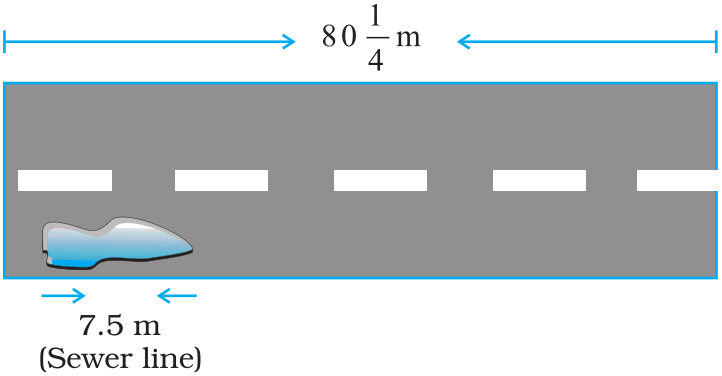
AnswerTotal sewar line to be installed $=80\frac{1}{4}\text{m}=\frac{(80\times4)+1}{4}=\frac{321}{4}\text{m}$
In one day labourers can complete $= 7.5m$
$\therefore$ Number of days to complete the project $=\frac{\text{Total sewer line to be installed}}{\text{One day work}}$
$=\bigg(\frac{\frac{321}{4}}{7.5}\bigg)=\frac{321}{4\times7.5}=\frac{312}{30}$
$=10.4\text{ days}\approx11\text{days}.$
$\therefore$ Hence, the number of days to complete the project will be $11$ days.
View full question & answer→Question 133 Marks
Anvi is making bookmarker like the one shown in Fig. How many bookmarker can she make from a $15\ m$ long ribbon$?$ 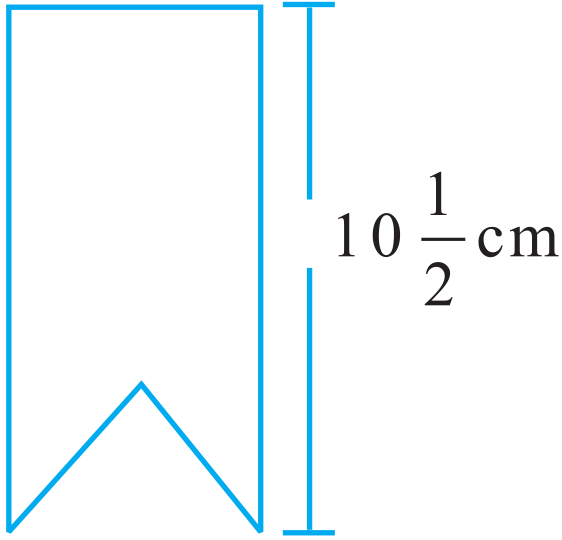
AnswerHeight of one bookmarker $=10\frac{1}{2}\text{cm}$
$=\frac{(10\times2)+1}{2}=\frac{21}{2}\text{cm}$
Length of ribbon $= 15\ m = 1500\ cm$
$\therefore$ Number of bookmarkers $=\frac{\text{length of ribbon}}{\text{Height of one bookmarker}}$
$\big[\because1\text{m}=100\text{cm}\big]$
$=\frac{1500}{\frac{21}{2}}$
$=\frac{1500}{21}\times2 = 142.85 = 142$
Hence, $142$ bookmakers can be made from a $15m$ long ribbon.
View full question & answer→Question 143 Marks
How much cloth will be used in making $6$ shirts, if each required $2\frac{1}{4}\text{m}$ of cloth, allowing $\frac{1}{8}\text{m}$ for waste in cutting and finishing in each shirt$?$
AnswerCloth required in making one shirt
$=\big(2\frac{1}{4}+\frac{1}{8}\big)=\frac{(2\times4)+1}{4}+\frac{1}{8}$
$=\frac{9}{4}+\frac{1}{8}$
$=\frac{18+1}{8}$
$[\because LCM$ of $4$ and $8 = 8]$
$=\frac{19}{8}\text{m}$
Total cloth required in making such $6$ shirts $= 6\ \times $ cloth required in one shirt
$=6\times\frac{19}{8}=\frac{114}{8}=\frac{57}{4}=14\frac{1}{4}\text{m}$
Hence, $14\frac{1}{4}\text{m}$ cloth will be use in making $6$ shirts.
View full question & answer→Question 153 Marks
Describe two methods to compare $\frac{13}{17}$ and $0.82.$ Which do you think is easier and why$?$
AnswerMethod $I$ convert both into decimals
$\frac{13}{17}=0.76$
$\therefore0.76<0.82$
Hence, $\frac{13}{17}<0.82$
Method $II$ Convert both into fractions
$0.82=\frac{82}{100}=\frac{41}{50}$
Now, compare $\frac{13}{17}\ \text{and}\ \frac{41}{50}$
To compare these fractions, we have to make the denominator same,
$\therefore\frac{13}{17}=\frac{13}{17}\times\frac{50}{50}=\frac{650}{850}$
$\frac{41}{50}=\frac{41}{50}\times\frac{17}{17}=\frac{697}{850}$
$\therefore\frac{697}{850}>\frac{650}{250}$
Hence, $\frac{13}{17}<0.82$
Conclusion Method $II$ is easier.
View full question & answer→Question 163 Marks
For the celebrating children’s students of Class $VII$ bought sweets for $Rs. 740.25$ and cold drink for $Rs. 70.$ If $35$ students contributed equally what amount was contributed by each student?
AnswerCost of sweets $= Rs. 740.25$
Cost of cold drink $= Rs. 70$
Total Cost $= Rs. (740.25 + 70) = Rs. 810.25$
Given that, $35$ students are contributing equally.
$\therefore$ Amount contributed by each student $=\text{Rs. }\frac{810.25}{35}=\text{Rs. }\frac{81025}{35\times100}$
$=\text{Rs. }\frac{2315}{100}=\text{Rs. }23.15$
View full question & answer→Question 173 Marks
What portion of a ‘saree’ can Rehana paint in $1$ hour if it requires $5$ hours to paint the whole saree? In $4\frac{3}{5}$ hours? In $3\frac{1}{2}$ hours?
AnswerIn $5h$ Rehana paints $=$ whole saree
In $5h$ Rehana paints $=\frac{1}{5}$ part of saree
In $4\frac{3}{5}\text{h}$ she paints $=\frac{1}{5}\times4\frac{3}{5}=\frac{1}{5}\times\frac{(5\times4)+3}{5}$
$=\frac{1}{5}\times\frac{23}{5}=\frac{23}{25}$ part of saree
In $3\frac{1}{2}\text{h}$ She paints $=\frac{1}{5}\times3\frac{1}{2}$
$=\frac{1}{5}\times\frac{(3\times2)+1}{2}$
$=\frac{1}{5}\times\frac{7}{2}=\frac{7}{10}$ Part of saree.
View full question & answer→Question 183 Marks
Family photograph has length $14\frac{2}{5}\text{cm}$ and breadth $10\frac{2}{5}\text{cm}$ It has border of uniform width $2\frac{3}{5}\text{cm}$ Find the area of framed photograph.
Answer Length of family photograph $=14\frac{2}{5}\text{cm}$ $=\frac{(14\times5)+2}{5}=\frac{72}{5}\text{cm}$ 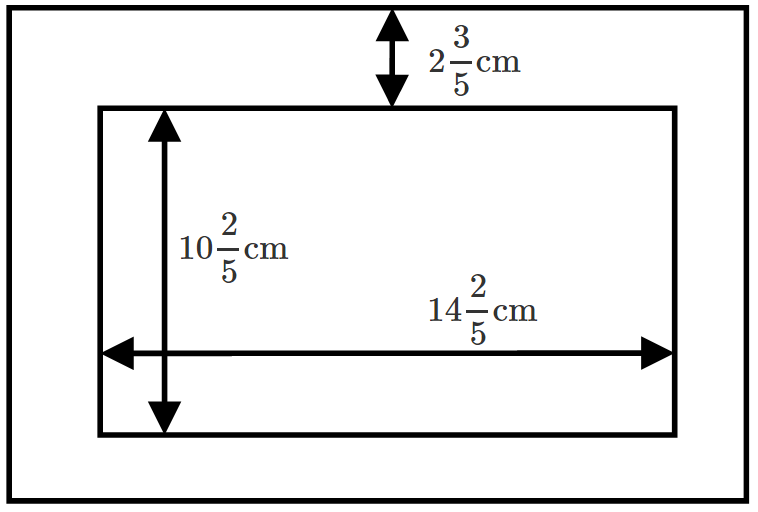
Breadth of family photograph $10=\frac{2}{5}\text{cm}$ $=\frac{(10\times5)+2}{5}=\frac{52}{5}\text{cm}$ New length including border (from both sides) $=\frac{72}{5}+\big(2\frac{3}{5}\times2\big)=\frac{72}{5}+\big(\frac{13}{5}\times2\big)$ $\frac{72}{5}+\frac{26}{5}=\frac{72+26}{5}=\frac{98}{5}\text{cm}$ New width including border (from both sides) $=\frac{52}{5}+\big(2\frac{3}{5}\times2\big)=\frac{52}{5}+\frac{26}{5}$ $=\frac{52+26}{5}=\frac{78}{5}\text{cm}$ $\therefore$ Area of framed photograph = Length × Breadth $=\frac{98}{5}\times\frac{78}{5}=\frac{7644}{25}$ $=305\frac{19}{25}\text{cm}^{2}$ Hence, the area of framed photograph is $305\frac{19}{25}\text{cm}^{2}$ View full question & answer→Question 193 Marks
Meteorology: One measure of average global temperature shows how each year varies from a base measure.
| Year |
$1958$ |
$1964$ |
$1965$ |
$1978$ |
$2002$ |
| Difference from Base |
$0.10^\circ C$ |
$-0.17^\circ C$ |
$-0.10^\circ C$ |
$\big(\frac{1}{50}\big)^\circ\text{C}$ |
$0.54^\circ C$ |
The table shows results for several years. See the table and answer the following:
$a.$ Order the five years from coldest to warmest.
$b.$ In $1946,$ the average temperature varied by $-0.030C$ from the base measure. Between which two years should $1946$ fall when the years are ordered from coldest to warmest$?$ AnswerIn year $1987,$ temperature is $\big(\frac{1}{50}\big)^\circ\text{C}=0.02^\circ\text{C}$
$a.$ By observing coldest to warmest order is ascending order.
$\therefore-0.17^\circ\text{C}<-0.10^\circ\text{C}<-0.02^\circ\text{C}<-0.10^\circ\text{C}<-0.54^\circ\text{C}<-$ Order of year is
$1964<1965<1978<1958<2002$
$b.$ In year $1946,$ temperature is $-0.03^\circ\text{C}$
We know that, $-0.03^\circ\text{C}$ lies between $-0.10^\circ\text{C} $ and $\big(\frac{1}{50}\big)^\circ\text{C}$ or $ 0.02^\circ\text{C}$
$\therefore-0.10^\circ\text{C}<-0.03^\circ\text{C}-0.02^\circ\text{C}$
Hence, the coldest to warmest order including $1946$ is
$1964<1965<1946<1978<1958<2002$
View full question & answer→Question 203 Marks
In the morning a milkman filled $5\frac{1}{2}\text{L}$ of milk in his can. He sold to Renu, Kamla and Renuka $\frac{3}{4}\text{L}$ each to Shadma he sold $\frac{7}{8}\text{L}$ and to Jassi he gave $1\frac{1}{2}\text{L}$ How much milk is left in the can$?$
AnswerGiven, milk in can $=5\frac{1}{2}\text{L}$
$=\frac{(5\times2)+1}{2}=\frac{10+1}{2}=\frac{11}{2}\text{L}$
$\text{If }5\frac{3}{4}\text{L}$ sold to Renu, Kamal and Renuka
Then, total milk sold $=\frac{3}{4}+\frac{3}{4}+\frac{3}{4}$
$=\frac{3+3+3}{4}=\frac{9}{4}$
Milk sold to shadma $=\frac{7}{8}\text{L}$
milk sold to jassi $=1\frac{1}{2}\text{L}=\frac{(1\times2)+1}{2}=\frac{3}{2}\text{L}$
$\therefore$ Total milk left in can $=\frac{11}{2}-\big(\frac{37}{8}\big)$
$=\frac{44-37}{8}=\frac{7}{8}\text{L}$
$ [\because LCM$ of $2$ and $8 = 8] $
Hence, $\frac{7}{8}\text{L}$ milk is left in the can.
View full question & answer→Question 213 Marks
Ravi can walk $3\frac{1}{3}\text{km}$ in one hour. How long will it take him to walk to his office which is $10\ km$ from his home$?$
AnswerGiven, Ravi can walk $3\frac{1}{3}\text{km}$ in $1h$
$\therefore$ Ravi's speed $=3\frac{1}{3}\text{km}=\frac{(3\times3)+1}{3}$
$=\frac{9+1}{3}=\frac{10}{3}\text{km/h}$
$\because$ Distance between Ravi and his office $= 10\ km$
$\therefore\text{Time}=\frac{\text{Distance between Ravi and his office}}{\text{Ravi speed in 1h}}$
$=\frac{10}{10}=\frac{10}{1}\times\frac{3}{10}$
$[\because$ division is reverse of the multiplication$]$
$=\frac{30}{10}=3\text{h}$
Hence, Ravi reaches his office in $3h.$
View full question & answer→Question 223 Marks
It takes $2\frac{1}{3}\text{m}$ of cloth to make a shirt. How many shirts can Radhika make from a piece of cloth $9\frac{1}{3}\text{m}$ long?
AnswerGiven, Radhika takes $2\frac{1}{3}\text{m}$ of cloth to make a shirt
i.e. $2\frac{1}{3}\text{m}=\frac{(2\times3)+1}{3}=\frac{6+1}{3}=\frac{7}{3}\text{m}$
then, number of shirts that can be made $=\frac{\text{Available cloth}}{\text{Required cloth to make one shirt}}$
$=\frac{\frac{28}{3}}{\frac{7}{3}}=\frac{28}{3}\times\frac{3}{7}$
$[\because$ division is reverse of the multiplication$]$
$=\frac{28}{7}=4$
Hence, Radhika can make $4$ shirts from available piece of cloth.
View full question & answer→Question 233 Marks
In a hurdle race, Nidhi is over hurdle $B$ and $\frac{2}{6}$ of the way through the race, as shown in Fig. 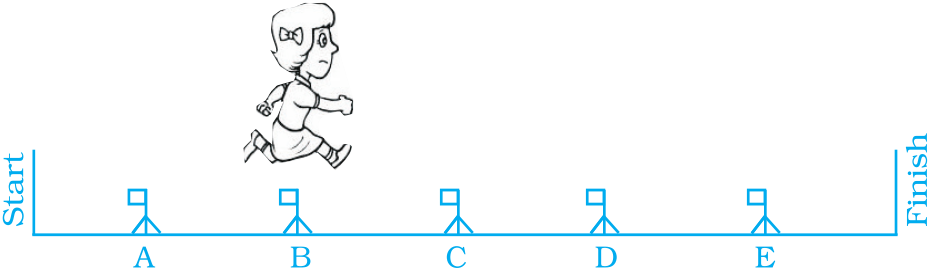
Then, answer the following:
- Where will Nidhi be, when she is $\frac{4}{6}$ of the way through the race$?$
- Where will Nidhi be when she is $\frac{5}{6}$ of the way through the race$?$
- Give two fractions to tell what part of the race Nidhi has finished when she is over hurdle $C.$
AnswerSince, if nidhi is at $B,$
then $\frac{2}{6}$ of the way is completed.
$\therefore$ If she is at $A,$
she will cover $=\frac{\big(\frac{2}{6}\big)}{2}\times1=\frac{2}{6\times2}=\frac{1}{6}\text{way}$
- When she is $\frac{4}{6}$ of the way, she will be at $\frac{\big(\frac{4}{6}\big)}{\big(\frac{1}{6}\big)}$ position
$=\big(\frac{4}{6}\times\frac{6}{1}\big)$ $\big[\because\text{reciprocal of}\frac{1}{6}=6\big]$
$= 4th$ position
$= D$
- When she is $\frac{5}{6}$ of the way, she will be at $\frac{\big(\frac{5}{6}\big)}{\big(\frac{1}{6}\big)}$ position
$=\frac{5}{6}\times\frac{6}{1}$
$= 5th$ position
$= E$
- When she is over hurdle $C,$ she has completed half race. Hance, she will be at
$\frac{3}{6}\text{way}$
$=\frac{3}{6}=\frac{1}{2}\text{way}.$ View full question & answer→