Questions

BLANKS [1 Marks Each]

🎯

Test yourself on this topic

15 questions · timed · auto-graded

Question 11 Mark
The supplement of an obtuse angle is always _________ angle.
Answer
The supplement of an obtuse angle is always $90^\circ $ angle.Solution:
Two angles are said to be complementary angles, if their sum is $90^\circ .$
Hence, if two angles are complementary, then each angle cannot be more than $90^\circ .$
View full question & answer
Question 21 Mark
If sum of measures of two angles is $90^\circ $, then the angles are _______.
Answer
If sum of measures of two angles is $90^\circ $, then the angles are Complementary. Solution: The sum of two complementary angles is $90^\circ .$
View full question & answer
Question 31 Mark
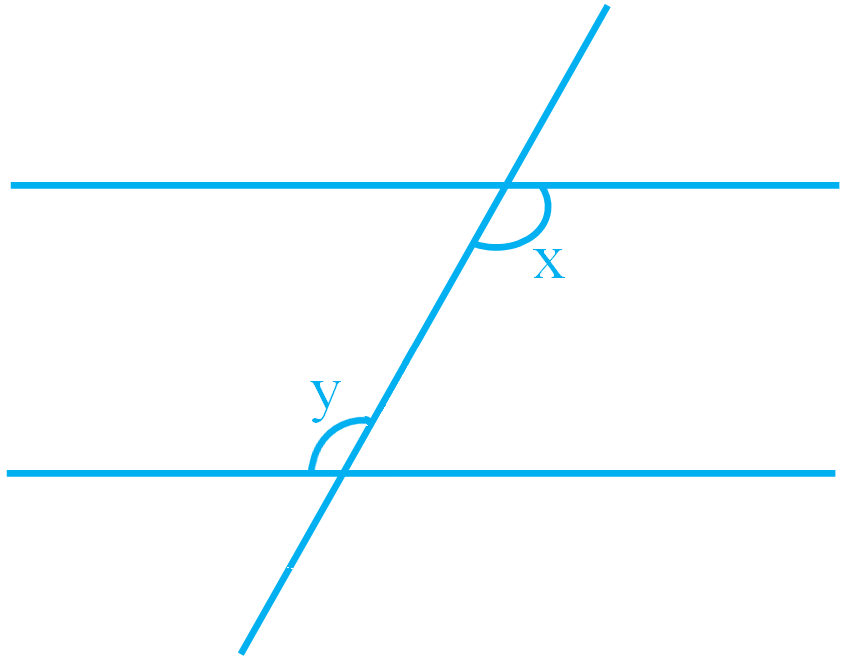
Sum of interior angles on the same side of a transversal is ________.
Answer
Sum of interior angles on the same side of a transversal is $180^\circ $.
Solution:
Sum of interior angles on the same side of a transversal is $180^\circ .$

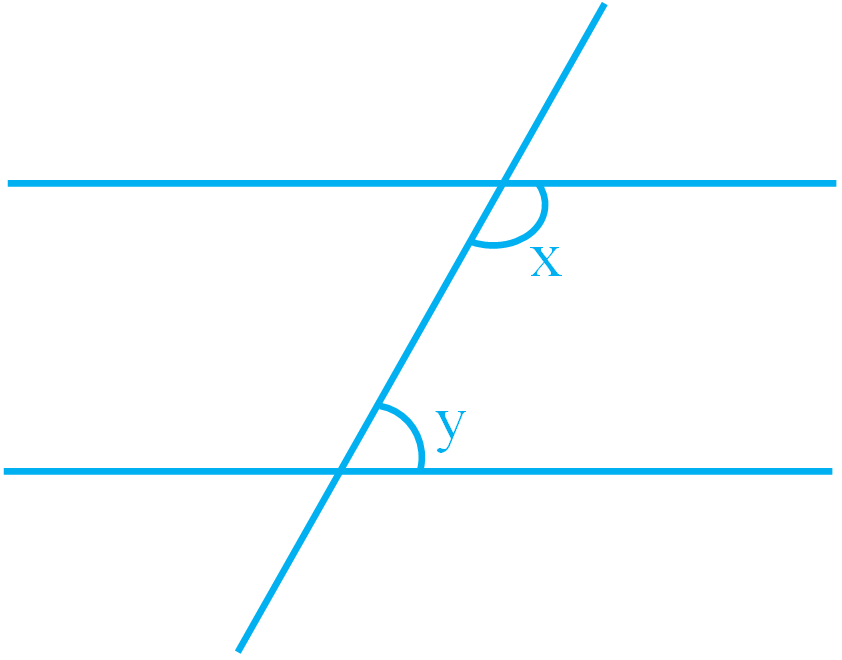
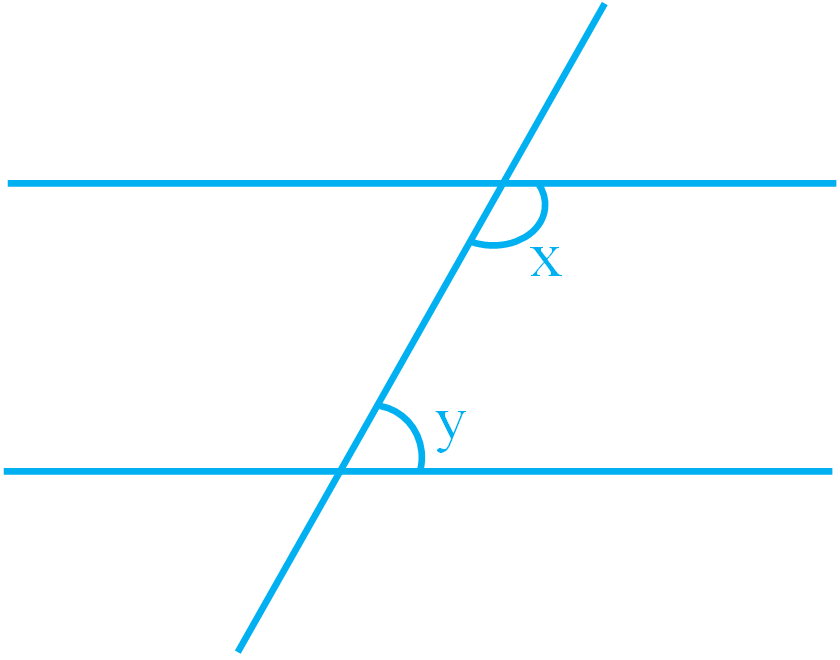
In the above figure, $x + y = 180^\circ .$
View full question & answer
Question 41 Mark
Two lines in a plane which do not meet at a point anywhere are called _________ lines.
Answer
Two lines in a plane which do not meet at a point anywhere are called Parallel lines. Solution: If two lines are parallel, then they will never meet each other.
View full question & answer
Question 51 Mark
The supplement of an acute is always __________ angle.
Answer
The supplement of an acute is always Obtuse angle. Solution: If angle is acute angle, then its supplement will be an obtuse angle. As, if we subtract an angle which is less than $90^\circ $ from $180^\circ $, then result will be an angle greater than $90^\circ .$
View full question & answer
Question 61 Mark
Alternate interior angles are on the _______ side of the transversal.
Answer
Alternate interior angles are on the Opposite side of the transversal.Solution:
Two alternate interior angles are on the opposite side of the transversal.
View full question & answer
Question 71 Mark
Alternate interior angles have one common __________ .
Answer
Alternate interior angles have one common Arm. Solution: Two alternate interior angles have one common arm.
View full question & answer
Question 81 Mark
Corresponding angles are on the ____________ side of the transversal.a
Answer
Corresponding angles are on the Same side of the transversal. Solution: Two corresponding angles are on the same side of the transversal.
View full question & answer
Question 91 Mark
The supplement of a right angle is always _________ angle.
Answer
The supplement of a right angle is always Right angle. Solution: Let x be the supplement of the right angle. Then, $x + 90^\circ = 180^\circ \Rightarrow x = 180^\circ - 90^\circ = 90^\circ $
View full question & answer
Question 101 Mark
An angle is $45^\circ $. Its complementary angle will be _________.
Answer
An angle is $45^\circ $. Its complementary angle will be $45^\circ $.
Solution: Let $x$ be the required angle. Then, $x + 45^\circ = 90^\circ \Rightarrow x = 90^\circ - 45^\circ = 45^\circ $
View full question & answer
Question 111 Mark
Two angles forming a ___________ pair are supplementary.
Answer
Two angles forming a Linear pair are supplementary. Solution : If two angles form a linear pair, then their sum will be $180^\circ .$ Hence, they are supplementary.
View full question & answer
Question 121 Mark
The supplement of an obtuse angle is always ________ angle.
Answer
The supplement of an obtuse angle is always Acute angle.
Solution:
The supplement of an obtuse angle is always an acute angle. As, if we subtract an obtuse angle from $180^\circ $, then result will be an acute angle, i.e. $90^\circ .$
View full question & answer
Question 131 Mark
An angle which is half of its supplement is of __________.
Answer
An angle which is half of its supplement is of $60^\circ .$​​​​​​​
Solution: Let the required angle be $x.$
Then, its supplement will be $(180^\circ - x)$.
​​​​​​​It is given that $x$ is the half of it supplement i.e. $(180^\circ - x).$
Therefoer, $\text{x}\frac{1}{2}(180^\circ-\text{x})$
 $\Rightarrow2\text{x}=180^\circ-\text{x}$
$\Rightarrow2\text{x}+\text{x}=180^\circ$
$\Rightarrow3\text{x}=180^\circ$
$\Rightarrow\text{x}=\frac{180^\circ}{3}$
$\Rightarrow\text{x}=60^\circ$
View full question & answer
Question 141 Mark
If the sum of measures of two angles is $180^\circ $, then they are __________.
Answer
If the sum of measures of two angles is $180^\circ $, then they are Supplementary.
Solution: The sum of two supplementary angles is $180^\circ .$
View full question & answer
Question 151 Mark
A transversal intersects two or more than two lines at _________ points.
Answer
A transversal intersects two or more than two lines at Distinct points.
Solution:
A transversal intersects two or more than two lines at distinct points.
View full question & answer