MCQ 11 Mark
The area of a square and that of a square drawn on its diagonal are in the ratio:
- A
$1:\sqrt{2}$
- ✓
$1 : 2$
- C
$1 : 3$
- D
$1 : 4$
AnswerCorrect option: B. $1 : 2$
Let side of square $=\text{a}$
Then its diagonal $=\sqrt{2}\text{a}$
Now, area of square $=\text{a}^2$
and area of square on diagonal $=(\sqrt{2}\text{a}^2)=2\text{a}^2$
Ratio $=\text{a}^2:2\text{a}^2=1:2$
View full question & answer→MCQ 21 Mark
The perimeters of a square and a rectangle are equal. If their areas be $\mathrm{A m}^2$ and $\mathrm{B} \mathrm{m}{ }^2$, then which of the following is a true statement?
- A
$\text{A}<\text{B}$
- B
$\text{A}\leq\text{B}$
- ✓
$\text{A}>\text{B}$
- D
$\text{A}\geq\text{B}$
AnswerCorrect option: C. $\text{A}>\text{B}$
If perimeters of a square and a rectangle are equal Then the area of the square will be greater than that of a rectangle $A > B$
View full question & answer→MCQ 31 Mark
The base and height of a triangle are $12m$ and $8m$ respectively. Its area is:
- A
$96\text{m}^2$
- ✓
$48\text{m}^2$
- C
$16\sqrt{3}\text{m}^2$
- D
$16\sqrt{2}\text{m}^2$
AnswerCorrect option: B. $48\text{m}^2$
Base of triangle $=12\text{m}$
and height $=8\text{m}$
Area $=\frac{1}{2}\times\text{base}\times\text{height}$
$=\frac{1}{2}\times12\times8=48\text{m}^2$
View full question & answer→MCQ 41 Mark
The area of a rhombus is $144\ cm^2$ and one of its diagonals is double the other. The length of the longer diagonal is:
- A
$12\ cm$
- B
$16\ cm$
- C
$18\ cm$
- ✓
$24\ cm$
AnswerCorrect option: D. $24\ cm$
Area of a rhombus $=144\ cm^2$
Let one diagonal $\left(\mathrm{d}_1\right)=\mathrm{a}$
then Second diagonal $\left(\mathrm{d}_2\right)=2 \mathrm{a}$
$\therefore\frac{1}{2}\text{d}_1\times\text{d}_2=144$
$\Rightarrow\frac{1}{2}\text{a}\times2\text{a}=144$
$\Rightarrow\text{a}^2=144=(12)^2$
$\Rightarrow\text{a}=12$
Largar diagonal $= 2a = 2 \times 12 = 24\ cm$
View full question & answer→MCQ 51 Mark
On increasing each side of a square by $25\%$, the increase in area will be:
- A
$25\%$
- B
$55\%$
- C
$40.5\%$
- ✓
$56.25\%$
AnswerCorrect option: D. $56.25\%$
Let original side of square $= x$
area $=x^2$
Increased side $=\text{x}\times\Big(\frac{100+25}{100}\Big)$
$=\text{x}\times\frac{125}{100}=\frac{5}{4}\text{x}$
$\therefore\text{Area}=\Big(\frac{5}{4}\text{x}\Big)^2=\frac{25}{16}\text{x}^2$
$\therefore$ Increase in area $=\frac{25}{16}\text{x}^2-\text{x}^2$
$=\Big(\frac{25-16}{16}\Big)\text{x}^2$
$=\frac{9}{16}\text{x}^2$
$\%$ increase $=\frac{9}{16}\text{x}^2\times\frac{100}{\text{x}^2}$
$=\frac{9\times25}{4}\%=\frac{225}{4}\%$
$=56.25\%$
View full question & answer→MCQ 61 Mark
The length and breadth of a rectangular field are in the ratio $5 : 3$ and its perimeter is $480m$. The area of the field is:
- A
$7200 \mathrm{~m}^2$
- ✓
$13500 \mathrm{~m}^2$
- C
$15000 \mathrm{~m}^2$
- D
$54000 \mathrm{~m}^2$
AnswerCorrect option: B. $13500 \mathrm{~m}^2$
Perimeter of rectangle $=480\text{m}$
$\therefore\text{l + b}=\frac{480}{2}=240\text{m}$
$\text{l : b}=5:3$
$\therefore\text{length}=\frac{240\times5}{5+3}=\frac{240\times5}{8}=150$
and breadth $=\frac{240\times3}{5+3}=\frac{240\times3}{8}=90\text{m}$
and area $=\text{l}\times\text{b}=150\times90=13500\text{m}^2$
View full question & answer→MCQ 71 Mark
The area of an equilateral triangle is $4\sqrt{3}\text{cm}^2.$ The length of each of its sides is:
AnswerCorrect option: B. $4\text{cm}$
Let side $=\text{a}$
Then area $=\frac{\sqrt{3}}{4}\text{a}^2$
$\therefore\frac{\sqrt{3}}{4}\text{a}^2=4\sqrt{3}$
$\text{a}^2=4\sqrt{3}\times\frac{4}{\sqrt{3}}=16=(4)^2$
$\therefore\text{a}=4$
$\Rightarrow\text{side}=4\text{cm}$
View full question & answer→MCQ 81 Mark
Mark $(✓)$ against the correct answer. The circumference of a circle is $44\ cm$. Its area is:
- A
$308 \mathrm{~cm}^2$
- ✓
$154 \mathrm{~cm}^2$
- C
$77 \mathrm{~cm}^2$
- D
$616 \mathrm{~cm}^2$
AnswerCorrect option: B. $154 \mathrm{~cm}^2$
Let the radius of the circle be $r\ cm$.
Circumference $=(2\pi\text{r})\text{cm}$
$(2\pi\text{r})=44$
$\Rightarrow\Big(2\times\frac{22}{7}\times\text{r}\Big)=44$
$\Rightarrow\text{r}=\Big(\frac{44\times7}{2\times22}\Big)=7\text{cm}$
$\therefore$ Area of the circle $=\pi\text{r}^2$
$=\Big(\frac{22}{7}\times7\times7\Big)\text{cm}^2=154\text{cm}^2$
View full question & answer→MCQ 91 Mark
The length of a rectangular field is thrice its breadth and its perimeter is $240\ m$. The length of the field is:
- A
$80\ m$
- B
$120\ m$
- ✓
$90\ m$
- D
AnswerCorrect option: C. $90\ m$
Perimeter of rectangle $= 240\ m$
$l + b$ $=\frac{240}{2}=120\text{m}$
Let breadth $= x$, then length $4$
$3x + x = 120$
$\Rightarrow 4x = 120$
$\Rightarrow x = 30$
Length $= 3x = 3 \times 30 = 90m$
View full question & answer→MCQ 101 Mark
The perimeter of the floor of a room is $18m$ and its height is $3m$. What is the area of $4$ walls of the room?
- A
$21 \mathrm{~m}^2$
- B
$42 \mathrm{~m}^2$
- ✓
$54 \mathrm{~m}^2$
- D
$108 \mathrm{~m}^2$
AnswerCorrect option: C. $54 \mathrm{~m}^2$
Perimeter of room $= 18\ m$
and height $= 3\ m$
Area of $4$ walls = Perimeter $\times $ height
$=18 \times 3=54 \mathrm{~m}^2$
View full question & answer→MCQ 111 Mark
How many metres of carpet $63\ cm$ wide will be required to cover the floor of a room $14\ m$ by $9\ m$?
- ✓
$200\ m$
- B
$210\ m$
- C
$220\ m$
- D
$185\ m$
AnswerCorrect option: A. $200\ m$
Area of floor $=\mathrm{l} \times \mathrm{b}=14 \times 9=126 \mathrm{~m}^2$
Area of carpet $=126 \mathrm{~m}^2$
Width of carpet $=63\text{cm}=\frac{63}{100}\text{m}$
$\therefore$ Length of carpet $=\frac{\text{Area}}{\text{Width}}$
$=\frac{126\times100}{63}=200\text{m}$
View full question & answer→MCQ 121 Mark
Mark $(✓)$ against the correct answer. The area of a square is $50cm^2$. The length of its diagonal is:
- A
$5\sqrt{2}\text{cm}$
- ✓
$10\text{cm}$
- C
$10\sqrt{2}\text{cm}$
- D
$8\text{cm}$
AnswerCorrect option: B. $10\text{cm}$
Given that the area of the square is $50\ cm^2$
We know:
Area of a square
$=\Big\{\frac{1}{2}\times(\text{Diagonal})^2\Big\}\text{ sq. units}$
$\therefore$ Diagonal of the square $=\sqrt{2\times\text{Area of the square}}$
$=(\sqrt{2\times50})\text{cm}=(\sqrt{100})\text{cm}=10\text{cm}$
Hence, the diagonal of the square is $10\ cm$.
View full question & answer→MCQ 131 Mark
The length of a rectangle is $16\ cm$ and the length of its diagonal is $20\ cm$. The area of the rectangle is:
- A
$320 \mathrm{~cm}^2$
- B
$160 \mathrm{~cm}^2$
- ✓
$192 \mathrm{~cm}^2$
- D
$156 \mathrm{~cm}^2$
AnswerCorrect option: C. $192 \mathrm{~cm}^2$
Length of rectangle $AB = 16\ cm$
and diagonal $BD = 20\ cm$
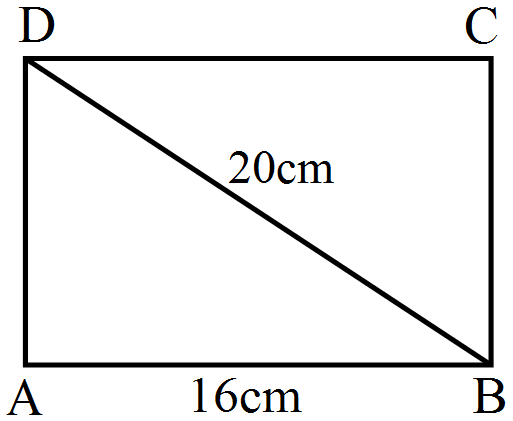
But, in right $\triangle\text{ABD}$
$B D^2=A B^2+A D^2$
$\Rightarrow(20)^2=(16)^2+A D^2$
$\Rightarrow 400=256+A D^2$
$\Rightarrow A D^2=400-256=144=(12)^2$
$\Rightarrow A D=12 \mathrm{~cm}$
$\text { Area }=l \times b=16 \times 12=192 \mathrm{~cm}^2$
View full question & answer→MCQ 141 Mark
Mark $(✓)$ against the correct answer. The lengths of the diagonals of a rhombus are $18\ cm$ and $15\ cm$. The area of the rhombus is:
- A
$270 \mathrm{~cm}^2$
- ✓
$135 \mathrm{~cm}^2$
- C
$90 \mathrm{~cm}^2$
- D
$180 \mathrm{~cm}^2$
AnswerCorrect option: B. $135 \mathrm{~cm}^2$
Area of the rhombus $=\frac{1}{2}\times(\text{Product of the diagonals})$
$=\frac{1}{2}\times18\times15=135\text{cm}^2$
Hence, the area of the rhombus is $135 \mathrm{~cm}^2$.
View full question & answer→MCQ 151 Mark
Mark $(✓)$ against the correct answer. Each diagonal of a square is $14\ cm$ long. Its area is:
- A
$196 \mathrm{~cm}^2$
- B
$88 \mathrm{~cm}^2$
- ✓
$98 \mathrm{~cm}^2$
- D
$147 \mathrm{~cm}^2$
AnswerCorrect option: C. $98 \mathrm{~cm}^2$
Given that the diagonal of a square is $14\ cm$
Area of a square
$=\Big\{\frac{1}{2}\times(\text{Diagonal})^2\Big\}\text{ sq. units}$
$=\Big\{\frac{1}{2}\times(14)^2\Big\}\text{cm}^2$
$=\Big\{\frac{1}{2}\times196\Big\}\text{cm}^2=98\text{cm}^2$
Hence, area of the square is $98\ cm^2$.
View full question & answer→MCQ 161 Mark
Mark $(✓)$ against the correct answer. The sides of triangle are $13\ cm, 14\ cm$ and $15\ cm.$ The area of the triangle is:
- ✓
$84 \mathrm{~cm}^2$
- B
$91 \mathrm{~cm}^2$
- C
$105 \mathrm{~cm}^2$
- D
$97.5 \mathrm{~cm}^2$
AnswerCorrect option: A. $84 \mathrm{~cm}^2$
Let $a = 13\ cm, b = 14\ cm$ and $c = 15\ cm$
$\text{s}=\frac{\text{a + b + c}}{2}$
$=\Big(\frac{13+14+15}{2}\Big)\text{cm}$
$=21\text{cm}$
$\therefore$ Area of the triangle
$=\sqrt{\text{s(s}-\text{a})\text{(s}-\text{b})\text{(s}-\text{c})}\text{ sq. units}$
$=\sqrt{21(21-13)(21-14)(21-15)}\text{cm}^2$
$=\sqrt{21\times8\times7\times6}\text{cm}^2$
$=\sqrt{3\times7\times2\times2\times2\times7\times2\times3}\text{cm}^2$
$=(2\times2\times3\times7)\text{cm}^2=84\text{cm}^2$
View full question & answer→MCQ 171 Mark
The difference between the circumference and radius of a circle is $37\ cm$. The area of the circle is:
- A
$111 \mathrm{~cm}^2$
- B
$148 \mathrm{~cm}^2$
- ✓
$154 \mathrm{~cm}^2$
- D
$259 \mathrm{~cm}^2$
AnswerCorrect option: C. $154 \mathrm{~cm}^2$
Let $r$ be the radius of the circle Then
$\text{c}=2\pi\text{r}$
$2\pi\text{r}-\text{r}=37$
$\Rightarrow\text{r}\Big(2\times\frac{22}{7}-1\Big)=37$
$\Rightarrow\text{r}\Big(\frac{44}{7}-1\Big)=37$
$\Rightarrow\text{r}\Big(\frac{37}{7}\Big)=37$
$\therefore\text{r}=\frac{37\times7}{37}=7\text{cm}$
and area $=\pi\text{r}^2=\frac{22}{7}\times7\times7=154\text{cm}^2$
View full question & answer→MCQ 181 Mark
The length of a room is $15\ m$. The cost of carpeting it with a carpet $75\ cm$ wide at $Rs\ 50$ per metre is $Rs\ 6000$. The width of the room is:
- ✓
$6\ m$
- B
$8\ m$
- C
$13.4\ m$
- D
$18\ m$
AnswerCorrect option: A. $6\ m$
Total cost of carpet $=\text{Rs. }6000$
Rate per metre $=\text{Rs. }50$
$\therefore$ Length of carpet $=\frac{6000}{50}=120\text{m}$
Width $=75\text{cm}=\frac{3}{4}\text{m}$
$\therefore$ Area of room $=120\times\frac{3}{4}$
$=90\text{m}^2$
But length of room $=15\text{m}$
$\therefore\text{breadth} =\frac{\text{Area}}{\text{Length}}=\frac{90}{15}=6\text{m}$
View full question & answer→MCQ 191 Mark
The ratio of the area of a square of side a and that of an equilateral triangle of side a, is:
- A
$2:1$
- B
$2:\sqrt{3}$
- C
$4:3$
- ✓
$4:\sqrt{3}$
AnswerCorrect option: D. $4:\sqrt{3}$
Side of a square $= a$
Area = $a^2$
Side of equilateral triangle $= a$
$\therefore\text{Area}=\frac{\sqrt{3}}{4}\text{a}^2$
$\therefore$ Ratio in their areas $=\frac{\text{a}^2}{\frac{\sqrt{3}}{4}\text{a}^2}$
$=\frac{4\text{a}^2}{\sqrt{3}\text{a}^2}=\frac{4}{\sqrt{3}}$
$=4:\sqrt{3}$
View full question & answer→MCQ 201 Mark
One side of a parallelogram is $16\ cm$ and the distance of this side from the opposite side is $4.5\ cm$. The area of the parallelogram is:
- A
$36 \mathrm{~cm}^2$
- ✓
$72 \mathrm{~cm}^2$
- C
$18 \mathrm{~cm}^2$
- D
$54 \mathrm{~cm}^2$
AnswerCorrect option: B. $72 \mathrm{~cm}^2$
One side (Base) of parallelogram $= 16\ cm$
and altitude $= 4.5\ cm$
Area = base $\times $ altitude = $16 \times 4.5=72 \mathrm{~cm}^2$
View full question & answer→MCQ 211 Mark
Mark $(✓)$ against the correct answer. One side of a parallelogram is $14\ cm$ and the distance of this side from the opposite side is $6.5\ cm$. The area of the parallelogram is:
- A
$45.5 \mathrm{~cm}^2$
- ✓
$91 \mathrm{~cm}^2$
- C
$182 \mathrm{~cm}^2$
- D
$190 \mathrm{~cm}^2$
AnswerCorrect option: B. $91 \mathrm{~cm}^2$
Base $= 14\ cm$
Height $= 6.5\ cm$
Area of the parallelogram = Base $\times $ Height
$=(14 \times 6.5) \mathrm{cm}^2=91 \mathrm{~cm}^2$
View full question & answer→MCQ 221 Mark
The lengths of the diagonals of a rhombus are $24\ cm$ and $18\ cm$ respectively. Its area is:
- A
$432 \mathrm{~cm}^2$
- ✓
$216 \mathrm{~cm}^2$
- C
$108 \mathrm{~cm}^2$
- D
$144 \mathrm{~cm}^2$
AnswerCorrect option: B. $216 \mathrm{~cm}^2$
Length of diagonals of a rhombus are $24\ cm$ and $18\ cm$
$\therefore\text{Area}=\frac{\text{Product of diagonals}}{2}$
$=\frac{24\times18}{2}=216\text{cm}^2$
View full question & answer→MCQ 231 Mark
Mark $(✓)$ against the correct answer.
The area of a circle is $154cm^2$. Its diameter is:
- ✓
$14\ cm$
- B
$11\ cm$
- C
$7\ cm$
- D
$22\ cm$
AnswerCorrect option: A. $14\ cm$
Let the radius of the circle be $r\ cm$
Then, its area will be $(\pi\text{r}^2)\text{cm}^2$
$\pi\text{r}^2=154$
$\Rightarrow\Big(\frac{22}{7}\times\text{r}\times\text{r}\Big)=154$
$\Rightarrow\text{r}^2=\Big(\frac{154\times7}{22}\Big)=49$
$\Rightarrow\text{r}=\sqrt{49}=7\text{cm}$
$\therefore$ Diameter of the circle $= 2r = (2 \times 7)cm = 14\ cm$
View full question & answer→MCQ 241 Mark
If the ratio of the areas of two squares is $9 : 1$, then the ratio of their perimeters is:
- A
$2 : 1$
- ✓
$3 : 1$
- C
$3 : 2$
- D
$4 : 1$
AnswerCorrect option: B. $3 : 1$
Ratio in area of two squares $= 9 : 1$
Let area of bigger square = $9x^2$
and of smaller square = $x^2$
Side of bigger square $=\sqrt{9}\text{x}^2=3\text{x}$
and perimeter $= 4 \times $ side $= 4 × 3x = 12x$
Side of smaller square $=\sqrt{\text{x}}^2=\text{x}$
Perimeter $= 4x$
Now ratio in their perimeter $= 12x : 4x = 3 : 1$
View full question & answer→MCQ 251 Mark
The sides of a triangle measure $13\ cm, 14\ cm$ and $15\ cm$. Its area is:
- ✓
$84 \mathrm{~cm}^2$
- B
$91 \mathrm{~cm}^2$
- C
$168 \mathrm{~cm}^2$
- D
$182 \mathrm{~cm}^2$
AnswerCorrect option: A. $84 \mathrm{~cm}^2$
Sides are $13\ cm, 14\ cm, 15\ cm$
$\therefore\text{s}=\frac{\text{a + b + c}}{2}$
$=\frac{13+14+15}{2}=\frac{42}{2}=21$
and area $=\sqrt{\text{s(s}-\text{a})\text{(s}-\text{b})\text{(s}-\text{c})}$
$=\sqrt{21(21-13)(21-14)(21-15)}$
$=\sqrt{21\times8\times7\times6}$
$=\sqrt{3\times7\times2\times2\times2\times7\times2\times3}$
$=2\times2\times3\times7=84\text{cm}^2$
View full question & answer→MCQ 261 Mark
The area of a rhombus is $36\ cm^2$ and the length of one of its diagonals is $6\ cm$. The length of the second diagonal is:
- A
$6\ cm$
- B
$6\sqrt{2}\text{cm}$
- ✓
$12\ cm$
- D
AnswerCorrect option: C. $12\ cm$
Area of rhombus = $36cm^2$
Length of one diagonal $= 6\ cm$
Length of second diagonal
$=\frac{\text{Area}\times2}{\text{One diagonal}}$
$=\frac{36\times2}{6}=12\text{cm}$
View full question & answer→MCQ 271 Mark
The area of a circle is increased by $22cm^2$ when its radius is increased by $1\ cm$. The original radius of the circle is:
- A
$6\ cm$
- B
$3.2\ cm$
- ✓
$3\ cm$
- D
$3.5\ cm$
AnswerCorrect option: C. $3\ cm$
Let original radius $=\text{r}$
Then its area $=\pi\text{r}^2$
Radius of increased circle $=\text{r}+1$
$\therefore\text{Area}=\pi(\text{r + 1})^2$
Now $\pi(\text{r}+1)^2-\pi\text{r}^2=22$
$\Rightarrow\pi(\text{r}^2+2\text{r}+1)-\pi\text{r}^2=22$
$\Rightarrow\pi\text{r}^2+2\pi\text{r}+\pi-\pi\text{r}^2=22$
$\Rightarrow\pi(2\text{r}+1)=22$
$\Rightarrow\frac{22}{7}(2\text{r}+1)=22$
$\Rightarrow2\text{r + 1}=\frac{22\times7}{22}$
$\Rightarrow2\text{r}=7-1=6$
$\Rightarrow\text{r}=\frac{6}{2}=3$
Radius of original circle $=3\text{cm}$
View full question & answer→MCQ 281 Mark
The area of a square is equal to the area of a circle. What is the ratio between the side of the square and the radius of the circle?
- ✓
$\sqrt{\pi}:1$
- B
$1:\sqrt{\pi}$
- C
$1:\pi$
- D
$\pi:1$
AnswerCorrect option: A. $\sqrt{\pi}:1$
Let a be the side of a square
Area = $a^2$
Then area of circle = $a^2$
Let $r$ be the radius
$\therefore\text{r}=\sqrt{\frac{\text{Area}}{\pi}}=\sqrt{\frac{\text{a}^2}{\pi}}=\frac{\text{a}}{\sqrt{\pi}}$
$\therefore$ Ratio in side of square and radius of circle
$=\text{a}:\frac{\text{a}}{\sqrt{\pi}}=1:\frac{1}{\sqrt{\pi}}$
$=\sqrt{\pi}:1$
View full question & answer→MCQ 291 Mark
Each side of an equilateral triangle is equal to the radius of a circle whose area is $154\ cm^2$. The area of the triangle is:
AnswerCorrect option: B. $\frac{49\sqrt{3}}{4}\ \text{cm}^2$
Let each side of an equilateral triangle $=\text{a}$
Then area $=\frac{\sqrt{3}}{4}\text{a}^2$
Now radius of the circle $=\text{a}$
Then area $=\pi\text{r}^2=\pi\text{a}^2$
$\therefore\pi\text{a}^2=154$
$\Rightarrow\frac{22}{7}\text{a}^2=154$
$\text{a}^2=\frac{154\times7}{22}=49=(7)^2$
$\therefore\text{a}=7$
$\therefore $ Area of $\triangle=\frac{\sqrt{3}}4{}(7)^2=\frac{49\sqrt{3}}{4}\ \text{cm}^2$
View full question & answer→MCQ 301 Mark
The height of an equilateral triangle is $\sqrt{6}\text{cm}.$ Its area is:
- A
$3\sqrt{3}\text{cm}^2$
- ✓
$2\sqrt{3}\text{cm}^2$
- C
$2\sqrt{2}\text{cm}^2$
- D
$6\sqrt{2}\text{cm}^2$
AnswerCorrect option: B. $2\sqrt{3}\text{cm}^2$
Let a be the side of an equilateral triangle
$\therefore\text{Altitude}=\frac{\sqrt{3}}{2}\text{a}$
$\therefore\frac{\sqrt{3}}2{}\text{a}=\sqrt{6}$
$\Rightarrow\text{a}=\frac{\sqrt{6}\times2}{\sqrt{3}}=2\sqrt{2}$
and area $=\frac{\sqrt{3}}{4}\text{a}^2=\frac{\sqrt{3}}{4}(2\sqrt{2})^2$
$=\frac{\sqrt{3}}4{}\times4\times2$
$=2\sqrt{3}\text{cm}^2$
View full question & answer→MCQ 311 Mark
Each diagonal of a square is $12\ cm$ long. Its area is:
- A
$144 \mathrm{~cm}^2$
- ✓
$72 \mathrm{~cm}^2$
- C
$36 \mathrm{~cm}^2$
- D
AnswerCorrect option: B. $72 \mathrm{~cm}^2$
Diagonal of square $= 12\ cm$
Let side $= 9$
diagonal $=\sqrt{2}\text{a}$
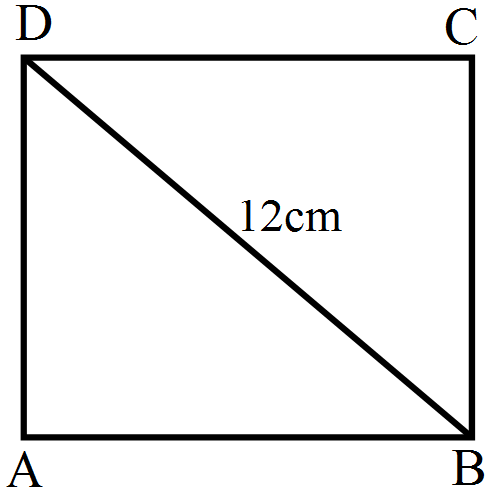
$\therefore\sqrt{2}\text{a}=12\Rightarrow\text{a}=\frac{12}{\sqrt{2}}$
$\therefore\text{Area = a}^2=\Big(\frac{12}{\sqrt{2}}\Big)^2=\frac{12}{\sqrt{2}}\times\frac{12}{\sqrt{2}}=\frac{144}{2}$
$=72\text{cm}^2$ View full question & answer→MCQ 321 Mark
Each side of an equilateral triangle is $8\ cm$ long. Its area is:
- A
$32\text{cm}^2$
- B
$64\text{cm}^2$
- ✓
$16\sqrt{3}\text{cm}^2$
- D
$16\sqrt{2}\text{cm}^2$
AnswerCorrect option: C. $16\sqrt{3}\text{cm}^2$
Side of an equilateral triangle $=8\text{cm}$
$\therefore\text{Area}=\frac{\sqrt{3}}{4}\text{a}^2=\frac{\sqrt{3}}{4}\times8\times8\text{cm}^2$
$=16\sqrt{3}\text{cm}^2$
View full question & answer→MCQ 331 Mark
If the diagonal of a rectangle is $17\ cm$ long and its perimeter is $46\ cm$, the area of the rectangle is:
- A
$100 \mathrm{~cm}^2$
- B
$110 \mathrm{~cm}^2$
- ✓
$120 \mathrm{~cm}^2$
- D
$150 \mathrm{~cm}^2$
AnswerCorrect option: C. $120 \mathrm{~cm}^2$
Perimeter $= 46\ cm$
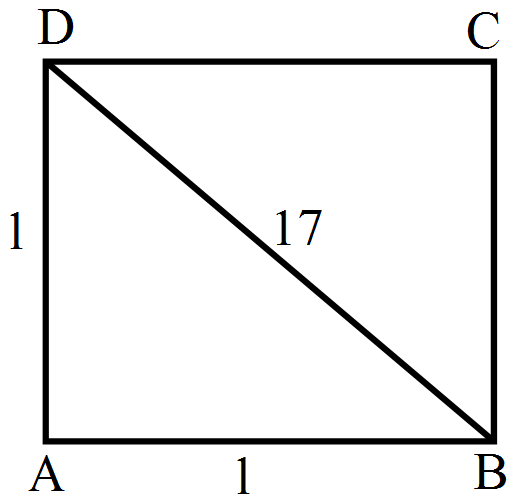
$=\text{l + b}=\frac{46}{2}=23\text{ cm}$
and $ \mathrm{l}^2+\mathrm{b}^2=17^2=289$
Now $(\mathrm{l}+\mathrm{b})^2=(23)^2$
$\Rightarrow \mathrm{l}^2+\mathrm{b}^2+2 \mathrm{l} b=529$
$\Rightarrow 289+2 \mathrm{lb}=529$
$\Rightarrow 2 \mathrm{lb}=529-289$
$\Rightarrow 21 \mathrm{~b}=240 $
$\Rightarrow \mathrm{lb}$
$=\frac{240}{2}=120$
Now area of rectangle $=\mathrm{lb}=120\ \mathrm{ cm}^2$ View full question & answer→MCQ 341 Mark
The radius of a circular wheel is $1.75m$. How many revolutions will it make in travelling $11km$?
- A
$10$
- B
$100$
- ✓
$1000$
- D
$10000$
AnswerCorrect option: C. $1000$
Radius of a circular wheel $(r)$ $=1.75\text{m}$
Circumference $=2\pi\text{r}=2\times\frac{22}{7}\times1.75\text{m}$
$=44\times0.25\text{m}=11\text{m}$
Total distance covered $=11\text{km}$
$\therefore$ No. of revolutions $=\frac{11\text{km}}{11\text{m}}$
$=\frac{11\times1000}{11}=1000$
View full question & answer→MCQ 351 Mark
The area of a square is $200\ cm^2$. The length of its diagonal is:
- A
$10\ cm$
- ✓
$20\ cm$
- C
$10\sqrt{2}\text{ cm}$
- D
$14.1\ cm$
AnswerCorrect option: B. $20\ cm$
Area $=200\text{ cm}^2$
side $=\sqrt{200}=\sqrt{2}\times10$
and diagonal $=\sqrt{2}\text{a}=\sqrt{2}\times\sqrt{2}\times10=20$
View full question & answer→MCQ 361 Mark
The area of a square field is $0.5$ hectare. The length of its diagonal is:
- ✓
$100m$
- B
$50m$
- C
$250m$
- D
$50\sqrt{2}\text{m}$
AnswerCorrect option: A. $100m$
Area of square $= 0.5$ hectare $=0.5\times10000=5000\text{m}^2$
$=\sqrt{10000}=100\text{m}$
View full question & answer→MCQ 371 Mark
The area of a circle is $24.64\ m^2$. The circumference of the circle is:
- A
$14.64\ m$
- B
$16.36\ m$
- ✓
$17.60\ m$
- D
$18.40\ m$
AnswerCorrect option: C. $17.60\ m$
Area of a circle $=24.64\text{m}^2$
$\therefore\text{Radius}=\sqrt{\frac{\text{Area}}{\pi}}$
$=\sqrt{\frac{24.64\times7}{22}}=\sqrt{1.12\times7}$
$=\sqrt{7.84}=2.8\text{m}$
$\therefore$ Circumference $=2\pi\text{r}$
$=2\times\frac{22}{7}\times2.8\text{m}$
$=17.60\text{m}$
View full question & answer→MCQ 381 Mark
The area of a rectangle $144\ m$ long is the same as that of a square of side $84\ m$. The width of the rectangle is:
AnswerCorrect option: C. $49\ m$
Side of square $=84\ m$
Area of square $=(84)^2=7056 m^2$
Area of rectangle $=7056 m^2$
Length of rectangle $=144 m$
Width $=\frac{\text { Area }}{\text { Length }}$
$=\frac{7056}{144}=49\ m$
View full question & answer→MCQ 391 Mark
Mark $(✓)$ against the correct answer. The length and breadth of a rectangular park are in the ratio $4 : 3$ and its perimeter is 56m. The area of the field is:
- ✓
$192 m^2$
- B
$300 m^2$
- C
$432 m^2$
- D
$228 m^2$
AnswerCorrect option: A. $192 m^2$
Let the length of the rectangular park be $4x.$
Breadth $= 3x$
Perimeter of the park $= 2 (l + b) = 56m$ (given)
$\Rightarrow 56 = 2 (4x + 3x)$
$\Rightarrow 56 = 14x$
$\Rightarrow x = 4$
Length $= 4x = (4 × 4) = 16m$
Breadth $= 3x = (3 × 4) = 12m$
Area of the rectangular park $= 16m \times 12m=$ $192 m^2$
View full question & answer→MCQ 401 Mark
The ratio of the areas of two squares, one having its diagonal double that of the other, is:
- A
$2 : 1$
- B
$3 : 1$
- C
$3 : 2$
- ✓
$4 : 1$
AnswerCorrect option: D. $4 : 1$
Let the diagonals of two square be $2\ d$ and $d$
Area of bigger square $2(2 d)^2=8 d^2$
and of smaller $=2(d)^2=2 d^2$
Ratio in their area $=\frac{8 d^2}{2 d^2}=\frac{4}{1}$
$=4: 1$
View full question & answer→MCQ 411 Mark
Mark $(✓)$ against the correct answer. Each side of an equilateral triangle is 8cm. Its area is:
- ✓
$16\sqrt{3}\text{cm}^2$
- B
$32\sqrt{3}\text{cm}^2$
- C
$24\sqrt{3}\text{cm}^2$
- D
$8\sqrt{3}\text{cm}^2$
AnswerCorrect option: A. $16\sqrt{3}\text{cm}^2$
Given that each side of an equilateral triangle is $8\ cm$
Area of the equilateral triangle
$=\frac{\sqrt{3}}{4}(\text{side)}^2\text{sq. units}$
$=\frac{\sqrt{3}}{4}(8)^2\text{cm}^2$
$=\Big(\frac{\sqrt{3}}4{}\times64\Big)\text{cm}^2=16\sqrt{3}\text{cm}^2$
View full question & answer→MCQ 421 Mark
The radius of a circular wheel is 1.75 m. How many revolutions will it make in travelling 11 km?
MCQ 431 Mark
The area of a circle is increased by $22 cm^2$ when its radius is increased by 1 cm. The original radius of the circle is
View full question & answer→MCQ 441 Mark
The area of a circle is $24.64 m^2$. The circumference of the circle is
View full question & answer→MCQ 451 Mark
The area of a rhombus is $144 cm^2$ and one of its diagonals is double the other. The length of the longer diagonal is
View full question & answer→MCQ 461 Mark
The area of a rhombus is $36 cm^2$ and the length of one of its diagonals is 6 cm. The length of the second diagonal is
View full question & answer→MCQ 471 Mark
Each side of an equilateral triangle is equal to the radius of a circle whose area is $154 cm^2$. The area of the triangle is
AnswerCorrect option: B. $\frac{49 \sqrt{3}}{4} cm^2$
View full question & answer→MCQ 481 Mark
The area of a square is equal to the area of a circle. What is the ratio between the side of the square and the radius of the circle?
- ✓
$\sqrt{\pi}: 1$
- B
$1: \sqrt{\pi}$
- C
$1: \pi$
- D
$\pi: 1$
AnswerCorrect option: A. $\sqrt{\pi}: 1$
View full question & answer→MCQ 491 Mark
The ratio of the area of a square of side a and that of an equilateral triangle of side a, is
- A
- B
$2: \sqrt{3}$
- C
- ✓
$4: \sqrt{3}$
AnswerCorrect option: D. $4: \sqrt{3}$
View full question & answer→MCQ 501 Mark
The area of a rectangle 144 m long is the same as that of a square of side 84 m. The width of the rectangle is
MCQ 511 Mark
The ratio of the areas of two squares, one having its diagonal double that of the other, is
MCQ 521 Mark
If the ratio of the areas of two squares is 9: 1, then the ratio of their perimeters is
MCQ 531 Mark
If the diagonal of a rectangle is 17 cm long and its perimeter is 46 cm, the area of the rectangle is
- A
$100 cm^2$
- B
$110 cm^2$
- ✓
$120 cm^2$
- D
$150 cm^2$
AnswerCorrect option: C. $120 cm^2$
View full question & answer→MCQ 541 Mark
How many metres of carpet 63 cm wide will be required to cover the floor of a room 14 m by 9 m?
MCQ 551 Mark
The perimeter of the floor of a room is 18 m and its height is 3 m. What is the area of 4 walls of the room?
- A
$21 m^2$
- B
$42 m^2$
- ✓
$54 m^2$
- D
$108 m^2$
AnswerCorrect option: C. $54 m^2$
View full question & answer→MCQ 561 Mark
The difference between the circumference and radius of a circle is 37 cm. The area of the circle is
- A
$111 cm^2$
- B
$148 cm^2$
- ✓
$154 cm^2$
- D
$259 cm^2$
AnswerCorrect option: C. $154 cm^2$
View full question & answer→MCQ 571 Mark
The lengths of the diagonals of a rhombus are 24 cm and 18 cm respectively. Its area is
- A
$432 cm^2$
- ✓
$216 cm^2$
- C
$108 cm^2$
- D
$144 cm^2$
AnswerCorrect option: B. $216 cm^2$
View full question & answer→MCQ 581 Mark
One side of a parallelogram is 16 cm and the distance of this side from the opposite side is 4.5 cm. The area of the parallelogram is
- A
$36 cm^2$
- ✓
$72 cm^2$
- C
$18 cm^2$
- D
$54 cm^2$
AnswerCorrect option: B. $72 cm^2$
View full question & answer→MCQ 591 Mark
The height of an equilateral triangle is $\sqrt{6} cm$. Its area is
- A
$3 \sqrt{3} cm^2$
- ✓
$2 \sqrt{3} cm^2$
- C
$2 \sqrt{2} cm^2$
- D
$6 \sqrt{2} cm^2$
AnswerCorrect option: B. $2 \sqrt{3} cm^2$
View full question & answer→MCQ 601 Mark
Each side of an equilateral triangle is 8 cm long. Its area is
- A
$32 cm^2$
- B
$64 cm^2$
- ✓
$16 \sqrt{3} cm^2$
- D
$16 \sqrt{2} cm^2$
AnswerCorrect option: C. $16 \sqrt{3} cm^2$
View full question & answer→MCQ 611 Mark
The area of an equilateral triangle is $4 \sqrt{3} cm^2$. The length of each of its sides is
View full question & answer→MCQ 621 Mark
The base and height of a triangle are 12 m and 8 m respectively. Its area is
- A
$96 m^2$
- ✓
$48 m^2$
- C
$16 \sqrt{3} m^2$
- D
$16 \sqrt{2} m^2$
AnswerCorrect option: B. $48 m^2$
View full question & answer→MCQ 631 Mark
The sides of a triangle measure 13 cm, 14 cm and 15 cm. Its area is
- ✓
$84 cm^2$
- B
$91 cm^2$
- C
$168 cm^2$
- D
$182 cm^2$
AnswerCorrect option: A. $84 cm^2$
View full question & answer→MCQ 641 Mark
The length of a room is 15 m. The cost of carpeting it with a carpet 75 cm wide at ₹50 per metre is ₹6000. The width of the room is
MCQ 651 Mark
The length and breadth of a rectangular field are in the ratio 5: 3 and its perimeter is 480 m. The area of the field is
- A
$7200 m^2$
- ✓
$13500 m^2$
- C
$15000 m^2$
- D
$54000 m^2$
AnswerCorrect option: B. $13500 m^2$
View full question & answer→MCQ 661 Mark
The perimeters of a square and a rectangle are equal. If their areas be $A m^2$ and $B m^2$. then which of the following is a true statement?
View full question & answer→MCQ 671 Mark
The area of a square and that of a square drawn on its diagonal are in the ratio
MCQ 681 Mark
On increasing each side of a square by 25%, the increase in area will be
MCQ 691 Mark
The length of a rectangular field is thrice its breadth and its perimeter is 240 m. The length of the field is
MCQ 701 Mark
The area of a square field is 0.5 hectare. The length of its diagonal is
MCQ 711 Mark
The area of a square is $200 cm^2$ The length of its diagonal is
View full question & answer→MCQ 721 Mark
Each diagonal of a square is 12 cm long. Its area is
- A
$144 cm^2$
- ✓
$72 cm^2$
- C
$36 cm^2$
- D
AnswerCorrect option: B. $72 cm^2$
View full question & answer→MCQ 731 Mark
The length of a rectangle is 16 cm and the length of its diagonal is 20 cm. The area of the rectangle is
- A
$320 cm^2$
- B
$160 cm^2$
- ✓
$192 cm^2$
- D
$156 cm^2$
AnswerCorrect option: C. $192 cm^2$
View full question & answer→