Question 12 Marks
Find the cost of polishing a circular table-top of diameter $1.6 \ m$, if the rate of polishing is ₹ $15 / \mathrm{m}^2$. (Take $\pi = 3.14)$
Answer$\text { Diameter of the table-top }=1.6 \mathrm{~m}$
$\therefore \text { Radius of the table-top }(\mathrm{r})=\frac{1.6}{2} \mathrm{~m}=0.8 \mathrm{~m}$
$\therefore \text { Area of the table-top }=\pi \mathrm{r}^2$
$=3.14 \times(0.8)^2$
$=3.14 \times 0.64$
$=2.0096 \mathrm{~m}^2$
Cost of polishing the table-top per meter$^2=₹ 15$
$\therefore$ Cost of polishing the complete table-top $=₹ 2.0096 \times 15=₹ 30.144$
View full question & answer→Question 22 Marks
Find the perimeter of the adjoining figure, which is a semicircle including it's the diameter.
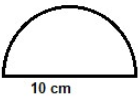
AnswerDiameter of the semicircle $(d) = 10 cm.$
Circumference of circle $= 2 \pi r = \pi d$
Circumference of semicircle $= \frac{1}{2} \pi d = \frac{1}{2} \times 3.14 \times 10$
$= 15.7 cm$
Therefore, perimeter of semicircle including its diameter $= 15.7 + 10 = 25.7 cm.$
View full question & answer→Question 32 Marks
Saima wants to put lace on the edge of a circular table cover of diameter $1.5 \ m$. Find the length of the lace required and also find its cost if one meter of the cost $₹ 15$. (Take $\pi = 3.14)$
AnswerDiameter of the table cover $= 1.5 m$
$\therefore$ Radius of the table cover $(r) = \frac{1.5}{2} m$
$\therefore$ Circumference of the table cover $= 2 \pi r$
$= 2 \times 3.14 \times \frac{1.5}{2} m = 4.71 m$
Cost of the $1 m$ lace $= ₹ 4.71$
\therefore Cost of the $4.71 m$ lace $= Rs. 4.71 \times 15 = ₹ 70.65$
View full question & answer→Question 42 Marks
If the circumference of a circular sheet is $154 \ m$, find its radius. Also, find the area of the sheet (Take $\pi$=$\frac{22}{7}$)
AnswerCircumference of the circular sheet $=154 \mathrm{~m}=2 \pi \mathrm{r}$
$\therefore$ Radius of the circular sheet $(r)=\frac{154 \times 7}{2 \times 22}=\frac{49}{2} \mathrm{~m}$
$\therefore$ Area of the sheet $=\pi r^2=\frac{22}{7}\left(\frac{49}{2}\right)^2$
$=\frac{22}{7} \times \frac{49}{2} \times \frac{49}{2}$
$=1886.5 \mathrm{~m}^2$
View full question & answer→Question 52 Marks
Find the area of the circle, given that: radius $= 5 cm.$
Answer$\mathrm{r}=5 \mathrm{~cm}$
$\therefore \text { Area of the circle }=\pi \mathrm{r}^2$
$=\frac{22}{7}(5)^2$
$=\frac{22}{7} \times 5 \times 5$
$=\frac{550}{7}$
$=78.57 \mathrm{~cm}^2$
View full question & answer→Question 62 Marks
Find the area of the circle, given that: diameter: $= 49 m$
Answer$\text { Diameter }=49 \mathrm{~m}$
$\text { Radius }(r)=\frac{49}{2} \mathrm{~m}$
$\therefore \text { Area of the circle }=\pi \mathrm{r}^2$
$=\frac{22}{7}\left(\frac{49}{2}\right)^2 \mathrm{~m}^2$
$=\frac{22}{7} \times \frac{49}{2} \times \frac{49}{2} \mathrm{~m}^2$
$=\frac{3773}{2} \mathrm{~m}^2=1886.5 \mathrm{~m}^2$
View full question & answer→Question 72 Marks
The minute hand of a circular clock is $15 \ cm$ long. How far does the tip of the minute hand move in 1 hour? (Take $\pi = 3.14)$
AnswerLength of the minute hand of the circular clock $= 15 \ cm$
$\therefore$ Radius of the circular clock $(r) = 15 \ cm$
$\therefore$ Circumference of the circular clock
$= 2 \pi r = 2 \times 3.14 \times 15 cm$
$= 94.2 cm$
$\therefore$ Length moved by the tip of the minute hand in $1$ hour $= 94.2 \ cm$ [As the minute hand makes one complete revolution round the clock in $1$ hour].
View full question & answer→Question 82 Marks
How many times the wheel of radius $28 cm$ must rotate to go $352 m$? (Take $\pi$ = $\frac{22}{7}$)
AnswerRadius of the wheel $(r) = 28 cm$
$\therefore$ The circumference of the wheel $= 2 \pi r cm$
$= 2 \times \frac{22}{7} \times 28 cm$
$= 176 cm$
$\therefore$ Number of times the wheel must rotate to go
$352 m (or 352 \times 100 cm) = \frac{352 \times 100}{176} $
$= 200$
View full question & answer→Question 92 Marks
Find the circumference of the inner and outer circle as show in the adjoining figure? (Take $\pi = 3.14)$
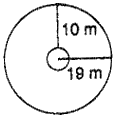
AnswerRadius of the outer circle $= 19 m$
$\therefore$ The circumference of the outer circle $= 2 \pi r $
$= 2 \times 3.14 \times 19 m$
$119.32 m$
Radius of the inner circle $= 19 m – 10 m = 9 m$
$ \therefore$ The circumference of the inner circle $= 2 \pi r $
$= 2 \times 3.14 \times 9 m$
$= 56.52 m$
View full question & answer→Question 102 Marks
A circular flower garden has an area of $314 \mathrm{~m}^2$. A sprinkler at the centre of the garden can cover an area that has a radius of $12 \ m$. Will the sprinkler water entire garden? (Take $\pi = 3.14)$
AnswerThe radius of the area covered by the sprinkler at the centre of the garden $(r)=12 \mathrm{~cm}$
$\therefore$ The area covered by the sprinkler at the centre of the garden $=\pi r^2$
$=3.14 \times(12)^2 \mathrm{~m}^2=452.16 \mathrm{~m}^2$
Area of the garden $=314 \mathrm{~m}^2$
Hence, the sprinkler will water the entire garden.
View full question & answer→Question 112 Marks
The circumference of a circle is $31.4 \ cm$. Find the radius and the area of the circle? (Take $\pi = 3.14)$
AnswerLet the radius of the circle be rcm .
Circumference of the circle $=31.4 \mathrm{~cm}$
$\therefore 2 \pi r=31.4$
$\therefore 2 \times 3.14 \times r=31.4$
$\therefore r=\frac{31.4}{2 \times 3.14}=5 \mathrm{~cm}$
$\therefore \text { Area of the circle }=\pi r^2$
$=3.14 \times 5^2 \mathrm{~cm}^2$
$=3.14 \times 25 \mathrm{~cm}^2$
$=78.5 \mathrm{~cm}^2$
View full question & answer→Question 122 Marks
A circle of radius $2 \ cm$ is cut out from a square piece of an aluminium sheet of side $6 \ cm$. What is the area of the leftover aluminium sheet? (Take $\pi = 3.14)$
Answer$\text { Side of the square piece }=6 \mathrm{~cm}$
$\therefore \text { Area of the square piece }=(\text { side })^2$
$=(6)^2 \mathrm{~cm}^2=6 \times 6 \mathrm{~cm}^2$
$=36 \mathrm{~cm}^2$
Area of the circle of radius $2 \mathrm{~cm}=\pi(2)^2 \mathrm{~cm}^2$
$=3.14 \times 4 \mathrm{~cm}^2$
$=12.56 \mathrm{~cm}^2$
$\therefore$ Area of the left over aluminium sheet
$=$ Area of the square piece - Area of the circles
$=36 \mathrm{~cm}^2-12.56 \mathrm{~cm}^2$
$=(36-12.56) \mathrm{cm}^2$
$=23.44 \mathrm{~cm}^2$
View full question & answer→Question 132 Marks
$\triangle ABC$ is isosceles with $AB = AC = 7.5 cm$, and $BC = 9 cm$. The length from $AD$ from $A$ to $BC$ is $6 \ cm$. Find the area of $\triangle ABC$. What will be the height from $C$ to $AB$ i.e, $CE?$
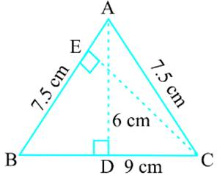
AnswerArea of $\triangle ABC = \frac{1}{2}$ (Base $\times$ Height)
$= \frac{1}{2} (BC \times AD)$
$= \frac{1}{2} (9 \times 6)$
$= 27 \mathrm{~cm}^2$
Hence, the area of $\triangle ABC is 27 \mathrm{~cm}^2 $
Again, Area of $\triangle ABC = \frac{1}{2}$ (Base $\times$ Height)
$= \frac{1}{2} (AB \times$ Height from $C$ to $AB$ or $CE)$
$\Rightarrow 27 = \frac{1}{2} (7.5 × CE)$
$ \Rightarrow CE = \frac{{27 \times 2}}{{7.5}} = \frac{{54}}{{7.5}} = 7.2 cm$
Hence, the height (from $C$ to $AB) CE$ is $7.2 cm.$
View full question & answer→Question 142 Marks
$\triangle ABC$ is right angled at $A.\ AD$ is perpendicular $BC.$ If $AB = 5\ cm, BC = 13\ cm$ and $AC = 12\ cm.$ Find the area of $\triangle ABC. $Also, Find the length of $AD.$
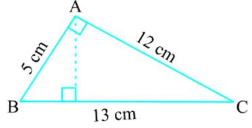
AnswerArea of $\frac{1}{2} ABC = \frac{1}{2}$ (Base $\times$ Height)
$= \frac{1}{2} (AB \times AC)$
$= \frac{1}{2} (5 \times 12) = 30 \mathrm{~cm}^2$
Hence, the area of $\frac{1}{2} ABC$ is $30 \mathrm{~cm}^2$
Area of $\triangle ABC = \frac{1}{2}$ (Base $\times$ Height)
$= \frac{1}{2} (BC \times AD)$
$30 = \frac{1}{2} (13 \times AD)$
$13 \times AD = 30 v 2$
$ \therefore AD = \frac{30 \times 2}{13}=\frac{60}{13} cm$
Hence, the length of $AD$ is $\frac{60}{13} cm.$
View full question & answer→Question 152 Marks
Find the missing value: Base is $22 \ cm$, Height is ________ and Area of the triangle is $170.5 \mathrm{~cm}^2$
AnswerIt is given in the question that,
Base of triangle $= 22 cm$
Area of triangle $= 170.5 \mathrm{~cm}^2$
Let Height of triangle $= h cm$
We know that, Area of triangle $= \frac{1}{2} \times$ Base $\times$ Height
$\Rightarrow 170.5 = \frac{1}{2} \times 22 \times h$
$ \Rightarrow 341 = 22 \times h$
$ \Rightarrow h = 341/22 = 15.5 cm$
Therefore, Height of triangle is $15.5 cm$
View full question & answer→Question 162 Marks
Find the missing value: Base is ________, Height is $31.4\ mm$ and Area of the triangle is $1256 \mathrm{~mm}^2$
AnswerIt is given in the question that,
Height of triangle $= 31.4 mm$
Area of triangle $= 1256 \mathrm{~mm}^2$
Let Base of triangle $= b mm$
We know that,
Area of triangle $= \frac{1}{2} \times$ Base $\times$ Height
$\Rightarrow 1256 = \frac{1}{2} \times b \times 31.4$
$ \Rightarrow 2512 = b \times 31.4$
$ \Rightarrow b=\frac{2512}{31.4} = 80 mm$
Therefore, Base of triangle is $80 mm$
View full question & answer→Question 172 Marks
Find the missing value: Base is $15\ cm,$ Height is ________ and Area of the triangle is $87 \mathrm{~cm}^2$
AnswerIt is given in the question that,
Base of triangle $= 15\ cm$
Area of triangle $= 87 \mathrm{~cm}^2$
Let Height of triangle $= h\ cm$
We know that,
Area of triangle $= \frac{1}{2} \times$ Base $\times$ Height
$\Rightarrow 87 = \frac{1}{2} \times 15 \times h$
$ \Rightarrow 174 = 15 \times h$
$ \Rightarrow h = \frac{174}{15} = 11.6\ cm$
Therefore, Height of triangle is $11.6\ cm$
View full question & answer→Question 182 Marks
Find the missing value: Base is $15.6\ cm, $ Height is ________ and Area of the parallelogram is $16.38 \mathrm{~cm}^2$
AnswerIt is given in the question that,
Base of parallelogram $= 15.6\ cm$
Area of parallelogram $= 16.38 \mathrm{~cm}^2$
Let Height of parallelogram $= h\ cm$
We know that,
Area of parallelogram $=$ Base $\times$ Height
$\Rightarrow 16.38 = 15.6 \times h$
$\Rightarrow h = \frac{16.38}{15.6} = 1.05\ cm$
Therefore, Height of parallelogram is $1.05\ cm$
View full question & answer→Question 192 Marks
Find the missing value: Base is ________, Height is $8.4\ cm$ and Area of the parallelogram is $48.72 \mathrm{~cm}^2$
AnswerIt is given in the question that,
Height of parallelogram $= 8.4 \ cm$
Area of parallelogram $= 48.72 \mathrm{~\ cm}^2$
Let Base of parallelogram $= b \ cm$
We know that,
Area of parallelogram $=$ Base $\times$ Height
$\Rightarrow 48.72 = b \times 8.4$
$\Rightarrow b = \frac{48.72}{8.4} = 5.8 \ cm$
Therefore, Base of parallelogram is $5.8 \ cm$
View full question & answer→Question 202 Marks
Find the missing value:
Base is ________, Height is $15 \ cm$ and Area of the parallelogram is $154.5 \mathrm{~cm}^2$
AnswerHere we are given that:
Height of parallelogram $= 15\ cm$
Area of parallelogram $= 154.5 \mathrm{~cm}^2$
Let Base of parallelogram $= b\ cm$
We know that,
Area of parallelogram $=$ Base $\times$ Height
$\Rightarrow 154.5 = b \times 15$
$\Rightarrow b = \frac{154.5}{15}$
$\Rightarrow b = 10.3\ cm$
$\therefore$ Base of parallelogram is $10.3\ cm$
View full question & answer→Question 212 Marks
Find the missing value: Base is $20\ cm,$ Height is ________ and Area of the parallelogram is $246 \mathrm{~cm}^2$.
AnswerHere, we are given that:
Base of parallelogram $= 20\ cm$
Area of parallelogram $= 246 \mathrm{~cm}^2$
Let height of the parallelogram $= h\ cm$
Then, Area of parallelogram $=$ Base $\times$ Height
$\Rightarrow 246 = 7 \times 4$
$\Rightarrow h=\frac{246}{20}$
$⇒ h = 12.3\ cm$
$\therefore$ Height of parallelogram is $12.3\ cm$
View full question & answer→Question 222 Marks
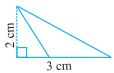
Find the area of the triangle:
AnswerHere, we are given that:
Height of triangle $= 2\ cm$
Base of triangle $= 3 \ cm$
We know that,
Area of triangle $= \frac{1}{2} \times Base \times Height$
$= \frac{1}{2} \times 3 \times 2 = \frac{1}{2} \times 6$
$= 3 \mathrm{~cm}^2$
$\therefore$ Area of triangle is $3 \mathrm{~cm}^2$
View full question & answer→Question 232 Marks
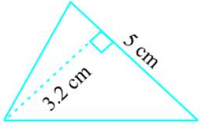
Find the area of the triangle:
AnswerHere, we are given that:
Height of triangle $= 3.2\ cm$
Base of triangle $= 5\ cm$
We know that,
Area of triangle = $\frac{1}{2}$ $\times$ Base $\times$ Height
$=\frac{1}{2} \times 5 \times 3.2$
$=\frac{1}{2} \times 16.0$
= $8 \mathrm{~cm}^2$
$\therefore$ Area of triangle is $8 \mathrm{~cm}^2$
View full question & answer→Question 242 Marks
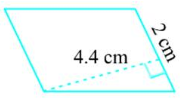
Find the area of the parallelogram:
AnswerHere, we are given that:
Height of parallelogram $= 4.4\ cm$
Base of parallelogram $= 2\ cm$
We know that,
Area of parallelogram $=$ Base $\times$ Height
$= 2 \times 4.4$
$= 8.8 ~cm^2$
$\therefore$ Area of parallelogram is $8.8 ~cm^2$
View full question & answer→Question 252 Marks
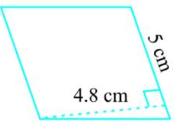
Find the area of the parallelogram:
AnswerHere, we are given that:
Height of parallelogram $= 4.8\ cm$
Base of parallelogram $= 5 \ cm$
We know that,
Area of parallelogram $=$ Base $\times$ Height
$= 4.8 \times 5$
$= 24 \mathrm{~cm}^2$
$\therefore$ Area of parallelogram is $24 \mathrm{~cm}^2$
View full question & answer→Question 262 Marks
Find the area of the parallelogram:
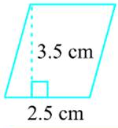
AnswerHere, we are given that:
Height of parallelogram $= 3.5 \ cm$
Base of parallelogram $= 2.5\ cm$
We know that,
Area of parallelogram $=$ Base $\times$ Height
$= 2.5 \times 3.5$
$= 8.75 \mathrm{~cm}^2$
$\therefore$ Area of parallelogram is $8.75 \mathrm{~cm}^2$
View full question & answer→Question 272 Marks
Find the area of the parallelogram:
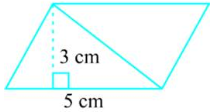
AnswerHere, we are given that:
Height of parallelogram $= 3\ cm$
Base of parallelogram $= 5\ cm$
We know that,
Area of parallelogram $=$ Base $\times$ Height
$= 5 \times 3$
$= 15 \mathrm{~cm}^2$
$\therefore$ Area of parallelogram is $15 \mathrm{~cm}^2$
View full question & answer→Question 282 Marks
Find the area of the parallelogram:
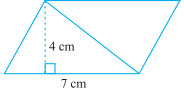
AnswerHere, we are given that:
Height of parallelogram $= 4\ cm$
Base of parallelogram $= 7\ cm$
We know that,
Area of parallelogram $=$ Base $\times$ Height
$= 7 \times 4$
$= 28 \mathrm{~cm}^2$
$\therefore$ Area of a parallelogram is $28 \mathrm{~cm}^2$
View full question & answer→Question 292 Marks
The two sides of the parallelogram $\ce{ABCD}$ are $6\ cm$ and $4 \ cm.$ The height corresponding to the base $CD$ is $3\ cm$ $($Fig$).$ Find the
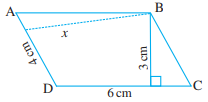
$i.$ area of the parallelogram.
$ii.$ the height corresponding to the base $AD.$ AnswerHere, we have
$ i. $ Area of parallelogram $=\mathrm{b} \times \mathrm{h}$
$=6 \mathrm{~cm} \times 3 \mathrm{~cm}$
$=18 \mathrm{~cm}^2$
$ii. $ Base $(b)=4 \mathrm{~cm}$, height $=x ($say$),$
Area of parallelogram $=18 \mathrm{~cm}^2$
$\Rightarrow$ Area of parallelogram $=\mathrm{b} \times \mathrm{x}$
$\Rightarrow 18=4 \times \mathrm{x}$
$\Rightarrow \frac{18}{4}=x$
Therefore, $x=4.5 \mathrm{~cm}$
Thus, the height corresponding to base $A D$ is $4.5\ cm .$
View full question & answer→Question 302 Marks
Two cross roads, each of width $5\ m, $ run at right angles through the centre of a rectangular park of length $70\ m$ and breadth $45\ m$ and parallel to its sides. Find the area of the roads. Also find the cost of constructing the roads at the rate of $₹ 105$ per $m^2.$
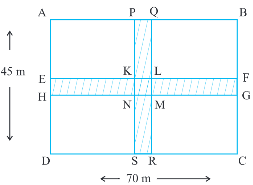
AnswerClearly, area of the cross roads is the area of shaded portion, i.e., the area of the rectangle $PQRS$ and the area of the rectangle $EFGH.$ But while doing this, the area of the square $KLMN$ is taken twice, which is to be subtracted once to get the required area.
Now, $P Q=5 \mathrm{~m}$ and $P S=45 \mathrm{~m}$
$\mathrm{EH}=5 \mathrm{~m} \text { and } \mathrm{EF}=70 \mathrm{~m}$
$\mathrm{KL}=5 \mathrm{~m} \text { and } \mathrm{KN}=5 \mathrm{~m}$
Therefore, area of the path $=$ Area of the rectangle $PQRS\ + $ area of the rectangle $EFGH\ -$ Area of the square $KLMN$
$=\mathrm{PS} \times \mathrm{PQ}+\mathrm{EF} \times \mathrm{EH}-\mathrm{KL} \times \mathrm{KN}$
$=(45 \times 5+70 \times 5-5 \times 5) \mathrm{m}^2$
$=(225+350-25) \mathrm{m}^2=550 \mathrm{~m}^2$
Hence, cost of constructing the path $=₹ 105 \times 550=₹ 57,750$
View full question & answer→Question 312 Marks
The area of a rectangular sheet is $500 \mathrm{~cm}^2$. If the length of the sheet is $25\ cm,$ what is its width? Also find the perimeter of the rectangular sheet.
AnswerHere, we are given that:
Area of the rectangular sheet $= 500 \mathrm{~\ cm}^2$
Length $(l) = 25 \ cm$
Area of the rectangle $= l \times b ($where $b =$ width of the sheet$)$
Therefore, width $b=\frac{\text { Area }}{l}=\frac{500}{25} = 20 \ cm$
Perimeter of sheet $= 2 \times (l + b) = 2 \times (25 + 20) \ cm = 90 \ cm$
So, the width of the rectangular sheet is $20 \ cm$ and its perimeter is $90 \ cm.$
View full question & answer→Question 322 Marks
The radius of a circular pipe is $10\ cm.$ What length of a tape is required to wrap once around the pipe $(\pi = 3.14)?$
AnswerHere, we are given that:
Radius of the pipe $(r) = 10 \ cm$
Length of tape required is equal to the circumference of the pipe.
Circumference of the pipe $= 2 \pi r$
$= 2 \times 3.14 \times 10 \ cm$
$= 62.8 \ cm$
Therefore, length of the tape needed to wrap once around the pipe is $62.8 \ cm.$
View full question & answer→Question 332 Marks
What is the circumference of a circular disc of radius $14\ cm?\ ($Use $\pi=\frac{22}{7})$
AnswerHere, we are given that:
Radius of circular disc $(r) = 14\ cm$
Circumference of disc $= 2πr =2 \times \frac{22}{7} \times 14\ cm = 88 \ cm$
So, the circumference of the circular disc is $88\ cm.$
View full question & answer→Question 342 Marks
What is the circumference of a circle of diameter $10\ cm($Take $\pi = 3.14)?$
AnswerDiameter of the circle $(d) = 10 \ cm$
Therefore, Circumference of circle $= \pi d = 3.14 \times 10 \ cm = 31.4 \ cm$
So, the circumference of the circle of diameter $10 \ cm$ is $31.4 \ cm.$
View full question & answer→Question 352 Marks
Find $BC,$ if the area of the triangle $ABC$ is $36 \mathrm{~cm}^2$ and the height $AD$ is $3\ cm$ (Fig).
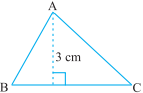
AnswerHere, we are given that:
Height $= 3\ cm$
Area $= 36 \mathrm{~cm}^2$
Also, Area of the triangle $ABC =\frac{1}{2} \times b\times h$
$\Rightarrow 36=\frac{1}{2} \times b \times 3$
$\Rightarrow b=\frac{36 \times 2}{3}=24 \mathrm{cm}$
So, $BC = 24\ cm$
View full question & answer→Question 362 Marks
A door-frame of dimensions $3\ m \times 2\ m$ is fixed on the wall of dimension $10\ m \times 10\ m.$ Find the total labour charges for painting the wall if the labour charges for painting $1\ m^2$ of the wall is $₹\ 2.50.$
AnswerPainting of the wall has to be done excluding the area of the door frame.
Now, Area of the door $=l \times b=3 \times 2 \mathrm{~m}^2=6 \mathrm{~m}^2$
Also, Area of the wall including door frame $=$ side $\times$ side $=10 \mathrm{~m} \times 10 \mathrm{~m}=100 \mathrm{~m}^2$
Therefore, Area of wall excluding door $=(100-6) \mathrm{m}^2=94 \mathrm{~m}^2$
Hence, the total labor charges for painting the wall $=₹ 2.50 \times 94=₹ 235$
View full question & answer→