Question 12 Marks
The hypotenuse of a triangle is $2.5\ cm$. If one of the sides is $1.5\ cm$. find the length of the other side.
AnswerLet the hypotenuse be $" c "$ and the other two sides be $" b "$ and $" c "$.
Using the Pythagoras theorem, we can say that:
$c^2=a^2+b^2$
$2.52=1.52+b^2$
$b^2=6.25-2.25=4$
$c=2 \mathrm{~cm}$
Hence, the length of the other side is $2\ cm$ .
View full question & answer→Question 22 Marks
Verity that the following number represent Pythagorean triplet:
$15, 36, 39$
AnswerWe will check for a Pythagorean triplet by checking if the square of the largest side is equal to the sum of the squares of the other two sides.
$39^2=1521$
$15^2+36^2$
$=225+1296=1521$
$15^2+36^2=39^2$
Yes, they represent a Pythagorean triplet.
View full question & answer→Question 32 Marks
Is it possible to have a triangle, in which. Two of the angles are obtuse?
AnswerGive reasons in support of your answer in.
No, because as we know that the sum of all three angles of a triangle is always $180^\circ$ .
If there are two obtuse angles, then their sum will be more than $180^\circ$ , which is not possible in case of a triangle.
View full question & answer→Question 42 Marks
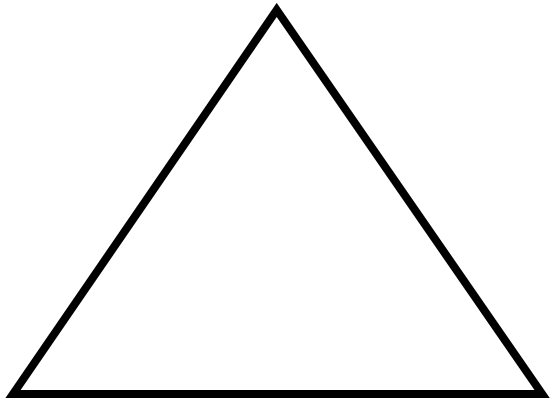
Explain the following term: Equilateral triangle.
AnswerAn equilateral triangle is a triangle in which all three sides are equal. Equilateral triangle.
View full question & answer→Question 52 Marks
If the sides of a triangle are $3\ cm, 4\ cm$ and $6\ cm$ long, determine whether the triangle is right-angled triangle.
AnswerIn the given triangle, the largest side is $6] cm$ .
We know that in a right angled triangle, the sum of the squares of the smaller sides should be equal to the square of the largest side.
Therefore,
$3^2+42=9+16=25$
But,
$6^2=36$
$3^2+4^2$ not equal to $6^2$
Hence, the given triangle is not a right angled triangle.
View full question & answer→Question 62 Marks
In right $\triangle \text{ABC},$ the lengths of the legs are given. Find the length of the hypotenuse.
$a = 8\ cm, b = 15\ cm$
AnswerAccording to the Pythagoras theorem,
$(\text { Hypotenuse })^2=(\text { Base })^2+(\text { Height })^2$
$c^2=a^2+b^2$
$c^2=8^2+15^2$
$c^2=64+225=289$
$c=17 \mathrm{~cm}$
View full question & answer→Question 72 Marks
In the following, there are three positive numbers. State if these number could possibly be the lengths of the sides of a triangle:
$2, 10.15$
AnswerNo, these numbers cannot be the lengths of the sides of a triangle because the sum of any two sides of a triangle is always greater than the third side, which is not true in this case.
View full question & answer→Question 82 Marks
The two legs of a right triangle are equal and the square of the hypotenuse is $50$. Find the length of each leg.
AnswerLet the length of each leg of the given triangle be $x$ units.
Using the Pythagoras theorem, we get:
$x^2+x^2=\text { (Hypotenuse)}^2$
$x^2+x^2=50$
$2 x^2=50$
$x^2=25$
$x=5$
Hence, we can say that the length of each leg is $5$ units.
View full question & answer→Question 92 Marks
In the following, there are three positive numbers. State if these number could possibly be the lengths of the sides of a triangle:
$3, 4, 5$
AnswerYes, these numbers can be the lengths of the sides of a triangle because the sum of any two sides of triangle is always greater than the third side. Here, $3 + 4 > 5, 3 + 5 > 4, 4 + 5 > 3$
View full question & answer→Question 102 Marks
In the following, there are three positive numbers. State if these number could possibly be the lengths of the sides of a triangle:
$5, 7, 9$
AnswerYes, these numbers can be the lengths of the sides of a triangle because the sum of any two sides of a triangle is always greater than the third side. Here, $5 + 7 > 9, 5 + 9 > 7, 9 + 7 > 5$
View full question & answer→Question 112 Marks
Distinguish between a triangle and its triangular region.
AnswerA triangle is a plane figure formed by three non-parallel line segments, whereas, its triangular region includes the interior of the triangle along with the triangle itself.
View full question & answer→Question 122 Marks
Explain the following term: Triangle.
AnswerA triangle is a plane figure formed by three non-parallel line segments.
View full question & answer→Question 132 Marks
Verity that the following number represent Pythagorean triplet:
$12, 35, 37$
AnswerWe will check for a Pythagorean triplet by checking if the square of the largest side is equal to the sum of the squares of the other two sides.
$372=1369$
$122+352$
$=144+1225=1369$
$122+352=37^2$
Yes, they represent a Pythagorean triplet.
View full question & answer→Question 142 Marks
In the following, there are three positive numbers. State if these number could possibly be the lengths of the sides of a triangle:
$2, 5, 7$
AnswerNo, these numbers cannot be the lengths of the sides of a triangle because the sum of any two sides of a triangle is always greater than the third side, which is not true in this case. Here, $2 + 5 = 7$
View full question & answer→Question 152 Marks
Is it possible to have a triangle, in which. Two of the angles are acute?
AnswerGive reasons in support of your answer in. Yes, in right triangles and acute triangles, it is possible to have two acute angles.
View full question & answer→Question 162 Marks
The sides of certain triangles are given below. Determine which of them are right triangles.
$a = 9\ cm, b = 16\ cm$ and $c = 18\ cm$
AnswerWe know that in a right angled triangle, the square of the largest side is equal to the sum of the squares of the smaller sides.
Here, the larger side is $c$, which is $18\ cm$ .
$c^2=324$
We have:
$a^2+b^2$
$=9^2+16^2$
$=81+256$
$=337 \text { not equal to } c^2$
Thus, the given triangle is not a right triangle.
View full question & answer→Question 172 Marks
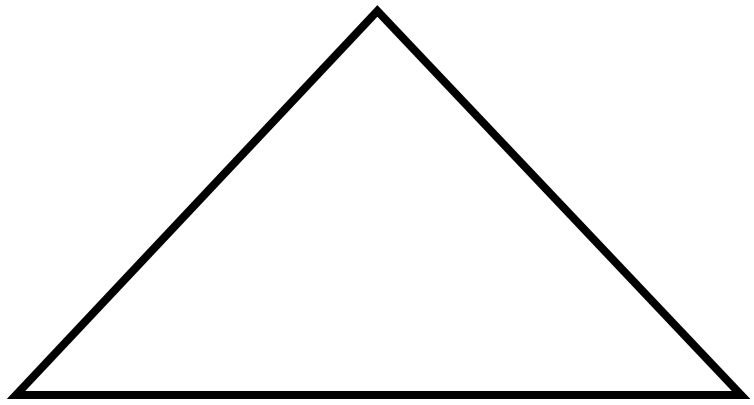
Explain the following term: Isosceles triangle.
AnswerAn isosceles triangle is a triangle in which two sides are equal. Isosceles triangle.
View full question & answer→Question 182 Marks
The sides of certain triangles are given below. Determine which of them are right triangles.
$a = 7\ cm, b = 24\ cm$ and $c = 25\ cm$
AnswerWe know that in a right angled triangle, the square of the largest side is equal to the sum of the squares of the smaller sides.
Here, the larger side is $c$ , which is $25\ cm$ .
$c^2=625$
We have:
$a^2+b^2$
$=7^2+24^2$
$=49+576$
$=625=c^2$
Thus, the given triangle is a right triangle.
View full question & answer→Question 192 Marks
Verity that the following number represent Pythagorean triplet:
$7, 24, 25$
AnswerWe will check for a Pythagorean triplet by checking if the square of the largest side is equal to the sum of the squares of the other two sides.
$25^2=625$
$7^2+24^2$
$=49+576=625$
$7^2+24^2=25^2$
Yes, they represent a Pythagorean triplet.
View full question & answer→Question 202 Marks
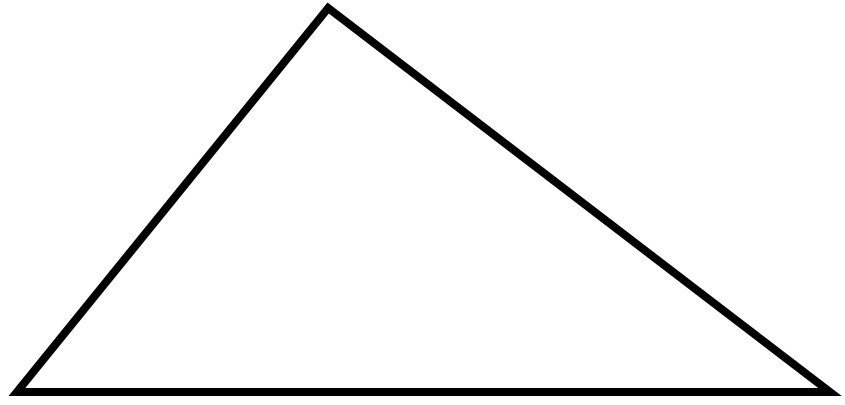
Explain the following term: Scalene triangle.
AnswerA scalene triangle is a triangle in which no two sides are equal.
View full question & answer→Question 212 Marks
In the following, there are three positive numbers. State if these number could possibly be the lengths of the sides of a triangle:
$5, 8, 20$
AnswerNo, these numbers cannot be the lengths of the sides of a triangle because the sum of any two sides of a triangle is always greater than the third side, which is not true in this case. Here, $5 + 8 < 20$
View full question & answer→Question 222 Marks
What is the difference between a triangle and triangular region?
AnswerPlane of figure formed by three non-parallel line segments is called a triangle where as triangular region is the interior of triangle $ABC$ together with the triangle $ABC$ itself is called the triangular region $ABC$.
View full question & answer→Question 232 Marks
$\angle\text{CBX}$ is an exterior angle of $\triangle \text{ABC}$ at $B$. Name.
$i.$ The interior adjacent angle.
$ii.$ The interior opposite angles to exterior $\angle\text{CBX}$
Also, name the interior opposite angles to an exterior angle at $A$.
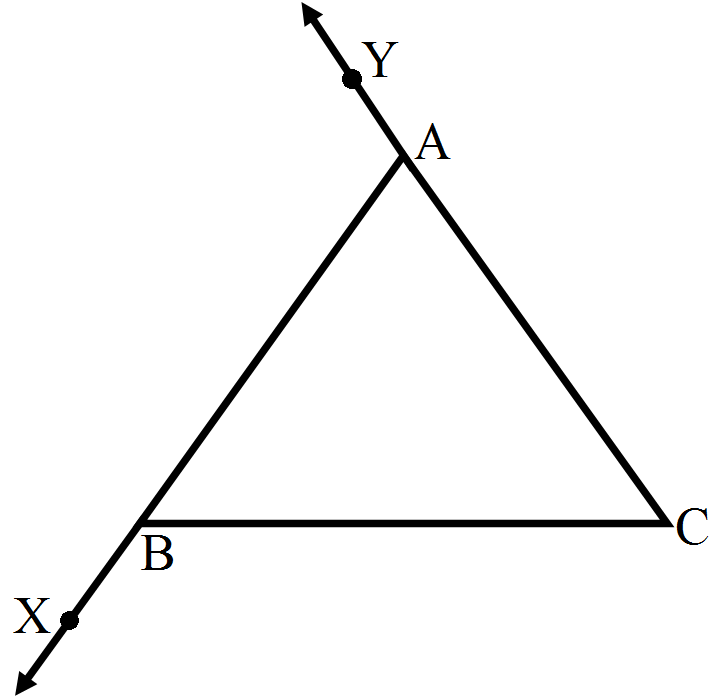
Answer$i.$ The interior angle ajacent to exterior $\angle \text{CBX}$ is $\angle \text{ABC}$
$ii.$ The interior angles opposite to exterior $\angle \text{CBX}$ are $\angle \text{BAC}$ and $\angle \text{ACB}$
Also, the interior angles opposite to exterior $\angle \text{BAY}$ are $\angle \text{ABC}$ and $\angle \text{ACB}$
View full question & answer→Question 242 Marks
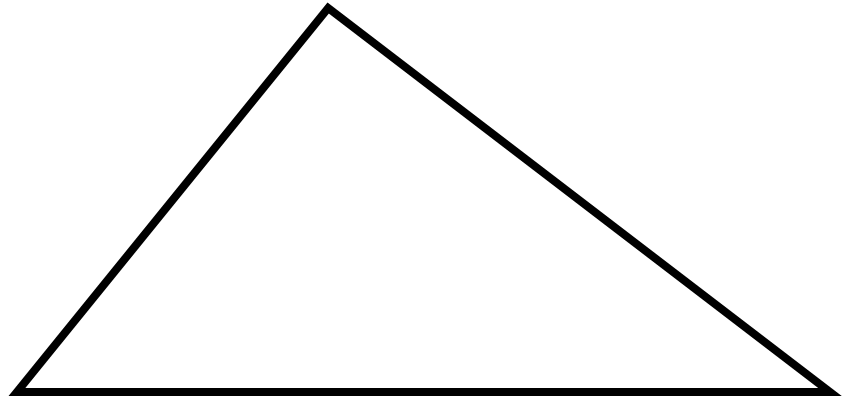
Explain the following term: Scalene triangle.
AnswerA scalene triangle is a triangle in which no two sides are equal.
View full question & answer→Question 252 Marks
$D$ is a point on side $BC$ of a $\triangle \text{CAD}$ is joined. Name all the triangles that you can observe in the figure. How many are they?
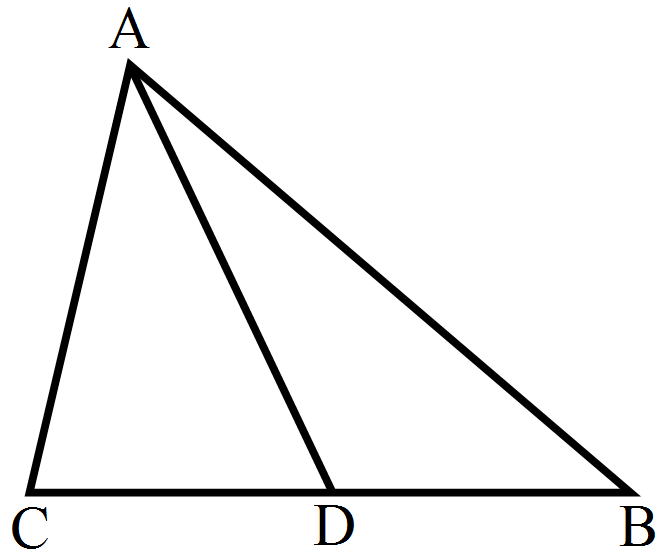
AnswerWe can observe the following three triangles in the given figure:
$i. \triangle \text{ABC}$
$ii. \triangle \text{ACD}$
$iii. \triangle \text{ADB}$
View full question & answer→Question 262 Marks
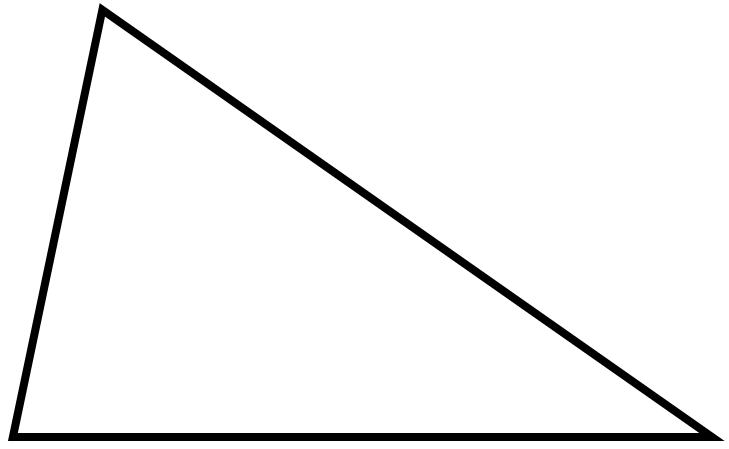
Explain the following term: Acute triangle.
AnswerAn acute triangle is a triangle in which all the angles are acute (less than $90^\circ $).
View full question & answer→Question 272 Marks
Is it possible to have a triangle, in which.
Two of the angles are right?
Answer Give reasons in support of your answer in.
No, because if there are two right angles in a triangle, then the third angle of the triangle must be zero, which is not possible.
View full question & answer→Question 282 Marks
In right $\triangle \text{ABC},$ the lengths of the legs are given. Find the length of the hypotenuse.
$a = 3\ cm, b = 4\ cm$
AnswerAccording to the Pythagoras theorem,
$(\text { Hypotenuse })^2=(\text { Base })^2+(\text { Height })^2$
$c^2=a^2+b^2$
$c^2=3^2+4^2$
$c^2=9+16=25$
$\mathrm{c}=5 \mathrm{~cm}$
View full question & answer→Question 292 Marks
In right $\triangle \text{ABC},$ the lengths of the legs are given. Find the length of the hypotenuse.
$a = 2\ cm, b =1.5\ cm$
AnswerAccording to the Pythagoras theorem,
$(\text { Hypotenuse })^2=(\text { Base })^2+(\text { Height })^2$
$c^2=a^2+b^2$
$c^2=2^2+1.5^2$
$c^2=4+2.25=6.25$
$c=2.5 \mathrm{~cm}$
View full question & answer→Question 302 Marks
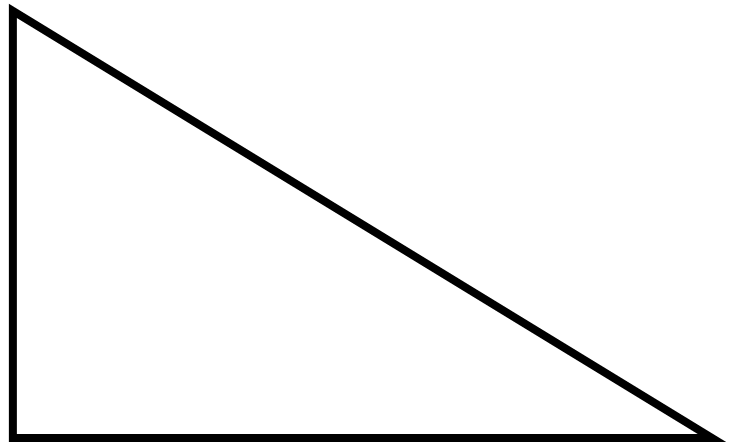
Explain the following term: Right triangle.
AnswerA right angled triangle is a triangle in which one angle is right angled, i.e. $90^\circ $.
View full question & answer→Question 312 Marks
In right $\triangle \text{ABC},$ the lengths of the legs are given. Find the length of the hypotenuse.
$a = 6\ cm, b = 8\ cm$
AnswerAccording to the Pythagoras theorem,
$(\text { Hypotenuse })^2=(\text { Base })^2+(\text { Height })^2$
$c^2=a^2+b^2$
$c^2=6^2+8^2$
$c^2=36+64=100$
$\mathrm{c}=10 \mathrm{~cm}$
View full question & answer→Question 322 Marks
Explain the following term: Exterior of a triangle.
AnswerThe exterior of a triangle is made up of all such points that are not enclosed within the triangle.
View full question & answer→Question 332 Marks
Explain the following term: Parts or elements of a triangle.
AnswerThe three sides and the three angles of a triangle are together known as the parts or elements of that triangle.
View full question & answer→Question 342 Marks
Explain the following term: Interior of a triangle.
AnswerThe interior of a triangle is made up of all such points that are enclosed with in the triangle.
View full question & answer→Question 352 Marks
$A, B, C$ and $D$ are four points, and no three points are collinear. $AC$ and $BD$ intersed at $O$. There are eight triangles that you can observe. Name all the triangles.
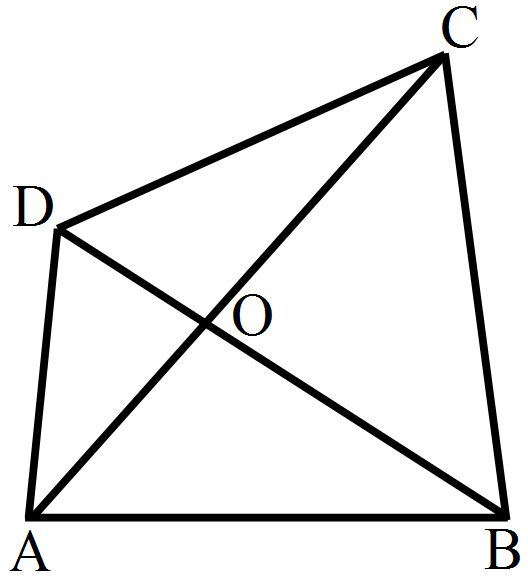
Answer$i. \triangle\text{ABC}$
$ii. \triangle\text{ABD}$
$iii. \triangle\text{ABO}$
$iv. \triangle\text{BCD}$
$v. \triangle\text{DCO}$
$vi. \triangle\text{AOD}$
$vii. \triangle\text{ACD}$
$viii. \triangle\text{BCD}$
View full question & answer→Question 362 Marks
Verity that the following number represent Pythagorean triplet:
$27, 36, 45$
AnswerWe will check for a Pythagorean triplet by checking if the square of the largest side is equal to the sum of the squares of the other two sides.
$45^2=2025$
$27^2+36^2$
$=729+1296=2025$
$27^2+36^2=45^2$
Yes, they represent a Pythagorean triplet.
View full question & answer→Question 372 Marks
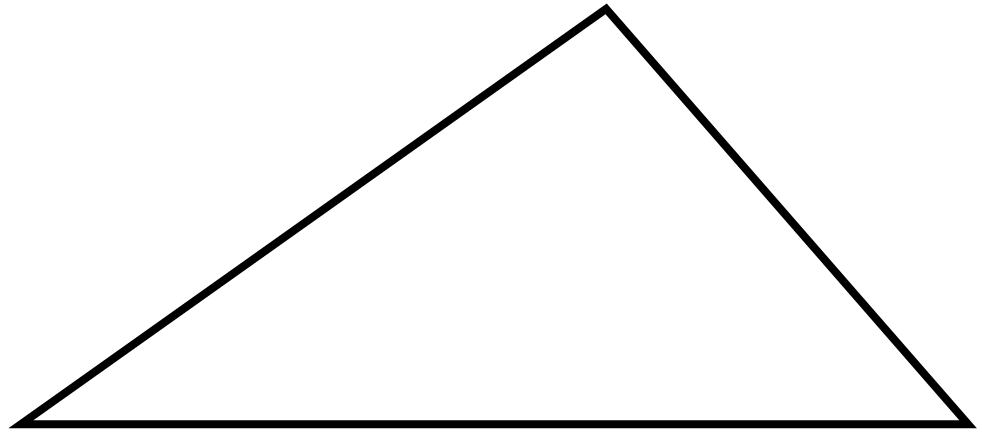
Explain the following term: Obtuse triangle.
AnswerAn obtuse triangle is a triangle in which one angle is obtuse (more than $90^\circ $).
View full question & answer→Question 382 Marks
In $\triangle \text{ABC}, \angle \text{A}=100^\circ,\angle \text{B}=30^\circ, \angle \text{C}=50^\circ.$ Name the smallest and the largest sides of the triangle.
AnswerBecause the smallest side is always opposite to the smallest angle, which in this case is $30^\circ $, it is $AC$.
Also, because the largest side is always opposite to the largest angle, which in this case is $100^\circ $, it is $BC$.
View full question & answer→Question 392 Marks
A man goes 15 m due west and then 8 m due north. How far is he from the starting point?
Question 402 Marks
In right $\triangle A B C$, the lengths of the legs are given. Find the length of the hypotenuse.
$a=2 cm, b=1.5 cm$
View full question & answer→Question 412 Marks
In right $\triangle A B C$, the lengths of the legs are given. Find the length of the hypotenuse.
$a=3 cm, b=4 cm$
View full question & answer→Question 422 Marks
In right $\triangle A B C$, the lengths of the legs are given. Find the length of the hypotenuse.
$a=8 cm, b=15 cm$
View full question & answer→Question 432 Marks
In right $\triangle A B C$, the lengths of the legs are given. Find the length of the hypotenuse.
$a=6 cm, b=8 cm$
View full question & answer→Question 442 Marks
Verify that the following numbers represent Pythagorean triplet:
$15,36,39$
View full question & answer→Question 452 Marks
Verify that the following numbers represent Pythagorean triplet:
$27,36,45$
View full question & answer→Question 462 Marks
Verify that the following numbers represent Pythagorean triplet:
$7,24,25$
View full question & answer→Question 472 Marks
Verify that the following numbers represent Pythagorean triplet:
$12,35,37$
View full question & answer→Question 482 Marks
In each of the following, there are three positive numbers. State if these numbers could possibly be the lengths of the sides of a triangle:
(i) $5,7,9$ $\quad$ (ii) $2,10,15$ $\quad$ (iii) $3,4,5$ $\quad$ (iv) $2,5,7$ $\quad$ (v) $5,8,20$
View full question & answer→Question 492 Marks
A student when asked to measure two exterior angles of $\triangle A B C$ observed that the exterior angles at $A$ and $B$ are of $103^{\circ}$ and $74^{\circ}$ respectively. Is this possible? Why or why not?
AnswerNo, since sum of interior angles $A$ and $B=183^{\circ}>180^{\circ}$
View full question & answer→Question 502 Marks
One of the exterior angles of a triangle is $80^{\circ}$, and the interior opposite angles are equal to each other. What is the measure of each of these two angles?
View full question & answer→Question 512 Marks
If each angle of a triangle is less than the sum of the other two, show that the triangle is acute angled.
Question 522 Marks
If one angle of a triangle is equal to the sum of the other two, show that the triangle is a right triangle.
Question 532 Marks
If the angles of a triangle are in the ratio 1: 2: 3, determine three angles.
Answer$30^{\circ}, 60^{\circ}, 90^{\circ}$
View full question & answer→Question 542 Marks
The three angles of a triangle are equal to one another. What is the measure of each of the angles?
Question 552 Marks
In $\triangle A B C, \angle A=60^{\circ}, \angle B=80^{\circ}$ and the bisectors of $\angle B$ and $\angle C$ meet at $O$. Find (i) $\angle C$ (ii) $\angle B O C$.
Answer(i) $40^{\circ}$ (ii) $120^{\circ}$
View full question & answer→Question 562 Marks
One of the angles of a triangle is $130^{\circ}$, and the other two angles are equal. What is the measure of each of these equal angles?
Answer$25^{\circ}, 25^{\circ}$
View full question & answer→Question 572 Marks
Two acute angles of a right triangle are equal. Find the two angles.
Answer$45^{\circ}, 45^{\circ}$
View full question & answer→Question 582 Marks
The angles of a triangle are in the ratio 3: 4: 5. Find the smallest angle.
Question 592 Marks
In each of the following, the measures of three angles are given. State in which cases, the angles can possibly be those of a triangle:
(i) $63^{\circ}, 37^{\circ}, 80^{\circ}$
(ii) $45^{\circ}, 61^{\circ}, 73^{\circ}$
(iii) $59^{\circ}, 72^{\circ}, 61^{\circ}$
(iv) $45^{\circ}, 45^{\circ}, 90^{\circ}$
(v) $30^{\circ}, 20^{\circ}, 125^{\circ}$
View full question & answer→Question 602 Marks
Two angles of a triangle are of measures $105^{\circ}$ and $30^{\circ}$. Find the measure of the third angle.
View full question & answer→Question 612 Marks
Explain the terms:
Interior of a triangle
Question 622 Marks
Explain the terms:
Obtuse triangle
Question 632 Marks
Explain the terms:
Right triangle
Question 642 Marks
Explain the terms:
Acute triangle
Question 652 Marks
Explain the terms:
Equilateral triangle
Question 662 Marks
Explain the terms:
Isosceles triangle
Question 672 Marks
Explain the terms:
Scalene triangle
Question 682 Marks
Explain the terms:
Parts or elements of a triangle
Question 692 Marks
Explain the terms:
Exterior of a triangle.
Question 702 Marks
Explain the terms:
Triangle
Question 712 Marks
Take three collinear points A, B and C on a page of your note book. Join AB, BC and CA. Is the figure a triangle? If not, why?
AnswerNo, by definition of triangle
View full question & answer→