Questions

1 Marks Question

Take a timed test

32 questions · self-marked practice — reveal the answer and mark yourself.

Question 11 Mark
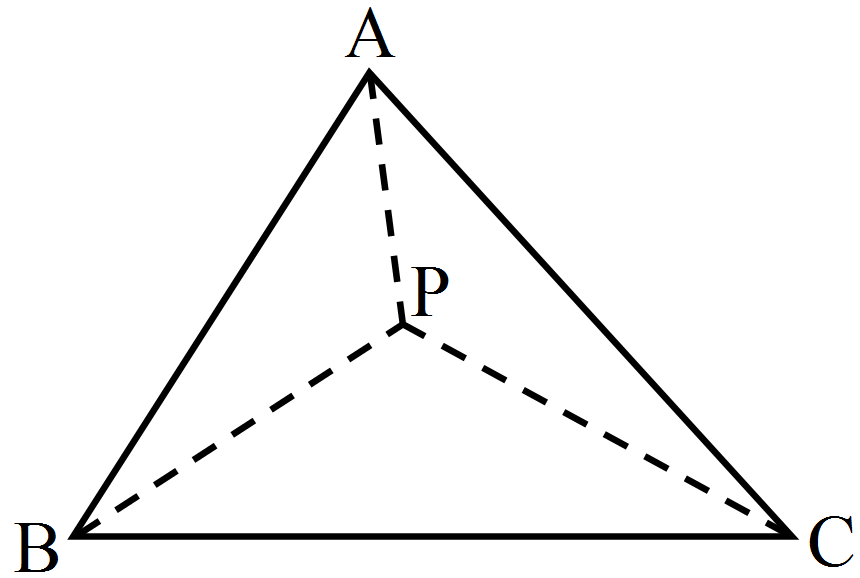
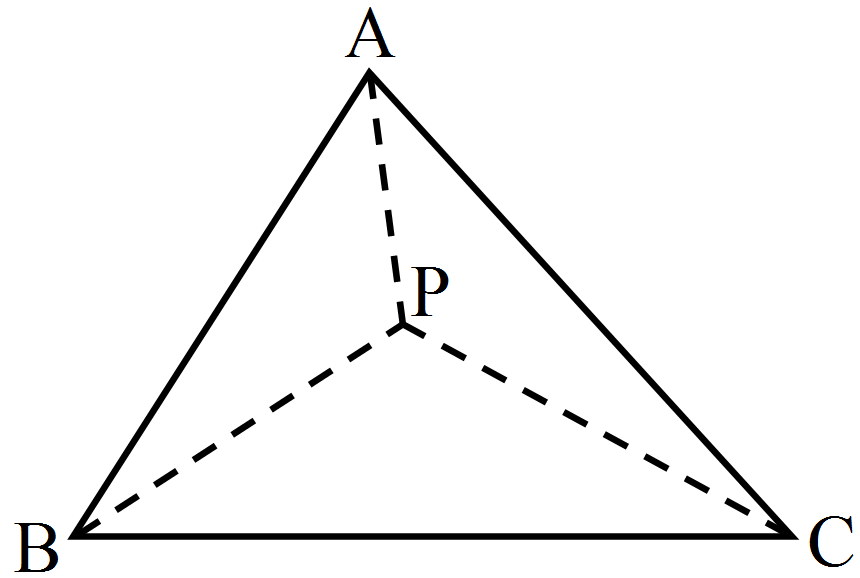
If $P$ is a point in the interior of $\triangle\text{ABC}$ then fill in the blanks with $>$ or $<$ or $=. PB + PC BC$
Answer
$PB + PC > BC$
In $\triangle\text{PBC},$ $PB + PC > BC$ (sum of two sides is greater than its third side)
View full question & answer
Question 21 Mark
Answer the following in 'Yes' or 'No'. Can an isosceles triangle be a right triangle?
Answer
Yes, it will be an isosceles right triangle.
View full question & answer
Question 31 Mark
Fill in the blanks: Of all the line segments that can be drawn to a given line from a given point outside it, the is the shortest.
Answer
Of all the line segments that can be drawn to a given line from a given point outside it, the perpendicular is the shortest.
View full question & answer
Question 41 Mark
Answer the following in 'Yes' or 'No'. Can a right triangle be a scalene triangle?
Answer
Yes, a right triangle can have all sides of different measures. For example, $3, 4$ and $5$ are the sides of a scalene right triangle.
View full question & answer
Question 51 Mark
Fill in the blanks: A right triangle cannot have an angle.
Answer
A right triangle cannot have an obtuse angle.
Obtuse (since the sum of the other two angles of the right triangle is $90^\circ $)
View full question & answer
Question 71 Mark
Fill in the blanks: Each acute angle of an isosceles right triangle measures .
Answer
Each acute angle of an isosceles right triangle measures $45^\circ .$
$45^\circ $ (since their sum is equal to $90^\circ $)
View full question & answer
Question 81 Mark
If $P$ is a point in the interior of $\triangle\text{ABC}$ then fill in the blanks with $>$ or $<$ or $=. AC PA + PC$
Answer
$AC < PA + PC$
In $\triangle\text{PAC},$ $AC < PA + PC (PA + PC > AC)$
View full question & answer
Question 91 Mark
Fill in the blanks: The sum of the lengths of the sides of a triangle is called its .
Answer
The sum of the lengths of the sides of a triangle is called its perimeter.
View full question & answer
Question 111 Mark
Can a triangle have all angles less than $60^\circ $?
Answer
No, this is because one angle has to more than $60^\circ $ as the sum of all angles is always $180^\circ $.
View full question & answer
Question 121 Mark
Fill in the blanks:
The side opposite the right angle of a right triangle is called .
Answer
The side opposite the right angle of a right triangle is called a hypotenuse.
View full question & answer
Question 131 Mark
Fill in the blanks: The acute angles of a right triangle are .
Answer
The acute angles of a right triangle are equal to the sum of $90^\circ $
View full question & answer
Question 141 Mark
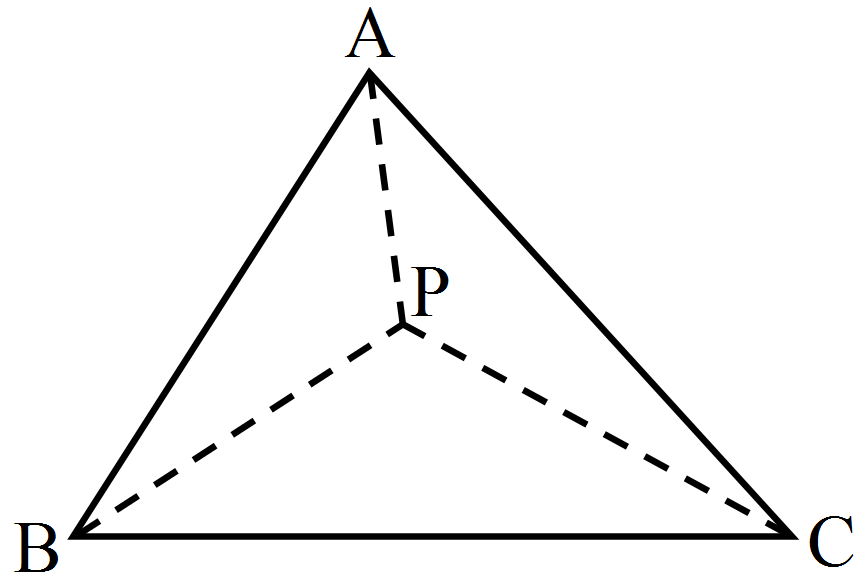
If $P$ is a point in the interior of $\triangle\text{ABC}$ then fill in the blanks with $>$ or $<$ or $=.$
$PA + PB\ AB$
Answer
$PA + PB > AB$
In $\triangle\text{ABC},$ $PA + PB > AB$ (sum of two sides is greater than its third side)
View full question & answer
Question 151 Mark
Answer the following in 'Yes' or 'No'. Can an obtuse triangle be an isosceles triangle?
Answer
Yes, if an obtuse triangle has an obtuse angle of $120^\circ $ and the other two angles of $30^\circ $ each, then it will be an isosceles triangle.
View full question & answer
Question 171 Mark
Answer the following in 'Yes' or 'No'. Can a right triangle be an equilateral triangle?
Answer
No, it cannot be an equilateral triangle since the hypotenuse sqaure will be the sum of the square of the other two sides.
View full question & answer
Question 181 Mark
Fill in the blanks: In a right triangle, the square of the hypotenuse is equal to the of the squares of the other two sides.
Answer
In a right triangle, the square of the hypotenuse is equal to the sum of the squares of the other two sides.
View full question & answer
Question 191 Mark
Can a triangle have two right angles?
Answer
No, this is because the sum of all the angles is $180^\circ $.
View full question & answer
Question 201 Mark
Can a triangle have all angles more than $60^\circ$?
Answer
No, this is because the sum of the angles cannot be more than $180^\circ$.
View full question & answer
Question 211 Mark
Fill in the blanks: Each angle of an equilateral triangle measures .
Answer
Each angle of an equilateral triangle measures 60°.
View full question & answer
Question 221 Mark
Fill in the blanks: If the square of one side of a triangle s equal to the sum of the squares of the other two sides then the triangle is .
Answer
If the square of one side of a triangle s equal to the sum of the squares of the other two sides then the triangle is a right angled.
View full question & answer
Question 261 Mark
Can a triangle have all angles more than $60^\circ$?
Answer
No, this is because the sum of the angles cannot be more than $180^\circ$.
View full question & answer
Question 271 Mark
Can a triangle have all angles less than 60°?
Answer
No, this is because one angle has to more than 60° as the sum of all angles is always 180°.
View full question & answer
Question 291 Mark
Answer the following in 'Yes' or 'No'.
Can a right triangle be a scalene triangle?
Answer
Yes, a right triangle can have all sides of different measures. For example, 3, 4 and 5 are the sides of a scalene right triangle.
View full question & answer
Question 301 Mark
Answer the following in 'Yes' or 'No'.
Can a right triangle be an equilateral triangle?
Answer
No, it cannot be an equilateral triangle since the hypotenuse sqaure will be the sum of the square of the other two sides.
View full question & answer
Question 311 Mark
Answer the following in 'Yes' or 'No'.
Can an obtuse triangle be an isosceles triangle?
Answer
Yes, if an obtuse triangle has an obtuse angle of 120° and the other two angles of 30° each, then it will be an isosceles triangle.
View full question & answer
Question 321 Mark
Answer the following in 'Yes' or 'No'.
Can an isosceles triangle be a right triangle?
Answer
Yes, it will be an isosceles right triangle.
View full question & answer