Questions

3 Marks Question

Take a timed test

22 questions · self-marked practice — reveal the answer and mark yourself.

Question 13 Marks
The acute angles of a right triangle are in the ratio $2 : 1.$ Find the each of these angles.
Answer
In a right triangle Sum of the two acute angle $= 90^\circ $ and ratio of these two angles $= 2 : 1$
Let first angle $= 2x$
The second angle $= x$
$2x + x = 90^\circ $
$\Rightarrow 3x = 90^\circ $
$\Rightarrow\text{x}=\frac{90}{3}=30^\circ$
$\therefore$ First angle $= 2x = 2 \times 30^\circ = 60^\circ $ and Second angle $= x = 30^\circ $
View full question & answer
Question 23 Marks
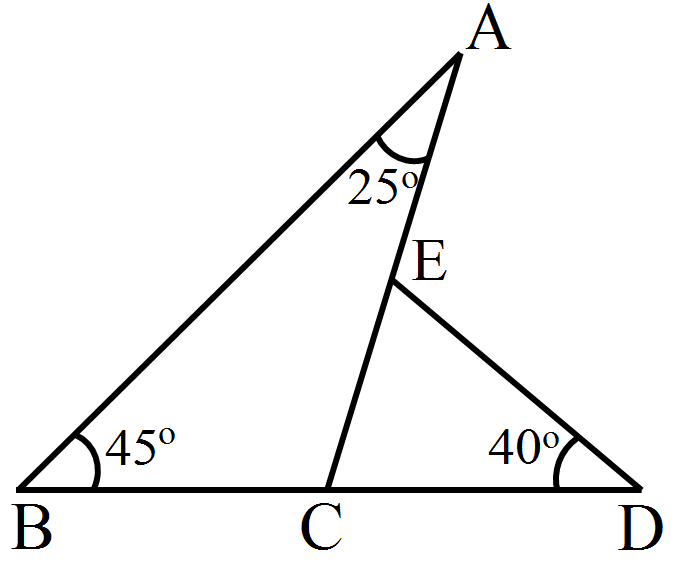
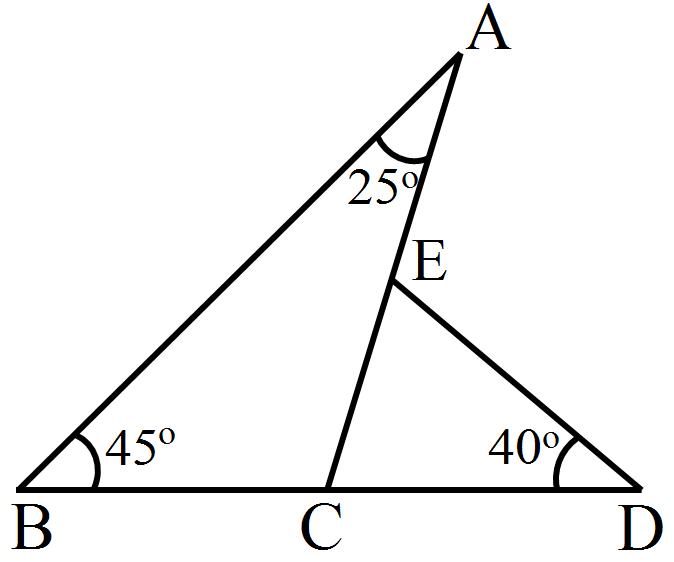
In the figure given alongside, find:
$i. \angle\text{ACD}$
$ii. \angle\text{AED}$
Answer
In $\triangle\text{ABC},$ side $BC$ is produced to $D$ From $D,$ draw a line meeting $AC$ at $E,$ so that $\angle\text{D}=40^\circ$. $\angle\text{A}=25^\circ,\angle\text{B}=45^\circ$

$i.$ In $\triangle\text{ABC},$
Exterior $\angle\text{ACD} = \angle\text{A}+\angle\text{B}=25^\circ+45^\circ=70^\circ$
$ii.$ In $\triangle\text{CDE},$
Exterior $\angle\text{AED} = \angle\text{ECD}+\angle\text{D}= \angle\text{ACD}+\angle\text{D}=70^\circ+40^\circ=7=110^\circ$
Hence, $\angle\text{ACD}=70^\circ$ and $\angle\text{AED}=110^\circ$
View full question & answer
Question 33 Marks
The lengths of the sides of triangles are given below. Which of them are right-angled? $a = 10\ cm, b = 24\ cm, c = 26\ cm$
Answer
 A triangle will be a right angled, if
$($longest side$)^2=$ Sum of squares of other two sides
Given,
Here, Ingest side $= C$
$\mathrm{a}=10 \mathrm{~cm}, \mathrm{~b}=24 \mathrm{~cm}, \mathrm{c}=26 \mathrm{~cm}$
The triangle $A B C$ will be right angled, if
$c^2=a^2+b^2$
$(26)^2=(10)^2+(24)^2$
$676=100+576=676$
$676=676$
Which is true.
It is a right angled triangle.
View full question & answer
Question 43 Marks
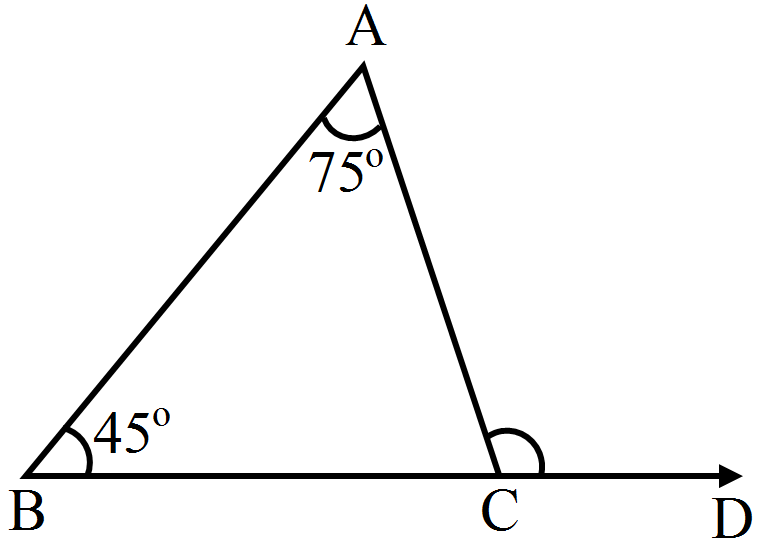
In the figure given alongside, find the measure of $\angle\text{ACD}.$
Answer
In $\triangle\text{ABC},$
$\angle\text{A}=75^\circ,\angle\text{B}=45^\circ$ side $BC$ is produced to $D$

Forming exterior $\angle\text{ACD}$
Exterior $\angle\text{ACD}=\angle\text{A}+\angle\text{B}$ (Exterior angle is equal to sum of its interior opposite angles)
$​​​​​​​= 75^\circ + 45^\circ = 120^\circ $
View full question & answer
Question 53 Marks
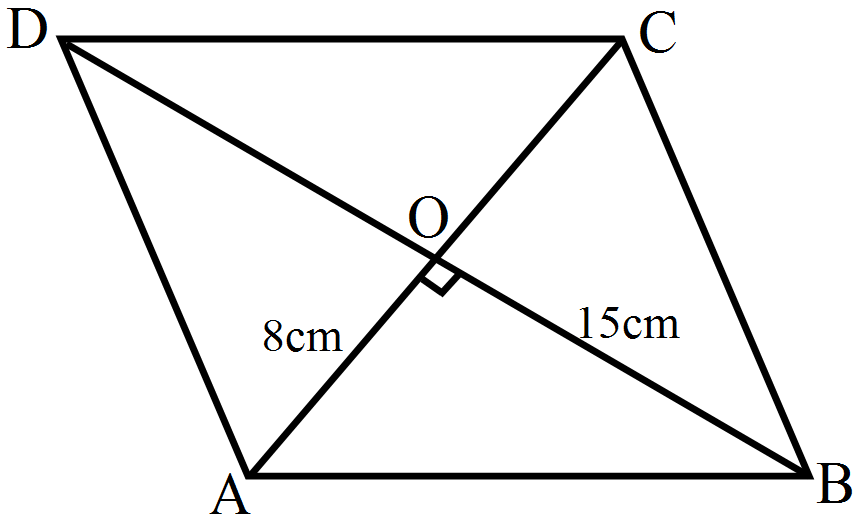
Find the perimeter of a rhombus, the lengths of whose diagonals are $16\ cm$ and $30\ cm.$
Answer
Perimeter of rhombus $A B C D=4 \times$ Side
Diagonal $\mathrm{AC}=30 \mathrm{~cm}$ and $\mathrm{BD}=16 \mathrm{~cm}$
The diagonal of rhombus bisect each other at right angles,
$\mathrm{AO}=\mathrm{OC}=\frac{30}{2}=15 \mathrm{~cm}$
$\text { and } \mathrm{BO}=\mathrm{OD}=\frac{16}{2}=8 \mathrm{~cm}$
Now in right $\triangle \mathrm{AOB}$,
$\mathrm{AB}^2=A O^2+\mathrm{BO}^2$
$\Rightarrow \mathrm{AB}=(15)^2+(8)^2$
$\Rightarrow \mathrm{AB}^2=225+64$
$\Rightarrow \mathrm{AB}=289$
$\Rightarrow \mathrm{AB}=(17)$
$\Rightarrow \mathrm{AB}=17 \mathrm{~cm}$
Now perimeter $=4 \times$ Side $=4 \times 17=68 \mathrm{~cm}$.
View full question & answer
Question 63 Marks
One of the angles of a triangle is $100^\circ $ and the other two angles are equal. Find each of these equal angles.
Answer
In a triangle Measure of one angle $= 100^\circ $
Sum of the other two angles $= 180^\circ - 100^\circ ($Sum of angles of a triangles$)$
But, these two angles are equal.
Measure of each angle $=\frac{80^\circ}{2}=40^\circ$
View full question & answer
Question 73 Marks
One of the acute angles of a right triangle is $36^\circ .$ Find the other.
Answer
In a right triangle Sum of the two acute angle $= 90^\circ $
One angle $= 36^\circ $
Second angle $= 90^\circ - 36^\circ = 54^\circ $
View full question & answer
Question 83 Marks
The lengths of the sides of triangles are given below. Which of them are right-angled$?$
$a = 9\ cm, b = 12\ cm, c = 16\ cm$
Answer
A triangle will be a right angled, if
$($longest side$)^2=$ Sum of squares of other two sides
Given,
$\mathrm{a}=9 \mathrm{~cm}, \mathrm{~b}=12 \mathrm{~cm}, \mathrm{c}=16 \mathrm{~cm}$
Here, Ingest side $= C$
The triangle $A B C$ will be right angled, if
$c^2=a^2+b^2$
$(16)^2=(9)^2+(12)^2$
$256=81+144=225$
$256=225$
Which is not true.
It is not a right angled triangle.
View full question & answer
Question 93 Marks
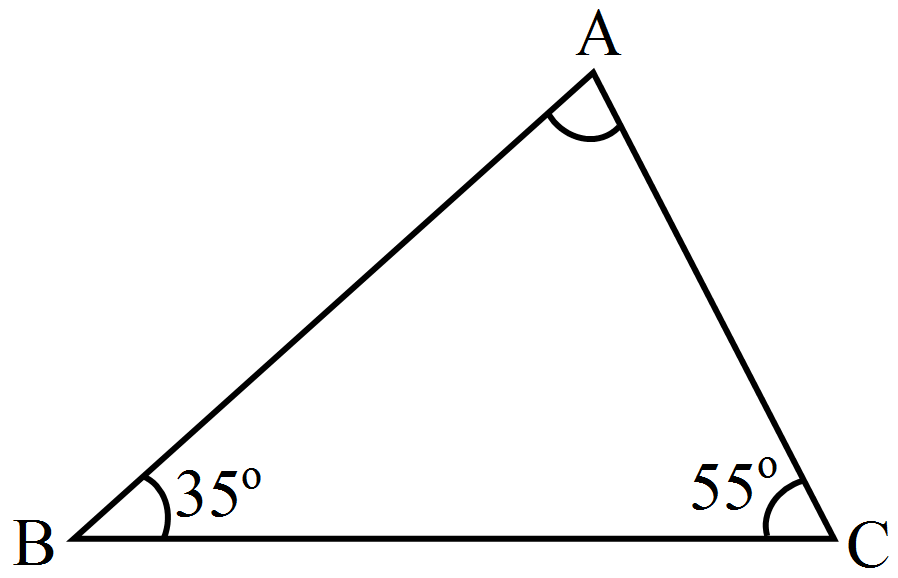
In a $\triangle\text{ABC}, \angle\text{B}= 35^\circ$ and $\angle\text{C}= 55^\circ$. Write which of the following is true:
i. $AC^2=AB^2+BC^2$
ii. $A B^2=B C^2+A C^2$
iii. $B C^2=A B^2+A C^2$
Answer


$\text { In } \triangle \mathrm{ABC} \text {, }$
$\angle \mathrm{B}=35^{\circ} \text { and } \angle \mathrm{C}=55^{\circ}$
$\Rightarrow \angle \mathrm{A}=180^{\circ}-(\angle \mathrm{B}+\angle \mathrm{C})$
$\Rightarrow \angle \mathrm{A}=180^{\circ}-\left(35^{\circ}+55^{\circ}\right)$
$\Rightarrow \angle \mathrm{A}=180^{\circ}-90^{\circ}$
$\angle \mathrm{A}=90^{\circ}$
By Pythagoras Theorem,
$\mathrm{BC}^2=\mathrm{A}\mathrm{B}^2+\mathrm{AC}^2$
$(iii)$ is true.
View full question & answer
Question 103 Marks
The lengths of the sides of triangles are given below. Which of them are right-angled$?$
$a = 15\ cm, b = 20\ cm, c = 25\ cm$
Answer
A triangle will be a right angled, if
$(\text { longest side })^2=$ Sum of squares of other two sides
Given,
$\mathrm{a}=15 \mathrm{~cm}, \mathrm{~b}=20 \mathrm{~cm}, \mathrm{c}=25 \mathrm{~cm}$
Here, longest side $=\mathrm{c}$
The triangle will be right angled, if
$c^2=a^2+b^2$
$(25)^2=(15)^2+(20)^2$
$625=225+400=625$
Which is true.
It is a right angled triangle.
View full question & answer
Question 113 Marks
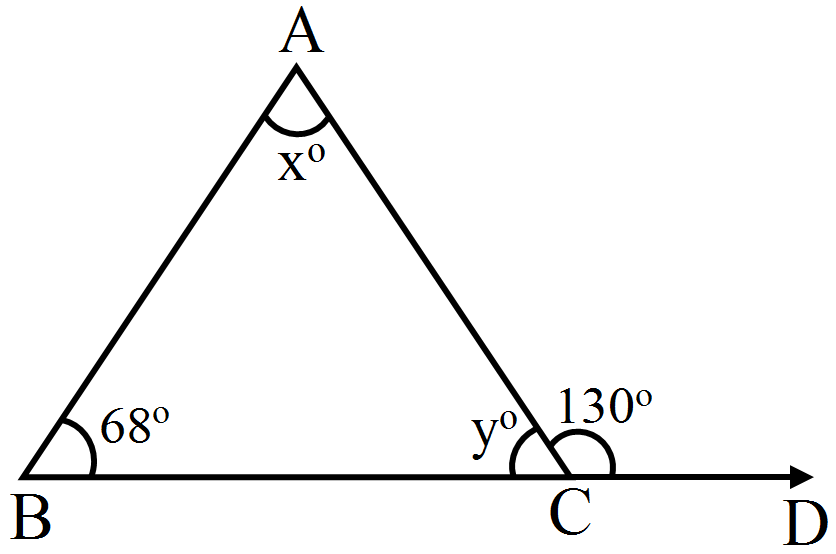
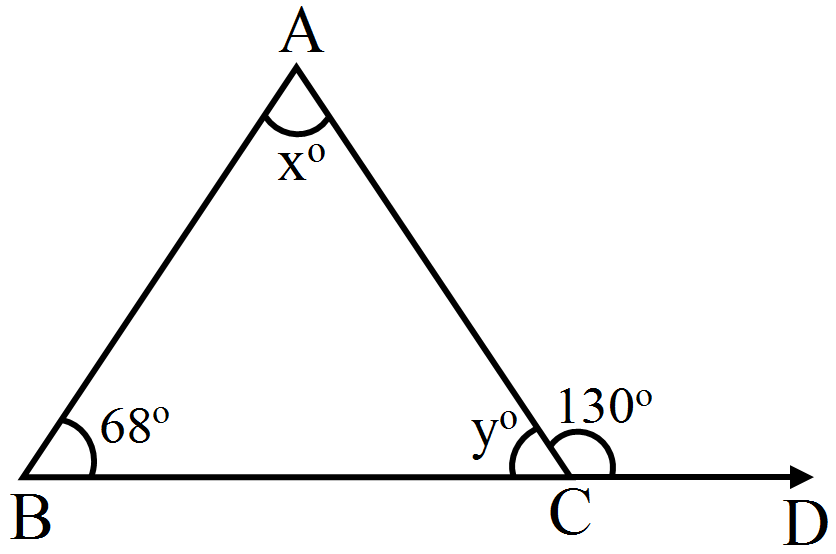
In the figure given alongside, find the values of $x$ and $y.$
Answer
In $\triangle\text{ABC}, BC$ is produced to $D$ forming an exterior angle $ACD\angle\text{B} = 68^\circ,\angle\text{A} = \text{X}^\circ,\angle\text{ACB} = \text{Y}^\circ$ and $\angle\text{ACD} = 130^\circ$

In triangle, Exterior angles is equal to sum of its interior opposite angles.
​​​​​​​ $\angle\text{ACD} = \angle\text{A}+\angle\text{B}$
$\Rightarrow 130^\circ = x + 68^\circ $
$\Rightarrow x = 130^\circ – 68^\circ = 62^\circ $
But $\angle\text{ACB}+\angle\text{ACD} = 180^\circ$ (Linear pair) $\Rightarrow y + 130^\circ = 180^\circ $
$\Rightarrow y = 180^\circ – 130^\circ = 50^\circ $
Hence, $x = 62^\circ $ and $y = 50^\circ $
View full question & answer
Question 123 Marks
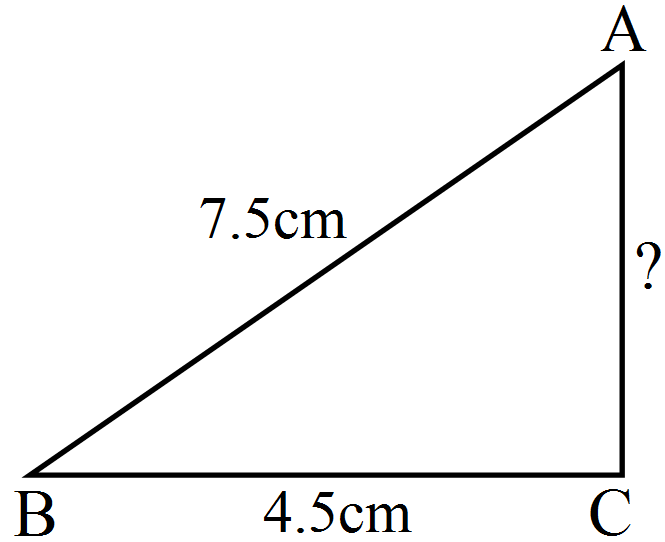
The length of one sides of a right triangle is $4.5\ cm$ and the length of its hypotenuse is $7.5\ cm.$ Find the length of its third side.
Answer


In right triangle $A B C$,
$\angle C=90^{\circ} \mathrm{AC}=7.5 \mathrm{~cm}, \mathrm{AB}=4.5 \mathrm{~cm}$
By Pythagoras Theorem,
$A B^2=B C^2+A C^2$
$\Rightarrow(7.5)^2=(4.5)^2+A C^2$
$\Rightarrow 56.25=20.25+A C^2$
$\Rightarrow A C^2=56.25-20.25$
$\Rightarrow A C^2=36.00$
$A C=\sqrt{36}=6 \mathrm{~cm}$
 
View full question & answer
Question 133 Marks
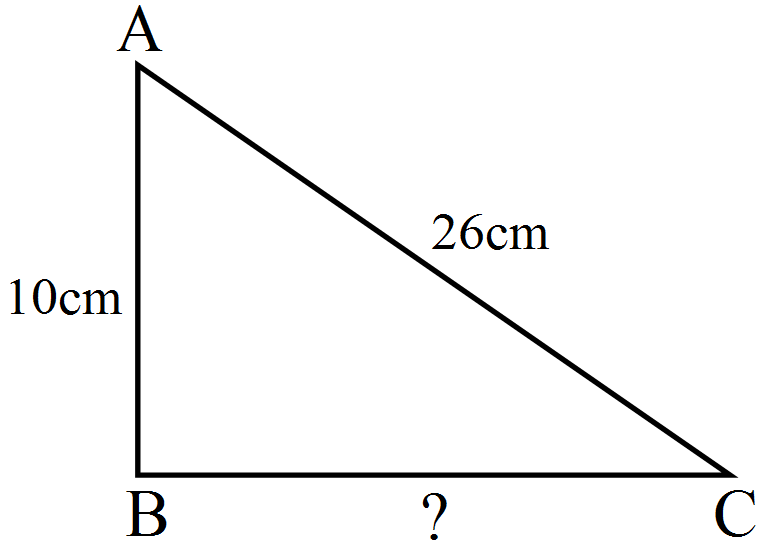
The hypotenuse of a right triangle is $26\ cm$ long. If one of the remaining two sides is $10\ cm$ long, find the length of the other side.
Answer


In right triangle $A B C$,
$\angle \mathrm{B}=90^{\circ} \mathrm{AC}=26 \mathrm{~cm}, \mathrm{AB}=10 \mathrm{~cm}$
By Pythagoras Theorem,
$\mathrm{AC}^2=\mathrm{AB}^2+\mathrm{BC}^2$
$\Rightarrow(26)^2=(10)^2+\mathrm{BC}^2$
$\Rightarrow 676=100+\mathrm{BC}^2$
$\Rightarrow \mathrm{BC}^2=676-100$
$\Rightarrow \mathrm{BC}^2=576$
$\mathrm{BC}=\sqrt{576}=24 \mathrm{~cm}$
 
View full question & answer
Question 143 Marks
Find the angles of a triangle which are in the ratio $4 : 3 : 2.$
Answer
Sum of angles of a triangle $= 180^\circ $ and
ratio in the three angles $= 4 : 3 : 2$
$\therefore\text{First angle}=\frac{180^\circ\times4}{4+3+2}=\frac{180^\circ\times4}{9}=80^\circ$
$\text{Second angle}=\frac{180^\circ\times3}{9}=60^\circ$
$\text{ and third angle}=\frac{180^\circ\times2}{9}=40^\circ$
View full question & answer
Question 153 Marks
Each of the two equal angles of an isosceles triangle is twice the third angle. Find the angles of the triangle.
Answer
Sum of angles of a triangle $=180^\circ$
Let third angle $= x$ then, each equal angles $= 2x$
$\text{x} + 2\text{x} + 2\text{x} = 180^\circ$
$\Rightarrow5\text{x} = 180^\circ$
$\Rightarrow\text{x} = \frac{180^\circ}{5}=36^\circ$
Each equal angle $= 2\text{x} = 2 \times36^\circ = 72^\circ$ and third angle $=36^\circ$
View full question & answer
Question 163 Marks
Two sides of a triangle are $5\ cm$ and $9\ cm$ long. What can be the length of its third side$?$
Answer
Let the length of the third side be $x\ cm.$
Sum of any two sides of a triangle is greater than the third side.
$\therefore 5 + 9 > x$
$\Rightarrow x < 14$
Hence, the length of the third side must be less than $14\ cm.$
View full question & answer
Question 173 Marks
The sides of a triangle measure $15\ cm, 36\ cm$ and $39\ cm.$ Show that it is a right-angled triangle.
Answer
The largest side of the triangle is $39\ cm .$
$15^2+36^2=225+1296$
$=1521$
Also, $39^2=1521$
$\therefore 15^2+36^2=39^2$
Sum of the square of the two sides is equal to the square of the third side.
Hence, the triangle is right angled.
View full question & answer
Question 183 Marks
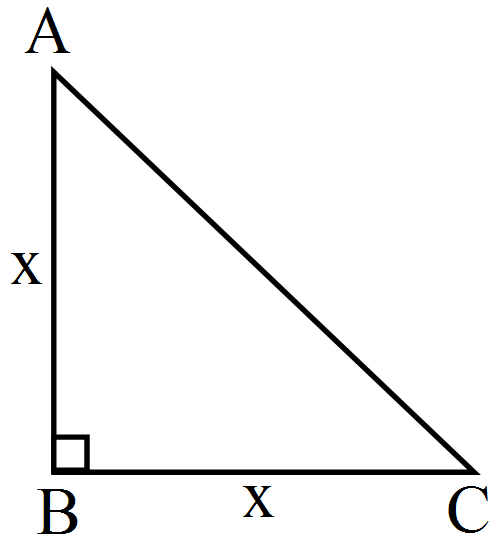
The two legs of a right triangle are equal and the square of its hypotenuse is $50\ cm.$ Find the length of each leg.
Answer


In right triangle $A B C$,
$\angle \mathrm{B}=90^{\circ}$
Let each leg $=\mathrm{xcm}$
By Pythagoras Theorem,
$x^2+x^2=A C^2$
$\Rightarrow 2 x^2=50$
$\Rightarrow x^2=25$
$\Rightarrow x^2=(5)^2$
$\Rightarrow x=5$
Length of each equal leg $=5 \mathrm{~cm}$.
View full question & answer
Question 193 Marks
In a $\triangle\text{ABC}$, If $​​2\angle\text{A}=3\angle\text{B}=6​\angle\text{C}$, calculate$​​\angle\text{A}$,$​​\angle\text{B}$ and$​​\angle\text{C}$.
Answer
In a $\triangle\text{ABC}$,

$​​2\angle\text{A}=3\angle\text{B}=6​\angle\text{C}=1$ (Suppose)

$\therefore\angle\text{A}=\frac{1}{2},\angle\text{B}=\frac{1}{3}$ and $\angle\text{C}=\frac{1}{6}$

$\therefore\angle\text{A}:\angle\text{B}:\angle\text{C}=\frac{1}{2}:\frac{1}{3}:\frac{1}{6}$

$=\frac{3:2:1}{6}$

But $\angle\text{A}+\angle\text{B}+\angle\text{C}=180^\circ$ (Sum of angles of a triangle)

$\therefore\angle\text{A}=\frac{3\times180^\circ}{3+2+1}=\frac{3\times180^\circ}{6}=90^\circ$

$\angle\text{B}=\frac{2\times180^\circ}{6}=60^\circ$

$\angle\text{C}=\frac{1\times180^\circ}{6}=30^\circ$

View full question & answer
Question 203 Marks
If one angle of a triangle is equal to the sum of the other two, show that the triangle is a right angled.
Answer
In a triangle $ABC,$
Let $\angle\text{A} =\angle\text{B}+\angle\text{C}$
But $\angle\text{A} +\angle\text{B}+\angle\text{C}=180^\circ$ (Sum of angles of a triangle)
$\Rightarrow\angle\text{A} +\angle\text{A}=180^\circ (\angle\text{B} +\angle\text{C} = \angle\text{A})$
$\Rightarrow2\text{A} =180^\circ$
$\Rightarrow\angle\text{A}=\frac{180^\circ}{2}=90^\circ$
$\angle\text{A}=90^\circ$
Hence, triangle $ABC$ is a right triangle.
View full question & answer
Question 213 Marks
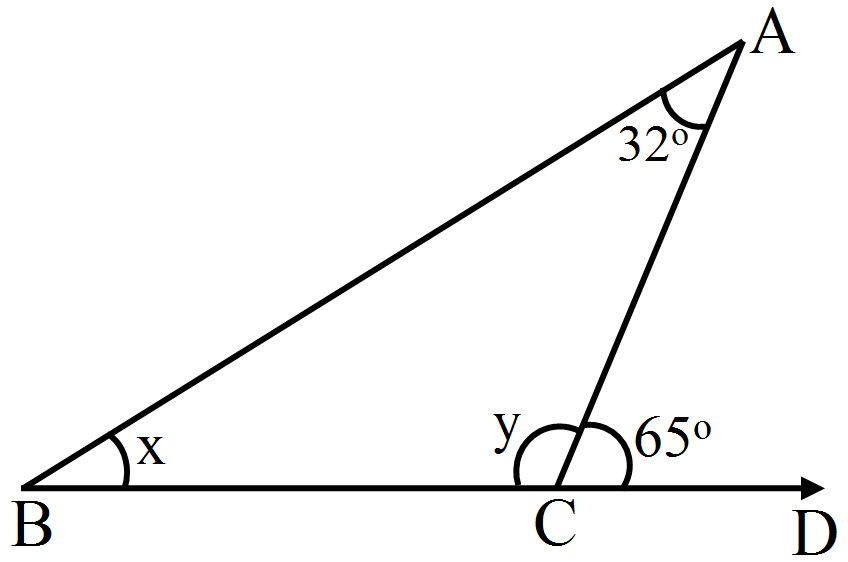
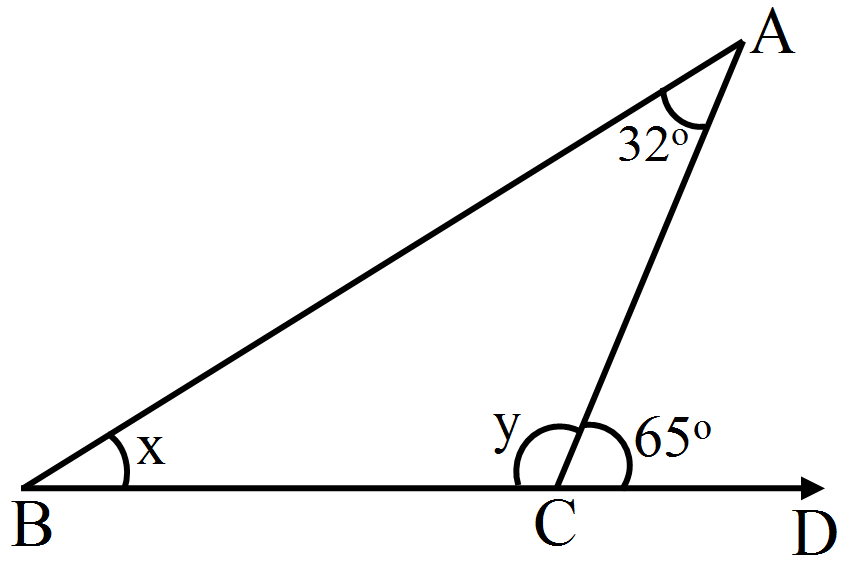
In the figure given alongside, find the values of $x$ and $y.$
Answer
In $\triangle\text{ABC},$ side $BC$ is produced to $D$ forming exterior angle $ACD.$
$\angle\text{ACD} = 65^\circ,\angle\text{A}=32^\circ$
$\angle\text{B}=\text{x},\angle\text{ACB} = \text{y}$

In triangle, the exterior angles is equal to sum of its interior opposite angles.
$\angle\text{ACD} = \angle\text{A}+\angle\text{B}$
$\Rightarrow 65^\circ = 32^\circ + x$
$\Rightarrow x = 65^\circ – 32^\circ = 33^\circ $
But $\angle\text{ACB}+\angle\text{ACD} = 180^\circ$ (Linear pair)
$\Rightarrow 65^\circ + y = 180^\circ $
$\Rightarrow y = 180^\circ – 65^\circ = 115^\circ $
Hence, $x = 33^\circ $ and $y = 115^\circ $
View full question & answer
Question 223 Marks
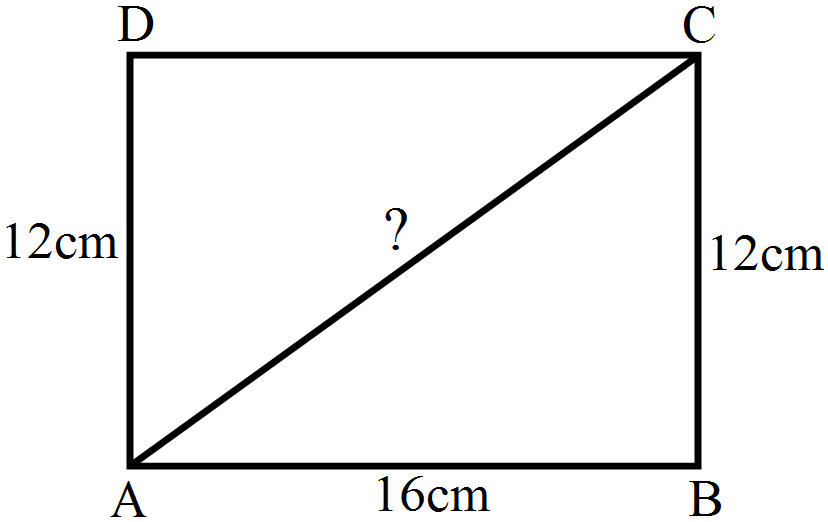
Find the length of diagonal of the rectangle whose sides are $16\ cm$ and $12\ cm.$
Answer

Given,
$A B C D$ is a rectangle whose sides, $A B=16 \mathrm{~cm}$ and $B C=12 \mathrm{~cm}$.
$A C$ is a diagonal
In right $\triangle \mathrm{ABC}$,
$\mathrm{AC}^2=\mathrm{AB}{ }^2+\mathrm{BC}^2 \text { (By Pythagoras Theorom) }$
$\mathrm{AC}^2=(16)^2+(12)^2$
$\Rightarrow \mathrm{AC}^2=256+144$
$\Rightarrow \mathrm{AC}^2=400$
$\Rightarrow \mathrm{AB}^2=(20)^2$
$\mathrm{AC}=20 \mathrm{~cm}$
Hence length of diagonal $A C=20 \mathrm{~cm}$.
View full question & answer