Question 13 Marks
A girl is $28$ years younger than her father. The sum of their ages is $50$ years. Find the ages of the girl and her father.
AnswerLet $x$ be the age of the girl.
Then, age of her father $= (x + 28)$ year According to the question,
$\therefore x + (x + 28) = 50$
$\Rightarrow 2x + 28 = 50 $
$\Rightarrow 2x = 50 - 25 $
$\Rightarrow 2x = 22$
$\Rightarrow\text{x}=\frac{22}{2}=11\text{ year}$
Hence, the age of the girl is $11$ year and age of her father's age is $(11 + 28), i.e. 39$ year.
View full question & answer→Question 23 Marks
After $20$ years, Manoj will be $5$ times as old as he is now. Find his present age.
AnswerLet the present age of Manoj be $x$ year.
Then, Manoj's age after $20$ year $= (x + 20)$ year.
It is given that after $20$ year, manoj's age will be $5$ times his present age.
Therefore, the equation is $x + 20\ 5x$
$\Rightarrow20 = 5\text{x}-\text{x} [$transposing $x$ to $RHS]$
$\Rightarrow\frac{20}{4}=\frac{4\text{x}}{4} [$dividing both sides by $4]$
$\Rightarrow5=\text{x}$
Hence, the present age of Manoj is $5$ year.
View full question & answer→Question 33 Marks
Thrice a number decreased by $5$ exceeds twice the number by $1.$ Find the number.
AnswerLet the number be $x.$
Then, thrice of this number $= 3x$ and twice of this number $= 2x.$
If we decrease thrice of $x$ by $5,$
we get $(3x - 5).$
According to the question,
$(3x - 5) - (2x) = 1 $
$\Rightarrow 3x - 5 - 2x = 1 $
$\Rightarrow x - 5 = 1 $
$\Rightarrow x = 1 + 5 [$transposing $(-5)$ to $RHS] $
$\Rightarrow x = 6$
Hence, the required number is $6.$
View full question & answer→Question 43 Marks
A number is as much greater than $27$ as it is less than $73.$ Find the number.
AnswerLet the number be $x.$
If we subtract $27$ from $x$ i.e, $(x - 27)$ and subtrect $x$ from $73$
i.e, $(73 - x)$ we get the same result.
Therefore, we get the following equation.
$x - 27 = 73 - x $
$⇒ x + x = 73 + 27 [$transposing $(-27)$ to $RHS$ and $(-x)$ to $LHS]$
$⇒ 2x = 100$
$\Rightarrow\frac{2\text{x}}{2}=\frac{100}{2} [$dividing both sides by $2]$
$\Rightarrow\text{x}=50$
Hence, the required number is $50.$
View full question & answer→Question 53 Marks
In a class of $60$ students, the number of girls is one third the number of boys. Find the number of girls and boys in the class.
AnswerAs per the given information in the question, the total number of students in the class $= 60$.
Let $x$ be the number of boys in the class.
Then, the number of girls in the class $=\frac{\text{x}}{3}$
According to the question,
$\text{x}+\frac{\text{x}}{3}=60$
$\Rightarrow\frac{3\text{x}+\text{x}}{3}=60$
$\Rightarrow\frac{4\text{x}}{3}=60$
$\Rightarrow4\text{x}=60\times3$
$\Rightarrow4\text{x}=180$
$\Rightarrow\text{x}=\frac{180}{4}=45$
Hence, the number of boys in the class is $45$ and the number of girls in the class is $\frac{45}{3}$ i.e, $15.$
View full question & answer→Question 63 Marks
In a school, the number of girls is $50$ more than the number of boys. The total number of students is $1070.$ Find the number of girls.
AnswerLet $x$ be the number of boys in the school.
Then, the number of girls in the school will be $x + 50.$
According to the question, $x + (x + 50) = 1070 $
$\Rightarrow 2x + 50 = 1070 $
$\Rightarrow 2x = 1070 - 50 [$transposing $50$ to $RHS] $
$\Rightarrow 2x = 1020 $
$\Rightarrow x = 510 [$dividing both sides by $2]$
So, the number of boys in the school $= 510$
$\therefore$ Number of girls in the school $= 510 + 50 = 560$
View full question & answer→Question 73 Marks
The sum of two consecutive multiples of $2$ is $18.$ Find the numbers.
AnswerLet the two consecutive multiples of $2$ be $2x$ and $2x + 2.$
According to the question,
$2x + 2x + 2 = 18 $
$\Rightarrow 4x + 2 = 18 $
$\Rightarrow 4x = 18 - 2 [$transposing $2$ to $RHS] $
$\Rightarrow 4x = 16$
$\Rightarrow\frac{4\text{x}}{4}=\frac{16}{4}$ [dividing both sides by $4]$
$\Rightarrow\text{x}=4$
Hence, the required numbers are $2x = 2 \times 4 = 8$ and $2x + 2 = 2 \times 4 + 2 = 10.$
View full question & answer→Question 83 Marks
Two-third of a number is greater than one-third of the number by $3.$ Find the number.
AnswerThen, two-third of this number $=\frac{2}{3}\text{x}$ and one-third of this number $=\frac{1}{3}\text{x}.$
According to the question,
$\Rightarrow\frac{2}{3}\text{x}=\frac{1}{3}\text{x}+3$
$\Rightarrow\frac{2}{3}\text{x}=\frac{1}{3}\text{x}= 3$
$\Rightarrow\frac{2\text{x}-\text{x}}{3}=3 [$taking $LCM$ on $LHS]$
$\Rightarrow\frac{\text{x}}{3}=3$
$\Rightarrow\frac{\text{x}}{3}\times3=3\times3 [$multiplying both sides by $3]$
$\Rightarrow\text{x}=9$
Hence, the required number is $9.$
View full question & answer→Question 93 Marks
In a family, the consumption of wheat is $4$ times that of rice. The total consumption of the two cereals is $80\ kg.$ Find the quantities of rice and wheat consumed in the family.
AnswerAs per the given information in the question, total consumption of the two cereals $= 80\ kg.$
Let $x$ be consumption of rice.
Then, consumption of wheat $= 4x$
According to the question,
$\text{x}+4\text{x}=80$
$\Rightarrow5\text{x}=80$
$\Rightarrow\text{ x}=\frac{80}{5}=16\text{kg}$
$\therefore$ Consumption of wheat $= 4x = 4 \times 16 = 64\ kg.$
Hence, the consumption of rice and wheat are $16\ kg$ and $64\ kg,$ respectively.
View full question & answer→Question 103 Marks
The perimeter of a rectangle is $40m.$ The length of the rectangle is $4m$ less than $5$ times its breadth. Find the length of the rectangle.
AnswerAs per the given information in the question, the perimeter of a rectangle is $40m.$
$[\because$ perimeter of rectangle $= 2($length $+$ breadth)$]$
Let $x$ be the breadth of the rectangle.
Then,length of the rectangle $= 5x - 4$
According to the question, $2x + 2(5x - 4) = 40$
$⇒ 2x + 10x - 8 = 40$
$⇒ 12x = 48$
$⇒ x = 4$
Hence, length of the rectangle $= 5x - 4 = (5 × 4) - 4 = 20 - 4 = 16m.$
View full question & answer→Question 113 Marks
In a bag, the number of one rupee coins is three times the number of two rupees coins. If the worth of the coins is $Rs. 120,$ find the number of $1$ rupee coins.
AnswerLet the number of two rupees coins be $y.$
Then, the number of one rupee coins is $3y.$
Total money by two rupee coins $= 2 \times y = 2y$
Total money by one rupee coins $= 1 \times 3y = 3y$
Total worth of coins $= Rs. 120$
So, the equation formed is, $2\text{y}+3\text{y}=120 [$given$]$
$\Rightarrow5\text{y}=120$
$\Rightarrow\frac{5\text{y}}{5}=\frac{120}{5} [$dividing both sides by $5]$
$\Rightarrow\text{y}=24$
$\therefore$ Number of two rupee coins $= y = 24$ and number of one rupee coins $= 3y = 3 \times 24 = 72$
View full question & answer→Question 123 Marks
My younger sister's age today is $3$ times, what it will be $3$ years from now minus $3$ times what her age was $3$ years ago. Find her present age.
AnswerLet the age of my younger sister be $x$ year.
Then, her age $3$ year $= (x + 3)$ year
Also, her age $3$ year ago $= (x - 3)$ year
It is given that her present age is $3$ times her age after $3$ year minus $3$ times her age $3$ year ago.
Therefore, we obtain following equation.
$x = 3(x + 3) - 3(x - 3)$
$⇒ x = 3x + 9 - 3x + 9 [$using the distributive property$]$
$⇒ x = 18$ year
Hence, her present age is $18$ year.
View full question & answer→Question 133 Marks
$1$ subtracted from one-third of a number gives $1.$ Find the number.
AnswerLet the number be $x.$
Then, one-third of the number $=\frac{1}{3}\text{x}.$
According to the question,
$\frac{1}{3}\text{x}-1=1$
$\Rightarrow\frac{1}{3}\text{x}=1+1 [$transposing $(-1)$ to $RHS]$
$\Rightarrow\frac{1}{3}\text{x}=2$
$\Rightarrow\text{x}=3\times2 [$multiplying both sides by $3]$
$\Rightarrow\text{x}=6$
View full question & answer→Question 143 Marks
After $25$ years, Rama will be $5$ times as old as he is now. Find his present age.
AnswerLet Rama's present age be $x$ year.
Then, Rama's age after $25$ year $= (x + 25)$ year It is given that after $25$ year,
Rama's age will be $5$ times his present age.
Therefore, the equation is $x + 25 = 5x$
$\Rightarrow25 = 5\text{x}-\text{x} [$transposing $x$ to $RHS]$
$\Rightarrow25 = 4\text{x}$
$\Rightarrow\frac{25}{4}=\frac{4\text{x}}{4}$
$[$dividing both sides by $4]$
$\Rightarrow6\frac{1}{4}=\text{x}$
Hence, the present age of Rama is $6\frac{1}{4}$ year.
View full question & answer→Question 153 Marks
Look at this riddle? If she answers the riddle correctly how ever will she pay for the pencils?
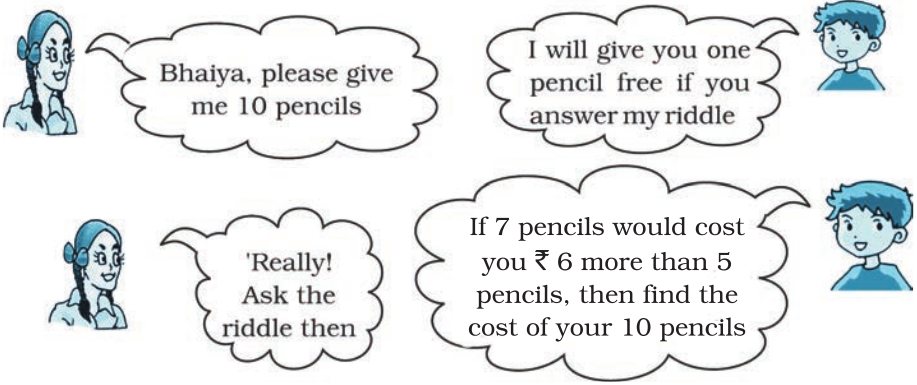
AnswerLet, the cost of one pencil be $Rs. x.$
Now, cost of such $7$ pencils will be $Rs. 7x$ and of $5$ pencils will be $Rs. 5x.$
It is given that cost of $7$ pencil is $Rs. 6$ more than cost of $5$ pencils.
Therefore, we get the following equation.
$7x - 5x = 6 $
$\Rightarrow 2x = 6$
$\Rightarrow\frac{2\text{x}}{2}=\frac{6}{2} [$dividing both sides by $2]$
$\Rightarrow\text{x}=3$
Since, cost of one pencil is $Rs. 3.$
So, the cost of 10 pencils $= 3 \times 10 = Rs. 30$
Thus, she have to pay $Rs. 30$ for $10$ pencils.
View full question & answer→Question 163 Marks
Each of the $2$ equal sides of an isosceles triangle is twice as large as the third side. If the perimeter of the triangle is $30\ cm,$ find the length of each side of the triangle.
AnswerLet third side of an isosceles triangle be $x.$
Then, two other equal sides are twice.
So, the both equal sides are $2x$ and $2x.$
We know that, perimeter of a triangle is sum of all sides of the triangle.
according to the question,
$x + 2x + 2x = 30 $
$\Rightarrow 5x = 30$
On dividing both sides by $5,$ we get
$\frac{5\text{x}}{5}=\frac{30}{5}$
$\Rightarrow\text{x}=6\text{cm}$
$\therefore$ Third side $= x = 6\ cm$
So, the other equal sides are $2x = 2 \times 6 = 12\ cm $
$2x = 2 \times 6 = 12\ cm.$
View full question & answer→Question 173 Marks
Two complementary angles differ by $20^\circ .$ Find the angles.
AnswerLet one of the angle be $x,$
then other will be $x - 20.$
According to the question,
$x + (x - 20) = 90^\circ [\because$ sum of complementary angle is $90^\circ ]$
$\Rightarrow x + x - 20 = 90^\circ $
$\Rightarrow 2x - 20 = 90^\circ $
$\Rightarrow 2x = 90 + 20 [$transposing $(-20)$ to $RHS] $
$\Rightarrow 2x = 110^\circ $
$\Rightarrow\frac{2\text{x}}{2}=\frac{110^\circ}{2} [$dividing both sides by $2]$
$\Rightarrow\text{x}=55^\circ$
Hence, the required angles are $55^\circ $ and $(55 - 20)^\circ $
i.e. $55^\circ $ and $35^\circ .$
View full question & answer→Question 183 Marks
Twice a number added to half of itself equals $24.$ Find the number.
AnswerLet the number be $x.$
Then twice of this number $= 2x$ and
half of this number $=\frac {1}{2}\text{x}.$
According to the question, $2\text{x}+\frac{1}{2}\text{x}=24$
Multiplying both sides by $2,$ we get $4x + x = 48$
$\Rightarrow5\text{x}=48$
$\Rightarrow\frac{5\text{x}}{5}=\frac{48}{5} [$dividing both sides by $5]$
$\Rightarrow\text{x}=9.6$
Hence, the required number is $9.6.$
View full question & answer→Question 193 Marks
The length of a rectangle is two times its width. The perimeter of the rectangle is $180\ cm$. Find the dimensions of the rectangle.
AnswerLet $x$ be the width of the rectangle.
Then, length of the rectangle will be $2x.$
$\because$ Perimeter of a rectangle $= 2 [$Length $+$ Width$]$
$[\because$ width = breadth$]$ According to the question,
$2(x + 2x) = 180 $
$\Rightarrow 2(3x) = 180$
$ \Rightarrow 6x = 180$
$\Rightarrow\text{x}=\frac{180}{6}=30\text{cm}$
Hence, width of the rectangle is $30\ cm$ and length of the rectangle is $2 \times 30,$
i.e, $60\ cm.$
View full question & answer→Question 203 Marks
$9$ added to twice a number gives $13.$ Find the number.
AnswerIt is given that $9$ added to twice this number given $13.$
$\therefore2\text{x}+9=13$
$\Rightarrow2\text{x}=13-9[$ transposing $9$ to $RHS]$
$\Rightarrow2\text{x}=4$
$\Rightarrow\frac{2\text{x}}{2}=\frac{4}{2} [$dividing both sides by $2]$
$\Rightarrow\text{x}=2$
Hence, the required number is $2.$
View full question & answer→Question 213 Marks
In a certain examination, a total of $3768$ students secured first division in the years $2006$ and $2007$. The number of first division in $2007$ exceeded those in $2006$ by $34.$ How many students got first division in $2006?$
AnswerLet the number of students who got first division in year $2006$ be $x.$
Since, the number of first division in year $2007$ exceeded those in year $2006$ by $34,$
therefore the number of students who got first division in year $2007$ will be $(x + 34).$
It is given that total number of students who got first division in years $2006$ and $2007$ is $3768.$
According to the question, $x + (x + 34) = 3768$
$\Rightarrow 2x + 34 = 3768$
$\Rightarrow 2x = 3768 - 34 [$transposing $34$ to $RHS]$
$\Rightarrow 2x = 3734$
$\Rightarrow\frac{2\text{x}}{\text{x}}=\frac{3734}{2} [$dividing both sides by $2]$
$\Rightarrow\text{x}=1867$
Hence, $1867$ students got first division in year $2006.$
View full question & answer→Question 223 Marks
A man travelled two fifth of his journey by train, one-third by bus, one-fourth by car and the remaining $3\ km$ on foot. What is the length of his total journey$?$
AnswerLet his total journey length be $x.$
$\therefore$ Then, travelled by train $=\frac{2}{5}\text{x},$
Travelled by bus $=\frac{1}{3}\text{x}$ and travelled by car $=\frac{1}{4}\text{x}$
$\therefore$ Total journey travelled by train, bus and car $=\frac{2}{5}\text{x}+\frac{1}{3}\text{x}+\frac{1}{4}\text{x}$
$=\frac{12\times2\text{x}+20\times\text{x}+15\times\text{x}}{60}$
$[\because LCM$ of $5, 3$ and $4 = 60]$
$=\frac{24\text{x}+20\text{x}+15\text{x}}{60}=\frac{59\text{x}}{60}$
$\therefore$ Remaining journey $=\frac{\text{x}}{1}-\frac{59\text{x}}{60}=\frac{60\text{x}-59\text{x}}{60}=\frac{\text{x}}{60}$
According to the question, remaining journey is $3\ km.$
$\therefore\frac{\text{x}}{60}=3$
$\Rightarrow\text{x}=3\times60=180\text{km}$ [by cross-multiplication]
Hence, the length of his total journey is $180\ km.$
View full question & answer→