Questions

2 Marks Questions

Take a timed test

32 questions · self-marked practice — reveal the answer and mark yourself.

Question 12 Marks
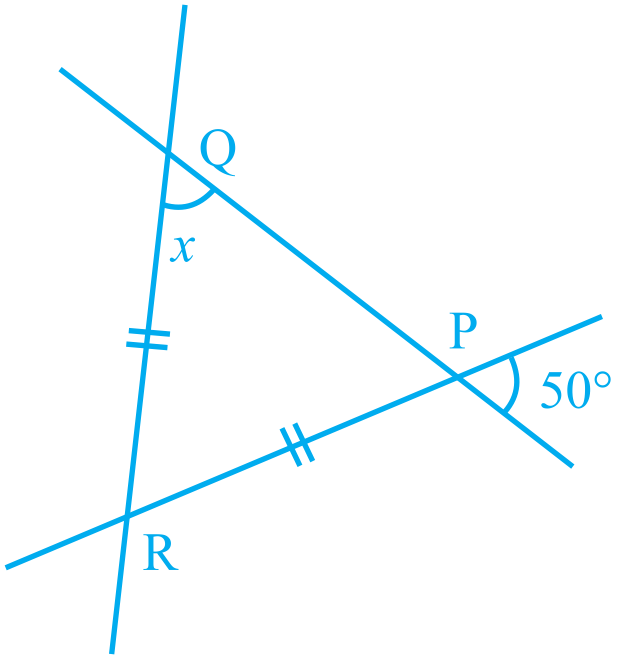
In Figure. if $RP = RQ,$ find the value of $x.$
Answer
Given, $RP = RQ$
Since, $\angle1=50^{\circ}$ [vertically opposite angles]
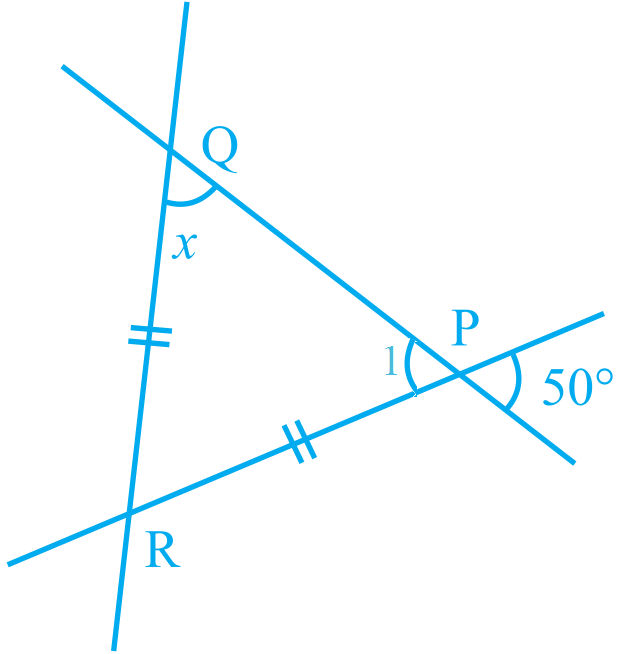
 Also, $\angle1=\text{x}$
$[\because\text{RP}=\text{RQ}]$
So, $\text{x}=50^{\circ}$
View full question & answer
Question 22 Marks
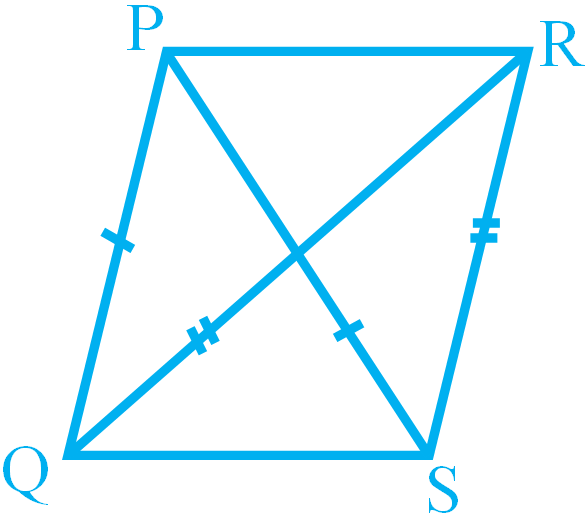
If $\triangle\text{PQR }$ and $\triangle\text{SQR}$ are both isosceles triangle on a common base $QR$ such that $P$ and $S$ lie on the same side of $QR.$ Are triangles $PSQ$ and $PSR$ congruent? Which condition do you use$?$
Answer
In $\triangle\text{PSQ}$ and $\triangle\text{PSR},$
$PQ = PR [$given$]$
$SQ = SR [$given$]$
$PS = PS [$common side$]$

By $SSS$ congruence criterion, $\triangle\text{PSQ}\cong\triangle\text{PSR}$
View full question & answer
Question 32 Marks
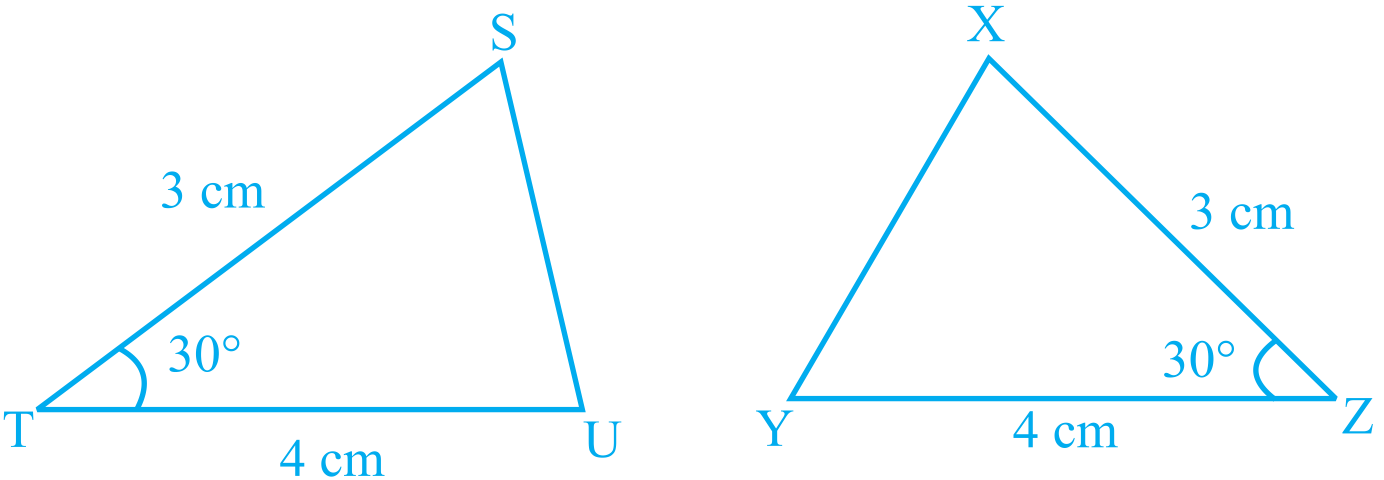
In Figure. which pairs of triangles are congruent by $SAS$ congruence criterion (condition)? If congruent, write the congruence of the two triangles in symbolic form.
Answer
In $\triangle\text{STU}$ and $\triangle\text{XZY},$
$TU = ZY = 4\ cm$
$TS = ZX = 3\ cm$
$\angle\text{STU}=\angle\text{XZY}=30^{\circ}$
By $SAS$ congruence criterion,
$\triangle\text{STU}\cong\triangle\text{XZY}$
View full question & answer
Question 42 Marks
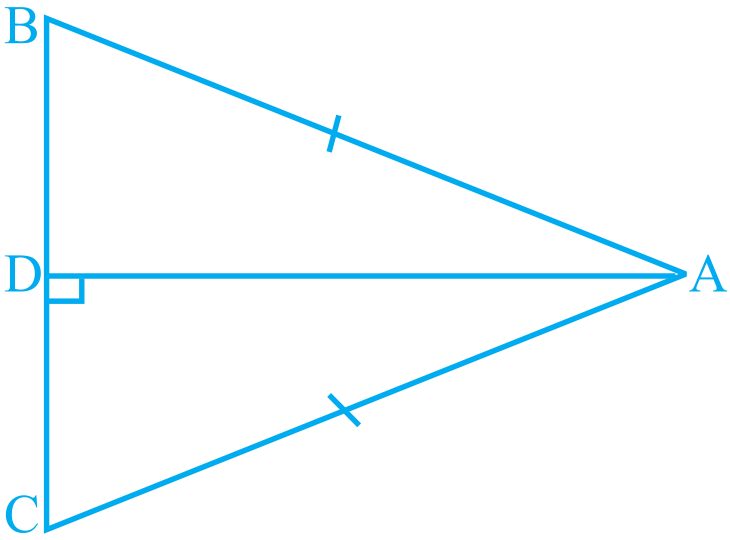
In given pairs of triangles of Figure. using only $RHS$ congruence criterion, determine which pairs of triangles are congruent. In case of congruence, write the result in symbolic form:
Answer
In $\triangle\text{ABD}$ and $\triangle\text{ACD},$
$AB = AC [$given$]$
$AD = AD [$common side$]$
$\triangle\text{ADB}=\triangle\text{ADC}=90^{\circ}$
By $RHS$ congruence criterion, $\triangle\text{ADB}\cong\triangle\text{ADC}$
View full question & answer
Question 52 Marks
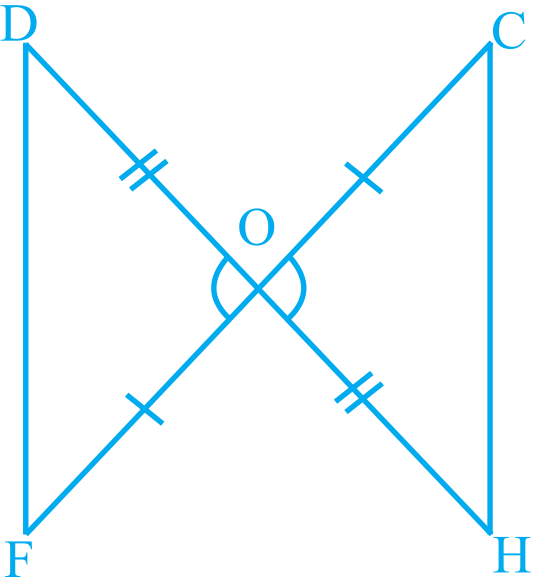
In Figure. which pairs of triangles are congruent by $SAS$ congruence criterion (condition)? If congruent, write the congruence of the two triangles in symbolic form.
Answer
In $\triangle\text{DOF}$ and $\triangle\text{HOC},$
$DO = HO = 3\ cm [$given$]$
$CO = FO [$given$]$
$\angle\text{DOF}=\angle\text{HOC} [$vertically opposite angles$]$
By $SAS$ congruence criterion,
$\triangle\text{DOF}\cong\triangle\text{HOC}$
View full question & answer
Question 62 Marks
The lengths of two sides of an isosceles triangle are $9\ cm$ and $20\ cm.$ What is the perimeter of the triangle? Give reason.
Answer
Third side must be $20\ cm,$ because sum of two sides should be greater than the third side
$\therefore$ Perimeter of the triangle $=$ Sum of all sides $= (9 + 20 + 20)\ cm= 49\ cm.$
View full question & answer
Question 72 Marks
In a triangle $ABC,$ the measure of angle $A$ is $40^\circ $ less than the measure of angle $B$ and $50^\circ $ less than that of angle $C.$ Find the measure of $\angle\text{A}.$
Answer
According to the question, Measure of $\angle\text{A}=\angle\text{B}+40^{\circ}$
Measure of $\angle\text{C}=\angle\text{B}-40^{\circ}+50^{\circ}$
We know that, the sum of all three angles in triangle is equal to $180^\circ .$
​​​​​​​i.e. $\angle\text{A}+\angle\text{B}+\angle\text{C}=180^{\circ}$
$\Rightarrow(\angle\text{B}-40^{\circ})+\angle\text{B}+(\angle\text{B}-40^{\circ}+50^{\circ})=180^{\circ}$
$\Rightarrow3\angle\text{B}-30^{\circ}=180^{\circ}$
$\Rightarrow3\angle\text{B}=210^{\circ}$
$\therefore\angle\text{B}=\frac{210^{\circ}}{3}=70^{\circ}$
So, the measure of $\angle\text{A}=70^{\circ}-40^{\circ}=30^{\circ}$
View full question & answer
Question 82 Marks
The measure of three angles of a triangle are in the ratio $5 : 3 : 1.$ Find the measures of these angles.
Answer
Let measures of the given angles of a triangles be $5x, 3x$ and $x.$
$\because$ Sum of all the angles in a triangle $= 180^\circ $
$\therefore 5x + 3x + x = 180^\circ $
$\Rightarrow 9x = 180^\circ $
$\Rightarrow\text{x}=\frac{180^{\circ}}{9}$
$\Rightarrow \ \text{x}=20^{\circ}$
So, the angles are $5x = 5 \times 20^\circ = 100^\circ ,$
$3x = 3 \times 20^\circ = 60^\circ $ and $x = 20^\circ $
i.e. $100^\circ $ and $20^\circ .$
View full question & answer
Question 92 Marks
In Figure. it is given that $\ce{LM = ON}$ and $\ce{NL = MO}$
$a.$ State the three pairs of equal parts in the triangles $\ce{NOM}$ and $\ce{MLN}.$
$b.$ Is $\triangle\text{NOM}\cong\text{MLN}.$ Give reason?
Answer
$a.$ In $\triangle\text{NOM}$ and $\triangle\text{MLN, LM = ON}[ $given$]$
$\ce{MN = MN} [$common side$]$
$\ce{LN = OM} [$given$]$
$b.$ Yes, by $\ce{SSS}$ congruence criterion,
$\triangle\text{NOM}\cong\text{MLN}.$
View full question & answer
Question 102 Marks
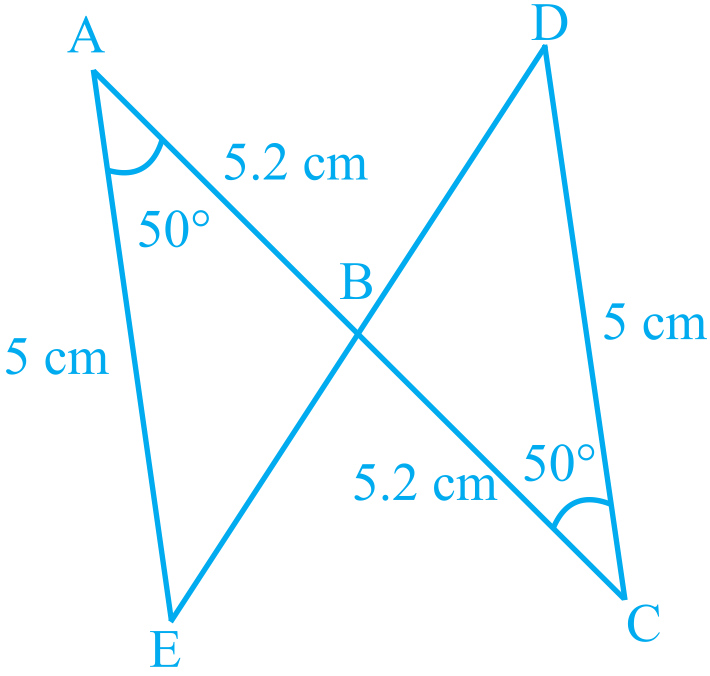
In Figure. which pairs of triangles are congruent by $SAS$ congruence criterion (condition)? If congruent, write the congruence of the two triangles in symbolic form.
Answer
In $\triangle\text{BCD}$ and $\triangle\text{BAE},$
$AB = CB = 5.2\ cm$
$DC = EA = 5\ cm$
$\angle\text{EAB}=\angle\text{DCB}=50^{\circ}$
By $SAS$ congruence criterion,
$\triangle\text{BCD}\cong\triangle\text{BAE}$
View full question & answer
Question 112 Marks
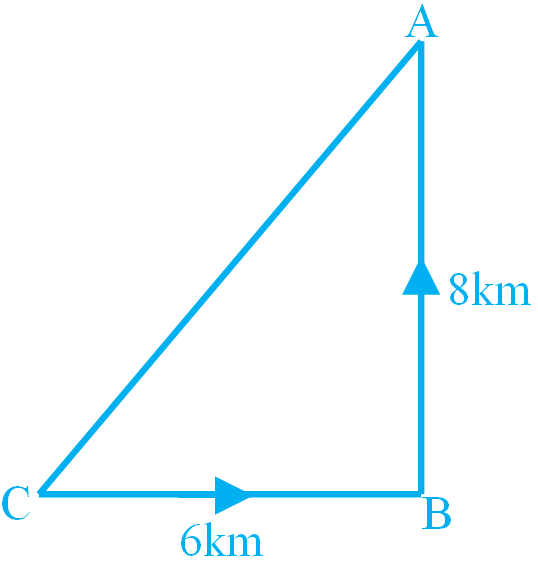
Jiya walks $6\ km$ due east and then $8\ km$ due north. How far is she from her starting place$?$
Answer
As per the given information, we can draw the following figure, which is a right angled triangle at $B.$
Distance from starting point to the final position is the hypotenuse of right angled $\triangle \mathrm{ABC}$,
$\text { i.e. } \left.A C^2=A B^2+B C^2 \text { [by pythagoras theoram }\right]$
$\Rightarrow(6)^2+(8)^2=(\text { Distance })^2[\because A C=\text { distance }]$
$\Rightarrow 36+64=(\text { Distance })^2$
$\therefore \text { Distance }=\sqrt{100}=10 \mathrm{~km}$
View full question & answer
Question 122 Marks
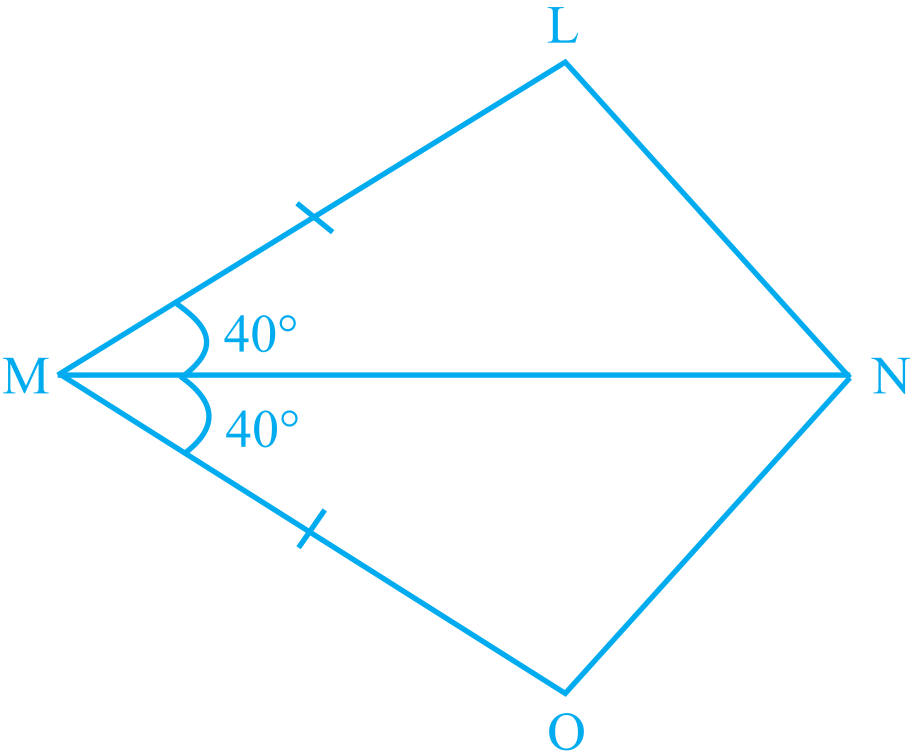
In Figure. which pairs of triangles are congruent by $SAS$ congruence criterion (condition)? If congruent, write the congruence of the two triangles in symbolic form.
Answer
In $\triangle\text{LMN}$ and $\triangle\text{OMN},$
$LM = OM [$given$]$
$MN = MN [$common side$]$
$\angle\text{LMN}=\angle\text{LMN}=40^{\circ}$
By $SAS$ congruence criterion, $\triangle\text{LMN}\cong\triangle\text{OMN}$
View full question & answer
Question 132 Marks
Check whether the following measures (in cm) can be the sides of a right-angled triangle or not. $1.5, 3.6, 3.9$
Answer
For a right angled triangle, the sum of square of two shorter sides must be equal to the square of the third side.
Now, $1.5^2+3.6=2.25+12.96$
$=15.21$
Also,
$(3.9)^2=15.21$
$\Rightarrow(1.5)^2+(3.6)^2=(3.9)^2$
Hence, the given sides form right angled triange.
View full question & answer
Question 142 Marks
In Figure $\triangle\text{PQR}$ is right-angled at $P.\ U$ and $T$ are the points on line $QRF.$ If $QP || ST$ and $US || RP,$ find $\angle\text{S}.$
Answer
If $QP || ST$ and $QT$ is a transversal,
then $\angle \text{PQR} = \angle \text{STU}     [$alternate interior angles$]$ and
if $DS || RP$ and $QT$ is a transversal,
then $\angle \text{PRQ} = \angle \text{SUT } [$alternate interior angles$]$
Hence,$ \angle \text{S }$
must be equal to$ \angle 90^\circ $.
View full question & answer
Question 152 Marks
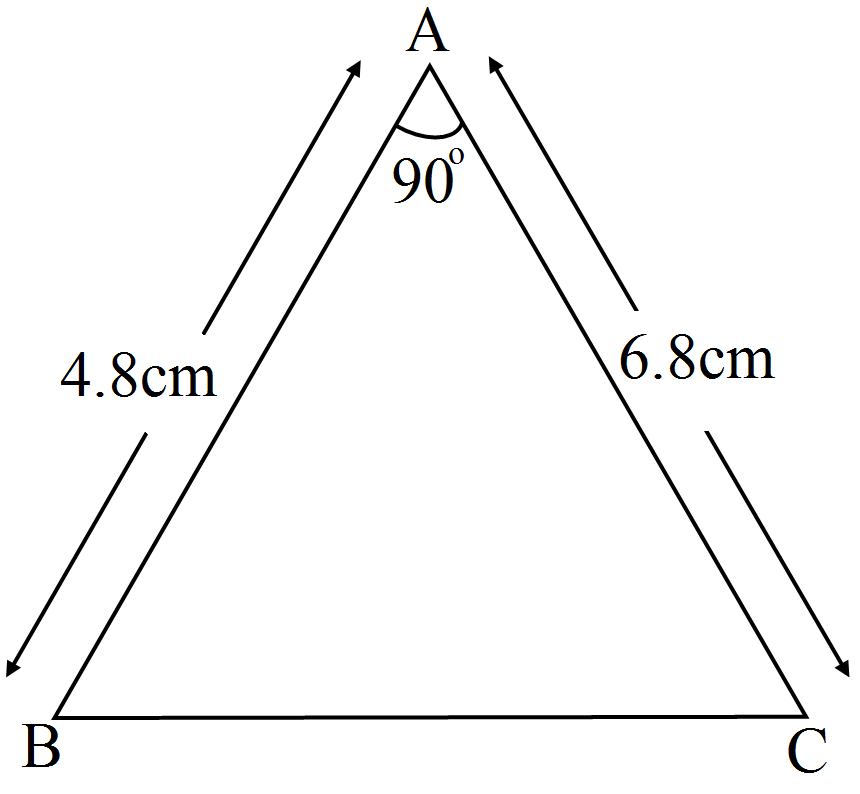
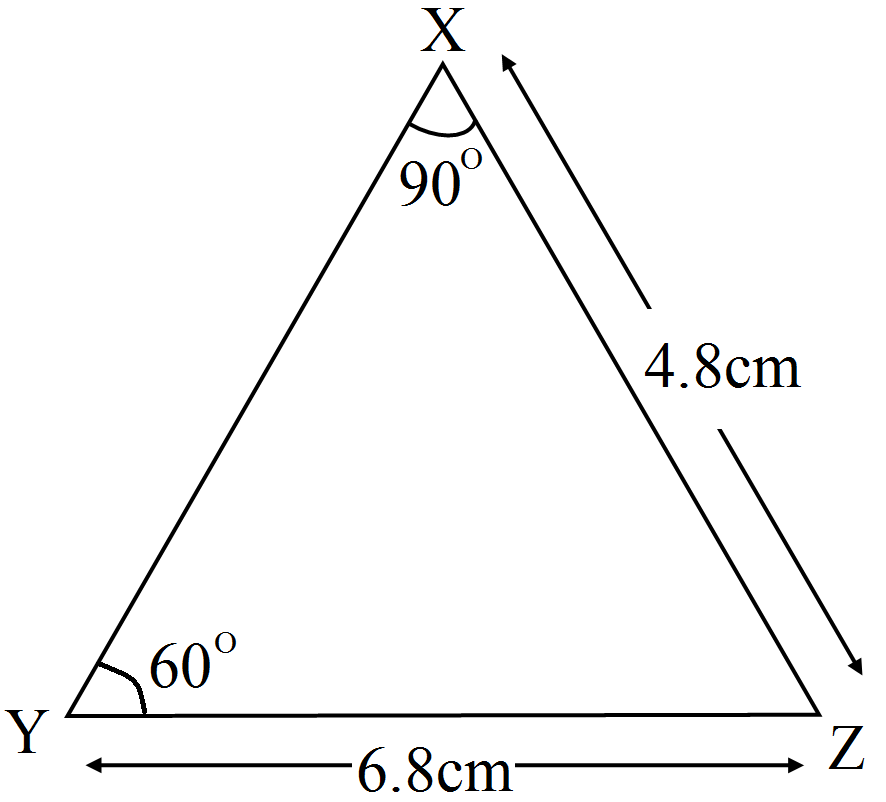
State which of the following pairs of triangles are congruent. If yes, write them in symbolic form (you may draw a rough figure). $\triangle\text{ABC}:\text{AB}=4.8\text{cm},$$\angle\text{A}=90^{\circ},$ $\text{AC}=6.8\text{cm}$ $\triangle\text{XYZ}:\text{YZ}=6.8\text{cm},$$\angle\text{X}=90^{\circ},$$\text{ZX}=4.8\text{cm}$
Answer
Both the triangles are not congruent.
View full question & answer
Question 162 Marks
The angles of a triangle are in the ratio $2 : 3 : 5.$ Find the angles.
Answer
Let measures of the given angles of a triangle be $2x, 3x$ and $5x.$
$\because$ Sum of all the angles in a triangle $= 180^\circ $
$\therefore 2x + 3x + 5x = 180^\circ $
$\Rightarrow 10x = 180^\circ $
$\Rightarrow \ \text{x}=\frac{180^{\circ}}{10}=18^{\circ}$
So, the angles are $2x = 2 \times 18^\circ = 36^\circ , $
$3x = 3 \times 18^\circ = 54^\circ $ and
$​​​​​​​5x = 5 \times 18^\circ = 90^\circ .$
View full question & answer
Question 172 Marks
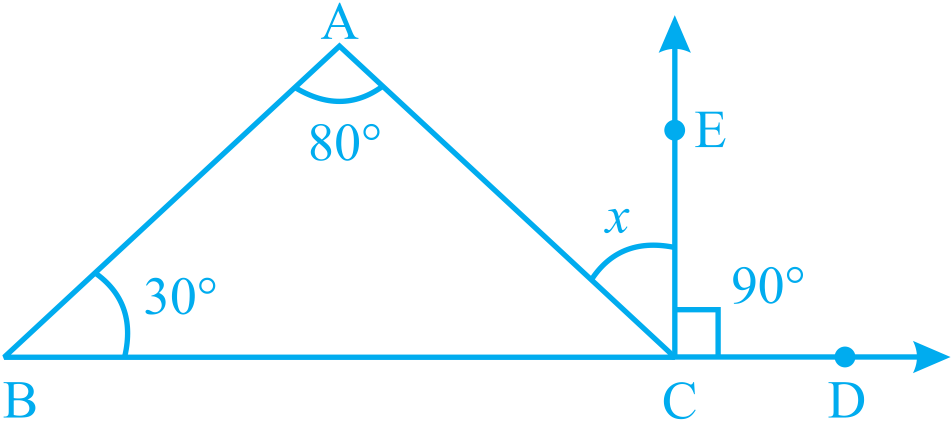
Find the value of $x$ in Figure.
Answer
In the given figure, $\angle\text{BAC}=80^{\circ},\angle\text{ABC}=30^{\circ},$
$\angle\text{ACE}=\text{x} \ \text{and} \ \angle\text{ECD}=90^{\circ}$ In $\triangle\text{ABC},$
we know that, exterior angle is equal to the sum of interior opposite angles.
$\therefore\angle\text{ACD}=\angle\text{CAB}+\angle\text{ABC}$
$\Rightarrow \ \angle\text{ACE}+\angle\text{ECD}=80^{\circ}+30^{\circ}$
$[\because\angle\text{ACD}=\angle\text{ACE}+\angle\text{ECD}]$
$\Rightarrow\angle\text{ACE}+90^{\circ}=110^{\circ}$
$[\because\angle\text{ECD}=90^{\circ}]$
$\Rightarrow \angle\text{ACE}=110^{\circ}-90^{\circ}=20^{\circ}$
View full question & answer
Question 182 Marks
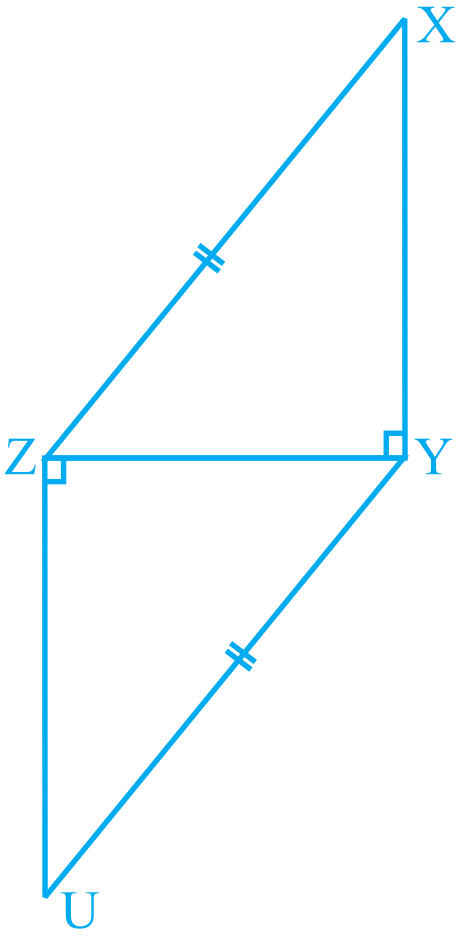
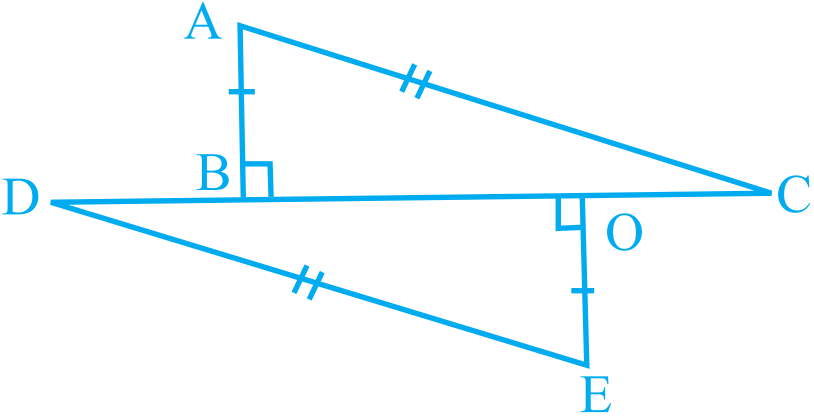
In given pairs of triangles of Figure. using only $RHS$ congruence criterion, determine which pairs of triangles are congruent. In case of congruence, write the result in symbolic form:
Answer
In $\triangle\text{XYZ}$ and $\triangle\text{UZY},$
$XZ = YU [$given$]$
$ZY = ZY [$common side$]$
$\angle\text{XYZ}=\angle\text{UZY}=90^{\circ}$
By $RHS$ congruence criterion,
$\triangle\text{ADB}\cong\triangle\text{ADC}$
View full question & answer
Question 192 Marks
In Figure. state the three pairs of equal parts in $\triangle\text{ABC}$ and $\triangle\text{EOD}.$
Is $\triangle\text{ABC}\cong\triangle\text{EOD}?$ Why?
Answer
In $\triangle\text{ABC},$ and $\triangle\text{EOD},$
$AB = EO [$given$]$
$AC = ED$
$\angle\text{ABC}=\angle\text{EOD}=90^{\circ}$
By RHS congruence criterion, $\triangle\text{ABC}\cong\triangle\text{EOD}$
View full question & answer
Question 202 Marks
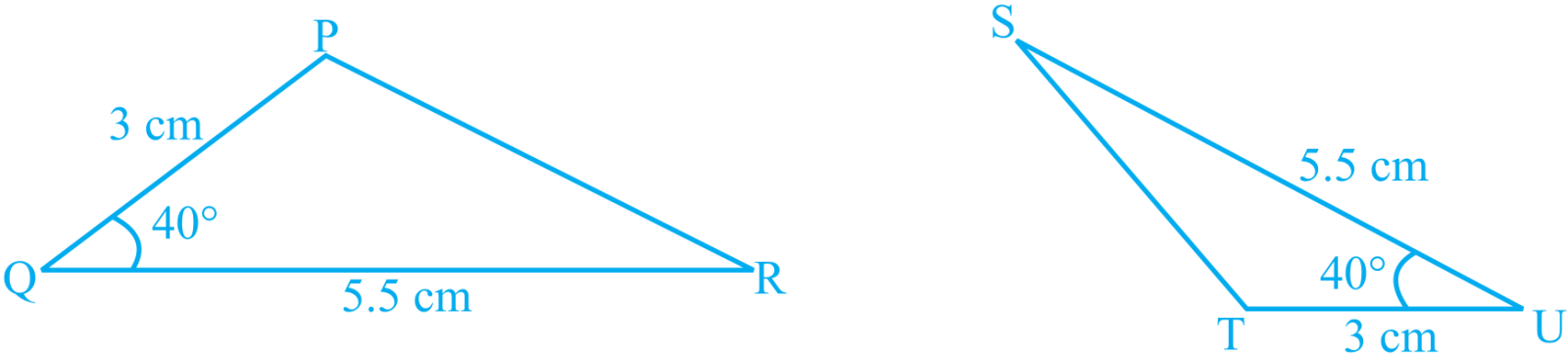
In Figure. which pairs of triangles are congruent by $SAS$ congruence criterion (condition)? If congruent, write the congruence of the two triangles in symbolic form.
Answer
In $\triangle\text{PQS}$ and $\triangle\text{TUS},$
$PQ = TU = 3\ cm$
$QR = US = 5.5\ cm$
$\angle\text{PQR}=\angle\text{TUS}=40^{\circ}$
By $SAS$ congruence criterion, $\triangle\text{PQR}\cong\triangle\text{TUS}$
View full question & answer
Question 212 Marks
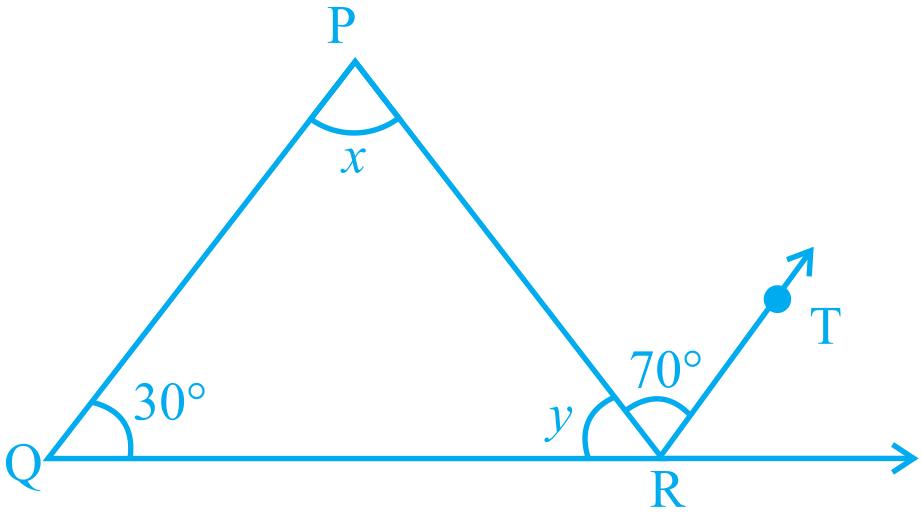
In Figure. $QP | | RT.$ Find the values of $x$ and $y.$
Answer
In the given figure, $QP || RT,$
where $PR$ is a transversal line.
So, $\angle \text{x}$ and $\angle \text{TRP}$ are alternate interior angles.
$\therefore\angle\text{x}=70^{\circ}$
We know that, the sum of all angles in triangle is equal to $180^\circ $
$\therefore\angle\text{x}+30^{\circ}+\angle\text{y}=180^{\circ}$
$\Rightarrow \ 70^{\circ}+30^{\circ}+\angle\text{y}=180^{\circ}$
$\Rightarrow \ \angle\text{y}=180^{\circ}-100^{\circ}$
$\Rightarrow\angle\text{y}=80^{\circ}$
View full question & answer
Question 222 Marks
In triangle $XYZ,$ the measure of angle $X$ is $30^\circ $ greater than the measure of angle $Y$ and angle $Z$ is a right angle. Find the measure of $\angle\text{Y}.$
Answer
According to the question, Measure of $\angle\text{X}=\angle\text{Y}+30^{\circ}$
Measure of $\angle\text{Z}=90^{\circ}$
We know that, the sum of all three angles in triangle is equal to $180^\circ .$ i.e.
​​​​​​​$\angle\text{X}+\angle\text{Y}+\angle\text{Z}=180^{\circ}$
$\Rightarrow\angle\text{Y}+(\angle\text{Y}+30^{\circ})+90^{\circ}=180^{\circ}$
$\Rightarrow2\angle\text{Y}+120^{\circ}=180^{\circ}$
$\Rightarrow2\angle\text{Y}+180^{\circ}-120^{\circ}=60^{\circ}$
$\therefore\angle\text{Y}=\frac{60^{\circ}}{2}=30^{\circ}$
View full question & answer
Question 232 Marks
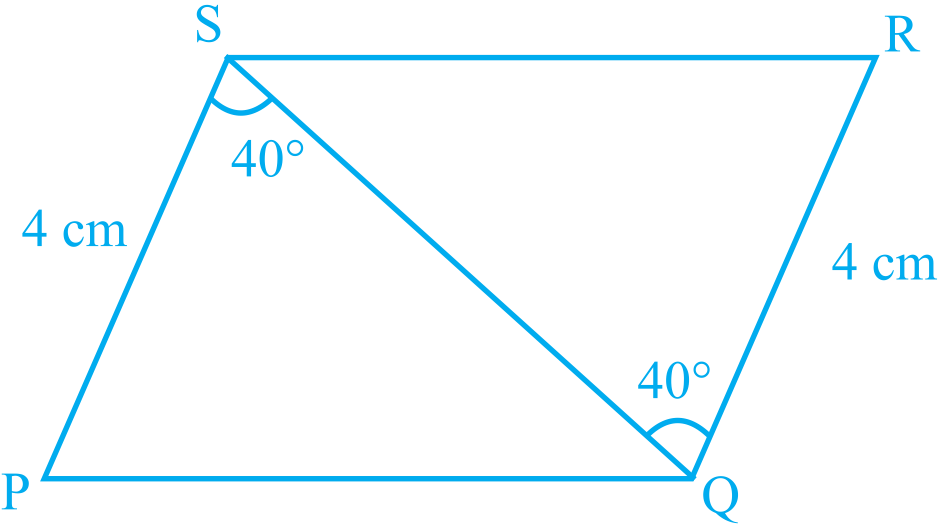
In Figure. which pairs of triangles are congruent by $SAS$ congruence criterion (condition)? If congruent, write the congruence of the two triangles in symbolic form.
Answer
In $\triangle\text{PSQ}$ and $\triangle\text{RQS},$
$PS = RQ = 4\ cm$
$SQ = SQ [$common side$]$
$\angle\text{PSQ}=\angle\text{RQS}=40^{\circ}$
By $SAS$ congruence criterion,
$\triangle\text{PSQ}\cong\triangle\text{RQS}$
View full question & answer
Question 242 Marks
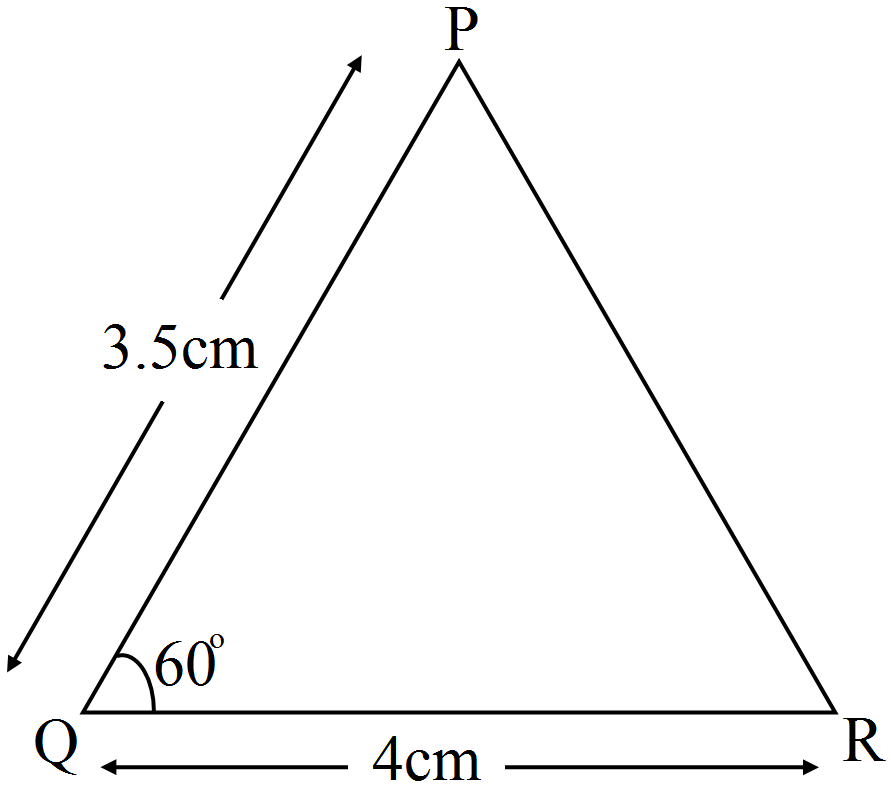
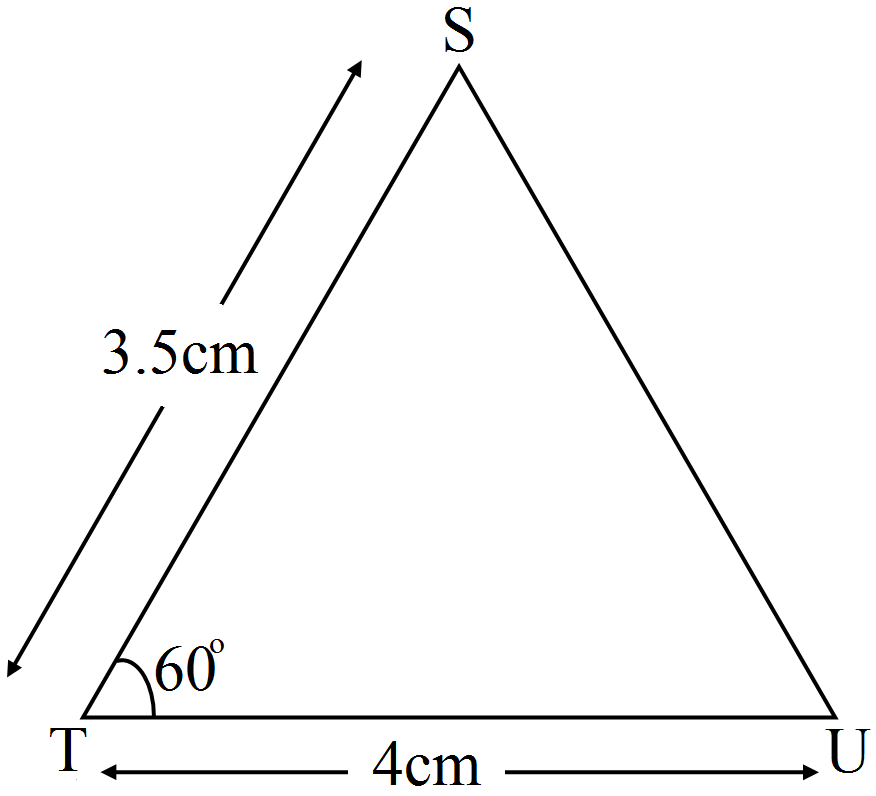
State which of the following pairs of triangles are congruent. If yes, write them in symbolic form (you may draw a rough figure). $\triangle\text{PQR}:\text{PQ}=3.5\text{cm},$$\text{QR}=4.0\text{cm},\angle\text{Q}=60^{\circ}$ $\triangle\text{STU}:\text{ST}=3.5\text{cm},$$\text{TU}=4\text{cm},\angle\text{T}=60^{\circ}$
Answer
​​
Both the triangles are congruent.
View full question & answer
Question 252 Marks
The angles of a triangle are arranged in descending order of their magnitudes. If the difference between two consecutive angles is $10^\circ ,$ find the three angles.
Answer
Let one of the angles of a triangle be $x.$
If angles are arranged in descending order.
Then, angles will be $x, (x - 10^\circ )$ and $(x - 20^\circ ).$
We know that, the sum of all angles in a triangle is equal to $180^\circ $
So, $x + (x - 10^\circ ) + (x - 20^\circ ) = 180^\circ $
$\Rightarrow x + x + x - 30^\circ = 180^\circ $
$\Rightarrow 3x = 180^\circ + 30^\circ $
$\Rightarrow 3x = 210^\circ $
$\Rightarrow\text{x}=\frac{210^{\circ}}{3}=70^{\circ}$
Hence, angles will be $70^\circ , 70^\circ - 10^\circ $ and $70^\circ , 60^\circ $ and $50^\circ $
View full question & answer
Question 262 Marks
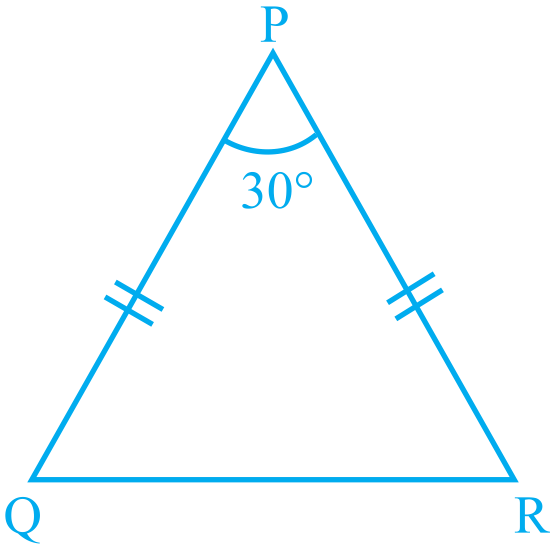
In $\triangle\text{PQR}$ of Figure. $PQ = QR,$ Find the measures of $\angle\text{Q}$ and $\angle\text{R}.$
Answer
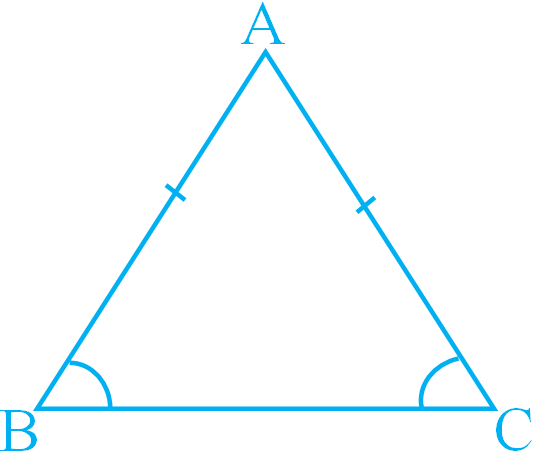
Since, $PQ = PR$ [given]
$\therefore\angle\text{Q}=\angle\text{R}=\text{x}$ [say]
As we know, $\angle\text{P}+\angle\text{Q}+\angle\text{R}=180^{\circ}$ [angle sum property of a triangle]
$\Rightarrow \ 30^{\circ}+\text{x}+\text{x}=180^{\circ}$
$\Rightarrow \ 2\text{x}=150^{\circ}$
$\Rightarrow \ \text{x}=75^{\circ}$
Hence, $\angle\text{Q}=\angle\text{R}=75^{\circ}$
View full question & answer
Question 272 Marks
Each of the two equal angles of an isosceles triangle is four times the third angle. Find the angles of the triangle.
Answer
Let the third angle be $x.$
Then, the other two angles are $4x$ and $4x,$ respectively.

We know that, the sum of all three angles in a triangle is $180^\circ .$
i.e. $\angle\text{A}+\angle\text{B}+\angle\text{C}=180^{\circ}$
$\Rightarrow \ \text{x}+4\text{x}+4\text{x}=180^{\circ}$
$\Rightarrow \ 9\text{x}=180^{\circ}$
$\Rightarrow \ \text{x}=\frac{180^{\circ}}{9}=20^{\circ}$
Hence, the three angles are $4x = 4 \times 20^\circ = 80^\circ ,$
$4x = 4 \times 20 = 80^\circ $ and $x = 20^\circ .$
View full question & answer
Question 282 Marks
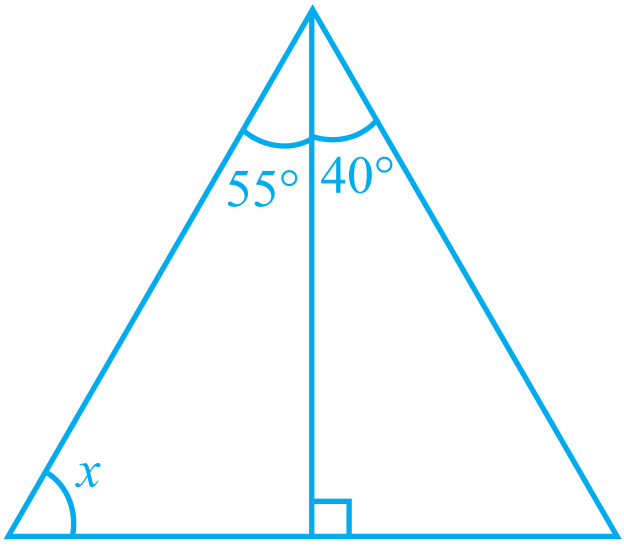
In Figure. find the value of $x.$
Answer
We know that, the sum of all three angles in a triangle is equal to $180^\circ .$
So, $x + 55^\circ + 90^\circ = 180^\circ $
$\Rightarrow x + 145^\circ = 180^\circ $
$\Rightarrow x = 180^\circ - 145^\circ $
$\Rightarrow x = 35^\circ $
View full question & answer
Question 292 Marks
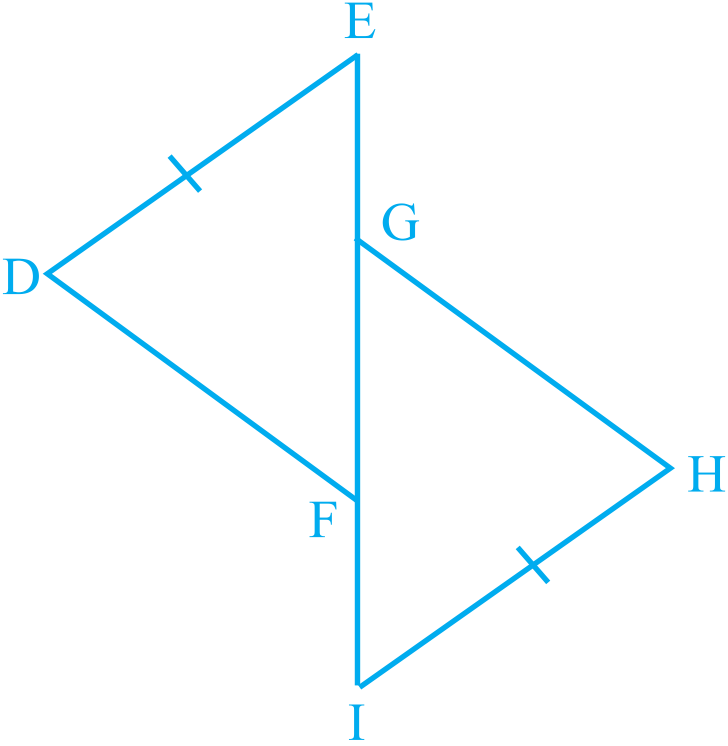
In Figure. $DE = IH, EG = FI$ and $\angle\text{ E} = \angle\text{I}.$ Is $\triangle\text{DEF}\triangle\text{HIG}? $ If yes, by which congruence criterion?
Answer
Given, $EG = FI$
$EG + GF = FI + GF [$adding $GF$ on both sides$]\ EF = IG$
In $\triangle\text{DEF}$ and $\triangle\text{HIG},$
$DE = IH [$given$]$
$EF = IG [$proved above$]$
$\angle\text{E}=\angle\text{I} [$given$]$
​​​​​​​By $SAS$ congruence criterion, $\triangle\text{DEF}\cong\triangle\text{HIG}$
View full question & answer
Question 302 Marks
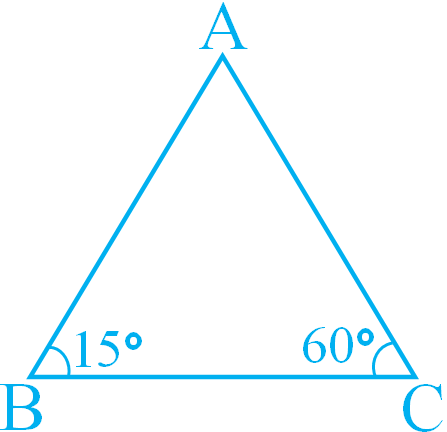
I have three sides. One of my angle measures $15^\circ .$ Another has a measure of $60^\circ .$ What kind of a polygon am $I?$ If I am a triangle, then what kind of triangle am $I?$
Answer
The polygon with three sides is called triangle.

According to the angle sum property of a triangle,
$\Rightarrow \ \angle\text{A}+\angle\text{B}+\angle\text{C}=180^{\circ}$
$\Rightarrow \ \angle\text{A}+\text{15}^{\circ}+\text{60}^{\circ}=180^{\circ}$
$\Rightarrow \ \angle\text{A}=180^{\circ}-75^{\circ}$
$ \angle\text{A}=105^{\circ}$ As one angle in this triangle is greater than $90^\circ $,
so it is an obtuse angled triangle.
View full question & answer
Question 312 Marks
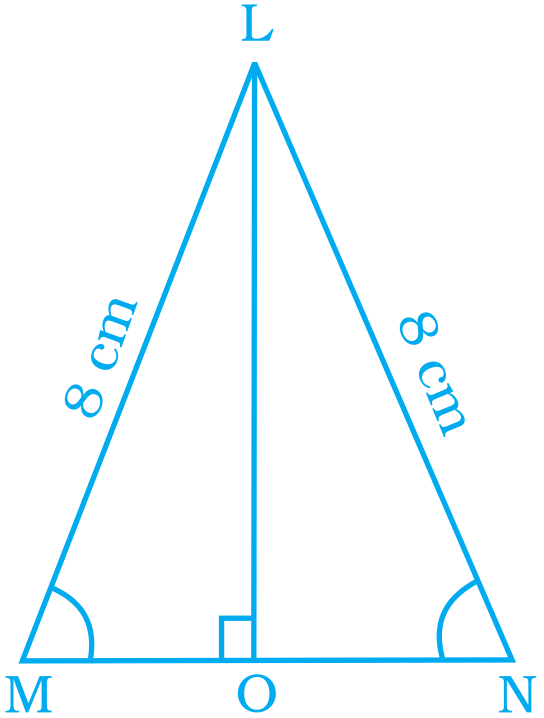
In given pairs of triangles of Figure. using only $RHS$ congruence criterion, determine which pairs of triangles are congruent. In case of congruence, write the result in symbolic form:
Answer
In $\triangle\text{LOM}$ and $\triangle\text{LON},$
$LM = LN = 8cm$
$LO = LO$
$\angle\text{LOM}=\angle\text{LON}=90^{\circ}$
By $RHS$ congruence criterion, $\triangle\text{LOM}\cong\triangle\text{LON}$
View full question & answer
Question 322 Marks
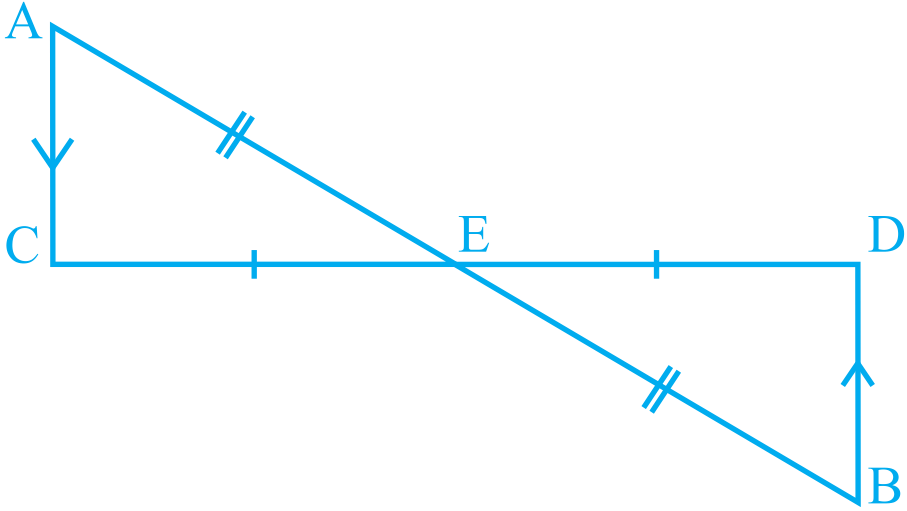
In given pairs of triangles of Figure. using only $RHS$ congruence criterion, determine which pairs of triangles are congruent. In case of congruence, write the result in symbolic form:
Answer
In $\triangle\text{AEC}$ and $\triangle\text{BED},$
$CE = DE [$given$]$
$AE = BE [$common side$]$
$\angle\text{ACE}=\angle\text{BDE}=90^{\circ}$
By $RHS$ congruence criterion, $\triangle\text{AEC}\cong\triangle\text{BED}$
View full question & answer