Questions

1 Marks Question

Take a timed test

13 questions · self-marked practice — reveal the answer and mark yourself.

Question 11 Mark
 
Examine if the following are true statements:
$i.$ The cube can cast a shadow in the shape of a rectangle.
$ii.$ The cube can cast a shadow in the shape of a hexagon.
 
Answer
A cube can cast shadow only in the shape of a square. So hexagon is not possible. Since a surface of cube is square from any view $($side or top view$).$ So both the statements are not true.
View full question & answer
Question 21 Mark
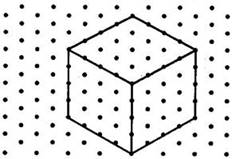
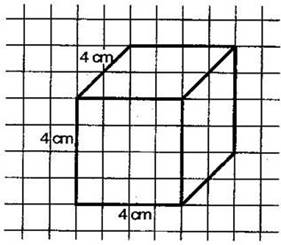
Give $(i)$ an oblique sketch and $(ii)$ an isometric sketch of a cube with an edge $4\ cm$ long.
Answer
-Oblique sketch for a cube of side $= 4\ cm$

Isometric sketch for the same cube-
View full question & answer
Question 31 Mark
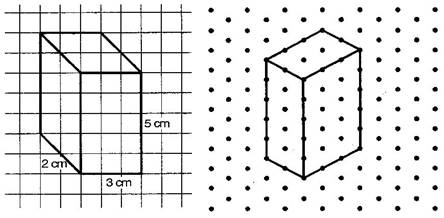
Give $(i)$ an oblique sketch and $(ii)$ an isometric sketch for a cuboid of dimensions $5\ cm, 3\ cm$ and $2\ cm.$ (Is your sketch unique?)
Answer
Oblique and isometric sketch

No it won’t be unique. Since length, height and width are not mentioned. I can draw $2$ more figures. I can switch the three.
View full question & answer
Question 41 Mark
 
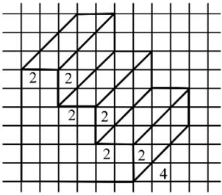
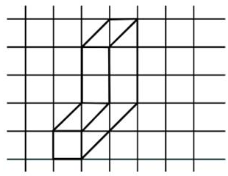
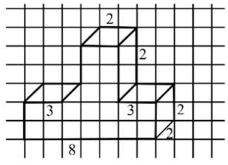
Make an oblique sketch for each one of the given isometric shapes?
$i.$ 
$ii.$
 
Answer
 
Oblique sketches:
$i.$ 
$ii.$ 
 
View full question & answer
Question 51 Mark
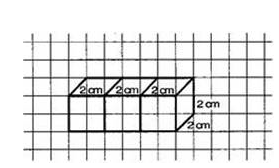
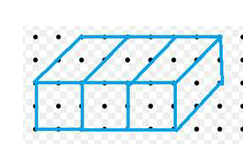
Three cubes each with $2\ cm$ edge are placed side by side to form a cuboid. Sketch an oblique or isometric sketch of this cuboid.
Answer
Here is an oblique sketch-

Here is isometric sketch for three cubes of $2\ cm$ edge placed side by side.
View full question & answer
Question 101 Mark
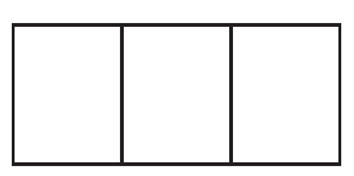
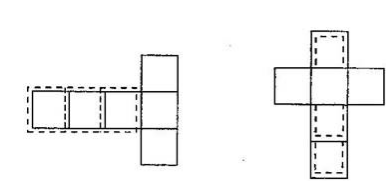
Here is an incomplete net for making a cube. Complete it in at least two different ways. Remember that a cube has six faces. How many are there in the net here? (Give two separate diagrams. If you like, you may use a squared sheet for easy manipulation.)
Answer
Here we have given $3$ faces of cube, so we can implement other $3$ faces in this way to get a cube-
View full question & answer
Question 111 Mark
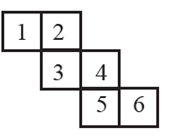
Can this be a net for a die$?$
Explain your answer.
Answer
It can be observed that the opposite faces of the dice so formed have $2$ and $5, 1$ and $4, 3$ and $6$ on them. The sum of the numbers on the opposite faces comes to $7, 5, 9$ respectively. However, in case of a dice, the sum of the numbers on the opposite faces should be $7.$ Hence, this net is not of a dice.
View full question & answer
Question 121 Mark
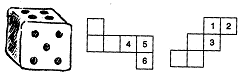
Dice are cubes with dots on each face. Opposite faces of a dice always have a total of seven dots on them. Here are two nets to make dice (cubes), the numbers inserted in each square indicate the number of dots in that box.

Insert suitable numbers in the blanks, remembering that the number on the opposite faces should total to $7.$
View full question & answer
Question 131 Mark
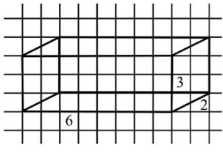
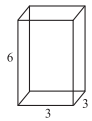
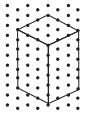
Here is an oblique sketch of a cuboid [ In Fig]. Draw an isometric sketch that matches this drawing

Answer
Here is the solution [In Fig]. Note how the measurements are taken care of.

View full question & answer