Questions

2 Marks Questions

Take a timed test

26 questions · self-marked practice — reveal the answer and mark yourself.

Question 12 Marks
What is physical weathering?
Answer
Physical weathering is the breakdown of rock into smaller particles due to factors such as freezing and thawing, release of pressure, water absorption, salt crystal formation, land mass uplift, expansion and contraction from the sun or fire, plant root growth, actions of animals, abrasion, or other means that do not directly affect the rock's chemistry. It is also called mechanical weathering.
View full question & answer
Question 22 Marks
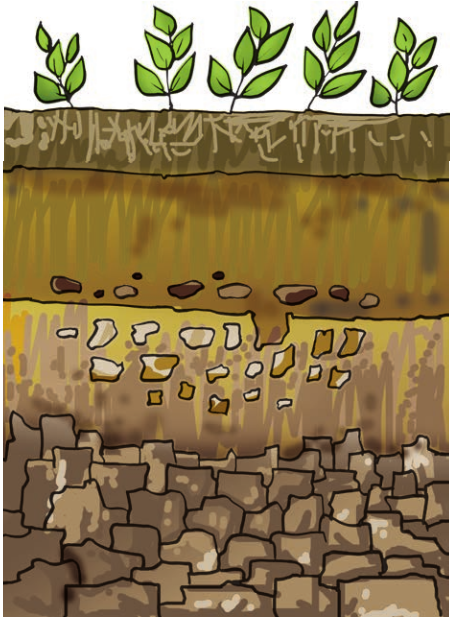
Locate the following zones given as boxed items in figure which shows a diagram of soil profile. Topsoil, subsoil, C-horizon, bedrock.
View full question & answer
Question 32 Marks
Sonia conducted an experiment in the field related to the rate of percolation. She observed that it took 60 minutes for 360ml of water to percolate through the soil sample, calculate the rate of percolation.
Answer
$\text{Percolation rate}=\frac{\text{Amount of water (mL)}}{\text{Percolation time (min)}}$ So, $\text{Percolation rate}=\frac{360\text{mL}}{60\text{ min}}=\frac{6\text{mL}}{\text{min}}$
View full question & answer
Question 42 Marks
Differentiate between alluvial soil and mountain soil.
Answer
Alluvial Soils are mainly found in the plains of northern India. These soils have low phosphorous and nitrogen content and found in the north western regions of the country but Mountain soils are considered as a significant variety of soil in the Himalayan region of the country. They are mainly found in dry and cold district in the northern region of India.
View full question & answer
Question 52 Marks
What are the constituents of soil?
Answer
Soil consists of:
  • soil particles of different sizes
  • soil water
  • humus
  • soil air
  • flora and fauna
View full question & answer
Question 62 Marks
What is chemical weathering?
Answer
Chemical weathering is the dissolution, carbonation, oxidation, or hydrolysis of rock and mineral by chemical means only, mostly from reactions with water or the acids contained in rainwater. Other materials are formed in the process. Warm, tropical climates are ideal environments for chemical weathering to take place as the chemical reactions are quickened by the bountiful rain and warm temperatures.
View full question & answer
Question 72 Marks
Unscramble the following jumbled words related to soil.
  1.  
$S$
$U$
$H$
$U$
$M$
 
  1.  
$I$
$L$
$O$
$S$
 
$F$
$I$
$P$
$R$
$O$
$L$
$E$
  1.  
$Z$
$O$
$I$
$N$
$O$
$R$
$H$
 
  1.  
$M$
$O$
$A$
$L$
 
  1.  
G
$I$
$N$
$R$
$H$
$E$
$T$
$W$
$E$
$A$
 
  1.  
$A$
$T$
$O$
$N$
$I$
$E$ 
$R$
$P$
$C$
$L$
Answer
  1. $HUMUS$
  2. $SOIL\ PROFILE$
  3. $HORIZON$
  4. $LOAM$
  5. $WEATHERING$
  6. $PERCOLATION$
View full question & answer
Question 82 Marks
How can a farmer convert acidic soil to neutral soil?
Answer
The farmer can convert acidic soil into neutral soil by adding a small quantify of quicklime or slaked lime solution to the soil. Quick lime and slaked lime are bases and hence, react with the excess acid present in the soil and reduce its acidity.
View full question & answer
Question 102 Marks
Explain silt.
Answer
Silt is the soil present as deposits in riverbeds. It is formed by the weathering of rocks in the mountains and flows into the rivers. It is a component of loamy soil which is considered most suitable for growth of plants.
View full question & answer
Question 112 Marks
Why Upper most layers in a soil profile are considered as most productive?
Answer
In the soil profile, Horizon-A, also known as Topsoil is best suited for the plant growth. As we know that availability of nutrients and water in soil helps to determine the productivity of soil. Top soil is rich in humus minerals along with water. Thus, Top soil is considered as more productive.
View full question & answer
Question 122 Marks
Razia conducted an experiment in the field related to the rate of percolation. She observed that it took 40min for 200ml of water to percolate through the soil sample. Calculate the rate of percolation.
Answer
Given amount of water $= 200ml$
Percolation time $= 40$min
Therefore, Percolation rate $=\frac{\text{Amount of water(ml)}}{\text{Percolation time (min)}}$
Percolation rate $=\frac{200\text{ml}}{40\text{min}}$
Percolation rate $=8\text{ml/min}$
View full question & answer
Question 132 Marks
Define the following:
  1. Soil profile.
  2. Horizon.
Answer
  1. A vertical section through different layers of the soil is called the soil profile.
  2. Each layer of soil differs in feel (texture), colour, depth and chemical composition. These layers are called horizons.
View full question & answer
Question 142 Marks
Gardeners gently dig up the soil around the roots of garden herbs (plants) frequently. Give reasons.
Answer
  1. It enables easy root growth.
  2. For easier percolation of water.
  3. For aerating the soil enabling air to get into deeper layers of soil.
  4. For removing the weeds.
View full question & answer
Question 152 Marks
A soil sample having mass of $200g$ was taken from garden.This soil was dried completely in the oven and again weight. The weight of the soil now was found to be $170g$. Calculate the percentage of water or moisture content present in the sample soil.
Answer
The moisture content of the soil can be calculated by the formula as follows:
$=\frac{\text{Mass of water in soil}}{\text{Original mass of soil}}\times100$ Given, Original mass of soil $= 200g$
Mass of soil after drying $=170g$
Then mass of water in soil will $= 200 - 170 = 30g$
The percentage of water in soil will be, $\frac{30\text{g}}{200\text{g}}\times100=15\%$
View full question & answer
Question 162 Marks
Explain humus and its importance.
Answer
A non-living organic matter formed from remains of dead and decay plants and animal by the activity of microorganism present in soil. Humus controls and regulates many soil functions, as well as plant growth. The better the humus content in the soil the healthier and more productive soil will be. Good humus count in soil will hold soil moisture longer, thus lesser water is required for crop production, also god humus count reduces wind erosion of soil.
View full question & answer
Question 172 Marks
List two harmful effects of soil erosion.
Answer
  1. Decrease in soil fertility and thus crop productivity.
  2. Water bodies become muddy, affecting aquatic life.
View full question & answer
Question 182 Marks
Suppose certain sample takes $120$min for $960$mL water to percolate into the soil. Calculate the rate of percolation of water.
Answer
Given, amount of water $= 960$mL
Time taken to percolate $= 120$min
The rate of percolation will be, Percolation rate $= 8\ mL/ min$
View full question & answer
Question 192 Marks
A student visits two types of field and observes that soil from field $A$ has high percolation rate of water, while soil from field $B$ has low percolation rate. In field $B$, paddy crop was grown while in field $A$, there was no standing crop. Name two types of soil present in two fields.
Answer
Soil in field $A$ is sandy soil while in field $B$ soil is clayey soil which has low percolation rate and water-logging is seen. Since, paddy requires lot of standing water, therefore it is grown in field $B$.
View full question & answer
Question 202 Marks
Read the following statements and give the appropriate terms for each of them.
  1. The process of breakdown of rocks by the action of wind, water, sunlight.
  2. Removal of top soil during heavy rains or strong winds.
  3. Accumulation of wastes in the soil generated by human activity which alter the features of soil.
  4. The process of movement of water into deeper layers of soil.
Answer
The terms for the above described statements are as follows:
  1. Weathering
  2. Soil erosion
  3. Soil pollution
  4. Percolation
View full question & answer
Question 212 Marks
Soil is a home to several animals. Give examples to support this statement.
Answer
Earthworms burrow through the soil, ants live in large colonies and burrows in soil, centipedes live under stones and in soil, some bacteria living in soil fix nitrogen for the plant to take up and microorganisms decompose dead plants and animals.
View full question & answer
Question 222 Marks
What is the difference between rate of percolation and the amount of water retained?
Answer
Percolation refers to the amount of water seeping down while amount of water rationed refers to the amount of water held. Higher percolation means large spaces between soil particles and lower in the amount of water retained.
View full question & answer
Question 232 Marks
Rajasthan is a desert state in India. Once while travelling to Rajasthan by train, Boojho observed several streams and rivulets of rain water during the journey but to his surprise he did not see streams of water in the desert region even during rains. Help Boojho find a suitable explanation for this.
Answer
Deserts are made up of sand, thus when the rainwater falls on land, it percolates immediately downwards in the spaces between sand particles. So, the streams of water in desert region are not visible even during rainy season.
View full question & answer
Question 242 Marks
Which of the following situations – $‘A’$ or $‘B’$ – is advantageous for absorption of water and minerals? Why?
Situation A: Growth and branching of roots in the $C$-horizon.
Situation B: Growth and branching of roots in $A$ and Bhorizons.
Answer
Situation $’B’$ is advantageous for absorption of water and minerals.
This is because $A$-horizon is top iaysr of soil and is rich in minerals and humus.
The plant roots grow in the topsoil. The roots of some or the trees are however, able to reach $B$-horizon (subsoil).
Subsoil is also rich in soluble minerals.
View full question & answer
Question 252 Marks
Describe how clayey soil is useful for crops?
Answer
Clayey soil is useful for the crops because:
  • It has good water retaining capacity.
  • It is rich in humus.
  • It is fertile in nature.
Crops like wheat and rice can be easily grown in clayey soil.
View full question & answer
Question 262 Marks
What is percolation of water? How it is different for different types of soil?
Answer
The gravity flow of groundwater through the pore spaces in rock or soil is called percolation of water. The rate of absorption is different for different types of soils. This phenomenon of absorption of water by soil is termed as percolation.Percolation rate of water is different in different types of soil. It is highest in the sandy soil and least in the clayey soil. The rate of absorption of a soil depends on its composition. $\text{Percolation rate}=\frac{\text{Amount of water (mL)}}{\text{Percolation time (min)}}$
View full question & answer
2 Marks Questions - Science STD 7 Questions - Vidyadip