Questions

5 Marks Questions

Take a timed test

11 questions · self-marked practice — reveal the answer and mark yourself.

Question 15 Marks
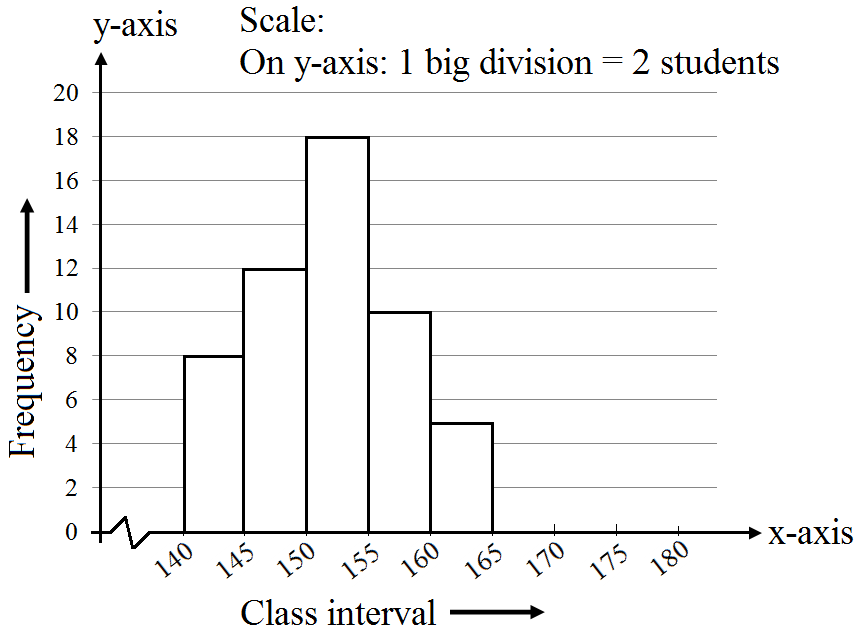
Given below is the frequency distribution of the heights of $50$ students of a class:
Class interval
$140-145$
$145-150$
$150-155$
$155-160$
$160-165$
Frequency
$8$
$12$
$18$
$10$
$5$
Draw a histogram representing the above data.
Answer
The class limits are represented along the $x$-axis on a suitable scale and the frequencies are represented along the $y$-axis on a suitable scale.
Taking class intervals as bases and the corresponding frequencies as heights, the rectangles can be constructed to obtain the histogram of the given frequency distribution as shown in the figure below:
View full question & answer
Question 25 Marks
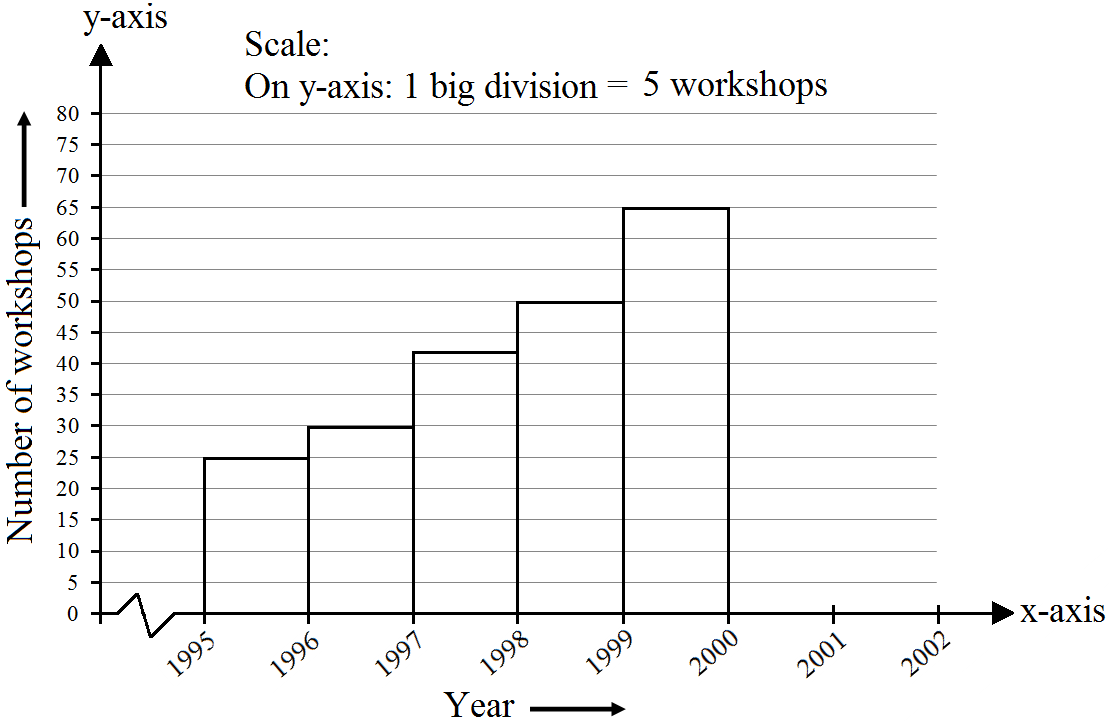
Number of workshops organized by a school in different areas during the last five years are as follows:
Year No. of workshops
$1995-1996$ $25$
$1996-1997$ $30$
$1997-1998$ $42$
$1998-1999$ $50$
$1999-2000$ $65$
Draw a histogram representing the above data.
Answer
The class limits are represented along the $x$-axis and the frequencies are represented along the $y$-axis on a suitable scale.
Taking class intervals as bases and the corresponding frequencies as heights, the rectangles can be constructed to obtain histogram for the given frequency. The histogram is shown below:
View full question & answer
Question 35 Marks
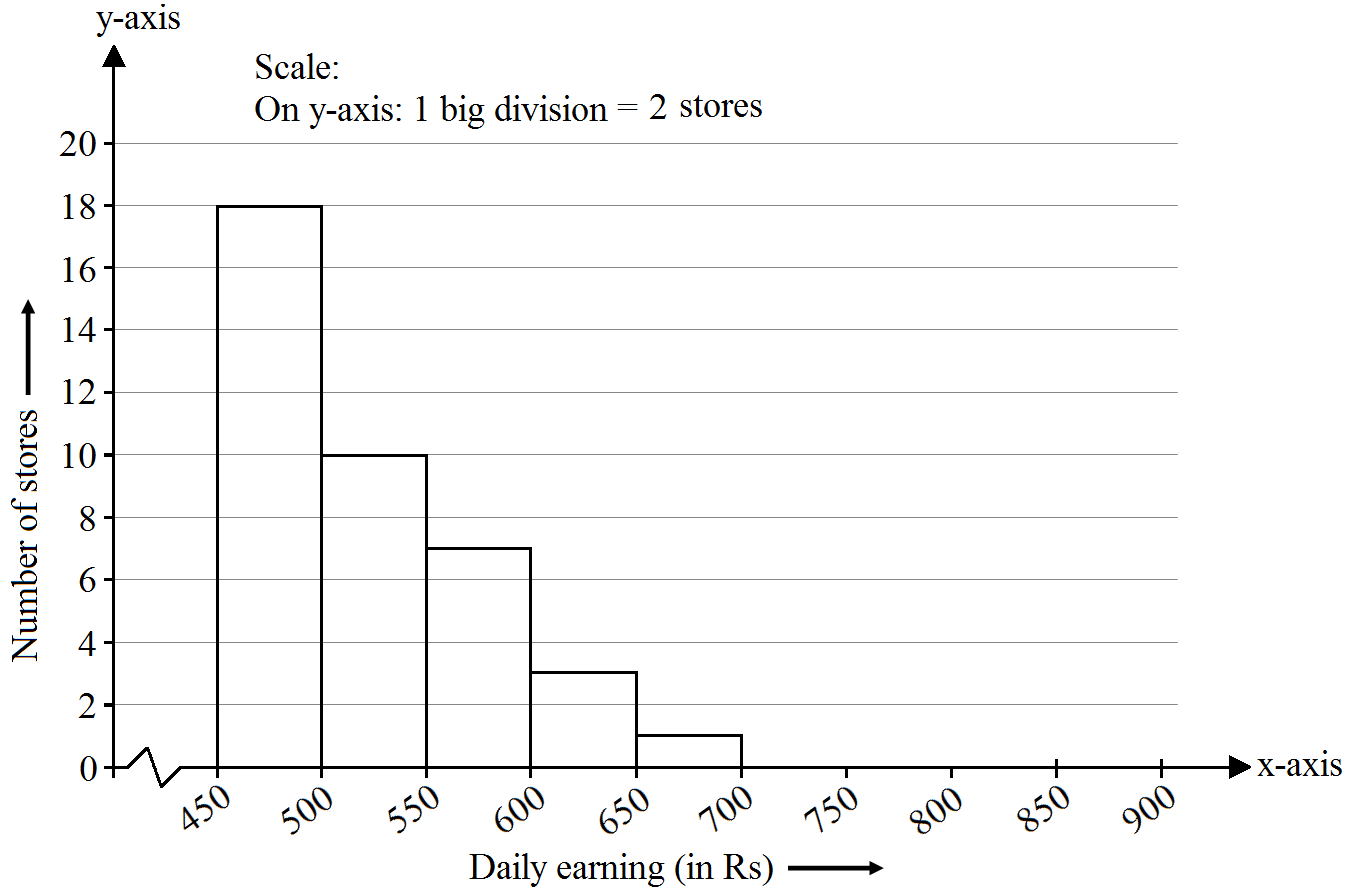
Draw a histogram for the daily earnings of $30$ drug stores in the following table:
Daily earnings (in Rs.)
$450-500$
$500-550$
$550-600$
$600-650$
$650-700$
Numbers of stores
$16$
$10$
$7$
$3$
$1$
Answer
The class limits are represented along the $x$-axis and the frequencies along the $y$-axis on a suitable scale.
Taking class intervals as bases and the corresponding frequencies as heights, the rectangles can be drawn to obtain the histogram of the given frequency distribution. The histogram is given below:
 
View full question & answer
Question 45 Marks
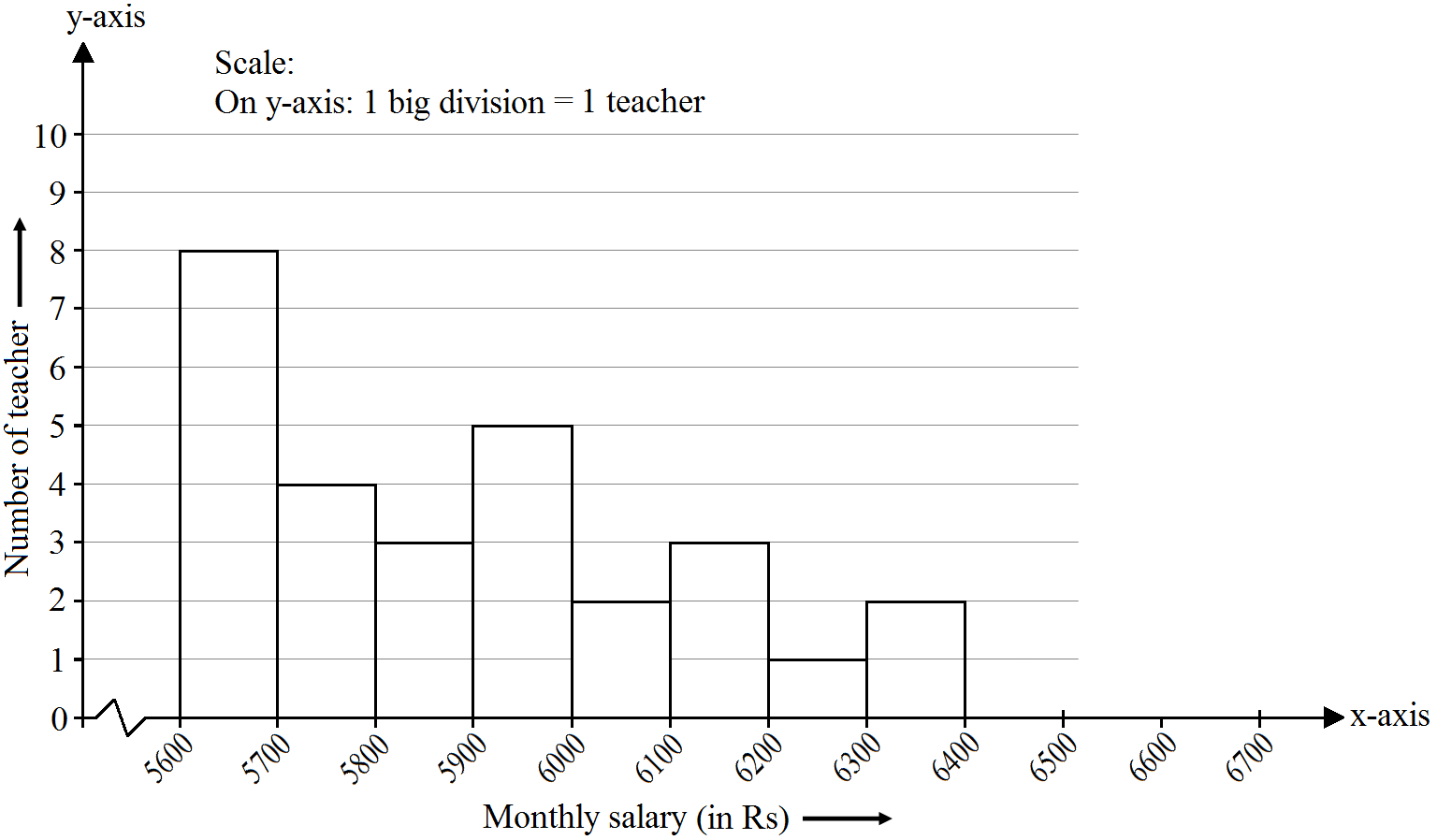
Draw a histogram to represent the following data:
Monthly salary (in Rs.)
Number of teachers
$5600-5700$
$8$
$5700-5800$
$4$
$5800-5900$
$3$
$5900-6000$
$5$
$6000-6100$
$2$
$6100-6200$
$3$
$6200-6300$
$1$
$6300-6400$
$2$
Answer
Taking class intervals as bases and the corresponding frequencies as heights, the rectangles can be constructed to obtain the histogram of the given data. The class intervals are represented along the $x$-axis and the frequencies along the $y$-axis on a suitable scale. The histogram representing the given data is shown below:
View full question & answer
Question 55 Marks
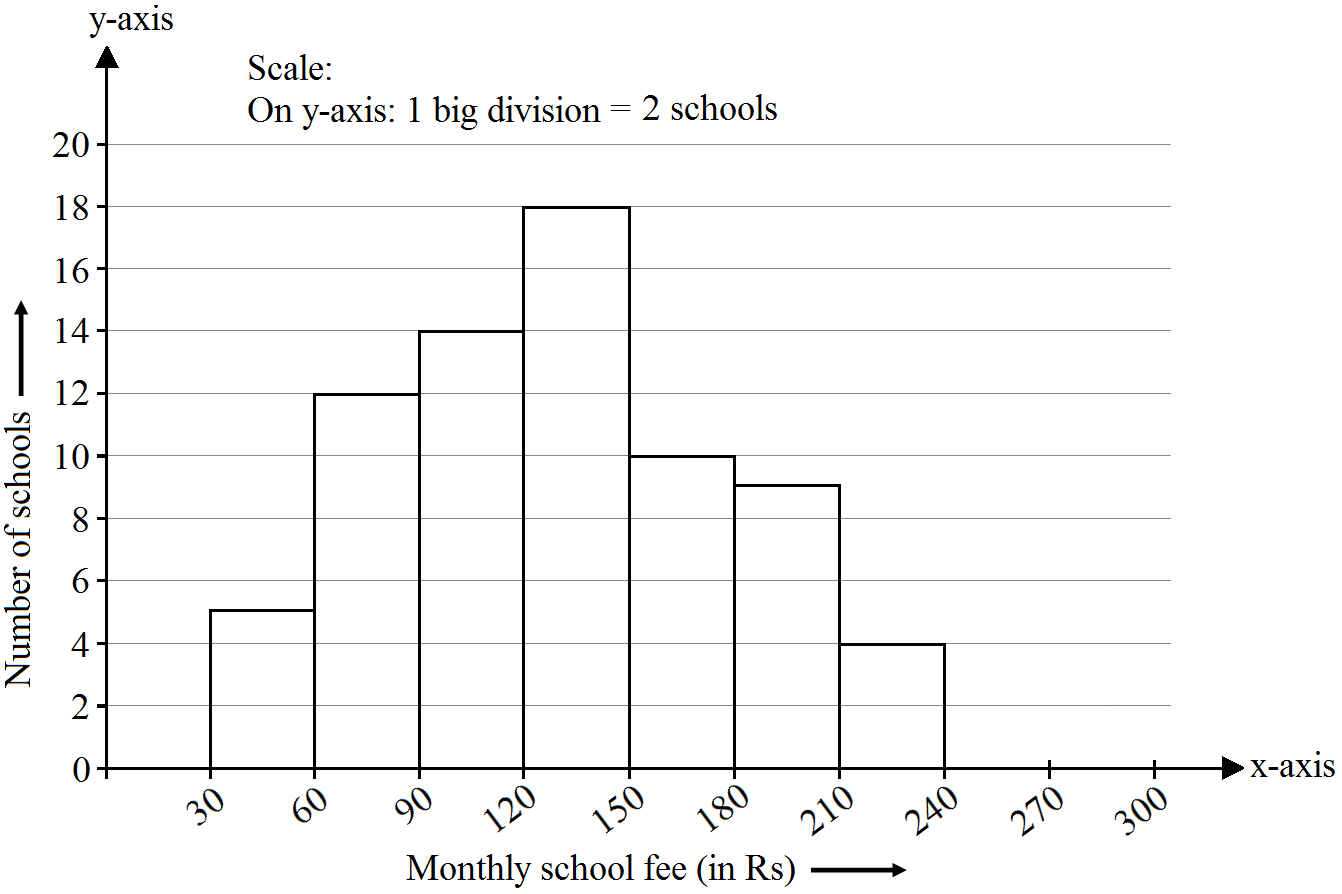
Construct a histogram for the following data:
Monthly school fee (in Rs.)
$30-60$
$60-90$
$90-120$
$120-150$
$150-180$
$180-210$
$210-240$
Number of schools
$5$
$12$
$14$
$18$
$10$
$9$
$4$
Answer
The class limits are represented along the $x$-axis and the frequencies along the $y$-axis on a suitable scale.
Taking class intervals as bases and corresponding frequencies as heights of the rectangles, the histogram of the given data can be obtained as shown in the figure below:
View full question & answer
Question 65 Marks
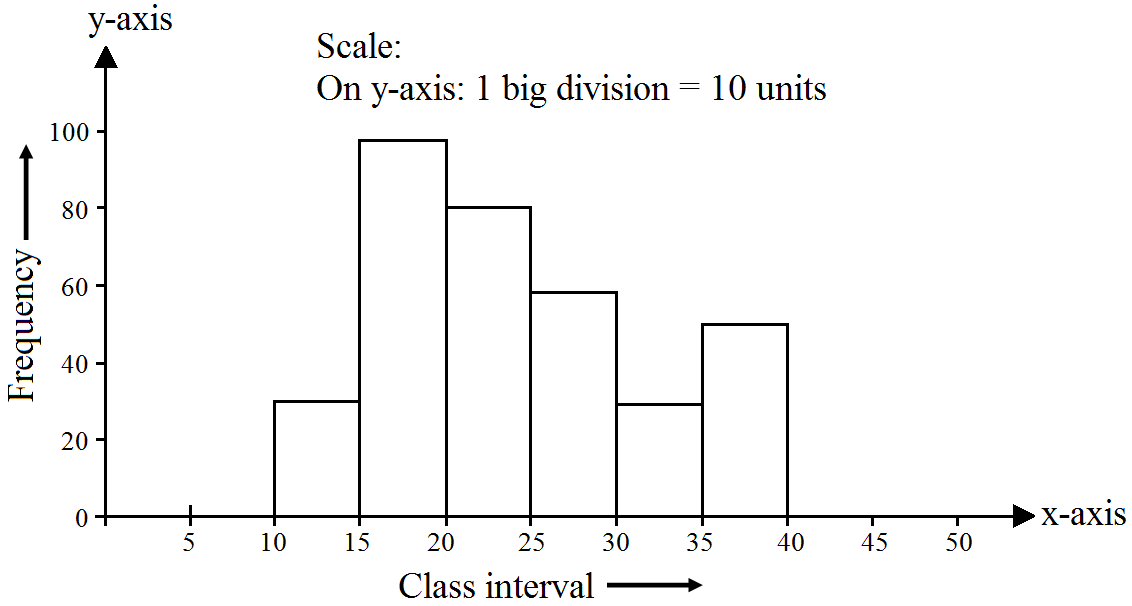
Draw a histogram of the following data:
Class interval:
$10-15$
$15-20$
$20-25$
$25-30$
$30-35$
$35-40$
Frequency:
$30$
$98$
$80$
$58$
$29$
$50$
Answer
The class limits are represented along the $x$-axis and the frequencies are represented along the $y$-axis on a suitable scale. Taking class intervals as bases and the corresponding frequencies as heights, the rectangles can be drawn to obtain the histogram of the given frequency distribution. The histogram is shown below:
View full question & answer
Question 75 Marks
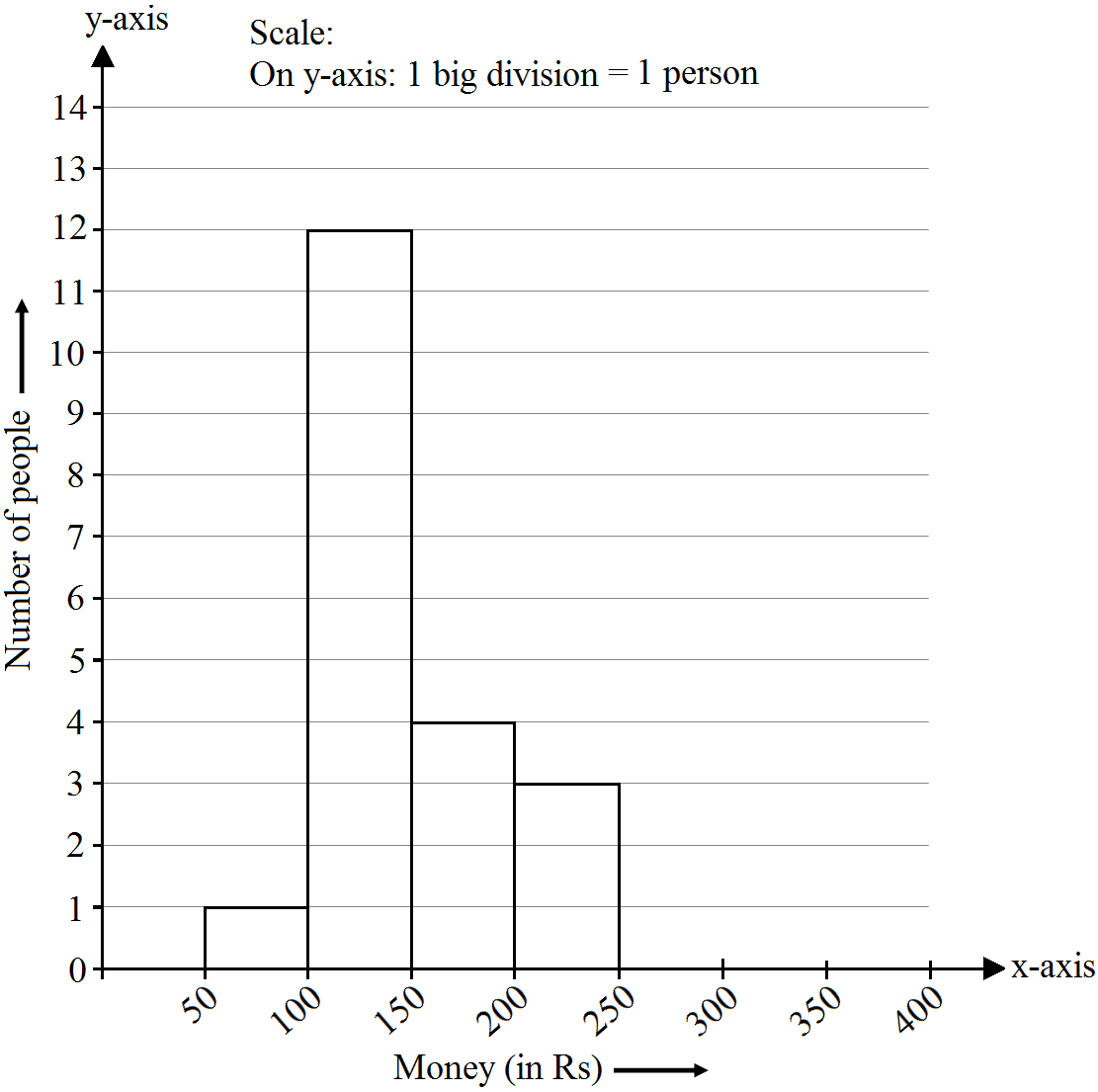
In a hypothetical sample of $20$ people the amounts of money with them were found to be as follows: $114, 108, 100, 98, 101, 109, 117, 119, 126, 131, 136, 143, 156, 169, 182, 195, 207, 219, 235, 118$. Draw the histogram of the frequency distribution (taking one of the class intervals as 50-100).
Answer
We first prepare the frequency table for the class intervals $50-100, 100-150, ........., 200-250,$ as shown below:
Money
Tally Amount
Frequency
$50-100$
$98$
$1$
$100-150$
$114, 108, 100, 101, 109, 117, 119, 126, 131, 136, 143, 118$
$12$
$150-200$
$156, 169, 182, 195$
$4$
$200-250$
$207, 219, 235$
$3$
The class limits are represented along the $x$-axis and the frequencies along the $y$-axis on a suitable scale. Taking the class intervals as bases and the corresponding frequencies as heights, the rectangles can be drawn to obtain the histogram of the given frequency distribution. The histogram is shown below:
View full question & answer
Question 85 Marks
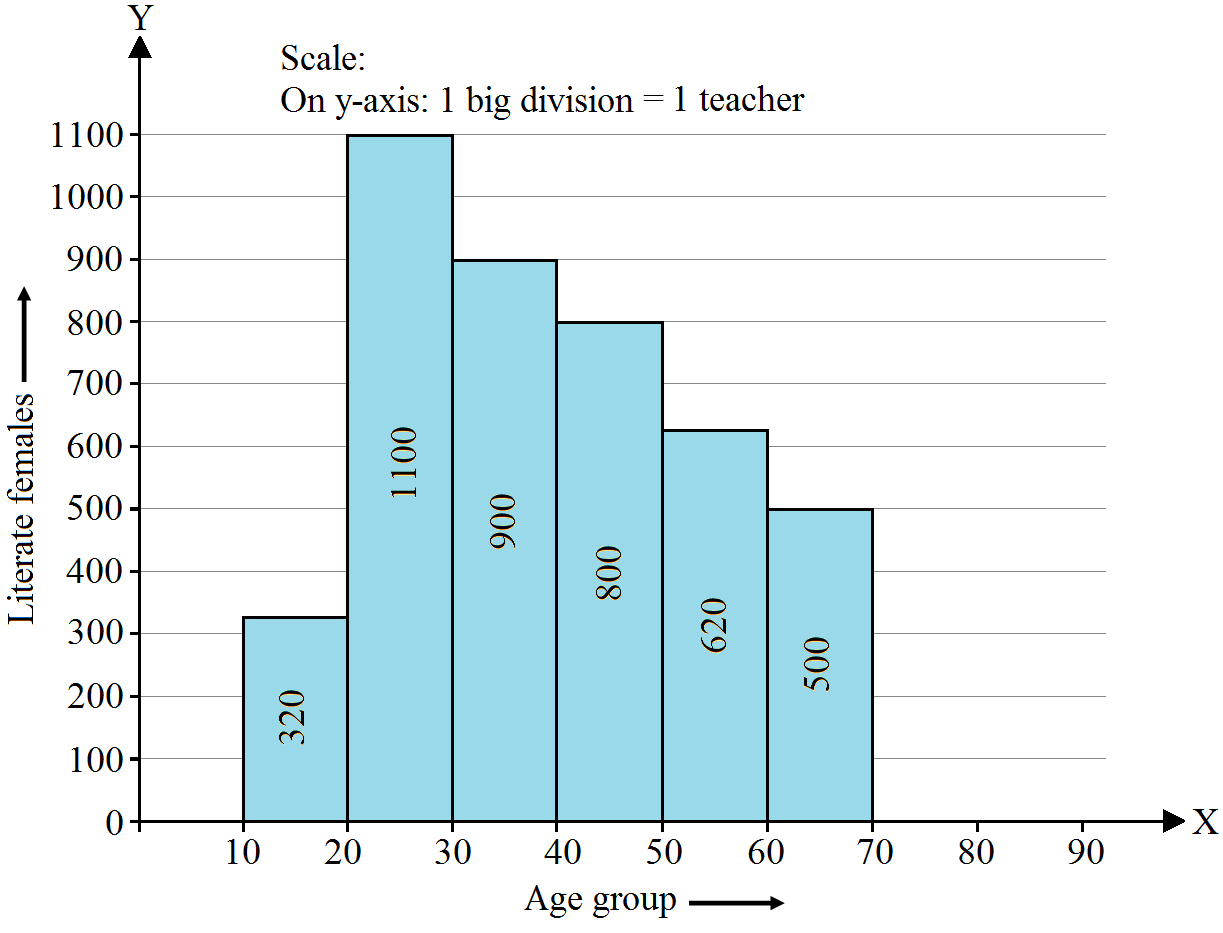
The following histogram shows the number of literate females in the age group of $10$ to $40$ years in a town:
$i.$ Write the age group in which the number of literate female is the highest.
$ii.$ What is the class width?
$iii.$ What is the lowest frequency?
$iv.$ What are the class marks of the classes?
$v.$ In which age group literate females are the least?
Answer
The highest rectangle corresponds to the highest number of literate females, which is in the interval $15-20$ years.
The class intervals are $10-15, 15-20, 20-25, 30-35, 35-40$.
Hence, the class width is $5$.
The lowest rectangle corresponds to the lowest frequency, which is $320$.
The class mark is the mid$-$point of the class interval.
$\text{Class mark}=\frac{\text{upper limit }+\text{ lower limit}}{2}$
Hence, the class mark of each class is as follows:
Interval
Class Mark
$10-15$
$12.5$
$15-20$
$17.5$
$20-25$
$22.5$
$25-30$
$27.5$
$30-35$
$32.5$
$35-40$
$37.5$
The lowest rectangle corresponds to the least number of literate females, which is in the interval $10-15$ years.
View full question & answer
Question 95 Marks
The weekly wages $($in $Rs.)$ of $30$ workers in a factory are given: $830, 835, 890, 810, 835, 836, 869, 845, 898, 890, 820, 860, 832, 833, 855, 845, 804, 808, 812, 840,$
$885, 835, 835, 836, 878, 840, 868, 890, 806, 840$ Mark a frequency table with intervals as $800-810, 810-820$ and so on, using tally marks. Also, draw a histogram and answer the following questions:
$i.$ Which group has the maximum number of workers?
$ii.$ How many workers earn $Rs. 850$ and more?
$iii.$ How many workers earn less than $Rs. 850$?
Answer
The frequency table with intervals $800-820, 810-820, ........., 890-900$ is given below:
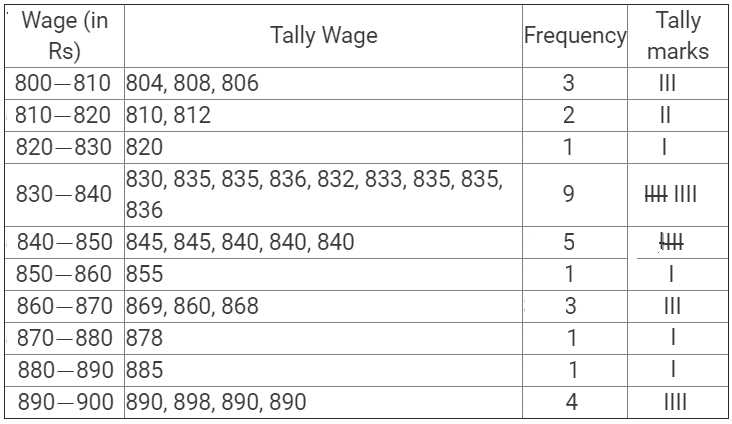
 
The class limits are represented along the $x-$axis and the frequencies along the $y-$axis on a suitable scale. Taking class intervals as bases and the corresponding frequencies as heights, the rectangles can be drawn to obtain the histogram of the given frequency distribution. The histogram is shown below:
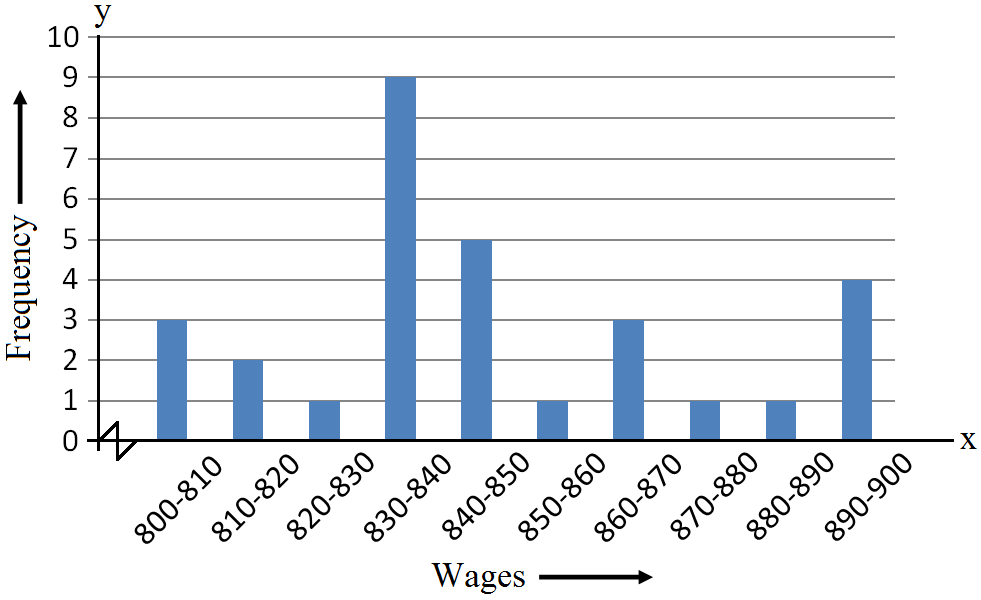
$i.$ The group that has the maximum number of workers is represented as the highest rectangle. It is in the interval $830-840$
$ii.$ The number of workers who earn $Rs. 850$ or more can be calculated from frequency table in the following manner:
$1 + 3 + 1 + 1 + 4 = 10$
$iii.$ The number of workers who earn less than $Rs. 850$ can be calculated from frequency table in the following manner:
$3 + 2 + 1 + 9 + 5 = 20$
View full question & answer
Question 105 Marks
The following histogram shows the frequency distribution $f$ the ages of $22$ teachers in a school:
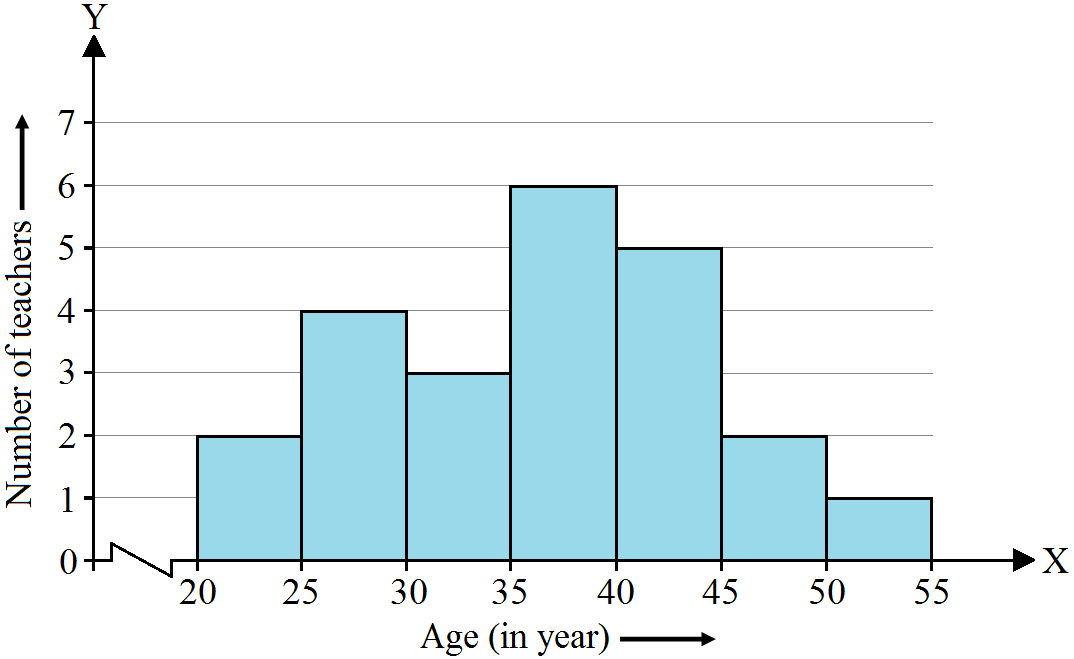
$i.$ What is the number of eldest and youngest teachers in the school?
$ii.$ Which age group teachers are more in the school and which least?
$iii.$ What is the size of the classes?
$iv.$ What are the class marks of the classes?
Answer
$i.$ The eldest $(50-55$ years$) = 1$ person
This is because the height of the rectangle with class interval $50-55$ as base is $1$ unit.
The youngest $(20-25$ years$) = 2$ persons
This is because the height of the rectangle with class interval $20-25$ as base is $2$ units.
$ii.$ The group containing the most number of teachers is $35-40$ years. This is because the height of the rectangle with class interval $35-40$ as base is the maximum.
The group containing the least number of teachers is $50-55$ years. This is because the height of the rectangle with class interval $50-55$ as base is the minimum.
$iii.$ Class size $=$ The range between the upper and the lower boundaries of the class.
For example, the size of the class $20-25$ years is $5$.
$iv. \text{Class mark}=\frac{\text{Upper limit }+\text{ Lower limit}}{2}$
For class $20-25:$
$\text{Class mark}=\frac{20+25}{2}=\frac{45}{2}=22.5$
Similarly, the class marks of the other classes are $27.5, 32.5, 37.5, 42.5, 47.5, 52.5$
View full question & answer
Question 115 Marks
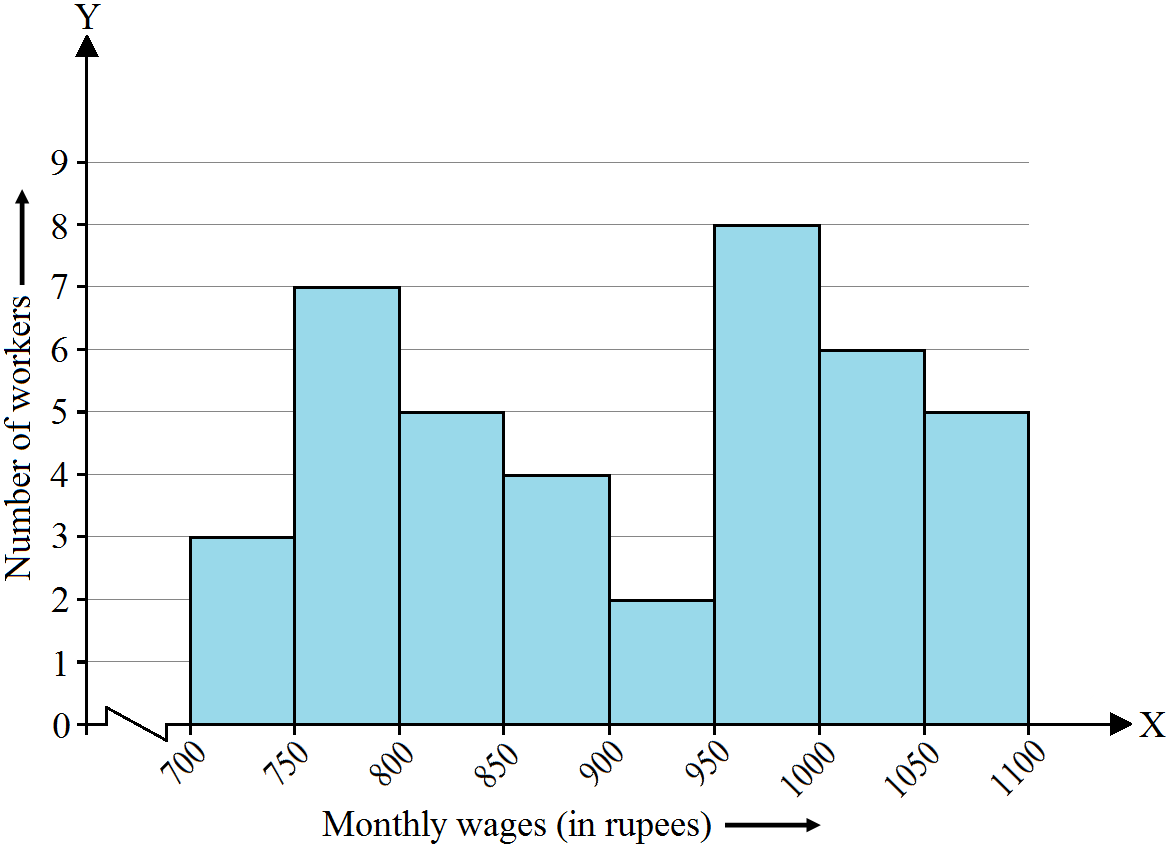
The following histogram shows the monthly wages $($ in $Rs.)$ of workers in a factory:

$1.$ In which wage$-$group the largest number of workers are being kept? What is their number?
$2.$ What wages are the least number of workers getting? What is the number of such workers?
$3.$ What is the total number of workers?
$4.$ What is the factory size?
Answer
$i.$ In the highest rectangle corresponds to the largest number of workers. The required interval is $Rs. 950-1000$. There are $8$ workers in this interval.
$ii.$ The lowest rectangle corresponds to the least number of workers. The required interval is $Rs. 900-950$. There are $2$ workers in this interval.
$iii.$ The total number of workers is the sum of workers in all the intervals. It can be calculated as follows:
$iv.$ Total workers $= 3 + 7 + 5 + 4 + 2 + 8 + 6 + 5 = 40$ workers
$v.$ The factory intervals are $750-800, 800-850, ......, 1050-100$. Hence, the factory size is $50$.
View full question & answer