Questions

3 Marks Question

Take a timed test

23 questions · self-marked practice — reveal the answer and mark yourself.

Question 13 Marks
If Naresh walks $250$ steps to cover a distance of $200$ metres, find the distance travelled in $350$ steps.
Answer
Naresh walks $250$ steps to cover distance $= 200m$
In $1$ step he covers the distance$=\frac{200}{520}\text{m}$
In $350$ steps, he covers$=\frac{200}{250}\times350=\frac{20\times350}{25}=\frac{7000}{25}=280\text{m}$
View full question & answer
Question 23 Marks
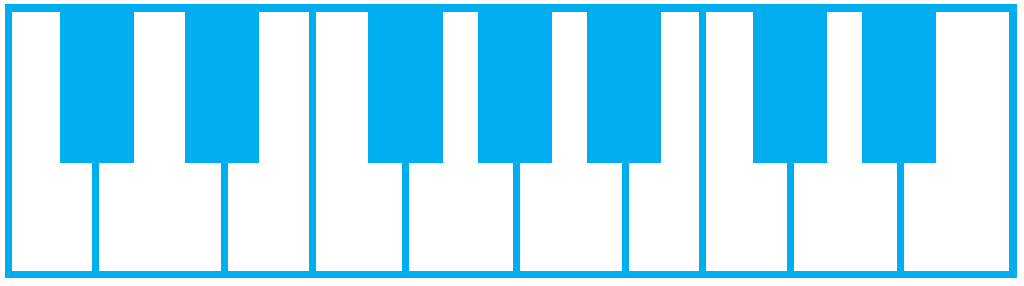
Here is a key board of a harmonium:

$a.$ Find the ratio of white keys to black keys on the keyboard.
$b.$ What is the ratio of black keys to all keys on the given keyboard.
$c.$ This pattern of keys is repeated on larger keyboard. How many black keys would you expect to find on a keyboard with $14$ such patterns.
Answer
$a.$ The total number of black keys $= 7$
The total number of white keys $= 10$
Hence, ratio of white keys to black eyes on the keyboard $=\frac{10}{7}$
$b.$ The total number of all keys $= 10 + 7 = 17$
The ratio of black keys to all keys on the given keyboard $= 7/17$
$c.$ Black keys in $1$ keyboard $= 7$
Black keys in $14$ such keyboards $= 14 \times 7 = 98$ keys
View full question & answer
Question 33 Marks
A contractor undertook a contract to complete a part of a stadium in $9$ months with a team of $560$ persons. Later on, it was required to complete the job in $5$ months. How many extra persons should he employ to complete the work?
Answer
In $9$ months, a part of stadium can complete by $560$ persons. In $1$
month, the work can be complete by $9 \times 560 = 5040$ persons In $5$ months,
the work can be complete by $\frac{5040}{5}=1008$ persons
Now, number of extra persons required to complete the work in $5$ months $= 1008 - 560 = 448$
View full question & answer
Question 43 Marks
Find the values of $x$ and $y$ if $a$ and $b$ are in inverse proportion:
$a. 12 x 8$
$b. 30 5y$
Answer
Given,
$a$ $12$ $x$ $8$
$b$ $30$ $5$ $y$
Here, we see that in part, $(b)$ when we divide $30$ by $6,$ we get $5$
So, in part $(a)$
we will get the value of $x \text{x}=12\times6=72$
I.e., similarly in part $(a)$ when we divide $x$
i.e., $72$ by $9,$ we will get
so, in part $(b)$ we will get the value of $y$.
I.e., $y = 5 \times 9 = 45$
View full question & answer
Question 53 Marks
Many schools have a recommended students-teacher ratio as $35:1.$ Next year, school expects an increase in enrolment by $280$ students. How many new teachers will they have to appoint to maintain the students-teacher ratio?
Answer
Students teachers ratio $= 35:1$ It show every $35$ students one teacher should available in the school. In the school, number of students increases $= 280$ students The number of teachers required for $280$ students $\frac{280}{35}=8\text{ teachers}$
View full question & answer
Question 63 Marks
The variable $x$ varies directly as $y$ and $x = 80$ when $y$ is $160$. What is $y$ when $x$ is $64?$
Answer
If x varies directly y. $\frac{\text{x}}{\text{y}}=\text{k}$ (constant) $x = 80$ and $y = 160 \frac{\text{x}}{\text{y}}=\frac{80}{160}=\frac{1}{2}$
$\text{k}=\frac{1}{2}$ When $x = 64$,
then from eq. $(i) \frac{64}{\text{y}}=\frac{1}{2} y = 64 \times 2 = 128$
View full question & answer
Question 73 Marks
A bowler throws a cricket ball at a speed of $120km/h$. How long does this ball take to travel a distance of $20$ metres to reach the batsman?
Answer
The speed of the cricket ball $= 120km/h =\frac{120\times1000}{60}\text{m/min.}$
$=2\times1000=2000\text{m/min}$
Now, speed in m/s $=\frac{2000}{60}=\frac{200}{6}=\frac{1000}{33}\text{m/s}$
So, $20$ m can be cover in $=\frac{\frac{20}{100}}{3}=\frac{60}{1000}=0.6\text{s}$
View full question & answer
Question 83 Marks
Shabnam takes $20$ minutes to reach her school if she goes at a speed of $6 \ km/h$. If she wants to reach school in $24$ minutes, whatshould be her speed?
Answer
Shabnam’s speed = 6km/h$=\frac{6\times100}{60}\times20$
Total distance covered by Shabnam in $20$ min$=\frac{6\times1000}{60}\times20$
$=\frac{1000}{10}\times20 = 100 \times 20 = 2000m$
If she want to reach the school in $24$ min,
then she should maintain the speed $=\frac{2000}{24}$
$=\frac{1000}{12}=\frac{500}{6}\text{m/min}$
$=\frac{500\times60}{1000\times6}=5\text{km/h}$
View full question & answer
Question 93 Marks
Kusum always forgets how to convert miles to kilometres and back again. However she remembers that her car’s speedometer shows both miles and kilometres. She knows that travelling $50$miles per hour is same as travelling $80$ kilometres per hour. To cover a distance of $200\ km$, how many miles Kusum would have to go?
Answer
$50$ miles per hour is same as travelling $80\ km$ per hour.
So, $1 \ km$ covers distance in $1$ h to $\frac{5}{80}\text{miles.}$
To cover a distance of $200km=\frac{50}{80}\times200=\frac{5\times200}{8}=125\text{miles}$
Hence, $125$ miles Kusum has to go for $200\ km$
View full question & answer
Question 103 Marks
If $x$ varies inversely as $y$ and $x = 20$ when $y = 600$, find y when $x = 400.$
Answer
Ifx varies inversely as $y. $
$xy = k$ (costant) If $x = 20$ and $x = 600 xy = 20 \times 600 = 12000 k = 12000$
When$ x = 400$, then from eq. $(i)$
View full question & answer
Question 113 Marks
Kritika is following this recipe for bread. She realises her sister used most of sugar syrup for her breakfast. Kritika has only $\frac{1}{6}$ cup of syrup, so she decides to make a small size of bread. How much of each ingredient shall she use? Bread recipe $1$ cup quick cooking oats $2$ cups bread flou $\frac{1}{3}$cup sugar syrup $1$ tablespoon cooking oi $1\frac{1}{3}$cups water $3$ tablespoons yeast $1$ teaspoon salt.
Answer
The remaining sugar is after used $=\frac{1}{6}\text{cup}$ Thus, its means $1-\frac{1}{6}=\frac{5}{6}$ has been used. She need $1/3$ cup of sugar syrup for $1$ piece of bread. So, new quantity of ingredient will be in proportion of $1/2$. Now, the bread recipe will be look like $1/2$ cup quick cooking oats $1$ cup bread flour $\frac{1}{6}$cup sugar syrup $1/2$ tablespoon cooking oil $\frac{2}{3}$cups water $3/2$ tablespoons yeast $1/2$ teaspoon salt.
View full question & answer
Question 123 Marks
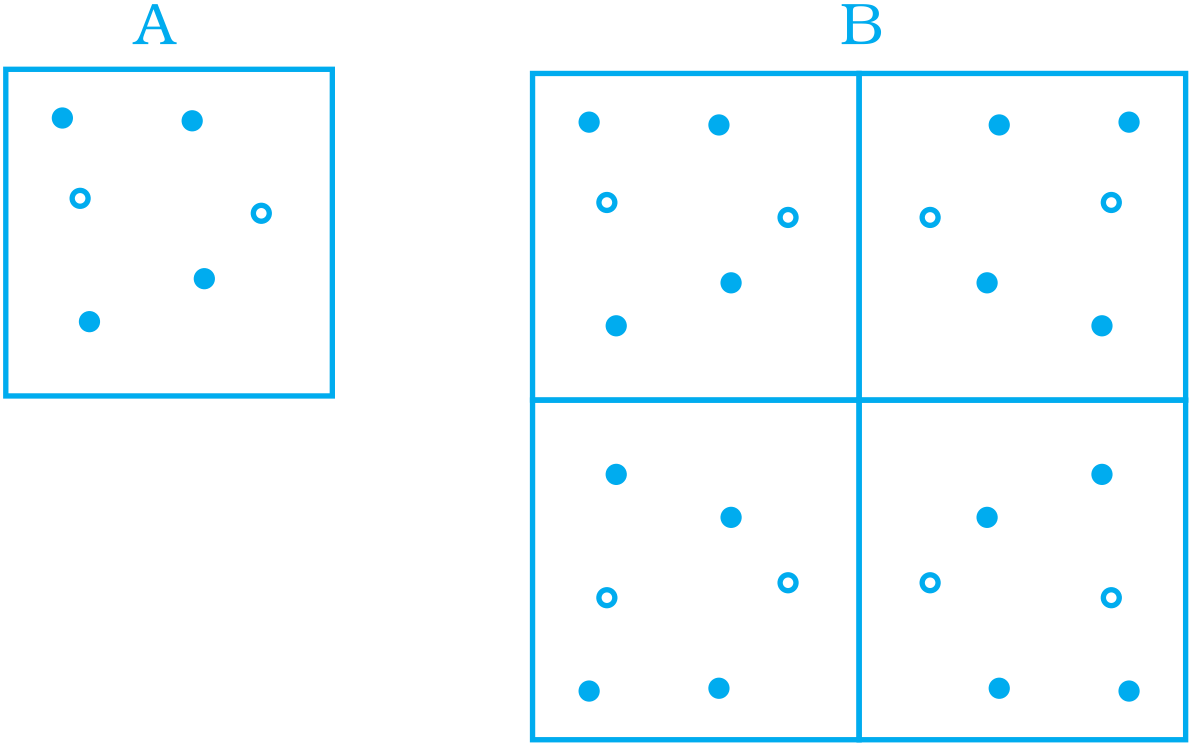
Pattern $B$ consists of four tiles like pattern A. Write a proportion involving red dots and blue dots in pattern $A$ and $B$. Are they in
direct proportion? If yes, write the constant of proportion.
Answer
No. of red dots in pattern $(A) = 4$ No. of blue dots in pattern $(A’) = 2$ Pattern $B$ consists of four tiles like pattern $A$
i.e, Pattern $A × 4$ =Pattern $B$ Proportion in pattern $=\frac{2}{6}=\frac{1}{3}$
Now, proportion of blue dots & red dots in pattern $B =\frac{8}{32}=\frac{1}{4}$
View full question & answer
Question 133 Marks
The mass of an aluminium rod varies directly with its length. If a $16\ cm$ long rod has a mass of $192 \ g$, find the length of the rod whose mass is $105g.$
Answer
According to the question, The mass $(m)$ of an aluminium rod varies directly with its length $(i).$
Here, we use the direct proportion.
In direct proportion,$\frac{\text{m}}{\text{l}}=\text{k}$(constant) $=\frac{\text{m}}{\text{l}}=\frac{192}{16}=12 = k = 12$
If mass of the rod $= 105g$
Then, $\frac{\text{m}}{\text{l}}=\text{k}$
$\frac{105}{\text{l}}=12$
$\text{l}=\frac{105}{12}=8.75\text{cm}$
View full question & answer
Question 143 Marks
In a camp, there is enough flour for $300$ persons for $42$ days. How long will the flour last if $20$ more persons join the camp?
Answer
For $300$ persons flour is enough for $42$ days. For $1$ person flour enough $= 300 \times 42 = 12600$ days
Now, $20$ more persons join the camp. So, total persons$=300 + 20 = 320$ For $320$ persons flour enough $=\frac{12600}{320}=\frac{3}{8}\text{days}$
View full question & answer
Question 153 Marks
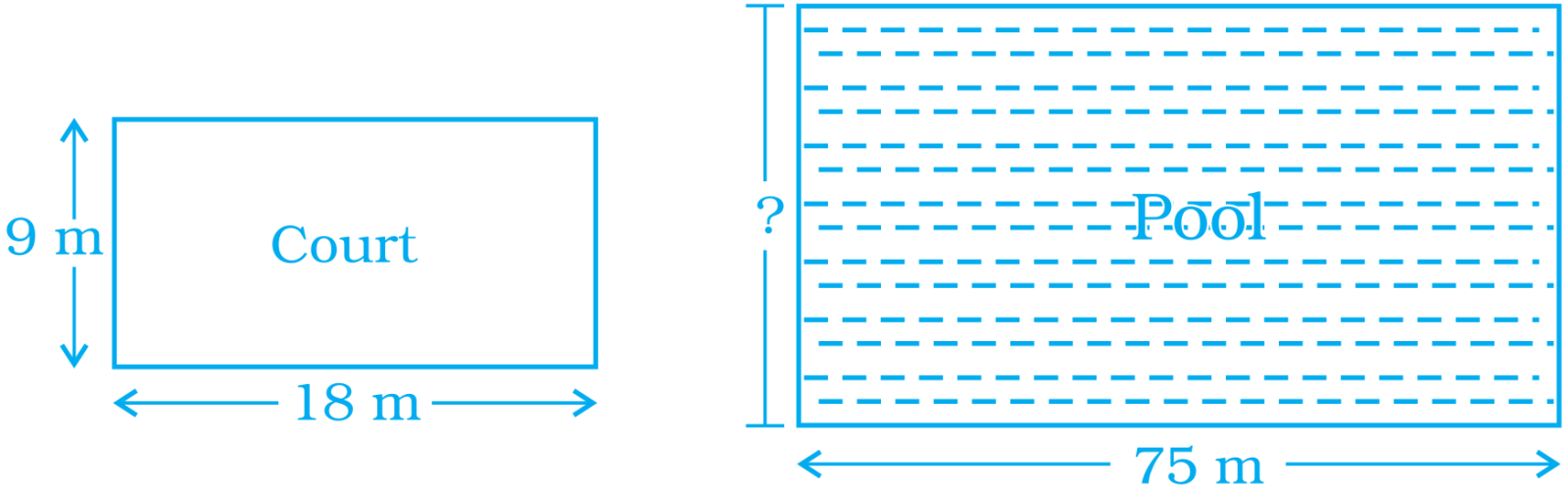
A volleyball court is in a rectangular shape and its dimensions are directly proportional to the dimensions of the swimming pool given below. Find the width of the pool.
Answer
Length of volleyball court $= 18M$
Breadth of volleyball court$= 9M$
Length of pool $= 75M$
Let width of swimming pool $= XM$
The size of volleyball court & swimming pool are in direct proportion to each other. $\frac{9}{18}=\frac{\text{x}}{75}$ $\text{x}=\frac{75\times9}{8}=\frac{75}{2}=37.5\text{m}$
Hence, the width of the swimming pool is $37.5m$
View full question & answer
Question 163 Marks
The following table shows the distance travelled by one of the new eco-friendly energy-efficient cars travelled on gas.
Litres of gas $1$ $0.5$ $2$ $2.5$ $3$ $5$
Distance (km) $15$ $7.5$ $30$ $37.5$ $45$ $75$
Which type of properties are indicated by the table? How much distance will be covered by the car in $8$ litres of gas?
Answer
On the basis of given table, the distance travelled by one of the new eco-friendly energy efficient earns travelled on gas.
The car travelled $15km$ In L of gas. The car travelled $7.5\ km$ in $0.5L$ of gas.
The car travelled $30km$ in $2L$ of gas.
This rate shows direct proportion between litres of gas and the distance cover.
The car can cover the distance in $8$ L of gas $= 8 \times 15 = 120$
View full question & answer
Question 173 Marks
A car covers a distance in $40$ minutes with an average speed of $60\ km/ h$. What should be the average speed to cover the same distance in $25$ minutes?
Answer
A car covers a distance in $40$ min with an average speed $=60\text{km/ h}=\frac{60\times1000}{60}\text{m/min}$ In $1$ min.,
the same distance can be cover with speed $=\frac{60\times1000\times40}{60}=40000\text{m/min}$ In $25$ min.
the same distance can be cover with speed $=\frac{4000}{25}=1600\text{m/min}$
$=\frac{1600}{1000}\times60=16\times6=96\text{km/ h}$
View full question & answer
Question 183 Marks
Campus and Welfare Committee of school is planning to develop a blue shade for painting the entire school building. For this purpose various shades are tried by mixing containers of blue paint and white paint. In each of the following mixtures, decide which is a lighter shade of blue and also find the lightest blue shade among all of them.
If one container has one litre paint and the building requires $105$ litres for painting, how many container of each type is required to paint the building by darkest blue shade?
Answer
$1.$ In mixture $E:$
$2.$ The mixture of blue container $= 6$
The number of white container $= 1$
Ratio of blue $\&$ white containers $=\frac{6}{1}=6$
$3.$ In mixture $F:$
$4.$ The number of blue container $= 4$
The number of white containers $= 2$
Ratio of blue $\&$ white $=\frac{4}{2}=2$
Clearly, mixture $F$ would be lighter shade,
​​​​​​​since for lighter shade white container should be equal or more than or nearest number of blue container.
View full question & answer
Question 193 Marks
Campus and Welfare Committee of school is planning to develop a blue shade for painting the entire school building. For this purpose various shades are tried by mixing containers of blue paint and white paint. In each of the following mixtures, decide which is a lighter shade of blue and also find the lightest blue shade among all of them.

If one container has one litre paint and the building requires $105$ litres for painting, how many container of each type is required to paint the building by darkest blue shade?
Answer
$1.$ Inmixture $C:$
The number of blue containers $= 3$
The number of white containers $= 3$
Ratio of blue $\&$ white $=\frac{3}{3}=1$
$2.$ Inmixture $D:$
The number of blue container $= 2$
The number of white container $= 5$
Ratio of blue $\&$ white $=\frac{2}{5}=0.4$
Clearly, mixture $D$ would be lighter shade,
since for lighter shade white container should be more than blue container.
View full question & answer
Question 203 Marks
Campus and Welfare Committee of school is planning to develop a blue shade for painting the entire school building. For this purpose various shades are tried by mixing containers of blue paint and white paint. In each of the following mixtures, decide which is a lighter shade of blue and also find the lightest blue shade among all of them.
If one container has one litre paint and the building requires $105$ litres for painting, how many container of each type is required to paint the building by darkest blue shade?
Answer
$1.$ In mixture $G:$
The number of blue container $= 3$
The number of white containers $= 3$
Ratio of blue $\&$ white $=\frac{3}{3}=1$
$2.$ In mixture $H:$
The number of blue container $= 4$
The number of white container $= 3$
Ratio of blue $\&$ white $=\frac{4}{3}=1.33$
Clearly, mixture $G$ would be lighter shade,
since for lighter shade white container should be more than blue container.
Above all mixtures, mixture $D$ is lightest among them.
The total number of containers required for painting $= 105$
Number of blue containers required for painting $=\frac{2}{7}\times105=2\times15=30$
Number of white containers required for painting $=\frac{5}{7}\times105=5\times15=75$
View full question & answer
Question 213 Marks
Campus and Welfare Committee of school is planning to develop a blue shade for painting the entire school building. For this purpose various shades are tried by mixing containers of blue paint and white paint. In each of the following mixtures, decide which is a lighter shade of blue and also find the lightest blue shade among all of them.
If one container has one litre paint and the building requires $105$ litres for painting, how many container of each type is required to paint the building by darkest blue shade?
Answer
$1.$ In mixture $A:$
The number of blue containers $= 3$
The number of white containers $= 4$
Ratio of blue $\&$ white $=\frac{3}{4}=0.75$
$2.$ In mixture $B:$
The number of blue containers $= 3$
The number of white containers $= 3$
Ratio of blue $\&$ white $=\frac{3}{3}=1$
Clearly, mixture $A$ would be lighter shade.
View full question & answer
Question 223 Marks
The students of Anju’s class sold posters to raise money. Anju wanted to create a ratio for finding the amount of money her class would make for different numbers of posters sold. She knew they could raise $Rs. 250$ for every $60$ posters sold.
$a.$ How much money would Anju’s class make for selling $102$ posters?
$b.$ Could Anju’s class raise exactly $ Rs.2,000?$ If so, how many posters would they need to sell? If not, why?
Answer
$a.$ Every $60$ posters , Anju’s class students raise $= Rs. 250$
so, from $1$ poster, Anju’s class students raise $=\frac{25}{60}=\text{Rs.}\frac{25}{6}$
If Anju’s sell $102$ posters, then they raise$=\frac{25}{6}=102$
$= 17 \times 25 = Rs. 425$
Hence, Anju’s class make $Rs.425$ for selling of $102$ posters
$b.$ Since, by selling $1$ poster, Anju’s class raise $=\text{Rs}\frac{25}{6}$
For raise exactly $Rs.2000$ they needs to sell $=2000\div\frac{25}{6}$
$=2000\times\frac{6}{25}$
$=480\text{posters}$
View full question & answer
Question 233 Marks
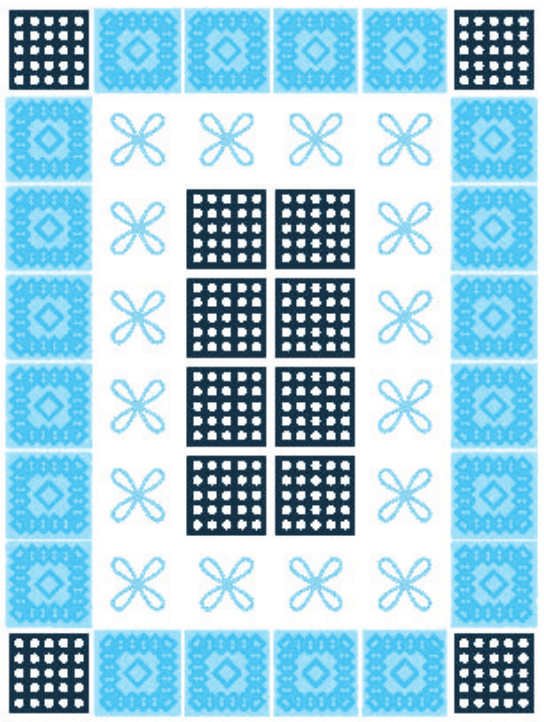
Work with a partner to write at least five ratio statements about this quilt, which has white, blue, and purple squares.
How many squares of each colour will be there in $12$ such quilts?
Answer
Basis of given figure, white, blue & purple squares are given: Purple $= 12$, Blue $= 20$ & white $= 16$ Total squares $= 12 + 20 +16 = 48$
Statement I Purple: total $= 12 : 48 = 1 : 4$
Statement II Blue : total $= 20 : 48=5 : 12$
Statement III White : total $=16 : 48 = 1 : 3$
Statement IV Purple : Blue $= 12 : 20 = 3 : 5$
Statement V Purple : White $= 12 : 16 = 3 : 4$
View full question & answer