Decide which of the following statements is true and which is false. Give reasons for your answer. The coordinates of the origin are $(0, 0).$
View full solution →Question types
Introduction to Graphs question types
18 questions across 3 question groups — pick any mix to generate a Maths paper with step-by-step answer keys.
18
Questions
3
Question groups
5
Question types
Sample Questions
Introduction to Graphs questions
One sample from each question group in this chapter. Select any group above to see the full set with answer keys.
Decide which of the following statements is true and which is false. Give reasons for your answer. Points whose $x$ and $y$ coordinates are equal, lie on a line passing through the origin.
View full solution →Find the coordinates of points $A, B, C, D$ in Figure.
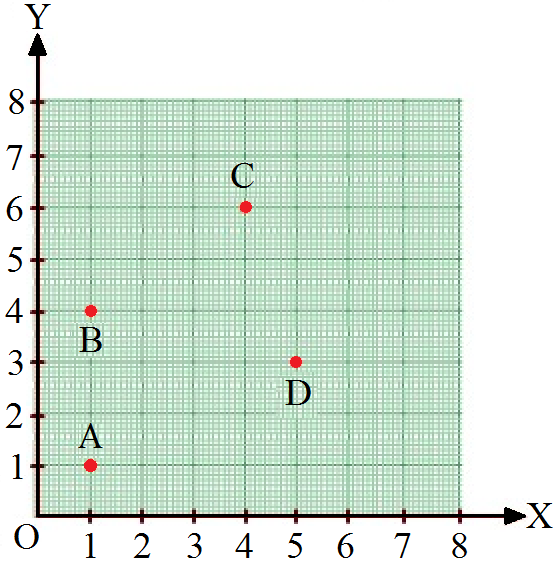
View full solution →Decide which of the following statements is true and which is false. Give reasons for your answer. A point whose $x-$coordinate is zero, will lie on the y-axis.
View full solution →Decide which of the following statements is true and which is false. Give reasons for your answer. A point whose y-coordinate is zero, will lie on $x-$axis.
View full solution →Find the coordinates of points $P, Q, R$ and $S$ in Figure.
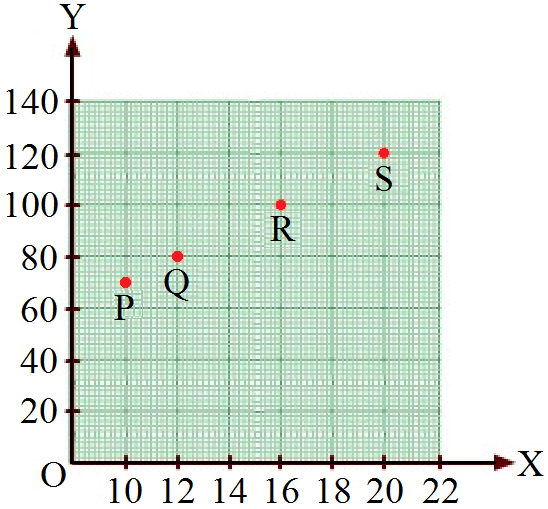
View full solution →The runs scored by a cricket team in first $15$ overs are given below:
Draw the graph representing the above data in two different ways as a graph and as a bar chart.
View full solution →| Overs: | $I$ | $II$ | $III$ | $IV$ | $V$ | $VI$ | $VII$ | $VIII$ | $IX$ | $X$ | $XI$ | $XII$ | $XIII$ | $XIV$ | $XV$ |
| Runs: | $2$ | $1$ | $4$ | $2$ | $6$ | $8$ | $10$ | $21$ | $5$ | $8$ | $3$ | $2$ | $6$ | $8$ | $12$ |
The following table shows the number of patients discharged from a hospital with $\text{HIV}$ diagnosis in different years:
View full solution →| Years: | $2002$ | $2003$ | $2004$ | $2005$ | $2006$ |
| Number of patients: | $150$ | $170$ | $195$ | $225$ | $230$ |
The runs scored by two teams $A$ and $B$ in first $10$ overs are given below:
Draw a graph depicting the data, making the graphs on the same axes in each case in two different ways as a graph and as a bar chart.
View full solution →| Overs: | $I$ | $II$ | $III$ | $IV$ | $V$ | $VI$ | $VII$ | $VIII$ | $IX$ | $X$ |
| Team A: | $2$ | $1$ | $8$ | $9$ | $4$ | $5$ | $6$ | $10$ | $6$ | $2$ |
| Team B: | $5$ | $6$ | $2$ | $10$ | $5$ | $6$ | $3$ | $4$ | $8$ | $10$ |
Locate the points:
$1. (1, 1), (1, 2), (1, 3), (1, 4)$
$2. (2, 1), (2, 2), (2, 3), (2, 4)$
$3. (1, 3), (2, 3), (3, 3), (4, 3)$
$4. (1, 4), (2, 4), (3, 4), (4, 4).$
View full solution →$1. (1, 1), (1, 2), (1, 3), (1, 4)$
$2. (2, 1), (2, 2), (2, 3), (2, 4)$
$3. (1, 3), (2, 3), (3, 3), (4, 3)$
$4. (1, 4), (2, 4), (3, 4), (4, 4).$
Generate a Introduction to Graphs paper free
Pick question groups from the list above, set marks and difficulty, and export a branded PDF with step-by-step answer keys. First 3 chapters free — no signup.