Questions

2 Marks Questions

Take a timed test

17 questions · self-marked practice — reveal the answer and mark yourself.

Question 12 Marks
A closed cylinder tank of radius $7\ m$ and height $3\ m$ is made from a sheet of metal. How much sheet of metal required?
Answer
$r = 7\ m$
$h = 3\ m$
$\therefore$ Total surface area
$ = 2\pi r(r + h)$
$ = 2 \times \frac{{22}}{7} \times 7 \times (7 + 3)$
$= 440 m^2$
Hence, $440m^2$ of metal sheet is required.
View full question & answer
Question 22 Marks
Find the side of a cube whose surface area is $600$ $cm^2$.
Answer
Let the side of the cube be $'a'\ cm$.
Then, Total surface area of the cube $= 6a^2$
According to the question,
$6a^2= 600$
$\therefore $ ${a^2} = \frac{{600}}{6}$
$\therefore $ $a^2= 100$
$\therefore $ ${a^2} = \sqrt {100} $
$\therefore $ $a= 10\ cm$
Hence, the side of the cube is $10\ cm$.
View full question & answer
Question 32 Marks
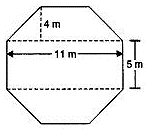
Top surface of a raised platform is in the shape of a regular octagon as shown in the figure. Find the area of the octagonal surface.
Answer
Area of the octagonal surface
= Area of rectangular portion + $2$(Area of trapezoidal portion)
$ = 11 \times 5 + 2 \times \left[ {\frac{{(5 + 11) \times 4}}{2}} \right]{m^2}$
$= 55 + 64\  m^2$
$= 119\  m^2$.
View full question & answer
Question 42 Marks
The diagonal of a rhombus are $7.5\ cm$ and $12\ cm$. Find its area.
Answer
Area of the rhombus
$ = \frac{1}{2} \times {d_1}{d_2}$
$ = \frac{1}{2} \times 7.5 \times 12$
$= 45\  cm^2$
View full question & answer
Question 52 Marks
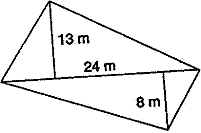
The diagonal of a quadrilateral shaped field is $24\ m$ and the perpendiculars dropped on it from the remaining opposite vertices are $8\ m$ and $13\ m$. Find the area of the field.
Answer
Area of the field $ABCD = 1/2$ $\times$ Diagonal $\times$ ( Height $1$ + Height $2$)
$ = \frac{{24 \times (8 + 13)}}{2}$
$ = \frac{{24 \times 21}}{2}$
$= 12$ $\times$ $21$
$= 252\  m^2$.
View full question & answer
Question 62 Marks
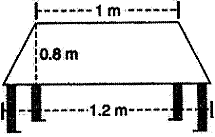
The shape of the top surface of a table is a trapezium. Find its area, if its parallel sides are $1\ m$ and $1.2\ m$ and perpendicular distance between them is $0.8\ m$.
Answer


Area of the top surface of the table
$ = \frac{1}{2}h(a + b)$
$ = \frac{1}{2} \times (0.8 \times (1.2 + 1)$
$= 0.88\ m^2$
View full question & answer
Question 72 Marks
The area of a rhombus is $240$ $cm^2$ and one of the diagonals is $16\ cm$. Find the other diagonal.
Answer
Let length of one diagonal, $d_1= 16\ cm$
and length of the other diagonal $= d_2$
Area of the rhombus = $\frac{1} {2} d_{1} . d_{2}$ $= 240$
So, $\frac {1}{2} \times 16\times d_{2}$$= 240$
Therefore, $d_2= 30$ $cm$
Hence the length of the second diagonal is $30\ cm$.
View full question & answer
Question 82 Marks
The area of a trapezium shaped field is $480$ $m^2$, the distance between two parallel sides is $15\ m$ and one of the parallel side is $20\ m$. Find the other parallel side.
Answer
One of the parallel sides of the trapezium is $a = 20\ m$. Let another parallel side be $b$.
Given: height $h = 15\ m$, Area of trapezium $= 480\  m^2$
Now, Area of a trapezium = $\frac{1}{2}h (a + b)$
So, $480 = \frac {1}{2} × 15 × (20 + b)$
or $\frac {{480}\times{2}}{15} = 20 + b$
or $20 + b = 60$
or $b = 44\ m$
Hence the other parallel side of the trapezium is $44\ m$.
View full question & answer
Question 92 Marks
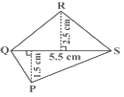
Find the area of quadrilateral $PQRS$ shown in Fig.
Answer
In this case, $d = 5.5\ cm$, $h_1= 2.5\ cm$, $h_2= 1.5\ cm,$
Area = $\frac {1}{2}$$d(h_1+h_2)$
= $\frac {1}{2}\times5.5 × (2.5 + 1.5)$
= $\frac {1}{2}\times5.5 × 4$ $= 11\ cm^2$
View full question & answer
Question 102 Marks
Water is pouring into a cuboidal reservoir at the rate of $60$ litres per minute. If the volume of the reservoir is $108 m^3$, find the number of hours it will take to fill the reservoir.
Answer
Volume of the reservoir $=108 m^3=108000 L\left[\because 1 m^3=1000 L\right]$
Volume of water flowing into the reservoir in $1$ minute $=60 L$
Time taken to fill the reservoir
$=\frac{\text { Volume of the reservoir }}{\text { Rate of flowing the water }}$
$=\frac{108000}{60} \text { minutes }$
$=1800 \text { minutes or } \frac{1800}{60} \text { hours }$
$=30 \text { hours }$
Hence, the required hour to fill the reservoir $= 30$ hours.
View full question & answer
Question 112 Marks
If each edge of a cube is doubled,
$(i)$ how many times will it be surface area increase?
$(ii)$ how many times will its volume increase?
Answer
Let the edge of the cube $=x cm$
If the edge is doubled, then the new edge $=$ 2x $cm$
$(i)$ Original surface area $=6 x ^2 cm^2$
New surface area $=6(2 x)^2=6 \times 4 x^2=24 x^2$
Ratio $=6 x^2: 24 x^2=1: 4$
Hence, the new surface area will be four times the original surface area.
$(ii)$ Original volume of the cube $=x^3 cm^3$
New volume of the cube $=(2 x)^3=8 x^3 cm^3$
Ratio $=x^3: 8 x^3=1: 8$
Hence, the new volume will be eight times the original volume.
View full question & answer
Question 122 Marks
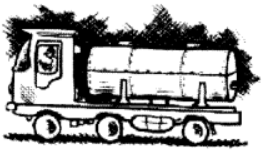
A milk tank is in the form of a cylinder whose radius is $1.5 m$ and length is $7 m$ . Find the quantity of milk in litres that can be stored in the tank.
Image
Answer
Here, $r=1.5 m$$h=7 m$
$\therefore$ Volume of the milk tank $=\pi r^2 h$
$=\frac{22}{7} \times 1.5 \times 1.5 \times 7$
$=22 \times 2.25$
$=49.50 m^3$
Volume of milk in litres
$=49.50 \times 1000 L\left(\because 1 m^3=1000 \text { litres }\right)$
$=49500 L$
Hence, the required volume $=49500 L$.
View full question & answer
Question 132 Marks
Find the height of the cylinder whose volume is $1.54 m^3$ and the diameter of the base is $140 \ cm.$
Answer
$V=1.54 m^3, d=140 cm=1.40 m$
$\text { Volume of the cylinder }=\pi r 2 h$
$\quad 1.54=\frac{22}{7} \times \frac{1.4}{2} \times \frac{1.4}{2} \times h$
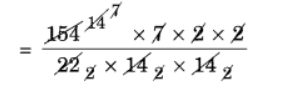
$\Rightarrow \quad h=\frac{1.54 \times 7 \times 2 \times 2}{22 \times 1.4 \times 1.4}$.
Image
$=1 m$
Hence, the height of cylinder $=1 m$.
View full question & answer
Question 142 Marks
A cuboid is of dimensions $60 cm \times 54 cm \times 30 cm$. How many small cubes with side 6 cm can be placed in the given cuboid?
Answer
Volume of the cuboid $=l \times b \times h=60 cm \times 54 cm \times 30 cm=97200 cm^3$
Volume of the cube $=(\text { Side })^3=(6)^3=216 cm^3$
Number of the cubes from the cuboid
$=\frac{\text { Volume of the cuboid }}{\text { Volume of cube }}$
$=\frac{97200}{216}$
$=450$
Hence, the required number of cubes $=450$.
View full question & answer
Question 152 Marks
Find the height of a cuboid whose base area is $180 \ cm^2$ and volume is $900 \ cm^3$.
Answer
Given: Area of base $= lb =180 \ cm^2$
$V=900 \ cm^3$
Volume of the cuboid $=l \times b \times h$
$900=180 \times h$
$h=5 \ cm$
Hence, the required height $=5 \ cm$.
View full question & answer
Question 162 Marks
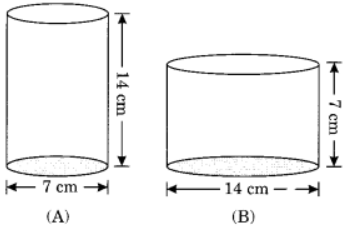
Diameter of cylinder $A$ is $7 \ cm$, and the height is $14 \ cm$. Diameter of cylinder $B$ is $14 \ cm$ and height is $7 \ cm$. Without doing any calculations can you suggest whose volume is greater? Verify it by finding the volume of both the cylinders. Check whether the cylinder with greater volume also has greater surface area?
Image
Answer
Cylinder $B$ has a greater volume.
Verification:
Volume of cylinder $A=\pi r^2 h$
$=\frac{\not 22^{11}}{\not7} \times \frac{\not 7}{\not 2} \times \frac{\not 7}{\not 2} \times \not14^7$
$=539 \ cm^3$
Volume of cylinder $B =\pi r^2 h$
$=\frac{22}{\not 7} \times \not 7 \times 7 \times 7$
$=22 \times 49$
$=1078 \ cm^3$
Hence, volume of cylinder $B$ is double to that of cylinder $A.$
Hence verified.
Total surface area of cylinder $A$
$=2 \pi r(h+r)$
$=2 \times \frac{22}{7} \times \frac{7}{2}\left(\frac{7}{2}+14\right)$
$=\not 2 \times \frac{\not 22^{11}}{\not 7} \times \frac{\not 7}{\not 2} \times \frac{35}{\not 2}$
$=385 \ cm^2$
Total surface area of cylinder $B$
$=2 \pi r(h+r)$
$=2 \times \frac{22}{7} \times 7(7+7)$
$=2 \times \frac{22}{\not 7} \times \not 7 \times 14$
$=616 \ cm^2$
Hence, cylinder $B$ has greater surface area.
View full question & answer
Question 172 Marks
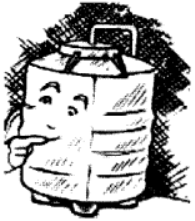
Given a cylindrical tank, in which situation will you find the surface area and in which situation volume.
$(a)$ To find how much it can hold.
$(b)$ Number of cement bags required to plaster it.
$(c)$ To find the number of smaller tanks that can be filled with water from it.
Image
Answer
$(a)$ In this situation, we can find the volume.
$(b)$ In this situation, we can find the surface area.
$(c)$ In this situation, we can find the volume.
View full question & answer