Questions

1 Marks Question

Take a timed test

34 questions · self-marked practice — reveal the answer and mark yourself.

Question 11 Mark
Two cylinders $A$ and $B$ are formed by folding a rectangular sheet of dimensions $20\ cm × 10\ cm$ along its length and also along its breadth respectively. Then volume of $A$ is ________ of volume of $B.$
Answer
We have a rectangular sheet of dimensions $20\ cm × 10\ cm.$
If we fold it along its length, which is $20\ cm,$ then the resultant figure is a cylinder with height, $h = 10\ cm$ and base circumference, $2\pi\text{r}=20\text{cm}$
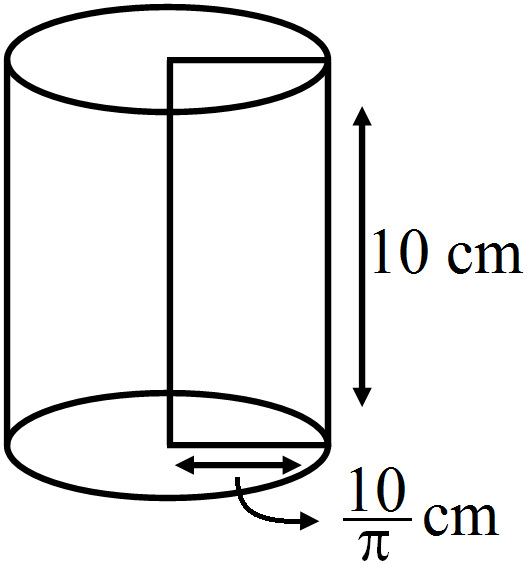
$\Rightarrow\text{r}=\frac{20}{2\pi}=\frac{10}{\pi}\text{cm}$
$\therefore$ The volume of the cylinder, so formed $=\pi\text{r}^2\text{h}$
$=\pi\times\frac{10}{\pi}\times\frac{10}{\pi}\times10$
$=\frac{1000}{\pi}\text{cm}^3$
$=\text{V}_1\text{(say)}$
Again, if we fold the rectangular sheet along its breadth, which is $10\ cm,$ the figure so obtained is a cylinder with height, $h = 20\ cm$ and the base circumference $2\pi\text{r}=10\text{cm}$
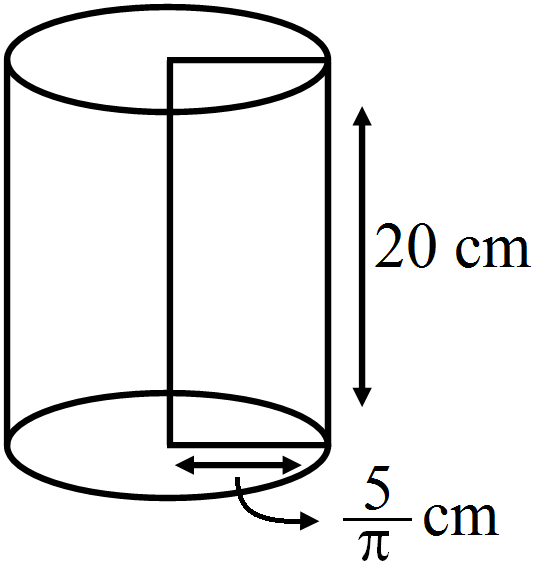
$\Rightarrow\text{r}=\frac{10}{2\pi}=\frac{5}{\pi}\text{cm}$
$\therefore$ Volume of the cylinder $=\pi\text{r}^2\text{h}=\pi\times\frac{5}{\pi}\times\frac{5}{\pi}\times20$
$=\frac{500}{\pi}\text{cm}^3$ = $V_2$ (say)
i.e. $V_2 = 2V_1$
From Eqs. $(i)$ and $(ii),$ we see that the volume of $A$ is twice the volume of $B.$
View full question & answer
Question 21 Mark
Curved surface area of a cylinder of radius $h$ and height $r$ is _______.
Answer
We know that the curved surface area of a cylinder of radius $h$ and height $r$
$=2\pi\times\text{Radius}\times\text{Height}.$
$=2\pi\times\text{h}\times\text{r}=2\pi\text{hr}$
$=2\pi\text{rh}$
View full question & answer
Question 31 Mark
The areas of any two faces of a cuboid are equal.
Answer
False.Solution:
A cuboid has rectangular faces with different lengths and breadths. Only opposite faces of cuboid have the same length and breadth.
Therefore, areas of only opposite faces of a cuboid are equal.
View full question & answer
Question 41 Mark
The curved surface area of a cylinder is reduced by __________ per cent if the height is half of the original height.
Answer
The curved surface area of a cylinder is reduced by $50\%$ per cent if the height is half of the original height.
Solution:
The curved surface area of a cylinder with radius r and height h $=2\pi\text{rh}$
If the height is halved, then new curved surface area of cylinder $=2\pi\text{r}\frac{\text{h}}{2}=\pi\text{rh}$
$\therefore$ Percentage reduction in curved surface area $=\frac{2\pi\text{rh}-\pi\text{rh}}{2\pi\text{rh}}\times100$
$=\frac{\pi\text{rh}}{2\pi\text{rh}}\times100$
$=50\%$
View full question & answer
Question 51 Mark
Two cylinders with equal volume will always have equal surface areas.
Answer
False.
Solution:
Consider two cylinders with the following measures
e.g. $r_1 = 2\ cm, h = 9\ cm$ and $r = 3\ cm, h = 4\ cm$
For the first cylinder,
Volume $=\pi\text{r}^2\text{h}=\pi\times2^2\times9=36\pi\text{cm}^3$
Again, for the second cylinder,
Volumes $\pi\text{r}^2\text{h}=\pi\times3^2\times4$
$=36\pi\text{cm}^3$
$\therefore$ The volumes are equal.
Now, surface area of first cylinder $=2\pi\text{rh}=2\pi\times2\times9=36\pi\text{cm}^2$
and surface area of second cylinder $=2\pi\text{rh}=2\pi\times3\times4=24\pi\text{cm}^2$
which are not equal.
So, the statement is false.
View full question & answer
Question 61 Mark
cube of side $5\ cm$ is cut into $1\ cm$ cubes. The percentage increase in volume after such cutting is _________.
Answer
cube of side $5\ cm$ is cut into $1\ cm$ cubes. The percentage increase in volume after such cutting is none.
Solution:
Given, a cube of side $5\ cm$ is cut into $1\ cm$ cubes.
The volume of big cube $= 5 × 5 × 5$
$= 125\ cm^3$
Now, the big cube is cut into $1\ cm$ cubes.
$\therefore$ The number of small cubes$=\frac{125}{\text{Volume of 1 small cube }}$
$=\frac{125}{1}$
Thus, the volume of big cube $=$ The volume of $125$ cubes having an edge $1\ cm$
Hence, there is no change in the volume.
View full question & answer
Question 71 Mark
The surface area of a cylinder which exactly fits in a cube of side $b$ is __________.
Answer
The surface area of a cylinder which exactly fits in $a$ cube of side $b$ is $\pi\text{b}^2.$
Solution: Since, the cylinder that exactly fits in a cube of side $b,$ has its height equal to the edge of the cube and radius equal to half the edge of the cube.
$\therefore$ Height $= b$ and radius $=\frac{\text{b}}{2}$ Now, curved surface area of the cylinder $=2\pi\text{rh}=2\pi\times\frac{\text{b}}{2}\times\text{b}$
$=\pi\text{b}^2$
View full question & answer
Question 81 Mark
If a cube fits exactly in a cylinder with height $h,$ then the volume of the cube is __________ and surface area of the cube is __________.
Answer
If a cube fits exactly in a cylinder with height $h,$ then the volume of the cube is $h^3$ and surface area of the cube is $6h^2$.
Solution:
Since, the cube fits exactly in the cylinder with height $h,$ therefore each side of the cube $= h$
Now, volume of the cube $= (Side)^3 = h^3$
and surface area of the cube $= 6 \times (Side)^2$
$= 6 \times h^2$
View full question & answer
Question 91 Mark
The surface area of a cuboid formed by joining two cubes of side a face to face is __________.
Answer
The surface area of a cuboid formed by joining two cubes of side a face to face is $10a^2$.
Solution:
We have two cubes of side $a.$
These two cubes are joined face-to-face, then the resultant solid figure is a cuboid which has same breadth and height as the joined cubes has length twice of the length of a cube, $l.e. l = 2a, b = a$ and $h = a$
Thus, the total surface area of the cuboid $= 2(lb + bh + hi)$
$= 2(2a \times a + a \times a + a \times 2a)$
$=2(2a^2 + a^2 + 2a^2)$
$= 2 \times 5a^2 = 10a^2$
View full question & answer
Question 101 Mark
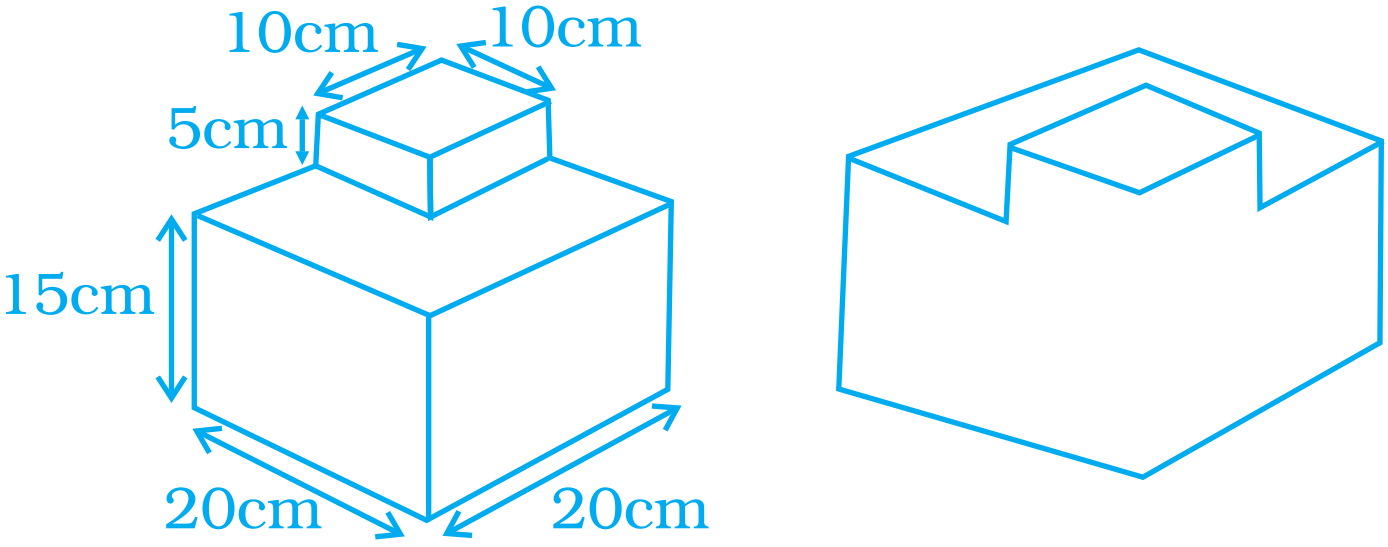
A birthday cake has two tiers as shown in the figure below. Find the volume of the cake.
Answer
Volume of the cake $=$ Volume of lower cuboid $+$ Volume of upper cuboid
$= 20 \times 20 \times 15 + 10 \times 10 \times 5 [\because$ volume of cuboid $= l \times b \times h]$
$= 6000 + 500 $
$= 6500cm^3$
View full question & answer
Question 111 Mark
Volume of a cylinder with radius $h$ and height $r$ is __________.
Answer
Volume of a cylinder with radius $h$ and height $r$ is $\pi\text{h}^2\text{r}.$
Solution:
Given, radius of cylinder $= h$ and height of cylinder $= r.$
Now, volume of a cylinder
$=\pi\times(\text{Radius})^2\times\text{Height}=\pi\times\text{h}^2\times\text{r}=\pi\text{h}^2\text{r}$
View full question & answer
Question 121 Mark
__________ surface area of room $=$ area of $4$ walls.
Answer
Lateral surface area of room $=$ area of $4$ walls.
Solution:
We know that a room is in the shape of a cuboid. Its $4$ walls are treated as lateral faces of the cuboid.
$\therefore$ Lateral surface area of room $=$ Area of $4$ walls
View full question & answer
Question 131 Mark
In the above question, curved surface area of $A$ is ________ curved surface area of $B.$
Answer
In the above question, curved surface area of A is equal curved surface area of $B.$
Solution:
For cylinder $A, h = 10\ cm$ and $\text{r}=\frac{10}{\pi}\text{cm}$
$\therefore$ Curved surface area of $A$
$=2\pi\text{rh}=2\pi\times\frac{10}{\pi}\times10=200\text{cm}^2$
Again, for cylinder $ B, \text{r}=\frac{5}{\pi}\text{cm}$ and $h = 20\ cm$
$\therefore$ Curved surface area of $\text{B}=2\pi\text{rh}=2\pi\times\frac{5}{\pi}\times20=200\text{cm}^2$
Hence, the curved surface area of both the cylinders are same.
View full question & answer
Question 141 Mark
If the diagonals of a rhombus get doubled, then the area of the rhombus becomes __________ its original area.
Answer
If the diagonals of a rhombus get doubled, then the area of the rhombus becomes 4 times its original area.
Solution:
We know that,
Area of a rhombus $=\frac{1}{2}\times\text{d}_1\times\text{d}_2$
where, $d _1$ and $d _2$ are diagonals of the rhombus.
If diagonals pet doubled, then the area $=\frac{1}{2}2\text{d}_1\times2\text{d}_2=4\Big(\frac{1}{2}\times\text{d}_1\times\text{d}_2\Big)$
Hence, the new area becomes 4 times its original area.
View full question & answer
Question 151 Mark
Two cuboids with equal volumes will always have equal surface areas.
Answer
 We discard the statement by a counter example.
Let the dimensions of two cuboids be $1\ cm \times 1\ cm \times 2\ cm$ and $ 1\ cm \times \frac{1}{2}\ cm x 4\ cm,$
respectively,
Then, volume of first cuboid $= l \times b \times h = 1 \times 1 \times 2 = 2cm^3$
and volume of second cuboid $= l \times b \times h = 1 \times \frac{1}{2}  \times 4 = 2cm^3$
Now, the surface area of first cuboid $= 2(lb + bh + hl)$
$= 2(1 \times 1 + 1 \times 2 + 2 \times 1)$
$= 2(1 + 2 + 2) = 10cm^2$
and surface area of the second cuboid $= 2(lb + bh + hl)$
$=2\Big(1\times\frac{1}{2}+\frac{1}{2}\times4+1\times4\Big)=2\Big(\frac{1}{2}+\frac{4}{2}+4\Big)$
$=2\Big(\frac{5}{2}+4\Big)=2\Big(\frac{13}{2}\Big)=13\text{cm}^2$
which are not equal.
So, the statement is false.
View full question & answer
Question 161 Mark
Two cylinders of same volume have their radii in the ratio $1 : 6,$ then ratio of their heights is __________.
Answer
 Let $r_1, r_2$ be the radii and $h_1, h_2$ be the heights of two cylinders.
Given, $\frac{\text{r}_1}{\text{r}_2}=\frac{1}6{}$
Now, according to the question,
$\pi\text{r}^2_1\text{h}_1=\pi\text{r}^2_2\text{h}_2$ [$\because$ volume of cylinder $\pi\text{r}^2\text{h}$]
$\Rightarrow\frac{\text{r}^2_1}{\text{r}_2^2}=\frac{\text{h}_2}{\text{h}_1}$
$\Rightarrow\Big(\frac{\text{r}_1}{\text{r}_2}\Big)^2=\frac{\text{h}_2}{\text{h}_1}$
$\Rightarrow\Big(\frac{1}{6}\Big)^2=\frac{\text{h}_2}{\text{h}_1}$
$\Rightarrow\frac{1}{36}=\frac{\text{h}_2}{\text{h}_1}$
Or $\frac{\text{h}_1}{\text{h}_2}=\frac{36}{1}$
Or $h_1: h_2 = 36 : 1$
View full question & answer
Question 171 Mark
The volume of a cylinder becomes __________ the original volume if its radius becomes half of the original radius.
Answer
The volume of a cylinder becomes $\frac{1}{4}$ the original volume if its radius becomes half of the original radius.
Solution:
The volume of a cylinder with radius $r$ and height $h =\pi\text{r}^2\text{h}$ If radius is halved, then new volume $=\pi\Big(\frac{\text{r}}{2}\Big)^2\text{h}=\frac{1}{4}\pi\text{r}^2\text{h}$
Hence, the new volume is $\frac{1}{4}$ th of the original volume.
View full question & answer
Question 181 Mark
The volume of a cylinder which exactly fits in a cube of side a is __________.
Answer
The volume of a cylinder which exactly fits in a cube of side a is $\frac{\pi\text{a}^3}{4}.$
Solution:
Since the cylinder that exactly fits in cube of side a, has its height equal to the edge of the cube and radius equal to half the edge of the cube.
$\therefore$ Height $= a$ and radius $=\frac{\text{a}}{2}$
Now, volume of the cylinder $=\pi\text{r}^2\text{h}=\pi\Big(\frac{\text{a}}{2}\Big)^2\text{a}$
$=\frac{1}4{}\pi\text{a}^3$
View full question & answer
Question 191 Mark
Two cylinders of equal volume have heights in the ratio $1 : 9. $ The ratio of their radii is __________.
Answer
 Let $r_1, r_2$ be the radii and $h_1, h_2$ be the heights of two cyinders.
Given, $\frac{\text{h}_1}{\text{h}_2}=\frac{1}{9}$
Now, according to the question,
$\pi\text{r}_1^2\text{h}_1=\pi\text{r}^2_2\text{h}_2[\because$ volume of cylinder $=\pi\text{r}^2\text{h}]$
$\Rightarrow\frac{\text{r}^2_1}{\text{r}^2_2}=\frac{\text{h}_2}{\text{h}_1}$
$\Rightarrow\Big(\frac{\text{r}_1}{\text{r}_2}\Big)^2=\frac{9}{1}$
$\Rightarrow\frac{\text{r}_1}{\text{r}_2}=\frac{\sqrt{9}}1{}$
$\Rightarrow\frac{\text{r}_1}{\text{r}_2}=-\frac{3}{1}$
Hence, $r_1  :  r_2 = 3 : 1$
View full question & answer
Question 201 Mark
A cube of side $4\ cm$ is painted on all its sides. If it is sliced in $1$ cubic cm cubes, then number of such cubes that will have exactly two of their faces painted is _________.
Answer
A cube of side $4\ cm$ is painted on all its sides. If it is sliced in $1$ cubic $cm$ cubes, then number of such cubes that will have exactly two of their faces painted is $= 12 × 2 = 24.$
Solution:
The volume of a cube of side $4\ cm = 4 × 4 × 4 = 64\ cm^3$ When it is sliced into $1\ cm$ cubes, we will get $64$ small cubes.
In each side of the larger cube, the smaller cubes in the edges will have more than one face painted.
The cubes which are situated at the comers of the big cube have three faces painted.
So, to each edge two small cubes are left which have two faces painted. As the total number of edges in a cube are $12.$
Hence, the number of small cubes with two faces painted $= 12 × 2 = 24.$
View full question & answer
Question 211 Mark
Ratio of area of a circle to the area of a square whose side equals radius of circle is $1 : \pi.$
Answer
 Given side of a square equals radius of a circle.
Then area of the square $=\text{r}^2$
Then and area of the circle $=\pi\text{r}^2$
where r is a radius of the circle.
Now, the ratio of area of the circle to area of the square $=\pi\text{r}^2:\text{r}^2=\pi:1.$
View full question & answer
Question 221 Mark
If the diagonal d of a quadrilateral is doubled and the heights $h_1$ and $h_2$ falling on $d$ are halved, then the area of quadrilateral is __________.
Answer
If the diagonal $d$ of a quadrilateral is doubled and the heights $h_1$ and $h_2$ falling on $d$ are halved, then the area of quadrilateral is $\frac{1}{2}(\text{h}_1+\text{h}_2)\text{d}.$
Solution:
Let $ABCD$ be a quadrilateral, where $h_1$ and $h_2$​​​​​​​ are altitudes on the diagonal $BD = d.$
Then, area of quadrilateral $ABCD =\frac{1}{2}(\text{h}_1+\text{h}_2)\times\text{BD}$
If altitudes are halved and the diagonal is doubled, then
Area of quadrilateral $ABCD =\frac{1}{2}\Big(\frac{\text{h}_1}{2}+\frac{\text{h}_2}{2}\Big)\times2\text{d}=\frac{1}{2}\Big(\frac{\text{h}_1+\text{h}_2}{2}\Big)\times2\text{d}$
$=\frac{1}{2}(\text{h}_1+\text{h}_2)\times\text{d}$
View full question & answer
Question 231 Mark
A cube of side $3\ cm$ painted on all its faces, when sliced into $1$ cubic centimetre cubes, will have exactly $1$ cube with none of its faces painted.
Answer
Given a cube of side $3\ cm$ is painted on all its faces. Now, it is sliced into $1$ cu cm cubes. Then, there will be $8$ corner cubes that have $3$ sides painted, $6$ centre cubes with only one side painted and only $1$ cube in the middle that has no side painted.
View full question & answer
Question 241 Mark
__________ of a solid is the measurement of the space occupied by it.
Answer
Volume of a solid is the measurement of the space occupied by it.Solution:
We know that, a solid always occupies some space and magnitude of this space region is known as the volume of the solid.
View full question & answer
Question 251 Mark
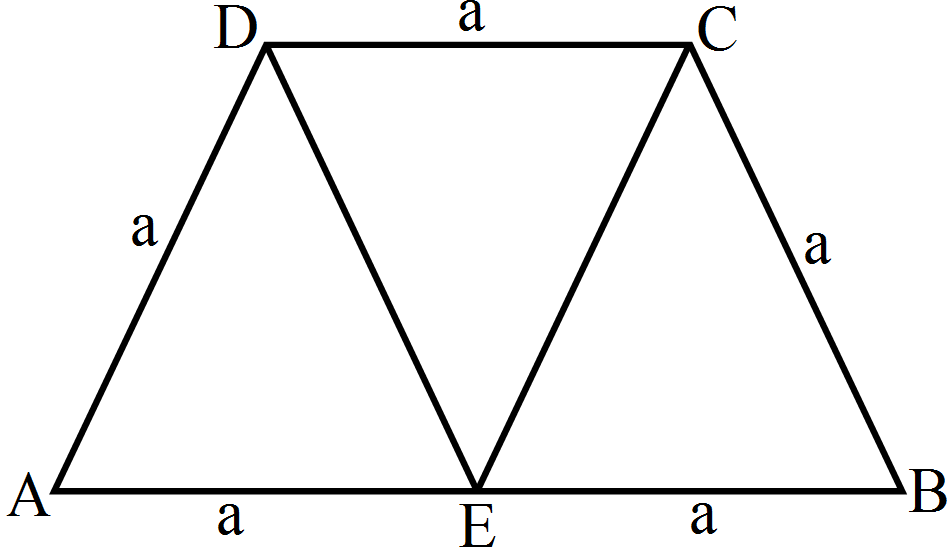
A trapezium with $3$ equal sides and one side double the equal side can be divided into __________ equilateral triangles of _______ area.
Answer
A trapezium with $3$ equal sides and one side double the equal side can be divided into $3$ equilateral triangles of equal area.
Solution:

Let $ABCD$ be a trapezium, in which
$AD = DC = BC = a ($say$)$
and $AB = 2a$
Draw medians through the vertices $D$ and $C$ on the side $AB.$
$\therefore AE = EB = a$
Now, in parallelogram $ADCE,$ we have
$AD = EC = a$ and $AE = CD = a [ \because$ opposite sides in a parallelogram are equal]
In $\triangle\text{ADE}$ and $\triangle\text{DEC},$ AD = EC
$AE = CD$
and $DE = DE$
By sss, $\triangle\text{ADE}=\triangle\text{DEC}$
By triangle rule, $\triangle\text{ADE}\cong\triangle\text{DEC}$ Thus, $\triangle\text{ADE}$ and $\triangle\text{DEC}$ are equilateral triangles having equal sides. Similarly, in parallelogram $DEBC. $ we can show that $\triangle\text{DEC}\cong\triangle\text{ECB}.$ Hence, the trapezium can be divided into $3$ equilateral triangles of equal area.
View full question & answer
Question 261 Mark
The perimeter of a rectangle becomes __________ times its original perimeter, if its length and breadth are doubled.
Answer
The perimeter of a rectangle becomes $2$ times its original perimeter, if its length and breadth are doubled. Solution:Perimeter of a rectangle with length and breadth $b = 2(l + b)$
If the length and the breadth are doubled, then the new perimeter
$= 2(2l + 2b)$
$= 2[2(l + b)]$
View full question & answer
Question 271 Mark
Opposite faces of a cuboid are _________ in area.
Answer
Opposite faces of a cuboid are equal in area.

Solution:

We know that, a cuboid has 6 rectangular races, of which opposite faces have the same length and breadth.

Therefore, area of the opposite faces are equal.

View full question & answer
Question 281 Mark
Total surface area of a cylinder of radius h and height $r$ is _________.
Answer
Total surface area of a cylinder of radius $h$ and height $r$ is $2\pi\text{h(r + h)}.$
Solution:
Given radius of cylinder $= h$ and height of cylinder $= r$
​​​​​​​ $\therefore$ Total surface area of a cylinder $=$ Curved surface area $+$ Area of top surface $+$ Area of base $=2\times\pi\times\text{Radius}\times\text{Height}+\pi(\text{Radius})^2+\pi(\text{Radius})^2$
$=2\pi\text{hr}+\pi\text{h}^2+\pi\text{h}^2$
$=2\pi\text{rh}+2\pi\text{h}^2$
$=2\pi\text{h}(\text{r + h})$
View full question & answer
Question 291 Mark
Area of a rhombus $=\frac{1}{2}$ product of _________.
Answer
Three cubes having side $x$ are joined face-to-face, then the cuboid so formed has the same height and breadth as the cubes but its length will be thrice that of the cubes.
Hence, the length, breadth and height of the cuboid so formed are $3x, x$ and $x$ respectively. Then its surface area $= 2(lb + bh + hl)$
$=2(3 x \times x+x \times x \times 3 x)=2\left(3 x^2+x^2+3 x^2\right)$
$=2 \times 7 x^2=14 x^2$
Now, the surface area of the cube of side $x=6(\text { Side })^2=6 x^2$ Hence, the statement is false.
View full question & answer
Question 301 Mark
Area of a rhombus $=\frac{1}{2}$ product of _________.
Answer
Area of a rhombus $=\frac{1}{2}$ product of diagonals.Solution:
We know that the area of a rhombus = Half of the product of its diagonals
$=\frac{1}{2}$ [Product of diagonals]
View full question & answer
Question 311 Mark
The area of a trapezium become $4$ times if its height gets doubled.
Answer
We know that,Area of a trapezium $=\frac{1}{2} (a + b) \times h$
where, $a$ and $b$ are the lengths of parallel sides and his the altitude (height).
Now, if the height gets doubled, then
Area of trapezium $=\frac{1}{2} (a + b) \times 2h = 2\Big(\frac{1}{2} (a + b) \times h\Big)$
Hence, the area is doubled.
So, the statement is false.
View full question & answer
Question 321 Mark
All six faces of a cuboid are __________ in shape and of ______ area.
Answer
All six faces of a cuboid are rectangular in shape and of different area.Solution:
We know that, a cuboid is made of $6$ rectangular plane regions, i.e. $6$ rectangular faces, which have different lengths and breadths Therefore the area of the rectangular faces are different.
View full question & answer
Question 331 Mark
The areas of any two faces of a cube are equal.
Answer
True.Solution:
Since all the faces of a cube are squares of same side length, therefore the areas of any two faces of a cube are equal.
View full question & answer
Question 341 Mark
The surface area of a cube formed by cutting a cuboid of dimensions $2 × 1 × 1$ in $2$ equal parts is $2\ sq.$ units.
Answer
The dimensions of the given cuboid are $2 × 1 × 1.$ It is sliced into two equal parts, which are cubes.
Then, the dimensions of the cube, so formed are $1 × 1 × 1.$
$\therefore$ The surface area of the cube so formed $= 6(Side)^2 = 6 × (1)^2 = 6\ sq$ units
Hence, the surface area of the sliced cube is $6\ sq$ units.
View full question & answer