MCQ 11 Mark
A covered wooden box has the inner measures as $115\ cm, 75\ cm$ and $35\ cm$ and thickness of wood as $2.5\ cm.$ The volume of the wood is:
- A
$85,000 \mathrm{~cm}^3$
- B
$80,000 \mathrm{~cm}^3$
- ✓
$82,125 \mathrm{~cm}^3$
- D
$84,000 \mathrm{~cm}^3$
AnswerCorrect option: C. $82,125 \mathrm{~cm}^3$
Given, inner measures of a wooden box as $115\ cm, 75\ cm$ and $35\ cm.$
Since, thickness of the box is $2.5\ cm,$ then outer measures will be $115 + 5.75 + 5$ and $35 + 5$
i.e. $120\ cm, 80\ cm$ and $40\ cm$.
$\therefore$ The outer volume $= 120 \times 80 \times 40 = 384000\ cm^3$
and the inner volume $= 115 \times 75 \times 35 = 301875\ cm^3[\because$ volume of cuboid $= l \times b \times h]$
$\therefore$ Volume of the wood $=$ Outer volume $-$ Inner volume
$= 384000 - 301875 = 82125\ cm^3$
View full question & answer→MCQ 21 Mark
If the height of a cylinder becomes $\frac{1}{4}$ of the original height and the radius is doubled, then which of the following will be true?
- A
Total surface area of the cylinder will be doubled.
- B
Total surface area of the cylinder will remain unchanged.
- C
Total surface of the cylinder will be halved.
- ✓
AnswerTotal surface area of cylinder having radius $r$ and height $\text{h}=2\pi\text{r}(\text{h + r})$
Total surface area of the cylinder with new height $\Big(\frac{\text{h}}{\text{u}}\Big)$ and radius $2r$
$=2\pi(2\text{r})\Big(2\text{r}+\frac{1}4{}\text{h}\Big)$
$=4\pi\text{r}(8\text{r}+\text{h})\times\frac{1}4{}$
$=\pi\text{r}(8\text{r + h})$
View full question & answer→MCQ 31 Mark
The perimeter of a trapezium is $52\ cm$ and its each non-parallel side is equal to $10\ cm$ with its height $8\ cm$. Its area is:
- A
$ 124 \mathrm{~cm}^2 $
- B
$ 118 \mathrm{~cm}^2 $
- ✓
$ 128 \mathrm{~cm}^2 $
- D
$ 112 \mathrm{~cm}^2 $
AnswerCorrect option: C. $ 128 \mathrm{~cm}^2 $
Given, perimeter of a trapezium is $52\ cm$ and each non $-$ parallel side is of $10\ cm.$
Then, sum of its parallel sides
$= 52 - (10 + 10) = 52 - 20 = 32\ cm$
$\therefore$ Area of the trapezium $=\frac{1}{2}(\text{a + b})\times\text{h}$
$=\frac{1}{2}\times32\times8 [ \because h = 8\ cm $ and $a + b = 32\ cm]$
$=128\text{ cm}^2$
View full question & answer→MCQ 41 Mark
The area of a parallelogram is $60\ cm^2$ and one of its altitude is $5\ cm.$ The length of its corresponding side is:
- ✓
$12\ cm$
- B
$6\ cm$
- C
$4\ cm$
- D
$2\ cm$
AnswerCorrect option: A. $12\ cm$
Area of a parallelogram $=$ Side $\times $ Altitude
$\Rightarrow a \times h = 60$
$\Rightarrow a \times 5 = 60$
$\Rightarrow\text{a}=\frac{60}{5}$
$\therefore a = 12\ cm$
View full question & answer→MCQ 51 Mark
Area of a quadrilateral $\text{ABCD}$ is $20\ cm^2$ and perpendiculars on $BD$ from opposite vertices are $1\ cm$ and $1.5\ cm.$ The length of $BD$ is:
- A
$4\ cm$
- B
$15\ cm$
- ✓
$16\ cm$
- D
$18\ cm$
AnswerCorrect option: C. $16\ cm$
Area of the given quadrilateral $=\frac{1}2{} \ ($sum of altitudes$) \times $ Corresponding diagonal
$\Rightarrow20=\frac{1}{2}(1+1.5)\times\text{BD}\ [$given$]$
$\Rightarrow\frac{1}2{}\times2.5\times\text{BD}=20\text{ cm}^2$
$\Rightarrow\text{BD}=20\times\frac{2}{2.5}$
$=\frac{40}{2.5}=16\text{ cm}$
View full question & answer→MCQ 61 Mark
A regular hexagon is inscribed in a circle of radius $r.$ The perimeter of the regular hexagon is:
- A
$3r.$
- ✓
$6r.$
- C
$9r.$
- D
$12r.$
AnswerA regular hexagon comprises $6$ equilateral triangles, each of them having one of their vertices at the centre of the hexagon.
The sides of the equilateral triangle are equal to the radius of the smallest circle inscribing the hexagon.
Hence, each side of the hexagon is equal to the radius of the hexagon and the perimeter of the hexagon is $6r.$
View full question & answer→MCQ 71 Mark
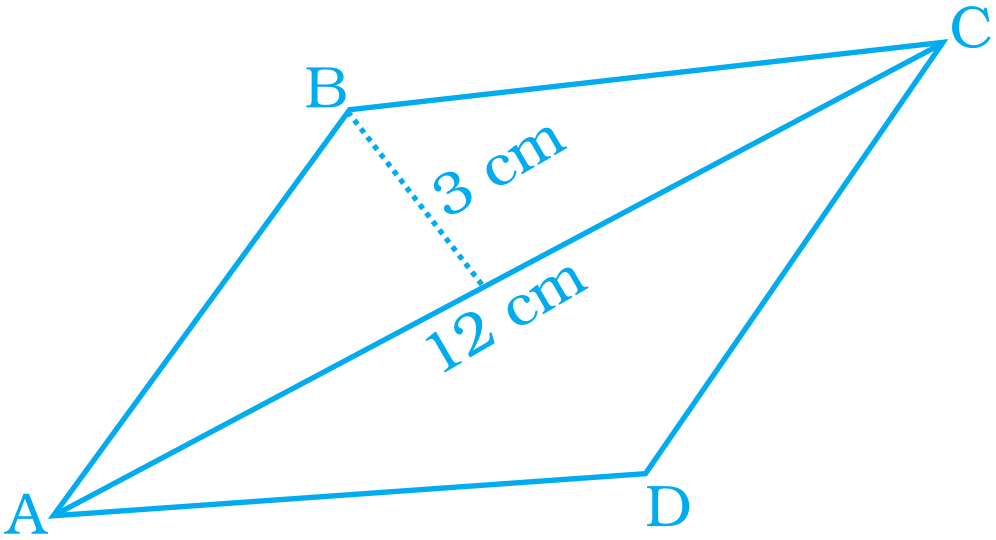
The figure $\text{ABCD}$ is a quadrilateral in which $AB = CD$ and $BC = AD.$ Its area is:
- A
$72 \mathrm{~cm}^2$
- ✓
$36 \mathrm{~cm}^2$
- C
$24 \mathrm{~cm}^2$
- D
$18 \mathrm{~cm}^2$
AnswerCorrect option: B. $36 \mathrm{~cm}^2$
It Is clear from the figure that, quadrilateral $\text{ABCD}$ is a parallelogram.
The diagonal $AC$ of the given paralelogram $\text{ABCD}$ divides it into two triangles of equal areas.
Area of the $\triangle\text{ABC}=\frac{1}{2} \times $ Base $\times $ Height
$=\frac{1}{2}\times12\times3=18\text{cm}^2$
$\therefore$ Area of the parallelogram $\text{ABCD} = 2\ \times $ Area of $\triangle\text{ABC}$
$= 2 \times 18$
$=36 \mathrm{~cm}^2$
View full question & answer→MCQ 81 Mark
The surface area of the three coterminus faces of a cuboid are $6, 15$ and $10\ cm^2$ respectively. The volume of the cuboid is:
- ✓
$ 30 \mathrm{~cm}^3 $
- B
$ 40 \mathrm{~cm}^3 $
- C
$ 20 \mathrm{~cm}^3 $
- D
$ 35 \mathrm{~cm}^3 $
AnswerCorrect option: A. $ 30 \mathrm{~cm}^3 $
If $l, b$ and $h$ are the dimensions of the cuboid. Then,
Volume of the cuboid $= l × b × h$
Here, $6 = l × b$
$15 = l × h$
$\therefore$ $6 × 15 × 10 = l^2b^2h^2$
$\therefore$ Volume $= l × b × h$
$=\sqrt{6\times15\times10}=30\text{ cm}^3$
View full question & answer→MCQ 91 Mark
The surface areas of the six faces of a rectangular solid are $16, 16, 32, 32, 72$ and $72$ square centimetres. The volume of the solid, in cubic centimetres, is:
- ✓
$192$
- B
$384$
- C
$480$
- D
$2592$
AnswerSince, the solid has rectangular faces.
So, we have $l × b = 16 ...(i)$
$b × h = 32 ...(ii)$
$l × h = 72 ...(iii)$
where $l, b$ and $h$ are the length, breadth and height respectively, of the solid. On multiplying Eqs. $(i), (ii)$ and $(iii)$, we get
$l × b × b × h × l × h = 16 × 32 × 72$
$\Rightarrow \mathrm{l}^2 \times \mathrm{b}^2 \times \mathrm{h}^2=36864$
$⇒ (lbh)^2= 36864$
$\therefore lbh = 192$
Hence, the volumne of the solid is $192\ cu\ cm.$
View full question & answer→MCQ 101 Mark
Ramesh has three containers.
$a.$ Cylindrical container $A$ having radius $r$ and height $h,$
$b.$ Cylindrical container $B$ having radius $2r$ and height $\frac{1}{2} h.$
$c.$ Cuboidal container $C$ having dimensions $r \times r \times h.$
The arrangement of the containers in the increasing order of their volumes is:
- A
$A, B, C$.
- B
$B, C, A.$
- ✓
$C, A, B.$
- D
AnswerCorrect option: C. $C, A, B.$
$i.$ The volume of the cylindrical container having radius $r$ and height $h =\pi\text{r}^2\text{h}$
$ii.$ The volume of the cylindrical container with radius $2r$ and height $\frac{1}{2}=\pi(2\text{r})^2\times\frac{1}{2}\text{h}$
$=\pi\times4\text{r}^2\times\frac{1}{2}\text{h}$
$=2\pi\text{r}^2\text{h}$
$iii.$ The volume of the cuboidal container having dimensions $r \times r \times h = r^2h$
$iv.$ From parts $(i), (ii)$ and $(iii),$ we have the following order $C, A, B.$
View full question & answer→MCQ 111 Mark
A circle of maximum possible size is cut from a square sheet of board. Subsequently, a square of maximum possible size is cut from the resultant circle. What will be the area of the final square?
- A
$\frac{3}{4}$ of original square.
- ✓
$\frac{1}{2}$ of original square.
- C
$\frac{1}{4}$ of original square.
- D
$\frac{2}{3}$ of original square.
AnswerCorrect option: B. $\frac{1}{2}$ of original square.
Let a be the side of a square sheet.
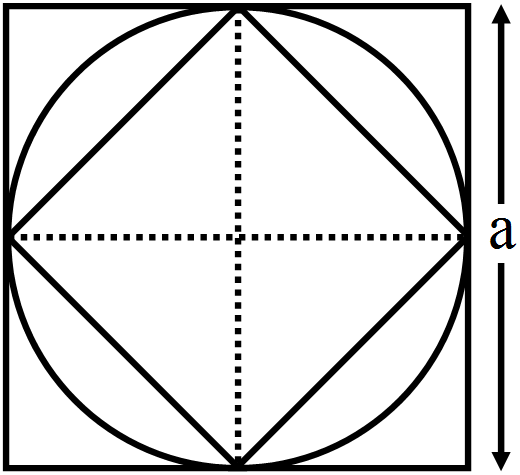
Then, area of bigger square sheet $a^2...(i)$
Now, we make the circle of maximum possible size from it.
Then, the radius of circle $=\frac{\text{a}}{2} \ ...(\text{ii})$
So, its diameter $(d) =2\times\frac{\text{a}}{2}=\text{a}$
Now any square in a circle of maximum size will have the length of diagonal equal to the diameter of circle.
i.e. diagonal of square made inside the circle $= a$
So, the side of this square $=\frac{\text{a}}{\sqrt{2}} [\because$ diagonal $=$ side $\sqrt{2}]$
$\therefore$ Area of this square $=\frac{\text{a}^2}{2} \ ...(\text{iii})$
From Eqs. $(i)$ and $(iii),$
Area of this square is $\frac{1}{2}$ of original square. View full question & answer→MCQ 121 Mark
The dimensions of a godown are $40m, 25m$ and $10m.$ If it is filled with cuboidal boxes each of dimensions $2m \times 1.25m \times 1m,$ then the number of boxes will be:
- A
$1800$
- B
$2000$
- ✓
$4000$
- D
$8000$
AnswerCorrect option: C. $4000$
Given, dimensions of a godown are $40m, 25m$ and $10m.$
Volume of godown $= 40 \times 25 \times 10$
$= 10000m^3$
Now, volume of each cuboidal box $= 2 \times 1.25 \times 1$
$= 2.5m^3$
$\therefore$ The number of boxes, that can be filed in the godown $=\frac{\text{Volume of godown}}{\text{Volume of each cuboidal box}}$
$=\frac{10000}{2.5}=4000$
View full question & answer→MCQ 131 Mark
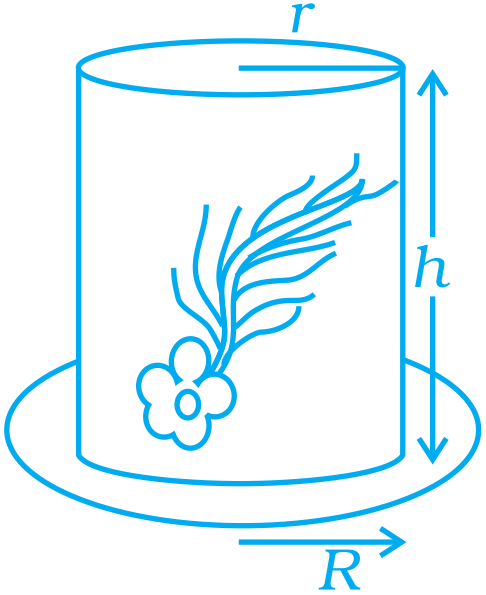
If $R$ is the radius of the base of the hat, then the total outer surface area of the hat is:
AnswerCorrect option: C. $2\pi\text{rh}+\pi\text{R}^2$
Given, a cylindrical hat with base radius $R$ and ris radius of the top surface.
Now, total surface area of hat $=$ Curved surface area $+$ Top surface area $+$ Base surface area
$=2\pi\text{rh}+\pi\text{r}^2+\pi(\text{R}^2-\text{r}^2)$
$=2\pi\text{rh}+\pi\text{r}^2+\pi\text{R}^2-\pi\text{r}^2$
$=2\pi\text{rt}+\pi\text{R}^2$
View full question & answer→MCQ 141 Mark
The volume of a cube whose edge is $3x$ is:
- ✓
$ 27 x^3 $
- B
$ 9 x^3 $
- C
$ 6 x^3 $
- D
$ 3 x^3 $
AnswerCorrect option: A. $ 27 x^3 $
We know that, the volume of a cube $= (Side)^3$
$= a^3$
$= (3x)^3 [\because a = 3x,$ given$]$
$= 27x^2$
View full question & answer→MCQ 151 Mark
What is the area of the largest triangle that can be fitted into a rectangle of length $l$ units and width $w$ units$?$
- ✓
$\frac{\text{lw}}{2}$
- B
$\frac{\text{lw}}{3}$
- C
$\frac{\text{lw}}{6}$
- D
$\frac{\text{lw}}{4}$
AnswerCorrect option: A. $\frac{\text{lw}}{2}$
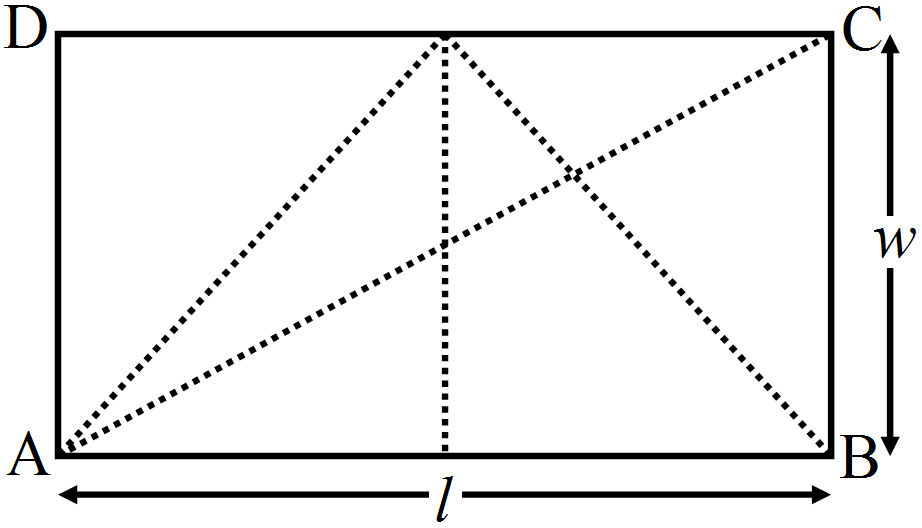
Let $ABCD$ be the rectangle of length $l$ and width $w.$
Now, we construct a triangle of maximum area inside it in all possible ways.
$\because$ We know that,
Area of triangle $=\frac{1}{2} ×$ Base $×$ Height
So, for maximum area, base and height of maxmum, length is nooded.
Hero, maximum base length $= l$
and maximum height $= w$
$\therefore$ Area (maximum) of triangle $=\frac{1}{2}\times\text{l}\times\text{w}=\frac{\text{l}\times\text{w}}{2}$ sq units. View full question & answer→MCQ 161 Mark
If the height of a cylinder becomes $\frac{1}4{}$ of the original height and the radius is doubled, then which of the following will be true?
AnswerCorrect option: C. Curved surface area of the cylinder will be halved.
Let the new height and radius be $\frac{\text{h}}{4}$ and 2r respectively, where r and h are original radius and original height respectively of the cyinder.
We know that, curved surface area of cylinder $=2\pi\text{rh}$
Then, curved surface of the new cylinder
$=2\pi(2\text{r})\times\frac{1}{4}\text{h}=4\pi\text{r}\times\frac{1}{4}\text{h}=\pi\text{rh}$
$=\frac{1}{2}\times2\pi\text{rh} [$multiplying and dividing by $2]$
$=\frac{1}{2}$ original curved surface area
Hence, the curved surface area of the cylinder will be halved.
View full question & answer→MCQ 171 Mark
Two cubes have volumes in the ratio $1 : 64.$ The ratio of the area of a face of first cube to that of the other is :
- A
$1 : 4$
- B
$1 : 8$
- ✓
$1 : 16$
- D
$1 : 32$
AnswerCorrect option: C. $1 : 16$
Let $a$ and $b$ be the edges of the two cubes, respectively.
Then, according to the question,
$\text{a}^3:\text{b}^3=1:64\ [\because$ volume of cube $= (\text{edge})^3]$
$\Rightarrow\frac{\text{a}^3}{\text{b}^2}=\frac{1}{64}$
$\Rightarrow\Big(\frac{\text{a}}{\text{b}}\Big)^3=\Big(\frac{1}{4}\Big)^3$
$\Rightarrow\frac{\text{a}}{\text{b}}=\frac{1}{4} \ [$taking cube roots on both sides$]$
Now, ratio of areas, $\Big(\frac{\text{a}}{\text{b}}\Big)^2=\Big(\frac{1}{4}\Big)^2\ [\because$ surface area of cube $= 6 \times (\text{edge})^2]$
$\Rightarrow\frac{\text{a}^2}{\text{b}^2}=\frac{1}{16}$
$\therefore\text{a}^2:\text{b}^2=1:16$
View full question & answer→MCQ 181 Mark
A cube of side $5\ cm$ is painted on all its faces. If it is sliced into $1$ cubic centimetre cubes, how many $1$ cubic centimetre cubes will have exactly one of their faces painted$?$
AnswerGiven, a cube of side $5\ cm$ is painted on all its faces and is sliced into $1\ cm^3$ cubes.
Then, from figure, it is clear that there are $9$ cubes available on face.
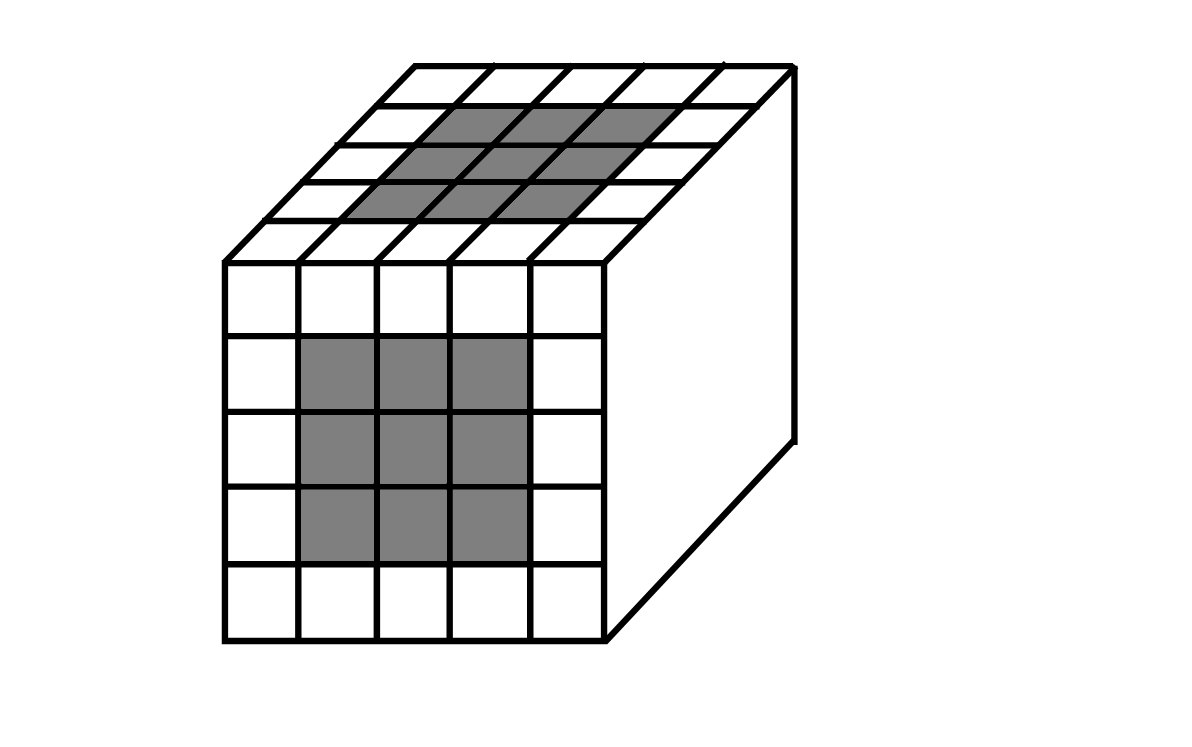
Since, there are six faces available.
Hence, total number of smaller cubes $= 6 \times 9 $
$= 54$ View full question & answer→MCQ 191 Mark
If the height of a cylinder becomes $\frac{1}{4}$ of the original height and the radius is doubled, then which of the following will be true?
AnswerCorrect option: B. Volume of the cylinder will remain unchanged.
We know that, the volume of a cylinder having base radius r and height h is $\text{V}=\pi\text{r}^2\text{h}$
Now, If new height is $\frac{1}{4}$ th of the original helight and the redius is doubled, i.e.
$\text{h}'=\frac{1}{4}\text{h}$ and $\text{r}'=2\text{r},$ then
New volume, $\text{V}'=\pi(2\text{r})^2\times\frac{1}{4}\text{h}=4\pi\text{r}^2\times\frac{1}{4}\text{h}$
$=\pi\text{r}^2\text{h = V}$
Hence, the new volume of cylinder is same as the original volume.
View full question & answer→MCQ 201 Mark
Three cubes of metal whose edges are $6\ cm, 8\ cm$ and $10\ cm$ respectively are melted to form a single cube. The edge of the new cube is:
- ✓
$12\ cm$
- B
$24\ cm$
- C
$18\ cm$
- D
$20\ cm$
AnswerCorrect option: A. $12\ cm$
The edges of three cubes are $6\ cm, 8\ cm$ and $10\ cm,$ respectively.
$\therefore$ Sum of volumes of the three metal cubes
$ =6^3+8^3+10^3\left[\because \text { volume of cube }=(\text { edge })^3\right] $
$ =216+512+1000 $
$ =1728 \mathrm{~cm}^3 $
Since, a new cube is formed by melting these three cubes.
Let a be the side of new cube. Then,
Volume of the new cube $=$ Sum of volumes of three metal cubes
$\Rightarrow a^3= 1728$
$\therefore a = 12\ cm$
Hence, the edge of the new cube is $12\ cm.$
View full question & answer→MCQ 211 Mark
The volume of a cylinder whose radius $r$ is equal to its height is:
AnswerCorrect option: C. $\pi\text{r}^3$
Given, $r = h$
Then, volume of cylinder $=\pi\text{r}^2\text{h}=\pi\text{r}^2\text{r}=\pi\text{r}^3$
View full question & answer→MCQ 221 Mark
If the radius of a cylinder is tripled but its curved surface area is unchanged, then its height will be:
AnswerLet h' be the new height.
Curved surface area of a cylinder with radius r and height h
$=2\pi\text{rh}$
Now, according to the question, radius is tripled. Then,
Curved surface area $=2\pi\times3\text{r}\times\text{h}'=2\pi\text{rh}$
$\Rightarrow6\pi\text{r}\times\text{h}'=2\pi\text{h}$
$\Rightarrow\text{h}'=\frac{2\pi\text{rh}}{6\pi\text{r}}$
$\therefore\text{h}'=\frac{1}{3}\text{h}$
Hence, the new height will be $\frac{1}{3}$ of the original height.
View full question & answer→MCQ 231 Mark
The ratio of radii of two cylinders is $1 : 2$ and heights are in the ratio $2 : 3.$ The ratio of their volumes is:
- ✓
$1 : 6$
- B
$1 : 9$
- C
$1 : 3$
- D
$2 : 9$
AnswerCorrect option: A. $1 : 6$
Let $r_1, r_2$ be radii of two cylinders and $h_1, h_2$ be their heights.
Then, $\frac{\text{r}_1}{\text{r}_2}=\frac{1}{2}$ and $\frac{\text{h}_1}{\text{h}_2}=\frac{2}{3}$
Now, $\frac{\text{V}1}{\text{V}_2}=\frac{\pi\text{r}^1_2\text{h}_1}{\pi\text{r}^2_2\text{h}_2}=\Big(\frac{\text{r}_1}{\text{r}_2}\Big)^2\times\frac{\text{h}_1}{\text{h}_2}=\Big(\frac{1}{2}\Big)^2\times\frac{2}{3}$
$=\frac{1}{4}\times\frac{2}{3}=\frac{1}{6}=1:6$
Hence,$ V_1 : V_2= 1 : 6$
View full question & answer→MCQ 241 Mark
A metal sheet $27\ cm$ long, $8\ cm$ broad and $1\ cm$ thick is melted into a cube. The side of the cube is:
- ✓
$6\ cm$
- B
$8\ cm$
- C
$12\ cm$
- D
$24\ cm$
AnswerCorrect option: A. $6\ cm$
Given, a metal sheet $27\ cm$ long, $8\ cm$ bread and $1\ cm$ thick.
Then, volume of the sheet $($cubiodal$) = 1 \times b \times h$
$= 27 \times 8 \times 1 = 216\ cm^3$
Now, since this sheet is melted to form a cube of edge length a $($say$)$.
Then, volume of the cube $=$ Volume of the metal sheet
$\Rightarrow a^3= 216\ cm^2$
$\Rightarrow a = 6\ cm$
Hence, the side of the cube is $6\ cm$
View full question & answer→MCQ 251 Mark
The volume of a cube is $64\ cm^3$. Its surface area is:
- A
$ 16 \mathrm{~cm}^2 $
- B
$ 64 \mathrm{~cm}^2 $
- ✓
$ 96 \mathrm{~cm}^2 $
- D
$ 128 \mathrm{~cm}^2 $
AnswerCorrect option: C. $ 96 \mathrm{~cm}^2 $
Let the side of the cube be a. Then,
Volume of cube $= a^3- 64 [$given$]$
$\Rightarrow a = 4$
Now, surface area of the cube $= a^2= 6 \times 4^2= 96\ cm^2$.
View full question & answer→MCQ 261 Mark
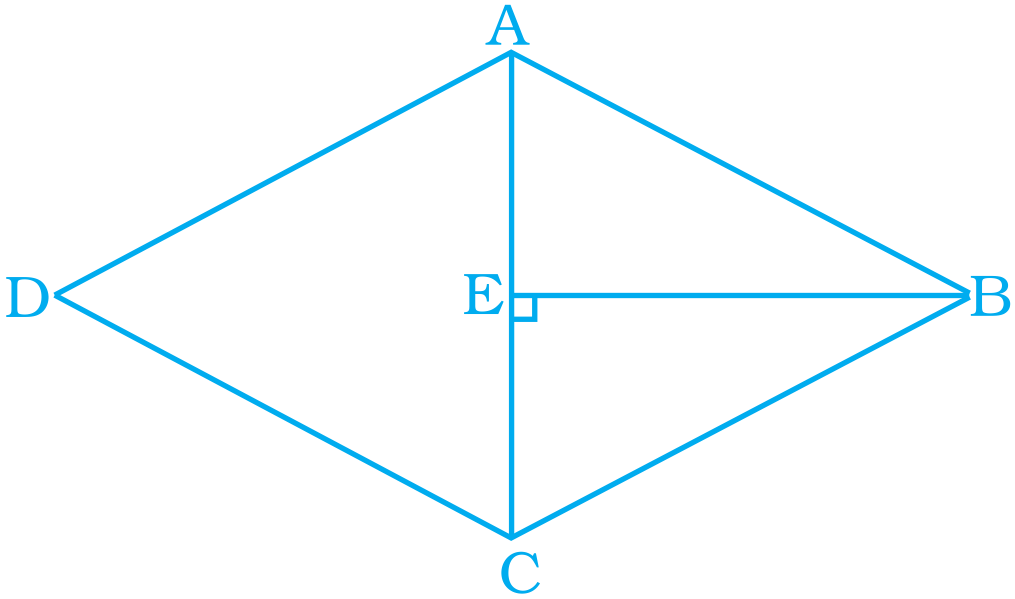
What is the area of the rhombus $ABCD$ below if $AC = 6\ cm,$ and $BE = 4\ cm?$
- A
$ 36 \mathrm{~cm}^2 $
- B
$ 16 \mathrm{~cm}^2 $
- ✓
$ 24 \mathrm{~cm}^2 $
- D
$ 13 \mathrm{~cm}^2 $
AnswerCorrect option: C. $ 24 \mathrm{~cm}^2 $
The diagonal $AC$ of the rhombus $ABCD$ divides it into two triangles of equal areas.
Now, area of $\triangle\text{ABC}=\frac{1}{2} \times$ Base $\times$ Height $=\frac{1}2{}\times 4 \times 6 = 12\ cm^2$
$\therefore$ Area of the rhombus $ABCD = 2 \times $ Area of $\triangle\text{ABC}$
$= 2 \times 12 = 24\ cm^2$
View full question & answer→MCQ 271 Mark
cube of side $4\ cm$ is cut into $1\ cm$ cubes. What is the ratio of the surface areas of the original cubes and cut-out cubes$?$
- A
$1 : 2$
- B
$1 : 3$
- ✓
$1 : 4$
- D
$1 : 6$
AnswerCorrect option: C. $1 : 4$
Volume of the original cube having side of length $4cm = (4)^3- 64cm^3$ [$\because$ volume of cube with side $a = a^3$]
Volume of the cut-out cubes with side of length $1cm = 1cm^3$
$\therefore$ Number of cut-out cubes $=\frac{\text{Volume of the original cube}}{\text{Volume of a smaller cube}}$
$=\frac{64}{1}=64$
Now, surface area of cut-out cubes $= 64 × 6 × (1)^2cm^2$ [$\because$ surface area of cube with side $a = 6a^2$]
and surface area of the original cute $= 6 × 4^2cm^2$
$\therefore$ The required ratio of surface areas of the original cube and cut$-$out cubes $=\frac{6\times4^2}{64\times6}=1:4$
View full question & answer→MCQ 281 Mark
How many small cubes with edge of $20\ cm$ each can be just accommodated in a cubical box of $2m$ edge$?$
- A
$10$
- B
$100$
- ✓
$1000$
- D
$10000$
AnswerCorrect option: C. $1000$
$ \text { Volume of cube }=(\text { Side })^3$
$ \text { Volume of each small cube }=20^3=8000 \mathrm{~cm}^3$
$=0.008 \mathrm{~m}^3$
Now, volume of the cubical box $=2^3=8 \mathrm{~m}^3$
$\therefore$ Number of small cubes, that can just be accommodated in the cubical box $=\frac{\text{Volume of cubical box}}{\text{Volume of small cube}}$
$=\frac{8}{0.008}$
$=1000$
View full question & answer→