Questions

M.C.Q. [1 Marks Each]

Take a timed test

20 questions · auto-graded multiple-choice test.

MCQ 11 Mark
The lengths of the diagonals of a rhombus are $16\ cm$ and $12\ cm.$ The length of each side of the rhombus is:
  • A
    $8\ cm$
  • B
    $9\ cm$
  • $10\ cm$
  • D
    $12\ cm$
Answer
Correct option: C.
$10\ cm$
$\text{AO}=\frac{1}{2}\text{AC}=\Big(\frac{1}{2}\times16\Big)=8\text{cm}$
$\text{BO}=\frac{1}{2}\text{BD}=\Big(\frac{1}{2}\times12\Big)=6\text{cm}$
From the right $\triangle\text{AOB},$ we have,
$\therefore\text{AB}^2=\text{AO}^2+\text{BO}^2$
$\Rightarrow\text{AB}^2=\big\{(8)^2+(6)^2\big\}\text{cm}^2$
$\Rightarrow\text{AB}=\sqrt{100}=10\text{cm}$
View full question & answer
MCQ 21 Mark
The two diagonals are not necessarily equal in a:
  • A
    Rectangle.
  • B
    Square.
  • Rhombus.
  • D
    Isosceles trapezium.
Answer
Correct option: C.
Rhombus.
All sides of Rhombus are equal in length but in case of angle it is not necessary to be equal.
If all the angles are equal then it will become a square. That’s why diagonals of rhombus are not necessary to be equal in length.
View full question & answer
MCQ 31 Mark
If an angle of a parallelogram is two-thirds of its adjacent angle, the smallest angle of the parallelogram is:
  • A
    $54^\circ$
  • $72^\circ$
  • C
    $81^\circ$
  • D
    $108^\circ$
Answer
Correct option: B.
$72^\circ$
Let the measure of the angle be $x^\circ .$
$\therefore\text{x}+\Big(\frac{2}{3}\times\text{x}\Big)=180$
$\Rightarrow\frac{3\text{x}+2\text{x}}{3}=180$
$\Rightarrow5\text{x}=3\times180$
$\Rightarrow\text{x}=\frac{3\times180}{5}=180$
Hence the anlge is $180^\circ .$
Its adjacent $= (180 - 108^\circ ) = 72^\circ .$
Therefore, the smallest angle is $72^\circ .$
View full question & answer
MCQ 41 Mark
The length and breadth of a rectangle are in the ratio $4 : 3.$ If the diagonal measures $25\ cm$ then the perimeter of the rectangle is:
  • A
    $56\ cm$
  • B
    $60\  cm$
  • $70\ cm$
  • D
    $80\ cm$
Answer
Correct option: C.
$70\ cm$
$70\ cm$
View full question & answer
MCQ 51 Mark
Two adjacent angles of a parallelogram are $(2x + 25)^\circ $ and $(3x - 5)^\circ $. The value of $x$ is:
  • A
    $28$
  • $32$
  • C
    $36$
  • D
    $42$
Answer
Correct option: B.
$32$
$\therefore (2x + 25) + (3x - 5) = 180$
$⇒ 2x + 25 + 3x - 5 = 180$
$⇒ 5x = 180 - 20$
$⇒ 5x = 160$
$⇒ x = 32$
View full question & answer
MCQ 61 Mark
The diagonals do not necessarily bisect the interior angles at the vertices in a:
  • Rectangle.
  • B
    Square.
  • C
    Rhombus.
  • D
    All of these.
Answer
Correct option: A.
Rectangle.
In rectangle, only opposite sides are equal which makes diagonals are not to be perpendicular to each other. As diagonals are not perpendicular to each other, they will not bisect the interior angles.
View full question & answer
MCQ 71 Mark
The bisectors of any two adjacent angles of a parallelogram intersect at:
  • A
    $30^\circ$
  • B
    $45^\circ$
  • C
    $60^\circ$
  • $90^\circ$
Answer
Correct option: D.
$90^\circ$
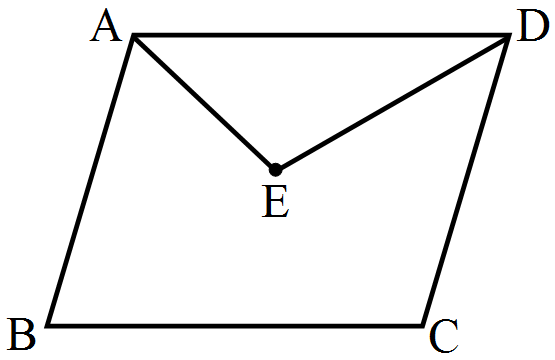
Let $ABCD$ is a parallelogram.

$AE$ and $AD$ is the bisector angles of adjacent angles of $\angle\text{A}$ and $\angle\text{D}.$
As we know that,
$\angle\text{A}+\angle\text{D}=180^\circ( $Sum of interior angles on the same side of traversal is $180^\circ )$
$\frac{1}{2}\angle\text{A}+\frac{1}{2}\angle\text{D}=\frac{1}{2}\times180^\circ$
$=90^\circ\ ...(\text{i})$
Now, in triangle $AOD,$
$\angle\text{AED}+\frac{1}{2}\angle\text{A}+\frac{1}{2}\angle\text{D}=180^\circ$
$(AE$ and $AD$ is the angle bisector of $\angle\text{A}$ and $\angle\text{D}).$
$\angle\text{AED}+90^\circ=180^\circ ($From eq $(i))$
$\angle\text{AED}=180^\circ-90^\circ=90^\circ$
So, the bisectors of any two adjacent angles of a parallelogram intersect at $90^\circ .$
View full question & answer
MCQ 81 Mark
The diagonals do not necessarily intersect at right angles in a:
  • Parallelogram.
  • B
    Rectangle.
  • C
    Rhombus.
  • D
    Kite.
Answer
Correct option: A.
Parallelogram.
The diagonals do not necessarily intersect at right angles in a parallelogram. Only opposite sides, opposite angles are equal and diagonal bisects each other in parallelogram. If diagonals intersect each other at right angle then it would be square or rhombus.
View full question & answer
MCQ 91 Mark
If one angle of a parallelogram is $24^\circ $ less than twice the smallest angle then the largest angle of the parallelogram is:
  • A
    $68^\circ $
  • B
    $102^\circ$
  • $112^\circ$
  • D
    $176^\circ$
Answer
Correct option: C.
$112^\circ$
Let the measure of smallest anlge be $x^\circ $ and other is $(2x - 24)^\circ .$
$\therefore x + (2x - 24) = 180$
$\Rightarrow x + 2x = 180 + 24$
$\Rightarrow 3x = 204$
$\Rightarrow x = 68$
Hence, the samllest angle is $68^\circ .$
Ite adjacent is $= (180 - 68)^\circ = 112^\circ .$
Therefore, the largest angle is $112^\circ .$
View full question & answer
MCQ 101 Mark
In a square $ABCD, AB = (2x + 3)cm$ and $BC = (3x - 5)cm.$ Then, the value of $x$ is:
  • A
    $4$
  • B
    $5$
  • C
    $6$
  • $8$
Answer
Correct option: D.
$8$
We know, all sides are equal of a square. Then,
$\therefore$ $AB = BC$
$⇒ 2x + 3 = 3x - 5$
$⇒ 3x - 2x = 3 + 5$
$⇒ x = 8$
View full question & answer
MCQ 111 Mark
If one angle of a parallelogram is 24 deg less than twice the smallest angle then the largest angle of the parallelogram is
  • A
    $68^{\circ}$
  • B
    $102^{\circ}$
  • $112^{\circ}$
  • D
    $176^{\circ}$
Answer
Correct option: C.
$112^{\circ}$
C
View full question & answer
MCQ 121 Mark
In a square $ABCD, AB=(2 x+3) cm$ and $BC=(3 x-5) cm$. Then, the value of $x$ is
  • A
    4
  • B
    5
  • C
    6
  • 8
Answer
Correct option: D.
8
D
View full question & answer
MCQ 131 Mark
The diagonals do not necessarily bisect the interior angles at the vertices in a
  • rectangle
  • B
    square
  • C
    rhombus
  • D
    all of these
Answer
Correct option: A.
rectangle
A
View full question & answer
MCQ 141 Mark
If an angle of a parallelogram is two-thirds of its adjacent angle, the smallest angle of the parallelogram is
  • A
    $54^{\circ}$
  • $72^{\circ}$
  • C
    $81^{\circ}$
  • D
    $108^{\circ}$
Answer
Correct option: B.
$72^{\circ}$
B
View full question & answer
MCQ 151 Mark
The bisectors of any two adjacent angles of a parallelogram intersect at
  • A
    $30^{\circ}$
  • B
    $45^{\circ}$
  • C
    $60^{\circ}$
  • $90^{\circ}$
Answer
Correct option: D.
$90^{\circ}$
D
View full question & answer
MCQ 161 Mark
The length and breadth of a rectangle are in the ratio 4 : 3. If the diagonal measures 25 cm then the perimeter of the rectangle is
  • A
    56 cm
  • B
    60 cm
  • 70 cm
  • D
    80 cm
Answer
Correct option: C.
70 cm
C
View full question & answer
MCQ 171 Mark
The diagonals do not necessarily intersect at right angles in a
  • parallelogram
  • B
    rectangle
  • C
    rhombus
  • D
    kite
Answer
Correct option: A.
parallelogram
A
View full question & answer
MCQ 181 Mark
Two adjacent angles of a parallelogram are $(2 x+25)^{\circ}$ and $(3 x-5)^{\circ}$. Yhe value of x is
  • A
    28
  • 32
  • C
    36
  • D
    42
Answer
Correct option: B.
32
B
View full question & answer
MCQ 191 Mark
The lengths of the diagonals of a rhombus are 16 cm and 12 cm. The length of each side of the rhombus is
  • A
    8 cm
  • B
    9 cm
  • 10 cm
  • D
    12 cm
Answer
Correct option: C.
10 cm
C
View full question & answer
MCQ 201 Mark
The two diagonals are not necessarily equal in a
  • A
    rectangle
  • B
    square
  • rhombus
  • D
    isosceles trapezium
Answer
Correct option: C.
rhombus
C
View full question & answer