Question 13 Marks
Find all possible values of $x$ for which the $4-$digit number $320x$ is divisible by $3.$ Also, find the numbers.
AnswerIf a number is divisible by $3 ,$ then the sum of the digits is also divisible by $3 .$
$5+x^3+2+0+x=5+x$ must be divisible by $3.$
This is possible in the following cases:
$x=1$
$therefore 5+x=6$
Thus, the number is $3201 .$
$x=4$
$\therefore 5+x=9$
Thus, the number is $3204 .$
$x=7$
$\therefore 5+x=12$
Thus, the number is $3207 .$
View full question & answer→Question 23 Marks
Find the values of $A, B, C$ when
Answer
Now $\text{B}\neq\text{A}=1$ and $(1+\text{B}^2)$
$\therefore\text{B}=2$
$\text{C}=(1+\text{B}^2)=(1+4)=5$
$\therefore\text{A}=1,\text{B}=2\text{ and }\text{C}=5$
View full question & answer→Question 33 Marks
In a two-digit number, the digit at the units place is double the digit in the tens place. The number exceeds the sum of its digits by $18.$ Find the number.
AnswerLet the tens digit be $x.$ The units place digit $= 2x.$
$\therefore$ Number $= 10x + 2x$
$\therefore (x + 2x) + 18 = (10x + 2x)$
$\Rightarrow 3x + 18 = 12x$
$\Rightarrow 12x = 3x + 18$
$\Rightarrow 12x - 3x + 18$
$\Rightarrow 9x = 18$
$\Rightarrow x = 2$
Therefore, the number $\{(10 \times 2) + (2 \times 2)\} = 24$
View full question & answer→Question 43 Marks
Replace $A, B, C$ by suitable numerals. $ \ \ \ \ \ \ \text{AB}\\\underline{ \ \ \ \times \ 3}\\\underline{ \ \ \text{CAB}}$
Answer$(B \times 3) = B$ Then, $B$ can either be $0$ or $5.$ If $B$ is $5$,
then $1$ will be carried.
Then $A \times 3 + 1 = A$ will not be possible for any number.
$\therefore B = 0$
$A \times 3 = A$ is possible for either $0$ or $5.$
If we take $A = 0,$ then all number will become $0.$
however this not a possible.
$\therefore A = 5$
Then, $1$ will be carried.
$\therefore C = 1$
$\therefore A = 5, B = 0$ and $C = 1$
View full question & answer→Question 53 Marks
Give five examples of numbers, each one of which is divisible by $3$ but not divisible by $9.$
AnswerLet the number $21,$ Sum of the digits is $2 + 1 = 3,$
Which is divisible by $3$ but not by $9.$
Let the number $24,$ sum of digits $2 + 4 = 6.$
Which is divisible by $3$ but not by $9.$
Let The number $30,$ sum of digits $3 + 0 = 3$
Which is divisible by $3$ but not by $9.$
Let the number $33,$ sum of digits $3 + 3 = 6,$
Which is divisible by $3$ not by $9.$
Let The number $39,$ sum of digits $3 + 9 = 12,$
Which is divisible by $3$ not by $9.$
View full question & answer→Question 63 Marks
The units digit of a two-digit number is $3$ and seven time the sum of the digits is the number itself. Find the number.
AnswerLet the digit be $x.$
Then the units place digit $= 3$
$\therefore$ Number $= (10x + 3)$
$\therefore 7(x + 3) = (10x + 3)$
$\Rightarrow 7x + 21 = 10x + 3$
$\Rightarrow 10x + 3 = 7x + 21$
$\Rightarrow 10x - 7x = 21 - 3$
$\Rightarrow 3x = 18$
$\Rightarrow x = 6$
Therefore the number is $\{(10 \times 6) + 3\} = 63.$
View full question & answer→Question 73 Marks
Replace $A, B, C$ by suitable numerals. $ \ \ \ \text{C B 5}\\-\underline{2 \ 8\text{ A}}\\ \ \ \ \ \underline{2 \ 5 \ 9 \ }$
Answer$5 - A = 9$ This implies That $1$ borrowed.
We know, $15 - 6 = 9$
$\Rightarrow A = 6$
$B - 5 = 8$ But $1$ has also been lent.
$\therefore B = 4$
$C - 2 = 2$
This implies that $1$ has been lent
$\therefore C = 5$
$\therefore A = 6, B = 4$ and $C = 5.$
View full question & answer→Question 83 Marks
Complete the magic square given below, so that the sum of the numbers in each row or in each column or along each diagonal is $15.$
Answer$6 + 5 + x = 15$
$\Rightarrow x = 4$
Now taking the first over: $6 + 1 + x = 15$
$\Rightarrow x = 15 - 7 = 8$
Taking last colunm: $8 + x + 4 = 15$
$\Rightarrow x = 15 - 12 = 3$
Taking second colunm: $1 + 5 + x = 15 $
$\Rightarrow x = 15 - 6 = 9$
Taking second Row: $x + 5 + 3 = 15$
$\Rightarrow x = 15 - 8 = 7$
Taking diagonal that begins with $8: 8 + 5 + x = 15$
$\Rightarrow x = 2$
| $6$ |
$1$ |
$8$ |
| $7$ |
$5$ |
$3$ |
| $2$ |
$9$ |
$4$ |
View full question & answer→Question 93 Marks
In a $3-$digit number, the tens digit is thrice the units digit and the hundreds digit is four times the units digit. Also, the sum of its digits is $16.$ Find the number.
AnswerLet the unit place digit be $x$.
Then, the tens place digit $= 3x$ and the hundred place digit $= 4x.$
$\therefore 4x + 3x + x = 16$
$\Rightarrow 8x = 16$
$\Rightarrow x =2$
Therefore, Units place digit $= 2.$
The Tens place digit $= (3 \times 2) = 6.$
The Hundreds place digit $= (4 \times 2) = 8$
Therefore, the number is $862.$
View full question & answer→Question 103 Marks
Replace $A, B, C$ by suitable numerals: $ \ \ \ 5 \ \ 7 \ \ \text{A}\\\underline{-\text{C} \ \text{B} \ \ 8}\\\underline{ \ \ \ 2 \ \ 9 \ \ \ 3 \ \ }$
Answer$A - 8 = 3$ This implies that $1$ is borrowed. $11 - 8 = 3$
$\Rightarrow A = 1$ Then,$ 7 - B = 9$ 1 is borrowed from $7.$
$\therefore 16 - B = 9$
$\Rightarrow B = 7$
Further, $5 - C = 2$ But $1$ has been borrowed from $5.$
$\therefore 4 - C = 2$
$\Rightarrow C = 2$
$\therefore A = 1, B = 7$ and $C = 2$
View full question & answer→Question 113 Marks
Replace $A, B, C$ by suitable numerals. $\ \ \ \ \ 6\text{ A}\\\underline{-\text{A B}}\\\underline{\ \ \ \ 3\ \ 7\ }$
Answer$6 - \text{A} = 3$
This implies That the maximum value of $A$ can be $3.$
$\text{A}\leq3\dots(1)$ The next column has the following:
$\text{A}-\text{B}=7$
To reconcile this with equation $(1),$
borrowing is involved We know: $12 - 5 = 7 $
$\therefore\text{A}=2$ and $\text{B}=5$
View full question & answer→Question 123 Marks
Fibonacci numbers Take $10$ numbers as shown below:
$a, b, (a + b), (a + 2b), (2a + 3b), (3a + 5b), (5a + 8b), (8a + 13b), (13a + 21b),$ and $(21a + 34b)$. Sum of all these numbers $= 11(5a + 8b) = 11 × 7th$ number.
Taking $a = 8, b = 13.,$
Write $10$ Fibonacci numbers and verify that sum of all these numbers $= 11 × 7th$ number
Hint. $I, II, (I + II), (III + II), (IV + III), [V + IV), $and so on
Answer$a = 8$ and $b = 13$
The numbers are $8, 13, 21, 34, 55, 89, 144, 233, 377$ and $610.$
Sum of the numbers $= 8 + 13 + 21 + 34 + 55 + 89 + 144 + 233 + 377 + 610 = 1584$
$11 \times 7th$ number $= 11 \times 144 = 1584$
View full question & answer→Question 133 Marks
Fill in the numbers from $1$ to $6$ without repetiflon, so that each side of the triangle adds up to $12$ 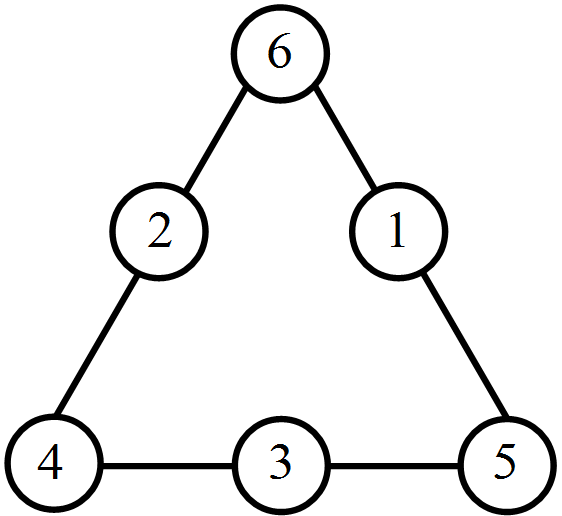
Answer$6 + 2 + 4$
$= 12 4 + 3 + 5$
$= 12 6 + 1 + 5 = 1$
View full question & answer→Question 143 Marks
Complete the magic square:
| |
$14$ |
|
$0$ |
| $8$ |
|
$6$ |
$11$ |
| $4$ |
|
|
$7$ |
| |
$2$ |
$1$ |
$12$ |
AnswerThe magic square is completed assuming that the sum of the row, columns and diagonals is $30$. This is because the sum of all the number of the last column is $30.$
| $3$ |
$14$ |
$13$ |
$0$ |
| $8$ |
$5$ |
$6$ |
$11$ |
| $4$ |
$9$ |
$10$ |
$7$ |
| $15$ |
$2$ |
$1$ |
$12$ |
View full question & answer→Question 153 Marks
The difference between a $2-$digit number and the number obtained by interchanging its digits is $63.$ What is the difference between the digits of the number$?$
AnswerLet the tens and unit digits of the number be $a$ and $b$ respectively.
Then, $\therefore$ Number $= (10a + b)$
$(10a + b) - (10b + a) = 63$
$\Rightarrow 10a - b - 10b - a = 63$
$\Rightarrow 9a - 9b = 63$
$\Rightarrow 9(a - b) = 63$
$\Rightarrow a - b = 7$
Therefore, the diffrerent between the digits is $7.$
View full question & answer→