Questions

5 Marks Questions

Take a timed test

3 questions · self-marked practice — reveal the answer and mark yourself.

Question 15 Marks
Prove that the sum of the angles of a quadrilateral is $360^\circ .$
Answer
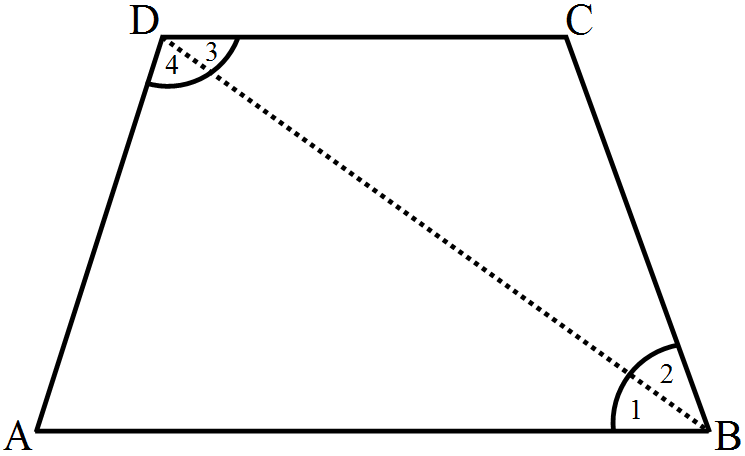
Given: $ABCD$ is a quadrilateral,

To prove: $\angle\text{A}+\angle\text{B}+\angle\text{C}+\angle\text{D}=360^\circ$
Construction: Join $BD$ Proof: $\triangle\text{ABD},$
$\angle\text{A}+\angle1+\angle4+\angle3=180^\circ$ Adding we get,
​​​​​​​ $\angle\text{A}+\angle1+\angle4+\angle\text{2}+\angle\text{C}+\angle3$
$=180^\circ+180^\circ$
$\Rightarrow\angle\text{A}+\angle1+\angle2+\angle\text{C}+\angle3+\angle4=360^\circ$
$\Rightarrow\angle\text{A}+\angle\text{B}+\angle\text{C}+\angle\text{D}=360^\circ$ Hence proved.
View full question & answer
Question 25 Marks
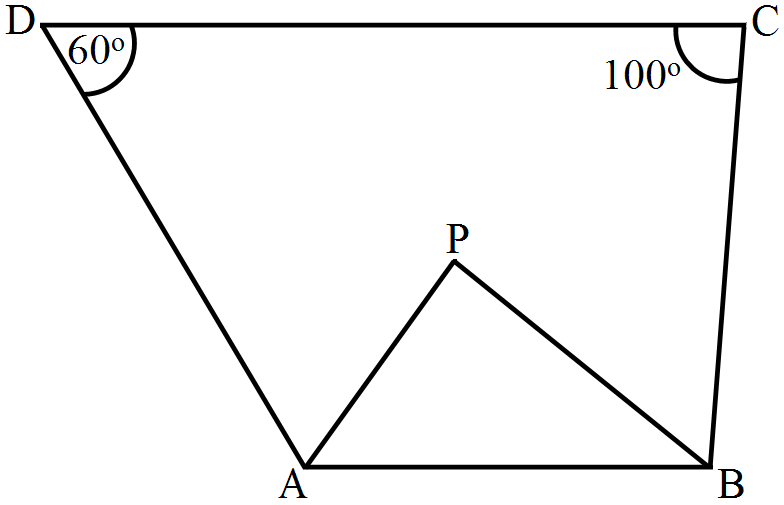
In the adjacent figure, the bisectors of $\angle\text{A}$ and $\angle\text{B}$ meet in a point $P.$ If $\angle\text{C}=100^\circ$ and $\angle\text{D}=60^\circ$ find the measure of $\angle\text{APB}.$
Answer
In quadrilateral $ABCD$, $\angle\text{C}=100^\circ,\angle\text{D}=60^\circ$ And $\angle\text{A}+\angle\text{B}+\angle\text{C}+\angle\text{D}=360^\circ$ (Sum of angles of a quadrilateral)
$\therefore\angle\text{A}+\angle\text{B}=360^\circ-(100^\circ+60^\circ)$
$=360^\circ-160^\circ=200^\circ$
But $AP$ and $BP$ are the bisectors of $\angle\text{A}$ and $\angle\text{B},$
$\therefore\frac{1}{2}-(\angle\text{A}+\angle\text{B})=200^\circ\times\frac{1}{2}=100^\circ$
i.e. $\angle1+\angle2=100^\circ$ But in $\triangle\text{APB},$
$\angle1+\angle2+\angle\text{P}=180^\circ$
$\Rightarrow100^\circ+\angle\text{P}=180^\circ$
$\Rightarrow\angle\text{P}=180^\circ-100^\circ=80^\circ$ Or $\angle\text{APB}=80^\circ$
View full question & answer
Question 35 Marks
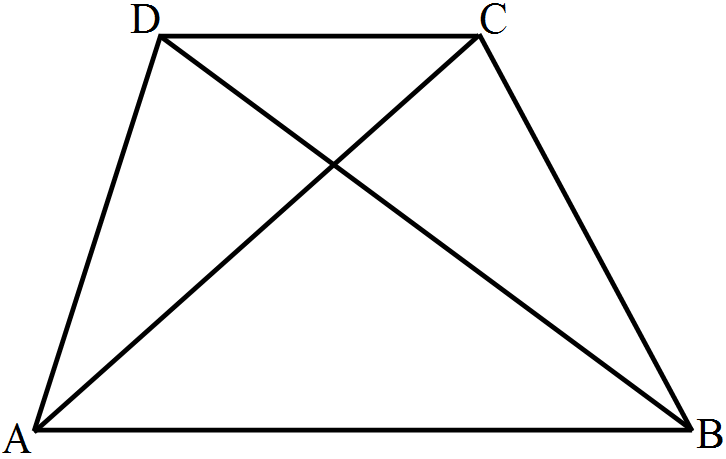
In the adjoining figure, $\text{ABCD}$ is a quadrilateral.

$i.$ How many pairs of adjacent sides are there? Name them.
$ii.$ How many pairs of opposite sides are there? Name them.
$iii.$ How many pairs of adjacent angles are there? Name them.
$iv.$ How many pairs of opposite angles are there? Name them.
$v.$ How many diagonals are there? Name them.
Answer
$i.$ There are four pairs of adjacent sides, which are $\text{(AB, BC), (BC, CD), (CD, DA)}$ and $\text{(DA, AB).}$
$ii.$ There are two pairs of opposite sides, which are $\text{(AB, DC)} $ and $\text{(AD, BC)}.$
$iii.$ There are four pairs of adjacent angles, which are $(\angle\text{A},\angle\text{B}),(\angle\text{B},\angle\text{C}),(\angle\text{C},\angle\text{D})$ and $(\angle\text{D},\angle\text{A}).$
$iv.$ There are two pairs of opposite angles, which are $(\angle\text{A},\angle\text{C})$ and $(\angle\text{B},\angle\text{D}).$
$v.$ There are two diagonals, namely $\text{AC}$ and $\text{BD}.$
View full question & answer