Questions

5 Marks Questions

Take a timed test

7 questions · self-marked practice — reveal the answer and mark yourself.

Question 15 Marks
The table given below shows the distances, in kilometres, between four villages of a state. To find the distance between two villages, locate the square where the row for one village and the column for the other village intersect.
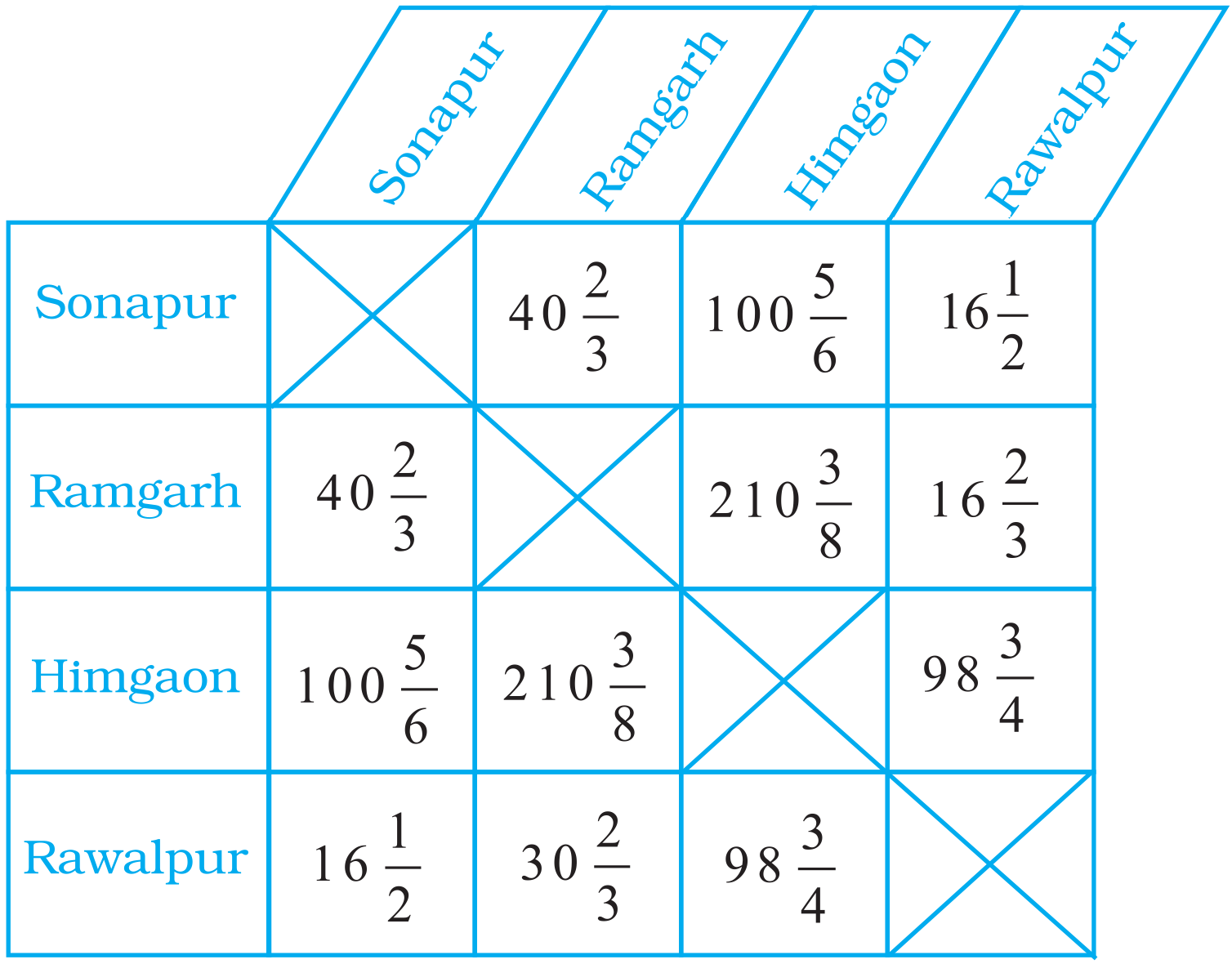
$a.$ Compare the distance between Himgaon and Rawalpur to Sonapur and Ramgarh?
$b.$ If you drove from Himgaon to Sonapur and then from Sonapur to Rawalpur, how far would you drive?
Answer
$a.$ The distance between Himgaon and Rawalpur $=98\frac{3}{4}\text{km}$
And the distance between Sonaput and Ramgarh $=40\frac{2}{3}\text{km}$
Difference of the distance between Himgaon and Rawalpur to Sonapur and Ramgarh,
$=\Big(98\frac{3}{4}-40\frac{2}{3}\Big)$
$=\Big(\frac{395}{4}-\frac{122}{3}\Big)$
$=\Big(\frac{1185-488}{12}\Big)$
$=\frac{697}{12}$
$=58\frac{1}{12}\text{km}.$
$b.$ Distanc betwee Himgaon and Sonapur $=100\frac{5}{6}\text{km}$
And distance between Sonapur and Rawalpur $=16\frac{1}{2}\text{km}$
Total distance that he would drive, $=100\frac{5}{6}+16\frac{1}{2}$
$=\frac{605}{6}+\frac{33}{2}$
$=\frac{605+99}{6}$
$=\frac{704}{6}$
$=\frac{352}{3}$
$=117\frac{1}{3}\text{km}.$
View full question & answer
Question 25 Marks

The average life expectancies of males for several states are shown in the table. Express each decimal in the form $\frac{\text{p}}{\text{q}}$ and arrange the states from the least to the greatest male life expectancy.State-wise data are included below; more indicators can be found in the $“FACTFILE”$ section on the homepage for each state.
State
Male
$\frac{\text{p}}{\text{q}}$ form
Lowest terms
Andhra Pradesh
$61.6$
 
 
Assam
$57.1$
 
 
Bihar
$60.7$
 
 
Gujarat
$61.9$
 
 
Haryana
$64.1$
 
 
Himachal Pradesh
$65.1$
 
 
Karnataka
$62.4$
 
 
Kerala
$70.6$
 
 
Madhya Pradesh
$56.5$
 
 
Maharashtra
$64.5$
 
 
Orissa
$57.6$
 
 
Punjab
$66.9$
 
 
Rajasthan
$59.8$
 
 
Tamil Nadu
$63.7$
 
 
Uttar Pradesh
$58.9$
 
 
West Bengal
$62.8$
 
 
India
$60.8$
 
 
Source: Registrar General of India $(2003)$ $SRS$ Based Abridged Lefe Tables. $SRS$ Analytical Studies, Report No. $3$ of $2003$, New Delhi: Registrar General of India. The data are for the $1995-99$ period; states subsequently divided are therefore included in their pre-partition states (Chhatisgarh in $MP$, Uttaranchal in $UP$ and Jharkhand in Bihar).
Answer
State Male $\frac{\text{p}}{\text{q}}$ form Lowest terms
Andhra Pradesh $61.6$ $\frac{616}{10}$ $\frac{308}{5}$
Assam $57.1$ $\frac{571}{10}$ $\frac{571}{10}$
Bihar $60.7$ $\frac{607}{10}$ $\frac{607}{10}$
Gujarat $61.9$ $\frac{619}{10}$ $\frac{619}{10}$
Haryana $64.1$ $\frac{641}{10}$ $\frac{641}{10}$
Himachal Pradesh $65.1$ $\frac{651}{10}$ $\frac{651}{10}$
Karnataka $62.4$ $\frac{624}{10}$ $\frac{312}{5}$
Kerala $70.6$ $\frac{706}{10}$ $\frac{353}{5}$
Madhya Pradesh $56.5$ $\frac{565}{10}$ $\frac{113}{2}$
Maharashtra $64.5$ $\frac{645}{10}$ $\frac{129}{2}$
Orissa $57.6$ $\frac{576}{10}$ $\frac{288}{5}$
Punjab $66.9$ $\frac{669}{10}$ $\frac{669}{10}$
Rajasthan $59.8$ $\frac{558}{10}$ $\frac{299}{5}$
Tamil Nadu $63.7$ $\frac{637}{10}$ $\frac{637}{10}$
Uttar Pradesh $58.9$ $\frac{589}{10}$ $\frac{589}{10}$
West Bengal $62.8$ $\frac{628}{10}$ $\frac{314}{5}$
Arrangement of the states from the least to the greatest male life expectancy, Haryana, Tamil Nadu, West Bengal, Karnataka, Gujarat, AndhraPradesh, Bihar, Rajasthan, Uttar Pradesh, Orissa, Assam, Madhya Pradesh.
View full question & answer
Question 35 Marks
The overall width in cm of several wide-screen televisions are $97.28\text{cm}\ ,98\frac{4}{9}\text{cm},\ 98\frac{1}{25}\text{cm}$ and $97.94\text{cm}.$ Express these numbers as rational numbers in the form $\frac{\text{p}}{\text{q}}$ and arrange the widths in ascending order.
Answer
We have, width of televisions screen are $97.28\text{cm}\ ,98\frac{4}{9}\text{cm},\ 98\frac{1}{25}\text{cm}$ and $97.94\text{cm}.$ Then, firstly, we convert all widths in the rational number.
$i. 97.28\text{cm}=\frac{9728}{100} [$Remove decimal$]$
$\therefore\frac{\text{p}}{\text{q}}=\frac{2432}{25}\text{cm}$ [numerator and denoninator both dividing by $4$]
$ii. 98\frac{4}{9}\text{cm}=\frac{886}{9}\text{cm} [$convert mixed fraction into simple fraction$]$
$\therefore\frac{\text{p}}{\text{q}}=\frac{886}{9}\text{cm}$
$iii. 98\frac{1}{25}\text{cm}=\frac{2451}{25}\text{cm} [$convert mixed fraction into simple fraction$]$
$\therefore\frac{\text{p}}{\text{q}}=\frac{2451}{25}\text{cm}$
$iv. 97.94\text{cm}=\frac{9794}{100} [$remove decimal$]$
$\therefore\frac{\text{p}}{\text{q}}=\frac{4897}{50}\text{cm} [$numerator and denominator both dividing by $2]$
To arrange in ascending order, firstly we convert all the denominators same, then we get,
$\begin{array}{c|c}2&25,\ 9,\ 25,\ 50\ \\ \hline25&25,\ 9,\ 25,\ 25\\\hline9&\ 1,\ 9,\ \ 1,\ \ 1\ \ \\\hline&1, \ \ 1,\ 1,\ 1\end{array}$
$\therefore$ $\text{LCM}$ of $25, 9, 50 = 2 \times 25 \times 9 = 450$
So, $\frac{2432}{25}=\frac{2432\times18}{25\times18}=\frac{43776}{450},$
$\frac{886}{9}=\frac{886\times50}{9\times50}=\frac{44300}{450}$
$\frac{2451}{25}=\frac{2451\times18}{25\times18}=\frac{44118}{450},$
$\frac{4897}{50}=\frac{4897\times9}{50\times9}=\frac{44073}{450}$ In ascending order,
$\frac{43776}{450}>\frac{44073}{450}>\frac{44118}{450}>\frac{44300}{450}$
i.e. $97.28\text{cm}>97.94\text{cm}<98\frac{1}{25}\text{cm}<98\frac{4}{9}\text{cm}.$
View full question & answer
Question 45 Marks
Here is a table which gives the information about the total rainfall for several months compared to the average monthly rains of a town. Write each decimal in the form of rational number $\frac{\text{p}}{\text{q}}.$
Month
Above/ Below normal $($ in $cm)$
May
$2.6924$
June
$0.6096$
July
$-6.9088$
August
$-8.636$
Answer
$i.$ May $= 2.6924$ $=\frac{26924}{10000}$ [remove decimal]
$\Rightarrow\frac{\text{p}}{\text{q}}=\frac{6731}{2500}\text{cm} [$after dividing numerator and denominator by $4]$
$ii.$ June $= 0.6096$ $=\frac{6096}{10000} [$remove decimal$]$
$\Rightarrow\frac{\text{p}}{\text{q}}=\frac{381}{625}\text{cm} [$after dividing numerator and denominator by $16]$
$iii.$ July $= -6.9088$ $=-\frac{69088}{10000} [$remove decimal$]$
$\Rightarrow\frac{\text{p}}{\text{q}}=-\frac{4318}{625}\text{cm} [$after dividing numerator and denominator by $16]$
$iv.$  August $= -8.636$ $=-\frac{8636}{1000}$
$\Rightarrow\frac{\text{p}}{\text{q}}=-\frac{2159}{250}\text{cm} [$after dividing numerator and denominator by $4]$
View full question & answer
Question 55 Marks
The table shows the portion of some common materials that are recycled.
Material Recycled
Paper $\frac{5}{11}$
Aluminium cans $\frac{5}{8}$
Glass $\frac{2}{5}$
Scrap $\frac{3}{4}$
$a.$ Is the rational number expressing the amount of paper recycled more than $\frac{1}{2}$ or less than $\frac{1}{2}?$
$b.$ Which items have a Recycled amount less than $-\frac{1}{2}?$
$c.$ Is the quantity of aluminium cans recycled more $($ or less$)$ than half of the quantity of aluminium cans?
$d.$  Arrange the rate of recycling the materials from the greatest to the smallest.
Answer
$a.$ Here, $\frac{1}{2}=\frac{1}{2}\times\frac{11}{11}=\frac{11}{22}$
And $\frac{5}{11}=\frac{5}{11}\times\frac{2}{2}=\frac{10}{22}$
So, paper recycled is less than $\frac{1}{2}.$
$b.$ Similarly, $\frac{5}{8}$ is greater than $\frac{1}{2}\Big(=\frac{4}{8}\Big)$
Also, $\frac{2}{5}=\frac{2\times2}{5\times2}$
$\frac{4}{10}<\frac{1}{2}\Big(=\frac{5}{10}\Big)$
And $\frac{3}{4}>\frac{1}{2}\Big(=\frac{2}{4}\Big)$
So, the quantity of paper and glass recycled is less than $\frac{1}{2}.$
$c.$ Quantity of aluminium cans $=\frac{5}{8}\Big(=\frac{10}{16}\Big)$ is more than $\frac{1}{2}$ of the quantity of aluminium cans
$=\frac{5}{8}\times\frac{1}{2}$
$=\frac{5}{16}$
$d.$ Taking $\text{LCM}$ of $11, 8, 5, 4 = 440$
Now, $\frac{5}{11}=\frac{5}{11}\times\frac{40}{40}=\frac{220}{440}$
$\frac{5}{8}=\frac{5}{8}\times\frac{55}{55}=\frac{275}{440}$
$\frac{2}{5}=\frac{2}{5}\times\frac{88}{88}=\frac{176}{440}$
$\frac{3}{4}=\frac{3}{4}\times\frac{110}{110}=\frac{330}{440}$
As, $\frac{330}{440}>\frac{275}{440}>\frac{200}{440}>\frac{176}{440}$
i.e. $\frac{3}{4}>\frac{5}{8}>\frac{5}{11}>\frac{2}{5}$
That meens, scrap $ > $ Aluminium cans $ > $ Paper $ > $ Glass.
View full question & answer
Question 65 Marks
Manavi and Kuber each receives an equal allowance. The table shows the fraction of their allowance each deposits into his/her saving account and the fraction each spends at the mall. If allowance of each is $Rs. 1260$ find the amount left with each.
Where money goes Fraction of allowance
Manavi Kuber
Saving Account $\frac{1}{2}$ $\frac{1}{3}$
Spend at mall $\frac{1}{4}$ $\frac{3}{5}$
Left over ? ?
Answer
Let total cost be $Rs. 1.$
For Manvi,
Left over = Total cost - All spends $=1-\Big(\frac{1}{2}+\frac{1}{4}\Big)$
$=1-\frac{3}{4}$
$=\frac{1}{4}$
$\therefore\ $Amount $=1260\times\frac{1}{4}$
$=\text{Rs}.\ 315$
For Kuber,
Left over = Total cost - All spends $=1-\Big(\frac{1}{3}+\frac{3}{5}\Big)$
$=1-\frac{14}{15}$
$=\frac{1}{15}$
$\therefore\ $Amount $=1260\times\frac{1}{15}$
$=\text{Rs}.\ 84$
View full question & answer
Question 75 Marks
Roller Coaster at an amusement park is $\frac{2}{3}\text{m}$ high. If a new roller coaster is built that is $\frac{3}{5}$ times the height of the existing coaster, what will be the height of the new roller coaster?
Answer
Given, height of the existing roller coaster $=\frac{2}{3}\text{m}$
Height of new roller coaster $=\frac{3}{5}$ of height of the existing roller coaster $=\frac{3}{5}\times\frac{2}{3}$ $=\frac{2}{5}\text{m}$
View full question & answer