Questions

2 Marks Questions

Take a timed test

14 questions · self-marked practice — reveal the answer and mark yourself.

Question 12 Marks
Diagonals of a quadrilateral are perpendicular to each other. Is such a quadrilateral always a rhombus? Give a figure to justify your answer.
Answer
False, it is not necessary that a quadrilateral having perpendicular diagonals is a rhombus.
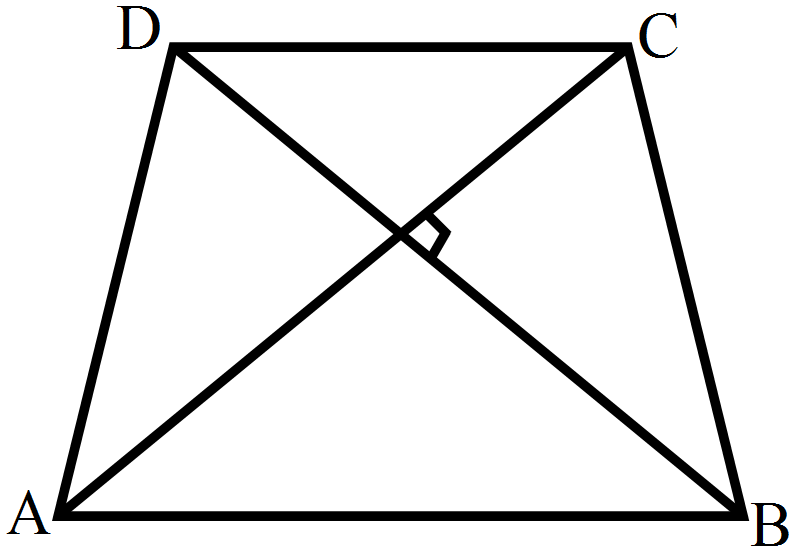
e.g., Consider a trapezium ABCD in which AB || CD.

View full question & answer
Question 22 Marks
The ratio between exterior angle and interior angle of a regular polygon is $1 : 5$. Find the number of sides of the polygon.
Answer
Let the exterior angle & interior angle be $x$ and $5x$ , respectively.
The, $x + 5x = 180^\circ $
$\Rightarrow6\text{x}=180^\circ$
$\Rightarrow\text{x}=\frac{180^\circ}{6}=30^\circ$
$\therefore$The number of sides $\Rightarrow\frac{360^\circ}{\text{Exterior angle}}=\frac{360^\circ}{30^\circ}=12^\circ$
View full question & answer
Question 32 Marks
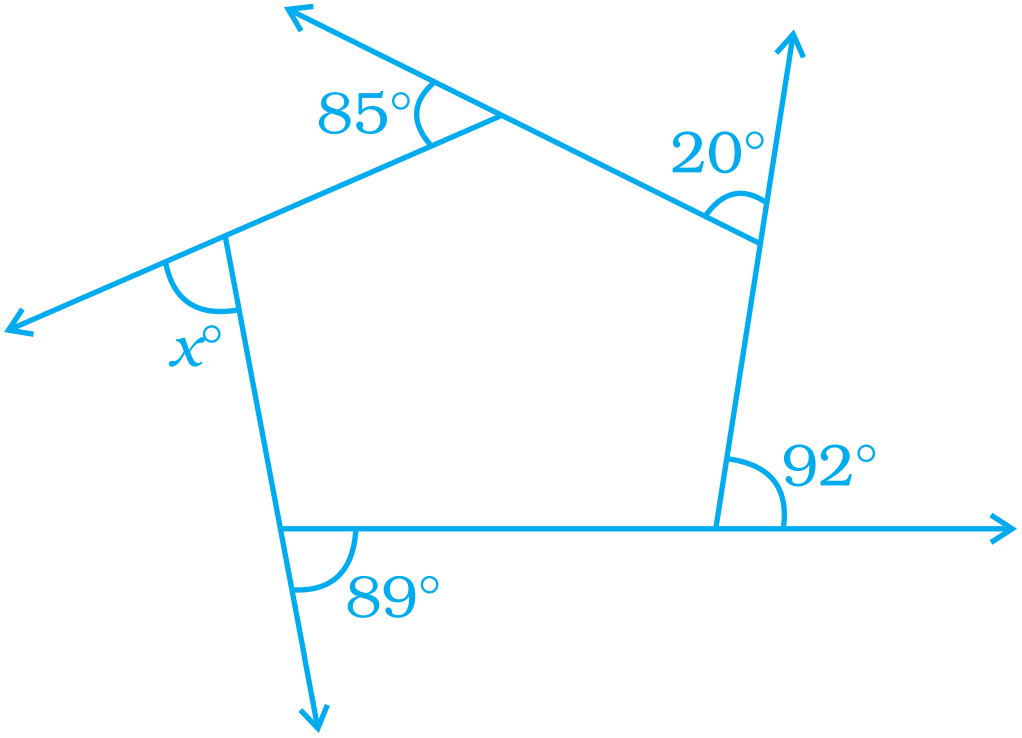
In the figure, find the value of $x$.
Answer
The given figure is a pentagon.
Sum of all the exterior angles of a pentagon is $360^\circ $
$\therefore $ $92^\circ + 20^\circ + 85^\circ + x + 89^\circ = 360^\circ $
$\Rightarrow 286^\circ + x = 360^\circ $
$ \Rightarrow x = 360^\circ - 280^\circ $
$ \Rightarrow x = 74^\circ $
View full question & answer
Question 42 Marks
Both the pairs of opposite angles of a quadrilateral are equal and supplementary. Find the measure of each angle.
Answer
Let $ABCD$ be a quadrilateral, such that $\angle\text{A}=\angle\text{C},\angle\text{B}=\angle\text{D}$ and also $\angle\text{A}+\angle\text{C}=180^\circ\angle\text{B}+\angle\text{D}=180^\circ$
Now, $\angle\text{A}+\angle\text{A}=180^\circ$
$2\angle\text{A}=90^\circ=180^\circ$
$\Rightarrow\angle\text{A}=90^\circ$ Similarly,
$\Rightarrow\angle\text{B}=90^\circ$ Hence, each angle is a right angle.
View full question & answer
Question 52 Marks
Two sticks each of length $7\ cm$ are crossing each other such that they bisect each other at right angles. What shape is formed by joining their end points? Give reason.
Answer
Sticks can be treated as the diagonals of a quadrilateral.
Now, since the diagonals (sticks) are bisecting each other at right angles, therefore the shape formed by joining their end points will be a rhombus.
View full question & answer
Question 62 Marks
A playground in the town is in the form of a kite. The perimeter is $106m$. If one of its sides is $23m$, what are the lengths of other three sides?
Answer
Let the length of other non-consecutive side be $x\ cm$. Then, we have, perimeter of playground
$= 23 + 23 + x + x$
$\Rightarrow 106 = 2 (23 + x)$
$\Rightarrow 46 + 2x = 106$
$2x = 106 - 46$
View full question & answer
Question 72 Marks
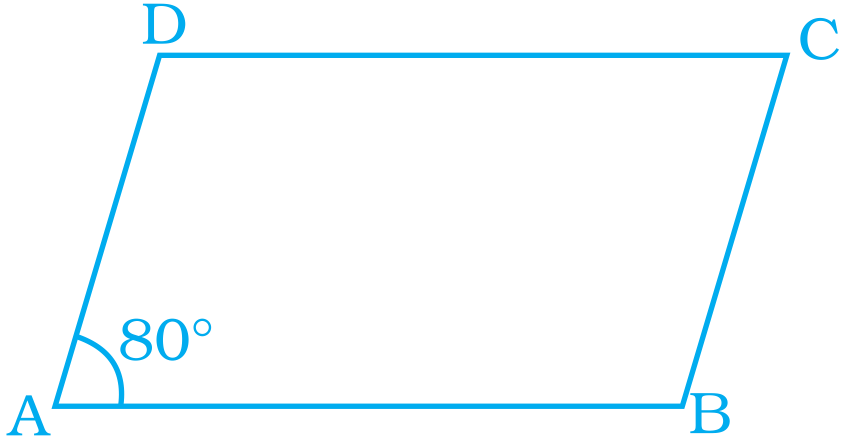
In parallelogram $ABCD$, find $\angle\text{B}.\ \angle\text{C}\ \text{and}\angle\text{D}.$
Answer
In a parallelogram, the opposite angles are equal, therefore $\angle\text{C}=\angle\text{A}=80^\circ$ Also, adjacent angles are supplementary.
$\therefore\angle\text{A}+\angle\text{B}=180^\circ$
$\Rightarrow80+\angle\text{B}=180^\circ$
$\Rightarrow\angle\text{B}=180^\circ-80^\circ=100^\circ$
Now, $\angle\text{B}=\angle\text{D}=100^\circ$
$\therefore\angle\text{D}=100^\circ.$
View full question & answer
Question 82 Marks
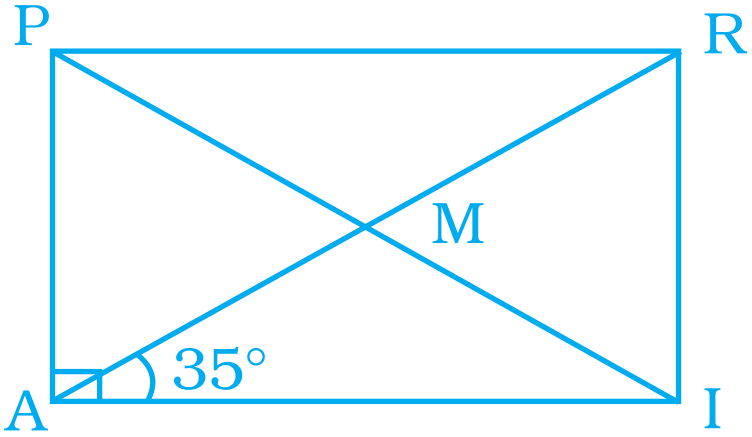
In rectangle $PAIR$, find $\angle\text{ARI},\angle\text{RMI}\ \text{and}\angle\text{PMA}.$
Answer
Given, $\angle\text{RAI}=35^\circ$
$\angle\text{PRA}=35^\circ$
$\angle\text{ARI}=90^\circ-\angle\text{PRA}=90^\circ-35^\circ=35^\circ$
$\text{AM}=\text{IM},\angle\text{MIA}=\angle\text{MAI}=35^\circ$
$\text{In}\triangle\text{AMI},\angle\text{RMI}=\angle\text{MAI}+\angle\text{MIA}=70^\circ$ [exterior angle] Also, $ \angle\text{RMI}=\angle\text{PMA}$
$ \angle\text{PMA}=70^\circ$ [Vertically opposite angles]
View full question & answer
Question 92 Marks
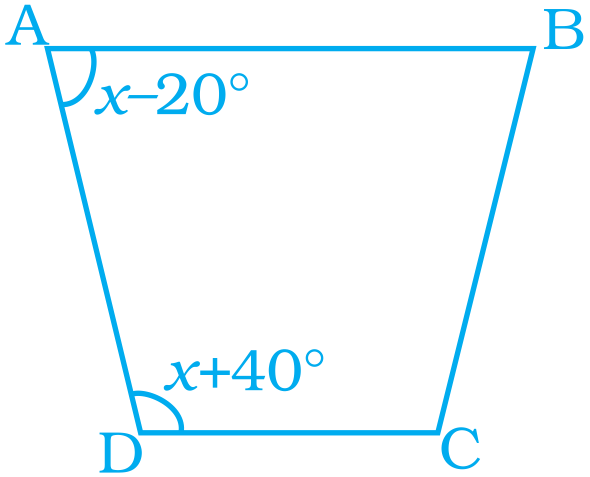
Find the value of $x$ in the trapezium $ABCD$ given below.
Answer
Given, a trapezium $ABCD$ in which $\angle=(\text{x}-20)^\circ,\angle\text{D}=(\text{x}+40)^\circ$
Since, in a trapezium, the angles on either side of the base are supplementary, therefore
$(\text{x}-20)+(\text{x}+40)=180^\circ$
$\Rightarrow\text{x}-20+40=180^\circ$
$\Rightarrow\text{2x}=20=180^\circ$
$\Rightarrow\text{2x}=(180^\circ+20^\circ)=160^\circ$
$\Rightarrow\text{x}=80^\circ.$
View full question & answer
Question 102 Marks
Two adjacent angles of a parallelogram are in the ratio $1 : 3$. Find its angles.
Answer
Let the adjacent angles of a parallelogram be $x$ and $8c$.
Then, we have $x + (3x) = 180^\circ $ [adjacent angles of parallelogram are supplementary]
$\Rightarrow 4x = 180^\circ $
$ \Rightarrow x = 45^\circ $
Thus, the angles are $45^\circ , 135^\circ .$
Hence, the angles are $45^\circ , 135^\circ , 45^\circ , 135^\circ $. [opposite angles in a parallelogram are equal]
View full question & answer
Question 112 Marks
A playground in the town is in the form of a kite. The perimeter is $106$ metres. If one of its sides is $23$ metres, what are the lengths of other three sides?
Answer
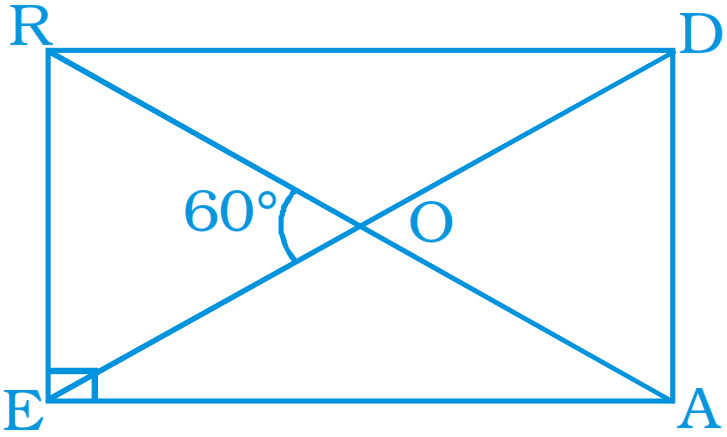
Given, a rectangle $READ$, in which$\angle\text{ROD}=60^\circ$
$\therefore\angle\text{EOA}=180^\circ-60^\circ=120^\circ$
Now, in $\triangle\text{EOA}, \angle\text{OEA}=\angle\text{OAE}=30^\circ$ [$OE$ & $OA$ equals sides make equal angles] $\therefore\angle\text{EAR}=30^\circ,\angle\text{RAD}=90^\circ-\angle\text{EAR}=60^\circ$ and $\angle\text{ARI}=\angle\text{EOA}=120^\circ$
View full question & answer
Question 122 Marks
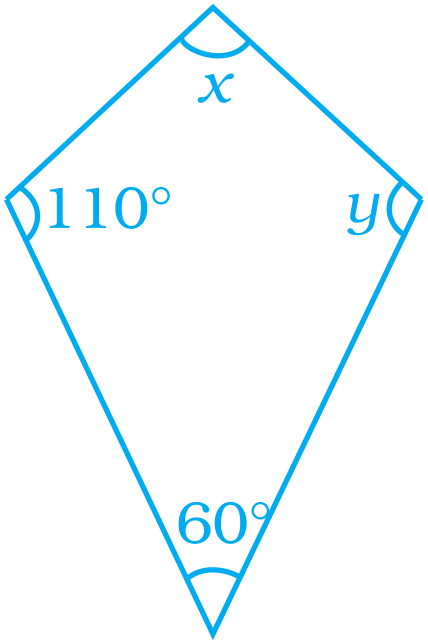
Find the values of $x$ and $y$ in the following kite.
Answer
The given figure is a kite In a kite, one pair of opposite angles are equal.
$\therefore\text{y}=110^\circ$
Now, by the angles sum property of a quadrilateral,
we have $110^\circ+ 60^\circ+ 110^\circ+ x = 360^\circ$
$\Rightarrow x = 360^\circ− 280^\circ$
$\Rightarrow x = 80^\circ$
View full question & answer
Question 132 Marks
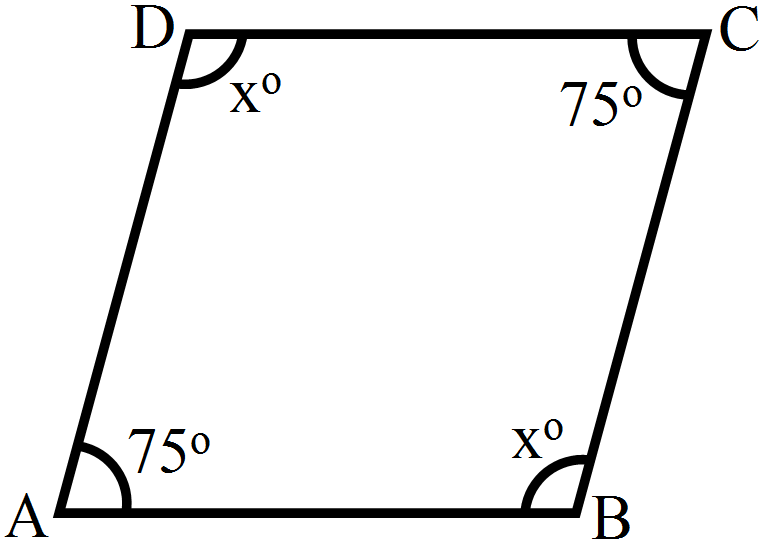
Two angles of a quadrilateral are each of measure $75^\circ$ and the other two angles are equal. What is the measure of these two angles? Name the possible figures so formed.
Answer
Let $ABCD$ be a quadrilateral where $\angle\text{A}+\angle\text{B}+\angle\text{C}=180^\circ\text{and}\angle\text{B}=\angle\text{D}=\text{x}$
Then, by the angle sum property of a quadrilateral $\angle\text{A}+\angle\text{B}+\angle\text{C}=360^\circ$ $\Rightarrow75^\circ+\text{x+75}^\circ+\text{x}=360^\circ$
$\Rightarrow2\text{x}=360^\circ-150^\circ$
$\Rightarrow2\text{x}=210^\circ$
$\Rightarrow2\text{x}=105^\circ$
Thus, other two angles are of $105^\circ$ each.
Since, opposite angles are equal, therefore the quadrilateral is a parallelogram.
View full question & answer
Question 142 Marks
A line $l$ is parallel to line m and a transversal p interesects them at $X, Y$ respectively. Bisectors of interior angles at $X$ and $Y$ interesct at $P$ and $Q$. Is $PXQY$ a rectangle? Given reason.
Answer
Number of sides in pentagon is $5$ and in decagon is $10$.
Now, exterior angle of a regular pentagon $=\frac{360^\circ}{5}=72^\circ$
Exterior angle of a regular decagon $=\frac{360^\circ}{10}=36^\circ$
Required ratio $=\frac{72}{36}=2:1$
So, the ratio between these two angles is $2 : 1$.
View full question & answer