Questions

1 Marks Question

Take a timed test

29 questions · self-marked practice — reveal the answer and mark yourself.

Question 11 Mark
Explain why a rectangle is a convex quadrilateral.
Answer
A rectangle is a convex quadrilateral because both of its diagonals lie in its interior.A convex quadrilateral is a four sided polygon that has interior angles that measure less than $180$ degrees each.
View full question & answer
Question 21 Mark
Name the quadrilaterals whose diagonals are equal.
Answer
The quadrilaterals whose diagonals are equal are Square and Rectangle.
View full question & answer
Question 31 Mark
Name the quadrilaterals whose diagonals are perpendicular bisector of each other.
Answer
The quadrilaterals whose diagonals are perpendicular bisectors of each other are Rhombus and Square.
View full question & answer
Question 41 Mark
Name the quadrilaterals whose diagonals bisect each other.
Answer
The names of the quadrilaterals whose diagonals bisect each other are parallelogram, rhombus, square, rectangle.
View full question & answer
Question 51 Mark
Explain how a square is a rectangle.
Answer
A square is a rectangle because its each interior angle measure $90^\circ$ and opposite sides are also equal.
View full question & answer
Question 71 Mark
Explain how a square is a parallelogram?
Answer
In a square, opposite sides are parallel, so it is a parallelogram.
View full question & answer
Question 91 Mark
Identify all the quadrilaterals that have four right angles.
Answer
All four right angles make it either a rectangle or a square.
View full question & answer
Question 101 Mark
Identify all the quadrilaterals that have four sides of equal length.
Answer
If all four sides are equal then it can be either a square or a rhombus.
View full question & answer
Question 211 Mark
How many diagonals are there in a convex quadrilateral?
Answer
There are only $2$ diagonals in a convex quadrilateral.
View full question & answer
Question 221 Mark
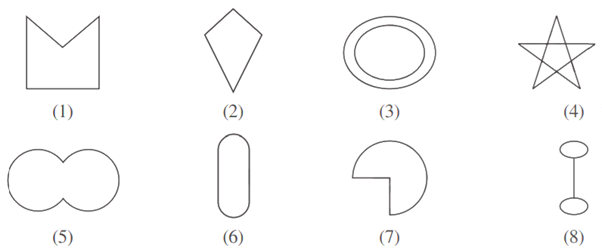
Given here are some figures. Classify them on the basis of the Concave polygon.
Answer
Concave Polygon: A concave polygon is defined as a polygon with one or more interior angles greater than $180^\circ$. It looks sort of like a vertex has been 'pushed in' towards the inside of the polygon.
Therefore, Concave polygon is: $1$
View full question & answer
Question 231 Mark
Given here are some figures. Classify them on the basis of the Convex polygon.
Answer
Convex polygons: A convex polygon is defined as a polygon with all its interior angles less than $180^\circ$. This means that all the vertices of the polygon will point outwards, away from the interior of the shape.
Therefore convex polygons are $2$
View full question & answer
Question 241 Mark
Given here are some figures. Classify them on the basis of the Polygon.
Answer
As we know that polygons are closed figures that do not contain any curves. For example - triangle, rectangle, square, hexagon etc.
Therefore, Polygon are: $1, 2$
View full question & answer
Question 251 Mark
Given here are some figures. Classify them on the basis of the Simple closed curve.
Answer
As we know that all the simple curved figures, that are closed are called simple closed.
Simple closed curved figures are : $3, 5, 6, 7$
View full question & answer
Question 261 Mark
Given here are some figures. Classify them on the basis of the Simple curve.
Answer
As we know that simple curved figures are those which contain a curved side in it.
Simple curved figures are : $3, 5, 6, 7, 8$
View full question & answer
Question 271 Mark
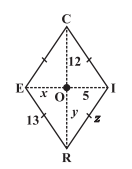
$RICE$ is a rhombus. Find z. Justify your findings.
Answer
In a rhombus, all sides are equal, so
$z = ER = 13$ units
View full question & answer
Question 281 Mark
$RICE$ is a rhombus. Find y. Justify your findings.
Answer
As in a rhombus, diagonals bisect each other, thus,
$y = OR = OC = 12$ units
View full question & answer
Question 291 Mark
$RICE$ is a rhombus. Find $x$. Justify your findings.
Answer
As in a rhombus, diagonals bisect each other, thus,
$x = OE = OI = 5$ units
View full question & answer