Questions

questions in details [4 marks ]

Take a timed test

21 questions · self-marked practice — reveal the answer and mark yourself.

Question 14 Marks
Explain why, chloroplasts are found only in plant cells.
Answer
Chloroplasts are the green coloured plastids present in the cytoplasm of plant cells. They possess photosynthetic pigment called chlorophyll. Chlorophyll absorbs energy from the sunlight during the process of photosynthesis. In the process of photosynthesis, green plants make their own food in the presence of sunlight and chlorophyll with the help of inorganic substances like carbon dioxide and water. Thus, chloroplast help in the synthesis of food by green plants.
View full question & answer
Question 24 Marks
Where are chromosomes found in a cell? State their function.
Answer
Chromosomes are thread-like structures usually present in the nucleus that become visible only during cell divisions. The function of chromosomes is to transfer the characters from parents to the off springs through the genes located on them.
View full question & answer
Question 34 Marks
State the difference between eukaryotes and prokaryotes.
Answer
The differences between eukaryotes and prokaryotes are:
Eukaryotes
Prokaryotes
The cells having a well-organized nucleus with a nuclear membrane are termed as eukaryotic cells.
The cells having nuclear material without nuclear membrane are termed as prokaryotic cells.
Most eukaryotes are multi-cellular.
Most prokaryotes are unicellular.
Cell organelles such as mitochondria, plastids, golgi bodies, etc. are present.
Cell organelles such as mitochondria, plastids, golgi bodies, etc. are absent.
Example: Fungi, onion cells, etc.
Example: Bacteria and blue green algae.
View full question & answer
Question 44 Marks
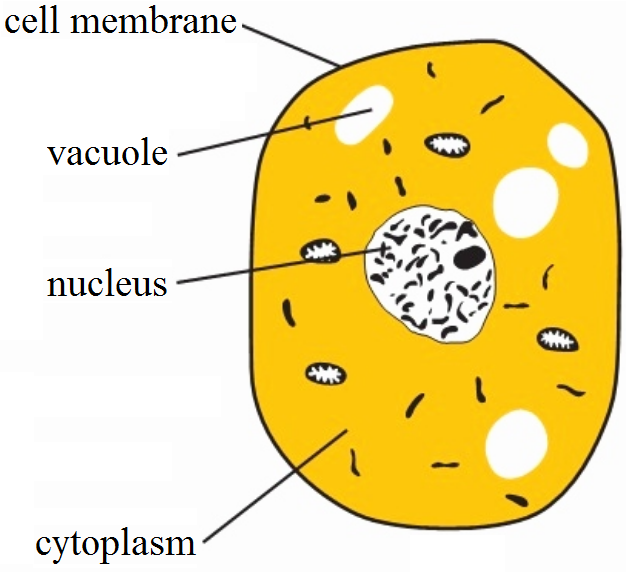
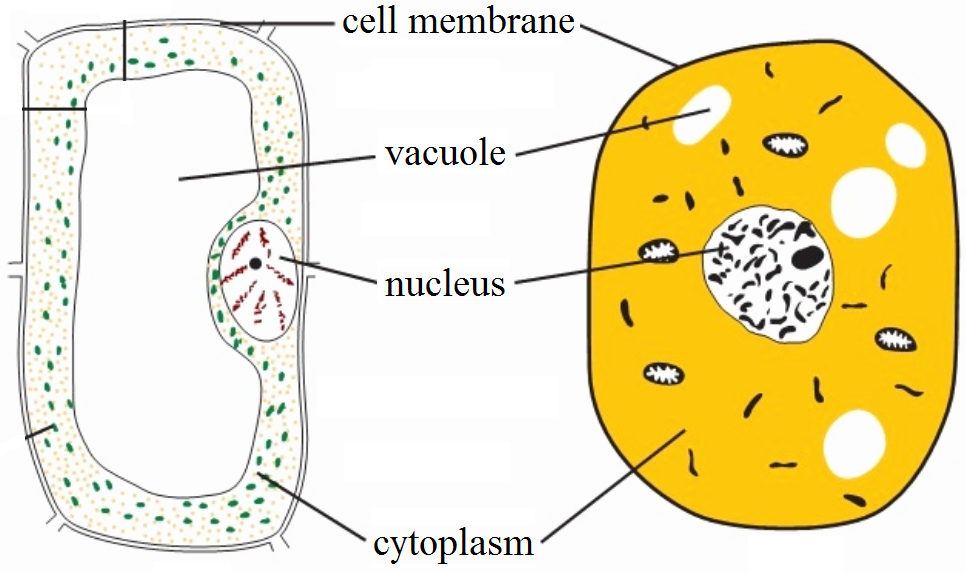
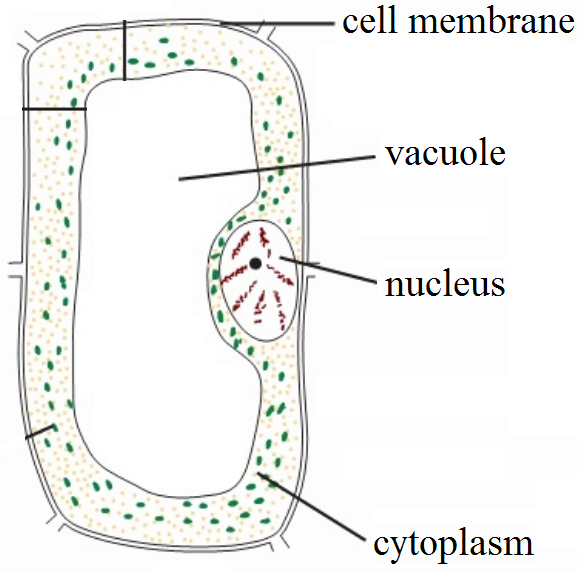
Make sketches of animal and plant cells. State three differences between them.
Answer
Parameter
Plant Cell
Animal Cell
Sketch
Cell wall
Present
Absent
Size
Small
Large
Vacuole
Large
Small or Absent
Plastids
Present
Absent
View full question & answer
Question 54 Marks
Write short notes on the following. Nucleus of a cell.
Answer

Nucleus of a cell: Nucleus is an important component of the living cell. It is mostly spherical and located in the centre of the cell. It is separated from the cytoplasm by a membrane called the nuclear membrane. In addition, nucleus contains thread-like structures called chromosomes. These carry genes and help in inheritance or transfer of characters from the parents to the offspring. Nucleus, in addition to its role in inheritance, acts as control centre of the activities of the cell. The entire content of a living cell is known as protoplasm. It includes the cytoplasm and the nucleus. Protoplasm is called the living substance of the cell.
View full question & answer
Question 64 Marks
Write short notes on the following.
Cytoplasm.
Answer
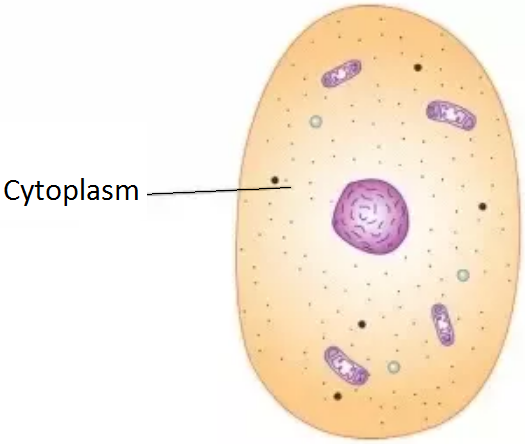
Cytoplasm: Cytoplasm is the jelly-like substance present between the cell membrane and the nucleus. Various other components or organelles like mitochondria, golgi bodies, ribosomes, etc. are present in the cytoplasm. Cytoplasm helps exchange and storage of substances among cell organelles. Most of the metabolic activities occur inside cytoplasm.

View full question & answer
Question 84 Marks
Match the terms given in column I with their functions given in column II and fill the blanks given below the table:
S.No
Column I
S.No
Column II
$A$
Chloroplast
$i$
Carries hereditary characters
$B$
Cell membrane
$ii$
Controls the activities of cells
$C$
Nucleus
$iii$
Site of photosynthesis
$D$
Chromosome
$iv$
Controls the movement of materials into and out of cells.
Answer
The correct matching is as given:
S.No
Column I
S.No
Column II
$A$
Chloroplast
$iii$
Site of photosynthesis
$B$
Cell membrane
$iv$
Controls the movement of materials into and out of cells.
$C$
Nucleus
$ii$
Controls the activities of cells.
$D$
Chromosome
$i$
Carries hereditary characters.
View full question & answer
Question 94 Marks
The size of the cells of an organism has no relation with the size of its body. Do you agree? Give reason for your answer.
Answer
he size of the cells of an organism is not related with the size of its body. This can be understood with the example of an elephant and a rat. The cells in elephant are not bigger as compared to the cells of small animal like rat. Hence, proving that cells are not related to the size of organism. However, the size of a cell is related to the function it performs. The nerve cells in both rat and elephant are long and branched and perform the same function of transferring and receiving messages. Thus, helps in coordination of different functions of body parts.
View full question & answer
Question 104 Marks
What are the functions of cell wall in plant cells?
Answer
Cell wall is an additional layer surrounding the plasma membrane in plant cells. Its functions are:
$i.$ To give shape and support to the plant cell.
$ii.$ To provide protection against variations in temperature, atmospheric moisture, etc.
$iii.$ Prevents water loss.
$iv.$ Controls the rate and direction of cell growth and regulates cell volume.
View full question & answer
Question 124 Marks
Is the following statement correct? If it is wrong, correct the statement. “Unicellular organisms do not respire, only multicellular organisms respire”
Answer
The above mentioned statement is wrong. The unicellular organisms also respire, reproduce and carry all metabolic functions like multicellular organisms. The difference is that all the functions are performed by the single cell in a unicellular organism. Similar functions in multicellular organisms are performed by various organs (organ system) which are made up of many different types of cells.
View full question & answer
Question 134 Marks
An Ameoba cell can change its shape and a white blood cell in human blood can also changing its shapes. What is the difference between an Amoeba cell and a white blood cell?
Answer
An Ameoba cell can change its shape and a white blood cell in human blood can also changing its shapes. The difference between an Amoeba cell and a white blood cell is that the Amoeba cell is a full-fledged organism which is capable of independent existence. While white blood cell is only a cell of human blood which is not a full-fledged organism and hence cannot exist independently. White blood cells can exist only inside the blood.
View full question & answer
Question 144 Marks
Which of the following are plant organs and which are animal organs? Brain, Leaf, Lungs, Roots, Stem, Kidneys, Flower, Heart.
Answer
Plant organs Anlmai organs
Leaf Brain
Roots Lungs
Stem Kidneys
Flower Heart
View full question & answer
Question 154 Marks
The part of $P$ and $Q$ are present only in plant cells, and they are not present in animal cells. The part $P$ contains a green pigment called $R$ whereas part $Q$ is made of a tough material $S$. The part $P$ takes part in the food making process whereas part $Q$ gives shape and support to the plant cell.
$a.$ What is $(i) P$, and $(ii) Q?$
$b.$ What is $(i) R$, and $(ii) S?$
Answer
$a. (i)$ The part $P$ is Chloroplasts Chloroplasts are the food producers in plant cells and they are not present in animal cells because animal cells do not make their own food.
$(ii)$ The part $Q$ is Cell wall The cell wall is absent in the animal cells because they don't need cell walls. The main purpose of a cell wall is to provide stability and stiffness to the cell. And it is made up of cellulose.
$b. (i)$ The part $R$ is Chlorophyll Chlorophyll is the green pigment present in the leaves.
$(ii)$ The part $S$ is Cellulose Cellulose is a fiber and wood, cotton, etc. all contain cellulose.
View full question & answer
Question 164 Marks
What are the functions of the following organs?
$a.$ Heart.
$b.$ Brain.
$c.$ Roots.
$d.$ Leaves.
Answer
$a.$ Heart $-$ It pumps blood throughout the body.
$b.$ Brain $-$ It controls the activities of other parts of the body.
$c.$ Roots $-$ These help in absorption of water and minerals.
$d.$ Leaves $-$ These are responsible for synthesis of food.
View full question & answer
Question 174 Marks
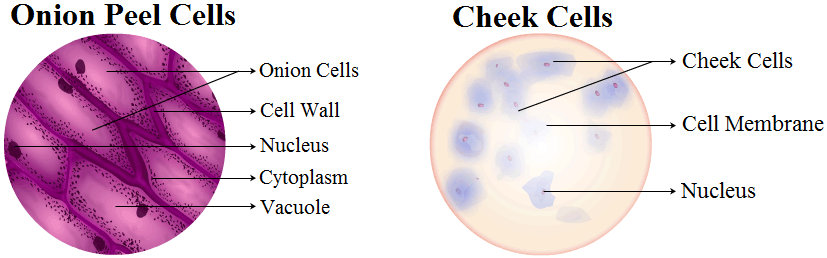
Tabulate differences between plant and animal cell with diagram of onion peel cells and cheek cells.
Answer
S.No.
Plant cell
Animal cell
1.
Cell wall is present.
Cell wall is absent.
2. Larger in size.
Smaller in size.
3.
They have one large central vacuole.
Many small vacuoles are found.
4.
Chloroplast is present which helps plant in photosynthesis.
Chloroplast is absent.
View full question & answer
Question 184 Marks
How can you differentiate prokaryotes from eukaryotes?
Answer
S.No.
Prokaryotes
Eukaryotes
$1$.
They do not have a nucleus.
They have a nucleus.
$2.$
They do not contain membrane bound organelle.
Membrane bound organelle are present.
$3.$
Prokaryotes are single celled.
Eukaryotes are multicellular usually, protists are unicellular
$4.$
Divide by binary fission and budding.
Divide either through motosis or meiosis followed by cytokinesis.
$5.$
Monera are prokaryotes.
Fungi, plant, animal and protists are eukaryotes.
View full question & answer
Question 194 Marks
Write the difference between plant cell and animal cell.
Answer
Plant cell Animal cell
Cell wall is present and is made of cellulose. They lack cell wall.
Usually lack lysosomes and peroxisomes. Lysosomes and peroximes are present.
They have one large central vacuole. Many small vacuoles are found.
Chloroplast is present which helps plant in photosynthesis. Chloroplast is absent.
View full question & answer
Question 204 Marks
Explain the structure and function of the nucleons.
Answer
The nucleus is a cell organelle found in eukaryotic cells. It is bound by the membrane and contains the cell’s hereditary information i.e. it contains the information that will be passed on
Structure:
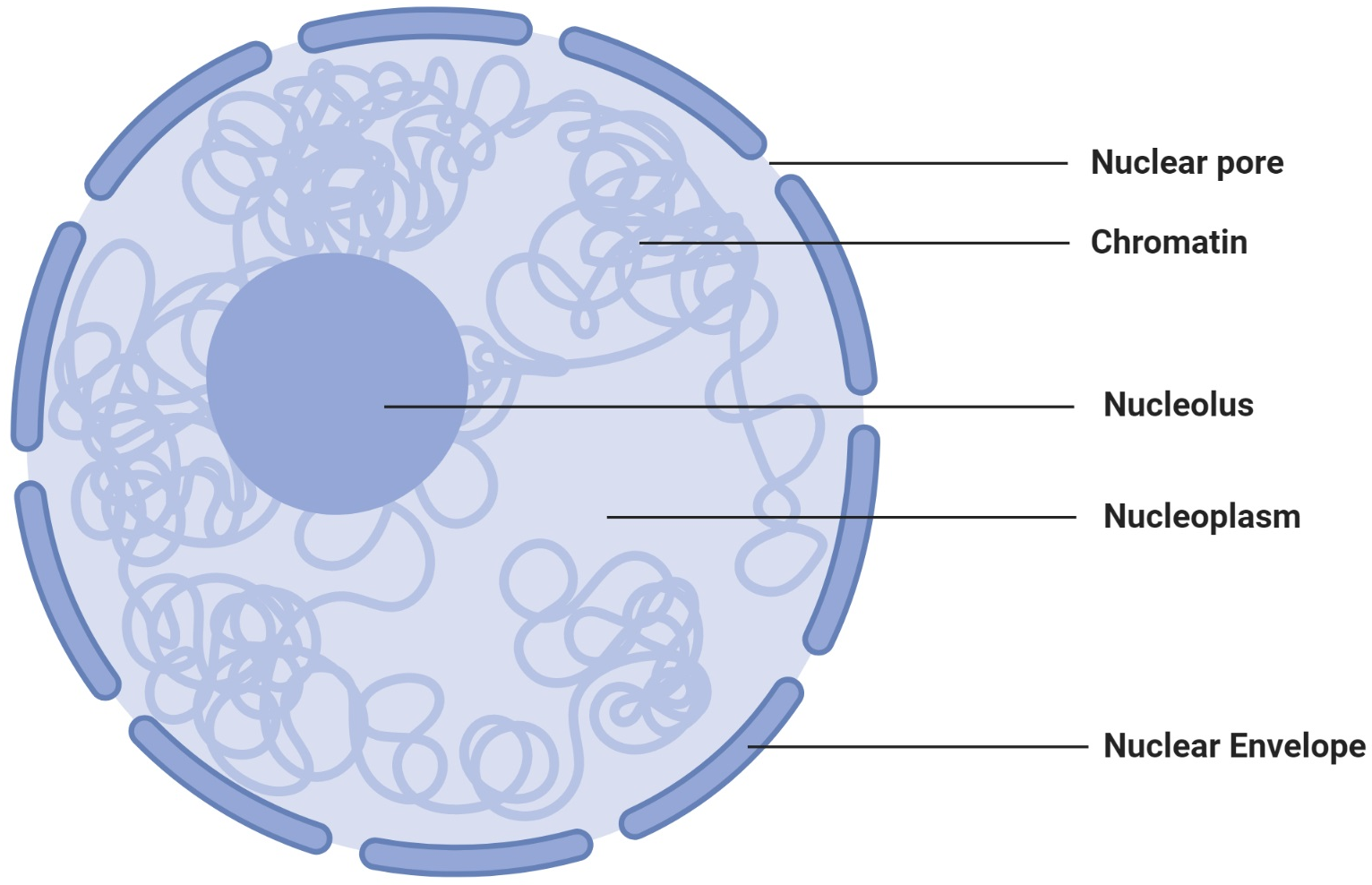
$i.$ The nucleus is surrounded by a membrane known as the nuclear membrane.
$ii.$ The nuclear envelope has pores through which the $\text{RNA}$ and proteins pass through.
$iii.$ The nucleus contains $\text{DNA}$ and $\text{RNA}$ which form chromatin.
$iv.$ When chromatin condenses, it forms chromosomes.
$v.$ There is another structure called nucleolus present inside of the nucleus.
$vi.$ The nucleolus is made up of $\text{RNA}$ and proteins.
$vii.$ There is another substance present inside the nucleus. It is known as the nucleoplasm. It is a gel like substance.

Function:
$i.$ Nucleus is like the brain of the cell.
$ii.$ Nucleus stores the genetic information in the form of $\text{DNA.}$
$iii.$ It is the $\text{DNA}$ that contains all the information regarding how the cell would work.
$iv.$ The nucleus also aids in cell division.
$v.$ It is the nucleus that makes $\text{RNA}$ which is then made into proteins.
View full question & answer
Question 214 Marks
Which of the following are prokaryotic cells and which are eukaryotic cells?Amoeba cell, Bacterium cell, Human cheek cell, Blue-green algae cell, onion peel cell.
Answer
Prokaryotic cells Eukaryotic cells
Bacterium cell. Amoeba cell.
Blue-green algae cell. Human cheek cell.
  onion peel cell.
View full question & answer