Questions

questions in short. [3 marks ]

Take a timed test

28 questions · self-marked practice — reveal the answer and mark yourself.

Question 13 Marks
Make a sketch of the human nerve cell. What function do nerve cells perform?
Answer
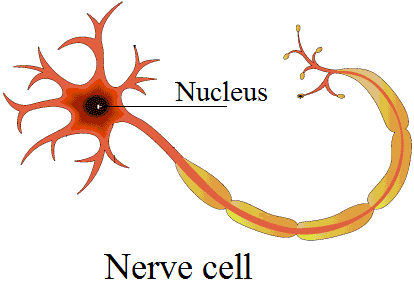
The function of a nerve cell is to transmit messages to the brain and also to take away messages from the brain to the receptor organs. Thus, it controls the working of different parts of the body.
View full question & answer
Question 23 Marks
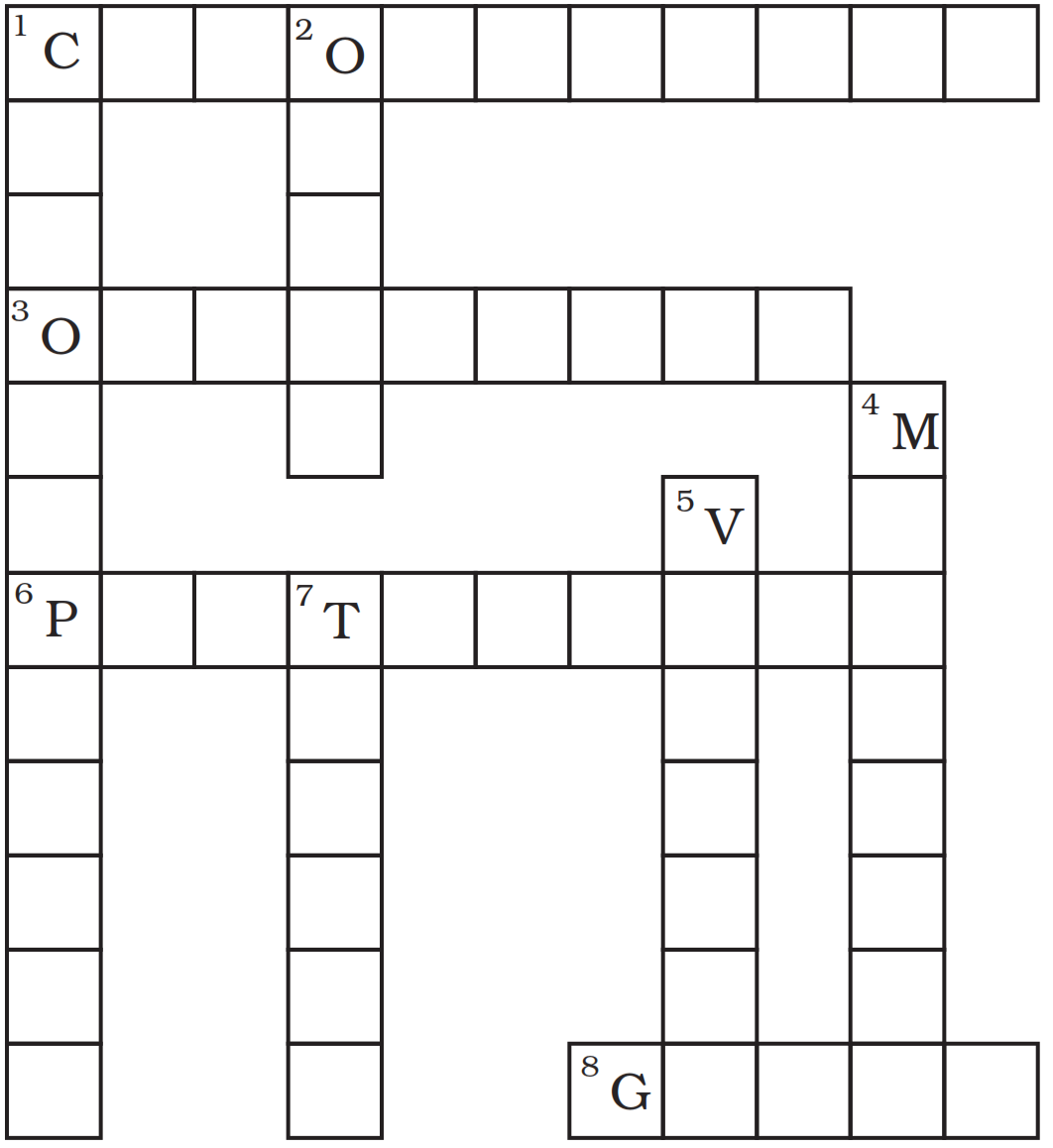
Complete the crossword with the help of clues given below.
Across:
$1.$ This is necessary for photosynthesis.
$3.$ Term for component present in the cytoplasm.
$6.$ The living substance in the cell.
$8.$ Units of inheritance present on the chromosomes.
Down:
$1.$ Green plastids.
$2.$ Formed by collection of tissues.
$4.$ It separates the contents of the cell from the surrounding medium.
$5.$ Empty structure in the cytoplasm.
$7.$ A group of cells.​​​​​​​
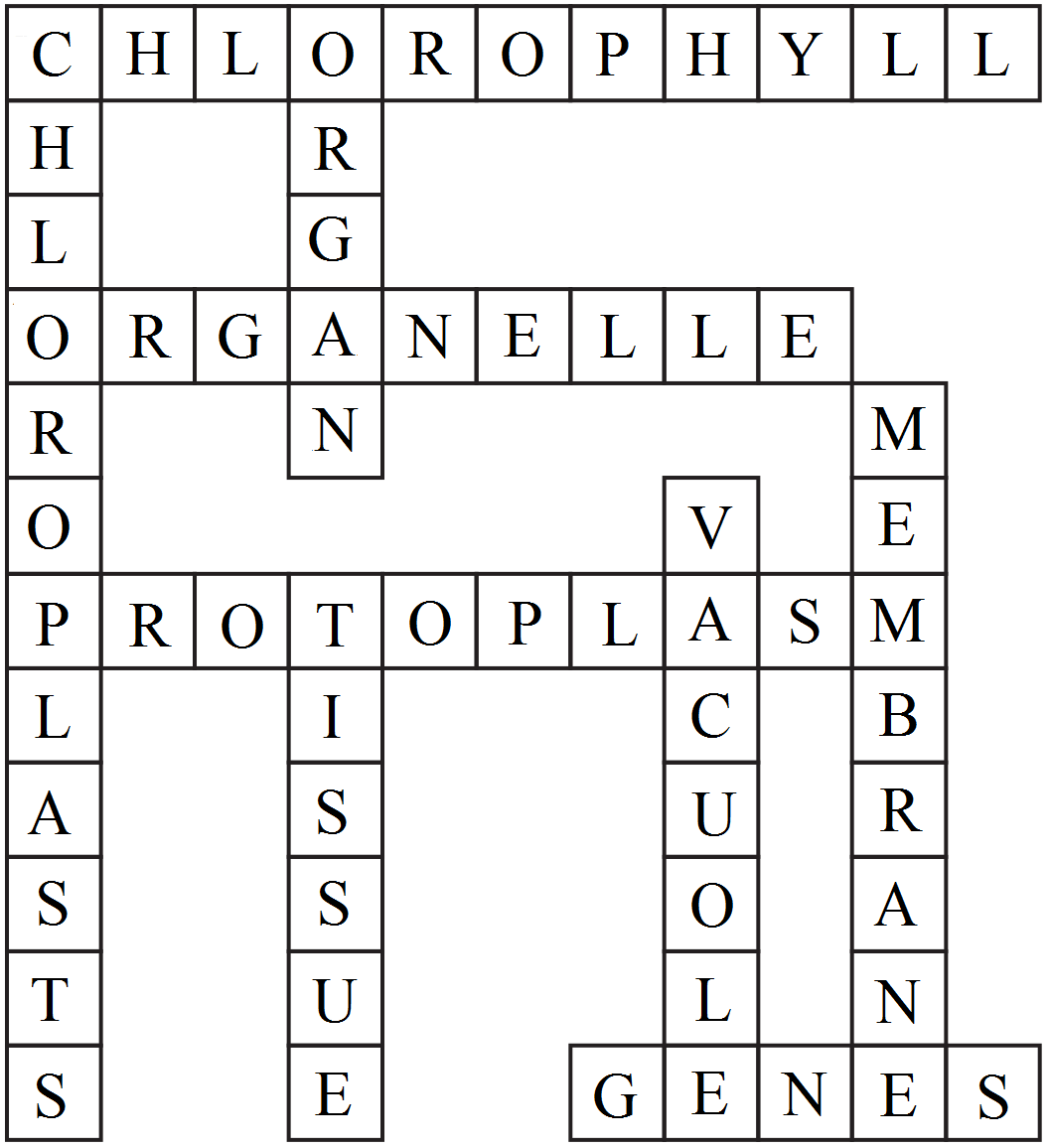
Answer
Across:
$1. \text{CHLOROPHYLL}$
$3. \text{ORGANELLE}$
$6. \text{PROTOPLASM}$
$8. \text{GENES}$
Down:
$1. \text{CHLOROPLASTS}$
$2. \text{ORGAN}$
$4. \text{MEMBRANE}$
$5. \text{VACUOLE}$
$7.\text{TISSUE}$
View full question & answer
Question 33 Marks
What are pseudopodia in Ameoba? What are the functions of pseudopodia?
Answer
The finger-like projection of varying lengths protruding out of the body of Amoeba, is called pseudopodia. These projections appear and disappear as Amoeba moves or feeds. Thus, the function of pseudopodia is to facilitates movement and help in capturing food.
View full question & answer
Question 43 Marks
State three difference between a plant cell and animal cell?
Answer
Differences between a plant cell and animal cell:
Plant cell Animal cell
A plant cell has a cell wall around its cell membrane. Blue-green algae cell. An animal cell does not have a cell wall around it.
Plastids are present. Plastids are absent.
A single large vacuole is present. Vacuoles either are absent or if present, they are smaller in size.
View full question & answer
Question 53 Marks
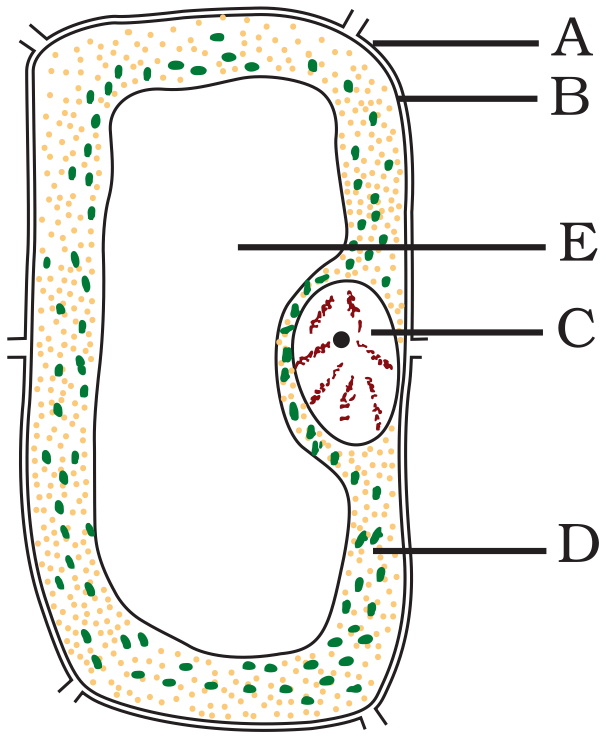
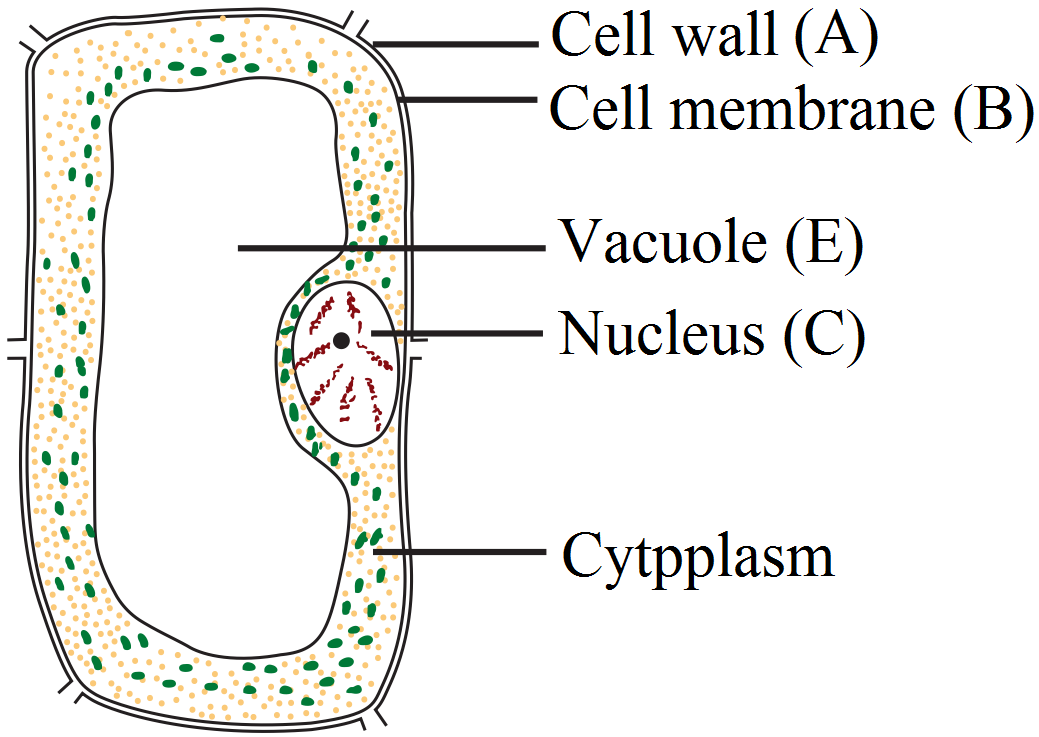
Label the parts A to E in the given as Fig. diagram.
Answer
The figure given in question, represents a plant cell. The various parts correctly labelled are as follows:
View full question & answer
Question 63 Marks
Plant and animal specimens are usually stained with dyes before observing them. Give reasons and name one dye used of the purpose.
Answer
Plant and animal specimens are usually stained with dyes before observing them because they are transparent and will not be visible to naked eye. Hence, they are stained and then observed under a microscope, staining makes them clearly visible. Animal cells are stained with methylene blue and plant cells are stained with iodine.
View full question & answer
Question 73 Marks
Do all organism have a cell membrane?
Answer
Yes, all organisms have a cell membrane. It is one of the basic component of cell that encloses the other basic components-cytoplasm and nucleus. The cell membrane separates the cells from one another and controls the movement of materials in and out of the cell. Both plant and animals have cell membrane. In plants it is inside the cell wall and in animals it is the outer layer of the cell.
View full question & answer
Question 83 Marks
What is an organ system?
$a.$ Give two examples of organ systems in animals.
$b.$ Name the two main organ systems in plants.
Answer
Organ system: A group of closely related organs that work together to perform a specific function for the organism is called organ system.
$a.$ Muscular system and digestive system are examples of organ systems in animals.
$b.$ Root system and shoot system are main organ systems in plants.
View full question & answer
Question 93 Marks
Why could cells not be observed and studied for thousands of years?
Answer
Most of cells are extremely small and cannot seen with naked eye, hence cells could not be observed and studied for thousands of years.
View full question & answer
Question 103 Marks
The cytoplasm of the cells of a tomato plant contains organelles $X$ having different pigments which impart different colours to the leaves of tomato plants and its fruits.
$a.$ What is the general name of the organelles $X?$
$b.$ What is the $(i)$ name $(ii)$ colour, and $(iii)$ function, of organelles $X$ present in the leaves of Tomato plant?
$c.$ What is the colour of organells $X$ which are present in the ripe fruits of tomato plant?
Answer
$a.$ The general name of the organelles $X$ is plastids.
$b. (i)$ Chloroplasts $(ii)$ green $(iii)$ Chloroplasts $(X)$ help in the synthesis of food by the process of photosynthesis.
$c.$ The colour of organells $X$ which are present in the ripe fruits of tomato plant is red.
View full question & answer
Question 113 Marks
The arrangement of cells is comparable to bricks of building. Why?
Answer
Although cells are living structures and bricks are non-living, the arrangement of cells is comparable to bricks of building because like buildings made of same bricks have different shapes, sizes and designs, similarly organisms are made up of same cells but are different from each other. Organism made of single cell are called unicellular organisms whereas, organisms made up of more than 1 cell are called multicellular organisms.
View full question & answer
Question 123 Marks
Define cell and tissue.
Answer
Cells are the basic unit of live. It is a membrane covered structure containing all the material needed for life. Cell are the smallest unit of life that carry out all the functions of living beings. Tissue is a group of cells of the same type that perform speciic function in the organism.
View full question & answer
Question 133 Marks
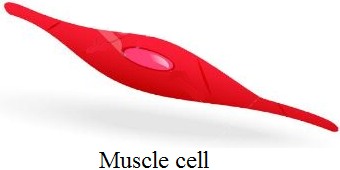
Make a sketch of the human muscle cell. What are the functions do muscles cell perform?
Answer

The muscle cells are responsible for movement in our body by contracting and relaxing.
View full question & answer
Question 143 Marks
Cells consist of many organelles, yet we do not call any of these organelles as structural and functional unit of living organisms. Explain.
Answer
The cell organelles like mitochondria, Golgi complex, ribosomes, nucleus, etc., have specific functions and carry out specific functions in a cell but they cannot be called as the structural and functional units of living organisms. This is because they can function only when present inside a living cell. They cannot act as independent units. The cei, on the contrary has independent existence. It is the smallest, structural and functional unit of life.
View full question & answer
Question 153 Marks
With the help of examples, show the variation in size and shape.
Answer
Different cells perform different functions and they have different shapes and sizes. For example, nerve cells have ibres that may be more than one meter long. Muscle cells are long and thin. This helps the muscle cells in expansion and contraction. White blood cells can change their shape, and this helps them to destroy germs. Plant cells located on the outer part of the stem have thick walls for support. Some cells in plants are used to store food, and these cells are larger than other cells.
View full question & answer
Question 173 Marks
What is an organ? Give two examples of organs.
Answer
A organ is a group of different tissues which work together to perform a specific function in the body of an organism.
Examples:
$a.$ Organs in the animal body $-$ Brain and kidney.
$b.$ Organs in the plant body $-$ Root and leaves.
View full question & answer
Question 183 Marks
Give the organisation of a multicellular organism.
Answer
The organisation of a multicellular organism is as follows- Cells- TissuesOrgan- Organ System- Organism. Cell are the smallest unit of life that carry out all the functions of living beings. Group of cells of the same type form tissue that perform speciic function in the organism. Several types of tissue form organ which carry out particular functions. Several organs together form organ system which work together to perform a function. All the organ systems together form a multicellular organism.
View full question & answer
Question 193 Marks
Why do plant cells have an additional layer surrounding the cell membrane? What is this layer known as?
Answer
The additional layer surrounding the cell membrane of plant cells is called cell wall. Since, the plants cannot show physical movement and escape themselves from extreme climatic conditions, therefore a cell wall is needed for protection. The cell wall protects the plant cells from temperature variation, high wind speed, atmospheric moisture, etc. It also gives shape and support to plant cells.
View full question & answer
Question 203 Marks
Fill in the blanks with the terms given in the box below: Nucleus, chromosomes, cell wall, cell membrane, protoplasm, cytoplasm, ribosome, cell organelles. The outermost layer of plant cells is the ________$(a)$. Beneath which is the ________$(b)$. The term ________$(c)$. Refers to the jelly-like substance containing all the ________$(d)$. The ________$(e)$. Contains thread-like structures called ________$(f)$.
Answer
The outermost layer of plant cells is the cell wall. Beneath which is the cell membrane. The term cytoplasm. Refers to the jelly-like substance containing all the cell organelles. The nucleus. Contains thread-like structures called chromosomes.
View full question & answer
Question 213 Marks
Write functions of cell membrane.
Answer
Cell membrane is the thin outermost layer of cells. It functions to keep the cytoplasm and organelles inside the cell. Since it is semi permeable, it regulates the entry and exit of water, soluble molecules and other materials. Cell membrane also helps in communicating with other cells & provides protection and support to the cell.
View full question & answer
Question 223 Marks
In the organisation of multicellular organisms, what are the lower levels of organisation?
Answer
The lower levels of organisation in multicellular organism are cells, tissues and organs. Cell are the smallest unit of life that carry out all the functions of living beings. Group of cells of the same type together form tissue that perform speciic function in the organism. Several types of tissue form organ which carry out particular functions. Organ system and inally organism are the levels followed after these 3 lower levels.
View full question & answer
Question 233 Marks
What is cytoplasm? What is its function?
Answer
Cytoplasm is a jelly-like substance present between the cell membrane and the nucleus. Cytoplasm contains many specialised cell organelles. Each of these organelles performs a specific function for the cell. Cytoplasm contains a number of minute living structure known as cell organelles. Each of these organelles performs a specific function for the cell. Most of the chemical reactions which are necessary to keep cell alive take place in the cytoplasm.
View full question & answer
Question 243 Marks
What is a plastid? What is the name of green plastids present in plant cells?
Answer
Plastids are major organelles found only in plant cells. The green coloured plastids present in plant cells, are called chloroplast. It contains photosynthetic pigment called chlorophyll which helps in the synthesis of food.
View full question & answer
Question 253 Marks
What is a tissue? Give two examples of tissues.
Answer
A tissue is a group of similar cells performing a specific function. Examples: Epithelial tissue, muscle tissue.
View full question & answer
Question 263 Marks
State the cell theory of organisms.
Answer
Two biologists, Schleiden $(1839)$ and Schwann $(1839)$ presented the cell theory. This stated that all the plants and animals are composed of cells and the cell is the basic unit of life.
View full question & answer
Question 273 Marks
Explain the function of mitochondria in a cell.
Answer
Mitochondria is the site of cellular respiration or oxidation of food in a cell. It uses glucose and oxygen to produce energy. Hence, it is knowns as “Powerhouse of the cell”.
View full question & answer
Question 283 Marks
Cell make up $A; A$ makeup $B; B$ make up $C$, and finally $C$ make up an organism. What is $A, B$, and $C?$
Answer
$A$ is tissue; $B$ is organ; and $C$ is organ system.
View full question & answer