Questions

questions in short. [2 marks ]

Take a timed test

41 questions · self-marked practice — reveal the answer and mark yourself.

Question 12 Marks
Can the process of rusting be called combustion? Discuss.
Answer
Combustion is a chemical process in which a substance reacts with oxygen and gives out energy during the process in the form of either heat or light or both. Rusting of iron is an exothermic process as heat is released during rusting. Hence, it is a kind of slow combustion.
View full question & answer
Question 22 Marks
What is the first thing you should do if a fire breaks out in your home or neighbourhood?
Answer
Water extinguishes heat by cooling down the burning substance such as wood and paper. When water is thrown on these substances, it gets cooled below its ignition temperature and also stops burning. The water vapour produced by the action of heat of fire on water surround the burning material and help in cutting off the supply of air.
View full question & answer
Question 32 Marks
How is the fire produced by burning oil (or petrol) extinguished?
Answer
To put an electrical fire out, we need to unplug or de-energies the equipment on fire. That will eliminate the electricity that is causing the fire. If one cannot unplug what is burning there is a special type of fire extinguisher.
View full question & answer
Question 42 Marks
Give one example of each combustible and non-combustible substance.
Answer
Combustible substance: The substance that undergoes combustion is said to be combustible. Example: Petrol Non-combustible substance: The substance that does not undergo combustion is said to be non-combustible. Example: Iron
View full question & answer
Question 52 Marks
State any four characteristics of an ideal fuel $($or good fuel$).$
Answer
Characteristics of ideal fuel$-$
$i.$ It has a high calorific value.
$ii.$ It burns easily in air at a moderate rate.
$iii.$ It has proper ignition temperature.
$iv.$ It does not produce any harmful gases or leaves any residue after burning.
View full question & answer
Question 62 Marks
At which temperature, a substance catches fire and starts burning?
Answer
The temperature at which a substance catches fire and starts burning is called its ignition temperature.
View full question & answer
Question 72 Marks
How will you show that air is necessary for combustion$?$
Answer
Oxygen helps in combustion. Air contains about $29\%$ of oxygen, thus supply of air makes the oxygen available which helps in combustion. Without oxygen, combustion will not take place.
View full question & answer
Question 82 Marks
A drum full of kerosene catches fire. What is the simplest way to put off this fire?
Answer
A small fire like a drum of kerosene on fire can be extinguished by throwing sand or soil over it. When sand is thrown over burning kerosene oil, the sand covers it like blanket. The sand cuts off the air supply to the burning kerosene oil due to which the fire gets extinguished.
View full question & answer
Question 92 Marks
Why do you have to use paper or kerosene oil to start fire in wood or coal?
Answer
The ignition temperature of wood or coal is very high, as it requires too much of time to get heated before burning. We use paper or kerosene to start fire because they have low ignition temperature which helps to catch fire immediately and helps the wood or the coal to reach its required ignition temperature.
View full question & answer
Question 102 Marks
Explain why, when a burning candle is covered with an inverted gas jar, the candle gets extinguished after some time.
Answer
When a burning candle is covered with an inverted gas jar, the oxygen supply gets cut-off. Oxygen is necessary for combustion to take place. It is a supporter of combustion. Hence the candle gets extinguished after sometime.
View full question & answer
Question 112 Marks
Carbon dioxide causes acid rain. Is it correct?
Answer
No, it is not correct carbon dioxide does not cause acid rain but it leads to global warming.
Acid rain is caused by oxides of sulphur and nitrogen.
View full question & answer
Question 122 Marks
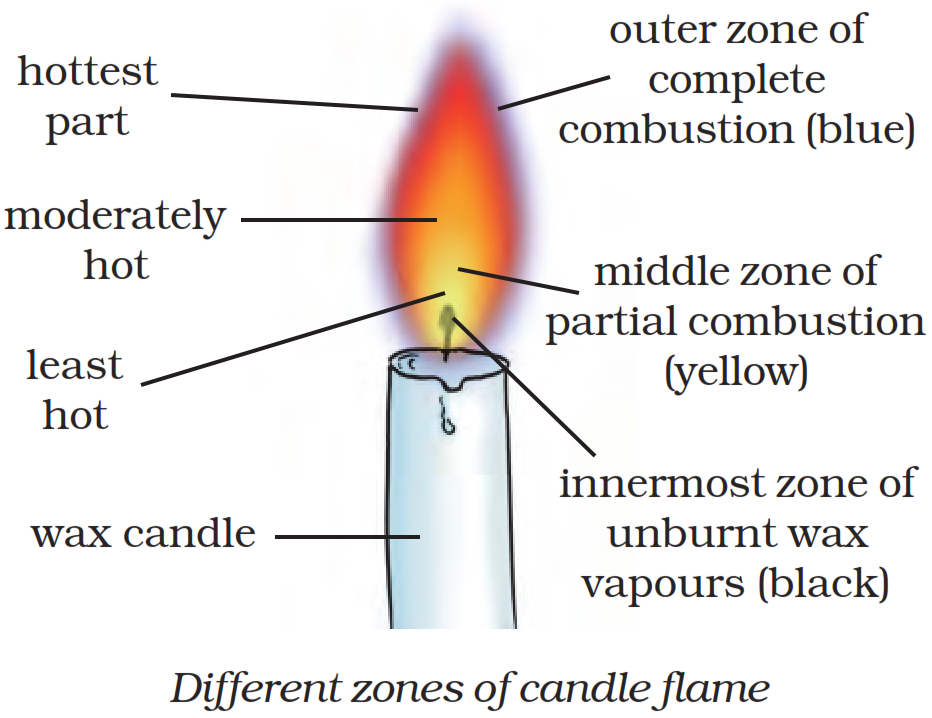
How many zones are there in a flame?
Answer

There are three zones in a flame as shown in the following diagram:
View full question & answer
Question 132 Marks
Define calorific value.
Answer
Calorific value: The amount of heat energy produced on complete combustion of $1\ kg$ of a fuel is called its calorific value. It is expressed in a unit called Kilojoule per $kg\ ( KJ/ Kg ).$
View full question & answer
Question 142 Marks
Why does charcoal not produce a flame?
Answer
The substances which get vapourised during burning gives flames. Charcoal while burning do not vapourise and so does not produce a flame while burning.
View full question & answer
Question 152 Marks
Why does a goldsmith blow air into the kerosene lamp flame with a blow-pipe?
Answer
A goldsmith blows air into the kerosene lamp flame with a blow pipe so that complete combustion of fuel takes place and the temperature of the flame increases. He blow the outermost zone of a flame with a metallic blow pipe for melting gold and silver because this is the hottest part of the flame.
View full question & answer
Question 162 Marks
What is the fuel of our body?
Answer
Food is the fuel for our body because in our body food is broken down by reaction with oxygen and heat is produced.
View full question & answer
Question 172 Marks
Define the word 'explosion'.
Answer
The reactions which proceed suddenly with the evolution of heat, light and sound along with the formation of a large amount of gas is called explosion.
View full question & answer
Question 182 Marks
Write the products which are formed when magnesium burns with oxygen.
Answer
When magnesium burns with oxygen the products formed are magnesium oxide, heat and light.
View full question & answer
Question 192 Marks
Why we cover the fire (like a blanket) to extinguish fire?
Answer
One of the necessary condition to continue the process of combustion is the continuous supply of oxygen. When we cover the fire with a blanket or anything we cut-off the supply of air to the fire. Hence, the fire extinguishes.
View full question & answer
Question 202 Marks
Why are fires produced by burning oil not extinguished by pouring water?
Answer
As water is heavier than petrol therefore slips down permitting the petrol to rise to the surface and continue to burn. Besides, the existing temperature is so high that the water poured on the fire evaporates even before it can extinguisher the fire.
View full question & answer
Question 212 Marks
Give two examples each of:
$i.$ solid fuels.
$ii.$ liquid fuels.
Answer
Two example of:
$i.$ Solid fuel – Wood, Coal.
$ii.$ Liquid fuel – Kerosene, Petrol.
View full question & answer
Question 222 Marks
$LPG$ stoves burn with which colour of flame$?$ Why$?$
Answer
$LPG$ stoves burn with a blue colour of the flame because in case of $LPG$ the fuel burns completely.
View full question & answer
Question 232 Marks
Name the most common fire extinguisher.
Answer
The most common fire extinguisher is water but it could not be used in fire involving electric current and oil.
View full question & answer
Question 242 Marks
Define ignition temperature of a substance.
Answer
Ignition temperature is the lowest temperature at which a substance catches fire. Ignition temperature is different for different substances. For example; $LPG,$ petrol, natural gas, etc. catch fire at very low temperature and thus have low ignition temperature, while wood, coal, etc. have high ignition temperature.
View full question & answer
Question 252 Marks
If the supply of oxygen is not sufficient, will the fuels burn completely?
Answer
Supply of oxygen is one of the necessary condition for combustion. Hence, if the supply of oxygen is not sufficient then the fuel will not burn completely.
View full question & answer
Question 262 Marks
Why is the use of diesel and petrol as fuels in automobiles being replaced by Compressed Natural Gas $(CNG)$ in big cities$?$
Answer
It is because when $CNG$ burns, it produces harmful products in very small amount. It is a clean fuel because it burns without producing smoke. The use of $CNG$ as fuel in automobiles has reduced air pollution In big cities.
View full question & answer
Question 272 Marks
Fuels can be in solid or liquid state only. Is it correct?
Answer
The above statement is not correct fuels can be in all the three states i.e solid liquid and gas.An example of fuel of each state is:
Solid– Coal. Liquid– Kerosene oil. Gas– Natural gas.
View full question & answer
Question 282 Marks
What is meant by ‘combustion’? Explain with an example.
Answer
A chemical process in which a substance reacts with the oxygen to give heat and light is called combustion. The light which is given off during combustion can be in the form of flame or as a glow. The substance which undergoes combustion is said to be combustible. It is called fuel.
View full question & answer
Question 292 Marks
Explain why, we are advised not to sleep in a room having closed doors and windows, with a coal fire burning inside.
Answer
Due to the burning of coal, the available oxygen gets depleted and it leads to incomplete burning of coal. Incomplete combustion of coal gives carbon monoxide gas. It is a very poisonous gas. It is dangerous to burn coal in a closed room. The carbon monoxide gas produced can kill persons sleeping in that closed room.
View full question & answer
Question 302 Marks
Give reasons.
Paper by itself catches fire easily whereas a piece of paper wrapped around an aluminium pipe does not.
Answer
Paper by itself catches fire easily whereas a piece of paper wrapped around an aluminium pipe does not because wrapping paper around an aluminium pipe increases its Ignition temperature.
View full question & answer
Question 312 Marks
Name the various zones of a candle flame. Which zone $($or part$)$ of a candle flame is the least hot $($or coldest$)$?
Answer
A candle flame has three main zones. They are$:-$
$i.$ Outer zone
$ii.$ Middle zone
$iii.$ Inner zone
In the inner zone there are no burnt vapours of the fuel due to which the colour is black and is least hot $($or coldest$)$ part.
View full question & answer
Question 322 Marks
Water is not suitable for firs involving oil and petrol. Why?
Answer
Water is not suitable for fires involving oil and petrol because water is heavier than oil and petrol. Hence, when we spray water on a fire involving oil and petrol the water sinks below the oil and petrol and the oil keeps on burning at the top.
View full question & answer
Question 332 Marks
How does pouring water extinguish a fire?
Answer
Water extinguishes heat by cooling down the burning substance. When water is thrown on substances, it gets cooled below its ignition temperature and also stops burning. The water vapour produced by the action of heat of fire on water surround the burning material and help in cutting off the supply of air.
View full question & answer
Question 342 Marks
If you see a person whose clothes are on fire, how will you extinguish the fire? Give reason for your answer.
Answer
If the clothes of a person catch fire, the person should be immediately covered with a blanket. When the burning clothes of a person are covered with a blanket, the supply of air to the burning clothes is cut off and hence the burning stops.
View full question & answer
Question 352 Marks
Write the causes of global warming.
Answer
$i.$ The burning of any fuel releases carbon dioxide into the environment.
$ii.$ This increased concentration of carbon dioxide above the normal level is believed to cause global warming.
View full question & answer
Question 362 Marks
A candle consists of unburnt wax vapours. Which zone is this?
Answer
The unburnt wax vapours of a burning candle constitutes the innermost zone of the flame which is least hot.
View full question & answer
Question 372 Marks
Can the process of rusting be called combustion? Give reason for your answer.
Answer
Combustion is a chemical process in which a substance reacts with oxygen and gives out energy during the process in the form of either heat or light or both. Rusting of iron is an exothermic process as heat is released during rusting. Hence, it is a kind of slow combustion.
View full question & answer
Question 382 Marks
Can you burn a piece of wood by bringing a lighted matchstick near it? Explain.
Answer
A matchstick can light a tiny splinter of wood but not a big log of wood. A splinter of wood has a low ignition temperature. A burning matchstick can produce sufficient heat to reach the ignition temperature of the splinter of wood therefore a matchstick can light a splinter of wood directly.
View full question & answer
Question 392 Marks
Write phosphorus burns in air at room temperature on its own. Which type of combustion is it?
Answer
The type of combustion in which a substance suddenly bursts into flames, without the application of any apparent cause is called spontaneous combustion. Here, phosphorus burns in air at room temperature on its own hence, it is a spontaneous combustion.
View full question & answer
Question 402 Marks
What gives a pollution free environment when burnt$?$
Answer
Compressed natural gas $(CNG)$ gives a pollution free environment when burned.
View full question & answer
Question 412 Marks
What are fuels? Name any two common fuels.
Answer
A fuel is a very good source of heat. The heat energy produced by burning a fuel can be used directly to cook food, for running motor vehicles and factory machines, can be converted into electrical energy at thermal power stations. Wood and Petrol are examples of two common fuels.
View full question & answer