Questions

case /data -based (4 Marks)

Take a timed test

4 questions · 1 auto-graded MCQ + 3 self-marked written.

MCQ 14 Marks
Nisha performs an experiment with two potted plants. She keeps the pots in sunlight and waters
them equally. She adds manure to the soil in Pot $1.$
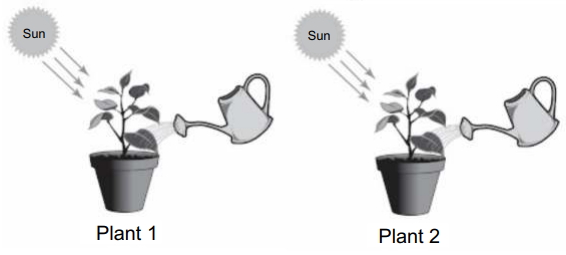
Image
She creates a table to record her observations.
  Manure added Height of the plant at the start of the experiment Height of the plant after $4$ weeks
Plant $1$ Yes $..........$ $..........$
Plant $2$ no $..........$ $..........$
$10.$ What is Nisha investigating?
  • A
    Does manure make soil porous?
  • Does manure help plants grow better?
  • C
    Do plants need sunlight and water to grow?
  • D
     Is manure better than chemical fertilisers for plant growth?
Answer
Correct option: B.
Does manure help plants grow better?
View full question & answer
Question 24 Marks
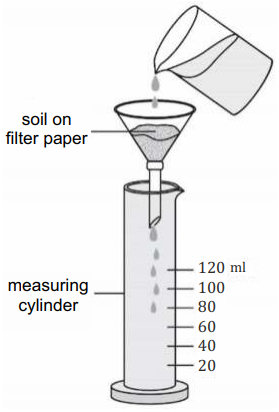
Soham investigates the water holding capacity of four different types of soils.
He sets up an experiment for each type of soil as shown in the diagram.
Soham records his observation in a table.
Image
  Soil type
Clay Loam Sand Silt
Amount of water added to the soil (ml) $150$ $150$ $150$ $150$
Amount of water collected in the measuring cylinder (ml) $30$ $60$ $105$ $50$
$8.$ Which type of soil absorbs the most water?
$A.$ Clay
$B.$ Loam
$C.$ Sand
$D.$ Silt
$9.$ Soham added the same amount of water to each type of soil.
State one more thing that Soham needs to keep the same in his experiment.
Answer
$8. A.$ Clay
$9.$ Mentions that the amount of each soil type on the ilter paper must remain the same for the experimental set up.
For example:
● The amount of soil on the ilter paper.
View full question & answer
Question 34 Marks
A farmer wants to grow crops in his ield between the months of June and July.
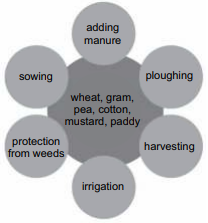
The chart below shows a list of crops and different agricultural practices.
Image
$5.$ Select two crops from the list that grow best during June and July
$6.$ The farmer prepared the soil in his ield by turning and loosening the soil.
How does turning and loosening the soil help in growing plants?
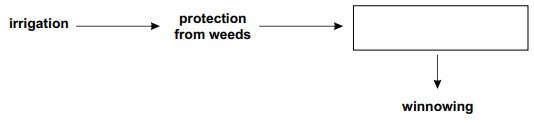
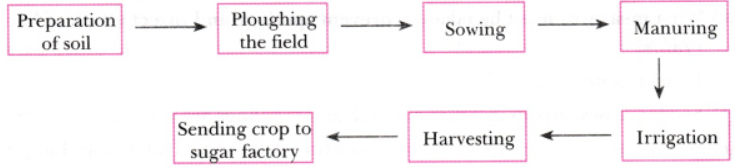
$7.$ Farmers follow a sequence of agricultural practices to grow crops. A part of the sequence is shown below.
Choose an appropriate agricultural practice from the chart above to ill in the box.
Image
Answer
$5.$ Mentions that paddy and crop grow best in any sequence.
● Crop $1: $ Paddy
● Crop $2: $ Cotton
$6.$ Mentions any one beneit of turning or loosening the soil.
For example:
● Helps the plant roots move deep into the soil.
● Help the microorganisms in the soil grow making the soil fertile.
● Turning brings soil nutrients to the top layer of soil.
$7.$ Mentions the word ‘harvesting’ in the box.
● Harvesting
View full question & answer
Question 44 Marks
Weedicides are chemicals that are sprayed on crop ields to remove weeds.
A farmer wanted to test the effect of two different weedicides on wheat production.
He sprayed each weedicide on two different ields. No weedicide was sprayed on ield $3.$Image

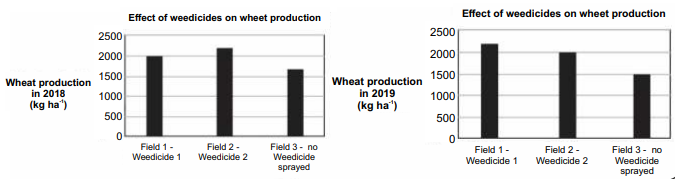
The graph shows the production of wheat crop from each ield over two years.
Image
$1.$ Why did the farmer not spray any weedicide on Field $3?$
$2.$ What can the farmer conclude from his tests$?$
$A.$ Weedicides $1$ and $2$ were not effective in controlling weeds.
$B$. Wheat production was better in ields sprayed with weedicide.
$C.$ Crop production decreased in Field $3$ as the soil was not fertile.
$D.$ Weedicide $1$ was more effective than Weedicide $2$ in controlling weeds.
$3.$The farmer’s friend suggested that the farmer should have tested Weedicide $1$ on wheat ield and Weedicide $2$ on mustard ield. Will this suggestion help improve the experiment? Explain your answer.
$4.$ Why are weedicides generally sprayed on weeds before they start producing lowers and seeds$?$
$A.$ Weedicides can kill only young weeds.
$B$. Weedicides can kill the crops if not sprayed early on.
$C.$ The weeds cannot be killed after they start producing lowers and seeds.
$D.$ The lowers produce more seeds and the seeds germinate to form more weeds.
Answer
$1.$ Mentions that Field $3$ was used as a control to compare wheat production from ields with and without weedicides.
For example:
● Field $3$ was used to compare with ields sprayed with weedicide.
Or
● Without ield $3,$ the farmer would not be able to tell if the weedicide was effective.
$2. B.$ Wheat production was better in ields sprayed with weedicide.
$3.$ Expresses disagreement with the farmer’s friend stating that changing a
variable might change the results of the experiment.
For example:
● Cannot compare production of wheat with production of mustard as results may vary.
Or
● To compare the effect of two different weedicides, the crop should remain the same.
$4. D.$ The lowers produce more seeds and the seeds germinate to form more weeds.
View full question & answer