Questions

M.C.Q. [I MARKS]

Take a timed test

20 questions · auto-graded multiple-choice test.

MCQ 11 Mark
The deficiency of one of the following in the diet of a person for a considerable time can lead to a disease called night blindness. This one is:
  • A
    Vitamin $B.$
  • B
    Vitamin $D.$
  • Vitamin $A.$
  • D
    Vitamin $C.$
Answer
Correct option: C.
Vitamin $A.$
Vitamin A deficiencies occur from fat malabsorption, liver disorders and inadequate food intake.
View full question & answer
MCQ 21 Mark
The number of images formed of an object placed between two plane mirrors inclined at right angles to each other is:
  • A
    Two
  • B
    Five
  • C
    One
  • Three
Answer
Correct option: D.
Three
Explanation:
The relationship between no. of images and angle of mirror is
$\text{Images}=\Big(\frac{360^\circ}{\text{angle between the mirrors}}\Big)-1$
$\text{Images}=\Big(\frac{360^\circ}{90^\circ}\Big)-1$
Images $= 4 – 1$
Images $= 3$
View full question & answer
MCQ 31 Mark
The change in converging power of an eye-lens is caused by the action of:
  • A
    Iris.
  • Ciliary muscles.
  • C
    Optic nerve.
  • D
    Retina.
Answer
Correct option: B.
Ciliary muscles.
Explanation:
The ciliary muscle fibers affect the zonular fibers in eye and thus change the lens shape and thus changes the converging power.
View full question & answer
MCQ 41 Mark
Which of the following is a non-luminous object?
  • A
    Sun.
  • B
    Star.
  • Moon.
  • D
    Fire.
Answer
Correct option: C.
Moon.
Explanation:
Non-luminous objects are those that are themselves not capable of producing their own light but can reflect light from another source. Moon reflects sunlight and hence is non-luminous.
View full question & answer
MCQ 51 Mark
The defect of vision in which the eye$-$lens of a person gets progressively cloudy resulting in blurred vision is called :
  • A
    Myopia.
  • B
    Night blindness.
  • Cataract.
  • D
    Hypermetropia.
Answer
Correct option: C.
Cataract.
Cataract.
View full question & answer
MCQ 61 Mark
Which of the following changes occur when you walk out of bright sunshine into a poorly lit room?
  • The pupil becomes larger.
  • B
    The lens becomes thicker.
  • C
    The ciliary muscle relaxes.
  • D
    The pupil becomes smaller.
Answer
Correct option: A.
The pupil becomes larger.
Explanation:
When a person walks out of bright sunshine into a poorly lit room, the pupil dilates and becomes larger to allow maximum light to enter the eye and thus helps in viewing things easily in a poorly lit room.
View full question & answer
MCQ 71 Mark
The angle of reflection is equal to the angle of incidence:
  • Always.
  • B
    Sometimes.
  • C
    Under special conditions.
  • D
    Never.
Answer
Correct option: A.
Always.
Explanation:
According to laws of reflection, angle of reflection is always equal to the angle of incidence. The law of reflection also states that the incident ray, reflected ray and the normal to a surface, all lie in the same plane.
View full question & answer
MCQ 81 Mark
The least distance of distinct vision for a young adult with normal vision is about:
  • A
    $25\ m$
  • B
    $2.5\ cm$
  • $25\ cm$
  • D
    $2.5\ m$
Answer
Correct option: C.
$25\ cm$
The least distance of distinct vision means the minimum distance for an object to be viewed clearly.
This minimum distance for a young adult with normal vision is $25\ cm.$
View full question & answer
MCQ 91 Mark
Which of the following produces diffuse reflection of light?
  • A
    Mirror on a dressing table.
  • Water surface of a pond.
  • C
    Screen in a cinema hall.
  • D
    Polished wooden table.
Answer
Correct option: B.
Water surface of a pond.
Explanation:
Others, the mirror, the screen and the polished wooden table will give regular reflection as they are even surfaces.
View full question & answer
MCQ 101 Mark
Which of the following is not a part of the human eye?
  • A
    Retina.
  • Auditory nerve.
  • C
    Optic nerve.
  • D
    Ciliary muscle.
Answer
Correct option: B.
Auditory nerve.
Explanation:
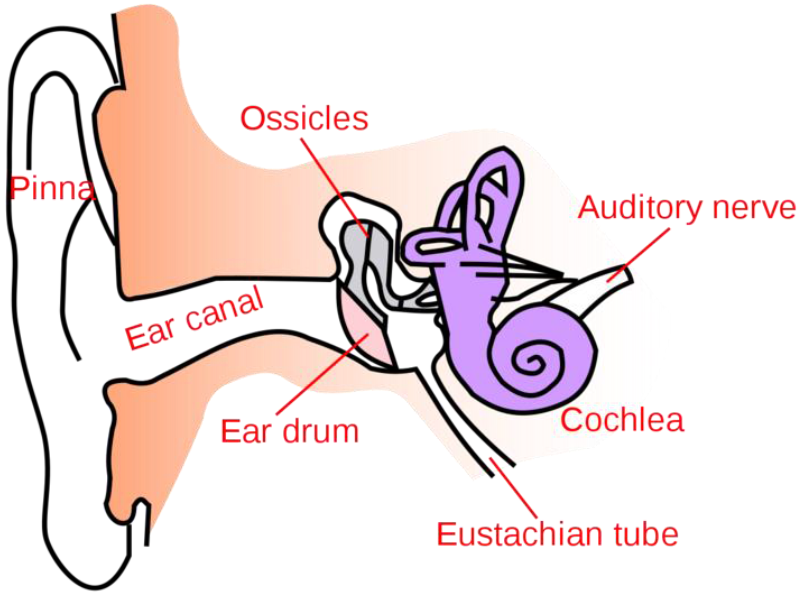
Auditory nerve is not a part of the human eye, but a part of human ear. It transmits hearing information between the brain and cochlea.
See the diagram of human ear attached:
View full question & answer
MCQ 111 Mark
The angle between an incident ray and the plane mirror is $30^\circ $. The total angle between the incident ray and the reflected ray will be:
  • $30^\circ$
  • B
    $60^\circ$
  • C
    $90^\circ$
  • D
    $120^\circ$
Answer
Correct option: A.
$30^\circ$
The angle between the incident ray and the mirror is $30$ degrees.
Angle of incidence = angle of reflection.
90 degrees is going directly into the mirror.
So, $90 – 30 = 60$ degrees.
The total angle between the incident ray and the reflected ray will be $120$ degree.
View full question & answer
MCQ 121 Mark
How does the eye change in order to focus on near or distant objects?
  • A
    The lens moves in or out.
  • B
    The retina moves in or out.
  • The lens becomes thicker or thinner.
  • D
    The pupil becomes larger or smaller.
Answer
Correct option: C.
The lens becomes thicker or thinner.
Explanation:
The shape of the lens is changed by ciliary muscles so that the image forms at a sharp focus at the retina. The lens becomes thicker to focus at near objects and becomes thinner to focus at distant objects.
View full question & answer
MCQ 131 Mark
The human eye forms the image of an object at its:
  • A
    Cornea.
  • B
    Iris.
  • C
    Pupil.
  • Retina.
Answer
Correct option: D.
Retina.
Explanation:
The image of an object is formed at the retina of an eye which is the third and the innermost coat of an eye. Light rays are focused on the retina by cornea, lens and the pupil.
View full question & answer
MCQ 141 Mark
An incident ray makes an angle of $65^\circ $ with the surface of a plane mirror. The angle of reflection in this case will be:
  • A
    $65^\circ$
  • B
    $45^\circ$
  • C
    $25^\circ$
  • $35^\circ$
Answer
Correct option: D.
$35^\circ$
Angle of incidence is always equal to angle of refection. Hence, angle of reflection will be $35^\circ .$
View full question & answer
MCQ 151 Mark
The size of the pupil of the eye is adjusted by:
  • A
    Cornea.
  • B
    Ciliary muscles.
  • C
    Optic nerve.
  • Iris.
Answer
Correct option: D.
Iris.
Explanation:
The muscles of the iris dilate and constrict the pupil and thus increases and reduces the amount of light entering the eye.
View full question & answer
MCQ 161 Mark
A person cannot see the distant objects clearly (though he can see the nearby objects clearly). He is suffering from the defect of vision called:
  • A
    Hypermetropia.
  • Myopia.
  • C
    Night blindness.
  • D
    Cataract.
Answer
Correct option: B.
Myopia.
Explanation:
Myopia is the defect of vision wherein a person cannot see the distant objects clearly as the light is unable to focus on the retina and thus distant objects appear to be blurred.
View full question & answer
MCQ 171 Mark
The image formed by a plane mirror is:
  • A
    Virtual, behind the mirror and enlarged.
  • Virtual, behind the mirror and of the same size as the object.
  • C
    Real, at the surface of the mirror and enlarged.
  • D
    Real, behind the mirror and of the same size as the object.
Answer
Correct option: B.
Virtual, behind the mirror and of the same size as the object.
Explanation:
The images formed by a plane mirror are virtual, opposite in direction and are of the same size as the object.
View full question & answer
MCQ 181 Mark
The image of an object formed by a plane mirror is:
  • Virtual.
  • B
    Real.
  • C
    Diminished.
  • D
    Upside-down.
Answer
Correct option: A.
Virtual.
Explanation:
The image of an object formed by a plane mirror is virtual always suggesting that the light rays do not actually come from the image.
View full question & answer
MCQ 191 Mark
As the angle between two plane mirrors is decreased gradually, the number of images of an object placed between them:
  • Increases gradually.
  • B
    Decreases gradually.
  • C
    First increases then decreases.
  • D
    First decreases then increases.
Answer
Correct option: A.
Increases gradually.
If the angle between $2$ plane mirrors is decreased, the number of images of an object placed in between will increase gradually.
The relationship between no. of images and angle of mirror is
$\text{Images}=\Big(\frac{{360^\circ}}{{\text{angle between the mirrors}}}\Big)-1$
View full question & answer
MCQ 201 Mark
A device which works on the reflection of light from two plane mirrors arranged parallel to one another is:
  • A
    Electroscope.
  • B
    Kaleiodoscope.
  • Periscope.
  • D
    Stethoscope.
Answer
Correct option: C.
Periscope.
Periscopes are used to see objects that are not in direct line of sight.
View full question & answer