Questions

questions in short. [3 marks ]

Take a timed test

19 questions · self-marked practice — reveal the answer and mark yourself.

Question 13 Marks
Name any one defect of the eye. How is it corrected?
Answer
Myopia (nearsightedness) is the defect of vision wherein a person is unable to see the distant objects clearly as the light is unable to focus on the retina and thus distant objects appear to be blurred. The problem of nearsightedness is that the light is focused in front of the retina Myopia is corrected by wearing glasses or contact lenses. A concave lens (diverging lens) with a minus power is used in the glass, which moves the image back to retina and thus clears the image. The diverging lens will diverge the light before it reaches the retina. The light will then be converged by cornea and lens thus producing an image on the retina.
View full question & answer
Question 23 Marks
What is the difference between regular reflection and diffuse reflection of light? Name one object which can produce regular reflection of light and another which produces diffuse reflection of light.
Answer
REGULAR REFLECTION OF LIGHT
DIFFUSED REFLECTION OF LIGHT
Regular reflection occurs from a polished or even surface.
Diffused reflection occurs from any uneven surface.
The reflected rays are parallel always.
The reflected rays are not parallel ever.
A plane mirror produces regular reflection of light.
A wall or piece of paper produces diffused reflection of light.
View full question & answer
Question 33 Marks
You see your image in a plane mirror? State two characteristics of the image so formed.
Answer
Characteristics of the image formed by a plane mirror are:
$-$The images formed by a plane mirror are virtual and erect.
$-$Image formed is of the same size as the object and is laterally inverted.
$-$Image is far behind the mirror as the object is in front of the mirror.
View full question & answer
Question 43 Marks
What makes things visible to us? Why cannot we see a book which is placed. $(a)$ Behind a wooden screen, and $(b)$ In a dark room?
Answer
Light makes things visible to us. We see an object when light passing through it is reflected. We cannot see a book which is placed.
$a.$ Behind a wooden screen because the wooden screen is opaque so it does not allow light to pass through it.
$b.$ In a dark room because there is no light to be reflected by the book. Thus, due to no reflection, the book is not visible.
View full question & answer
Question 53 Marks
What is meant by a non-luminous object? Name two non-luminous objects.
Answer
Non- luminous objects are those that are themselves not capable of producing their own light but can reflect light from another source. $2$ non-luminous objects are- wood, plastics etc. Moon also is incapable of producing its own light and it reflects sunlight and hence is non-luminous.
View full question & answer
Question 63 Marks
A student makes a device P by using three long and narrow strips of plane mirrors inclined at $60^\circ $ to one another which enables him to see beautiful patterns made by pieces of coloured glass bangles. On the other hand, another student makes a device $Q$ by using two plane mirrors arranged parallel to each other which helps him to see a football match clearly even when some very tall persons are sitting in front of him in the ground. What are $P$ and $Q?$
Answer
Device $P$ is a Kaleidoscope which consists of $3$ plain mirror strips are arranged inside a tube (cylinder) with colored glass pieces at one end and a glass to view on the other. The device $Q$ is a Periscope. A periscope is a device that reflects the reflected ray again. It consists of a tube attached to a set of $2$ mirrors. A periscope is used to see over, through or around any object. So, the student is able to see a football match clearly even when some very tall persons are sitting in front of him in the ground because the periscope helps him in seeing over, through and around the tall persons sitting in front of him in the ground.
View full question & answer
Question 73 Marks
Name the cells on the retina of an eye:
$a.$ Which are sensitive to bright light.
$b.$ Which are sensitive to dim light.
$c.$ Which produce sensation of colour.
Answer
$a.$ Cones are sensitive to bright light. Cone shaped cells present in the retina are sensitive to bright light.
$b.$ Rods are sensitive to dim light. Rod shaped cells present in the retina are sensitive to dim light. They are most important for vision in dim light.
$c.$ Cones are the cells of retina that produce color sensation. These photoreceptor cells are responsible for color vision.
View full question & answer
Question 93 Marks
How many images of an object will be formed when the object is placed between two plane mirrors which are inclined at the following angles to one another?
$a. 120^\circ $
$b. 45^\circ $
$c. 180^\circ $
$d. 60^\circ $
$e. 90^\circ $
Answer
The formula to calculate the no. of images of an object placed between $2$ plane mirrors $\Big(\frac{360}{\theta}\Big)-1$ where theta is the angle of inclination.$2\Big(\frac{360}{120}\Big)-1=3-1=2$
$7\Big(\frac{360}{45}\Big)-1=8-1=7$
$1\Big(\frac{360}{180}\Big)-1=2-1=1$
$5\Big(\frac{360}{60}\Big)-1=6-1=5$
$3\Big(\frac{360}{90}\Big)-1=4-1=3$
View full question & answer
Question 103 Marks
Explain why, an owl can see well in the night (but not during the day) whereas an eagle can see well during day (but not at night).
Answer
An owl can see well in the night but not during the day because owl is a night bird and night birds have fewer cones and more rods in the retina. Since rods function in less amount of light so an owl can see well in the night. To see well during the day, cones are required which are not present in adequate amount in an owl’s retina. An eagle can see well during the day but not during the night because eagle has more cones and lesser rods in the retina. Cones function in good amount of light so an eagle can see well during the day. To see well during the night, rods are required which are not present in adequate amount in a n eagle’s retina.
View full question & answer
Question 113 Marks
Man, A has a defect of vision due to which he cannot see the nearby objects clearly $($though he can see the distant objects clearly$).$ On the other hand, man $B$ has a defect of vision due to which he cannot see the distant object clearly $($though he can see the nearby objects clearly$)$. The defect in man $A$ can be corrected by using spectacles containing lenses $C$ whereas the defect in man $B$ can be corrected by using spectacles containing lenses $D.$
$a.$ Name the defect of vision in man $(i) A$, and $(ii) B.$
$b.$ What type of lenses are $(i) C$, and $(ii) D?$
Answer
$a.$ The defect of vision in man are:
$i.$ Man $A$ suffers from hypermetropia wherein the image of a nearby object is formed behind the retina so the person has a blurred vision while looking at nearby objects.
$ii.$ Man $B$ suffers from myopia wherein Light from a distant object forms an image before it reaches the retina so the person can see the nearby objects clearly but not the distant objects.
$b.$ The lenses are:
$i. C$ are Convex lens. These lenses are placed in front of a hyper$-$metropic eye which moves the image forward and focuses directly onto the retina which clears the vision of a nearby object.
$ii. D$ are concave lenses. These lenses are placed in front of a myopic eye which moves the image back to the retina and clarifies the image of a distant object.
View full question & answer
Question 123 Marks
The eye of a person exhibits a phenomenon $X$ due to which it can see the image of an object for a short duration of $Y$ even after the object has disappeared from his view. It is due to the phenomenon $X$ that we are able to see moving $Z$ on a television screen. What is $X, Y$ and $Z?$
Answer
The phenomenon $X$ is persistence of vision. The property of this phenomenon is that the image formed on the retina of the eye persists for about $\frac1{16}\text{th}$ of a second, hence if $16$ frames are shown on a screen in succession, they are viewed by the retina as an ongoing action. Short duration of $Y$ is $\frac1{16}$ seconds. $Z$ is pictures. Due to the phenomenon of persistence of vision, we are able to see moving pictures on a television or a cinema screen.
View full question & answer
Question 133 Marks
State the various uses of a periscope.
Answer
$-$A periscope is used to see over, through or around any object.
$-$It can be used to see over a wall, to see around a corner.
$-$Periscopes are also used in warfare to keep an eye on the enemy.
View full question & answer
Question 143 Marks
Two plane mirrors are set at right angles to each other. A coin is placed in-between these two plane mirrors. How many images of the coin will be seen?
Answer
When $2$ plane mirrors are set at right angles to each other and a coin is placed in-between these two plane mirrors, then three images will be formed, see the diagram below:

 The formula for calculating the number of images, when two are kept at an angle $\theta $, is given as: $\Big(\frac{360}{\theta}\Big)-1$
Now, $\theta=90$ degree.
Thus, the number of images formed will be$=\Big(\frac{360}{\theta}\Big)-1$
$=\Big(\frac{360}{90}\Big)-1$
$=4-1$
$=3$
View full question & answer
Question 153 Marks
A ray of light strikes a plane mirror $XY$ at an angle of incidence of $65^\circ $, is reflected from this plane mirror and then strikes a second plane mirror $YZ$ placed at right angles to the first mirror. What is the angle of reflection for the mirror $YZ?$
Answer
The mirrors $XY$ and $YZ$ are at right angles,
i.e., perpendicular. When a ray of light strikes the $XY$ mirror with 65degree angle, the incident angle will be $90 - 65 = 25^\circ $ on the $YZ$ mirror. Since angle of incidence = angle of reflection, the angle of reflection for $YZ$ mirror will be $25^\circ .$
View full question & answer
Question 163 Marks
A wall reflects light and a mirror also reflects light. What difference is there in the way they reflect light?
Answer
Reflection of light from a wall is diffused reflection because the surface of the wall is uneven so the light is reflected in different directions and also the reflected rays are not parallel. Reflection of light from a mirror is regular reflection because the surface of mirror is an even surface which is polished. The light gets reflected from the mirror surface in one particular direction and the reflected rays are all parallel.
View full question & answer
Question 173 Marks
What will be the number of images formed when an object is placed between two parallel plane mirrors facing each other?
Answer
Infinite number of images are formed when an object is placed between two parallel plane mirrors facing each other. The object undergoes multiple reflection to produce image of the distant object. The distance between the mirror and the object is inconsiderable in formation of infinite images. No matter how much the distance be, number of images formed will be infinite.
View full question & answer
Question 183 Marks
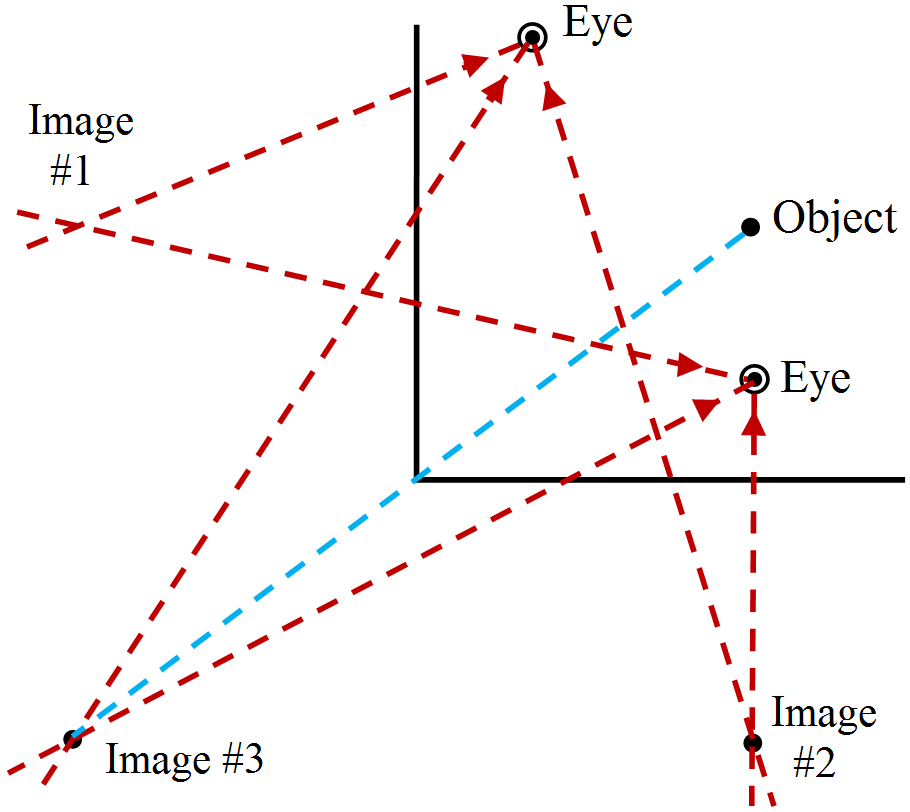
Draw a labelled diagram showing how a plane mirror forms an image of a point object placed in front of it.
View full question & answer
Question 193 Marks
Name the two types of reflection of light. Which type of reflection makes us see an object from all directions?
Answer
The two types of reflection of light are Regular reflection of light and Diffused reflection of light. Regular reflection of light makes us see an object from all directions as the reflected rays are all parallel and in a particular direction so the image of the object can be viewed from all directions. In diffused reflection of light the reflected rays are neither parallel nor in a specific direction so the image of the object isn't visible from any direction.
View full question & answer