Questions

case /data -based (4 Marks)

Take a timed test

5 questions · self-marked practice — reveal the answer and mark yourself.

Question 14 Marks
Mayank dropped four coins from the same height onto a concrete floor.
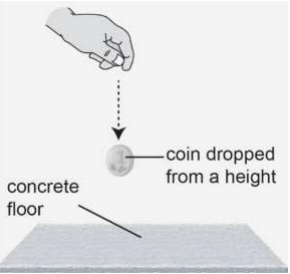
Image

The table below shows the type of sound that each coin produced after hitting the floor.
Coin Temperature of the ball when heated for a minute
Coin $1$ Ringing sound
Coin $2$ Damp sound
Coin $3$ Damp sound
Coin $4$ Ringing sound
$9.$ Which coins in Mayank’s activity are made of metal$?$
$A.$ Coin $1$ and Coin $2$
$B.$ Coin $2$ and Coin $3$
$C.$ Coin $3$ and Coin $4$
$D$. Coin $4$ and Coin $1$
$10.$ On which type of loor will Mayank’s activity produce the same results$?$
$A.$ Glass
$B.$ Sand
$C.$ Grass
$D.$ Carpet
Answer
$9. D.$ Coin $4$ and Coin $1$
$10. A.$ Glass
View full question & answer
Question 24 Marks
A scientist injected nitrogen dioxide gas in water.
He dropped a blue litmus paper in the water after the reaction was over.
The litmus paper turned red.
$7.$ What can be concluded from the experiment$?$
$A.$ A salt is produced by the reaction.
$B.$ An acid is produced by the reaction.
$C.$ Nitrogen gas is produced by the reaction.
$D.$ Hydrogen gas is produced by the reaction.
$8.$ The scientist heated the water after the reaction was over. Will there be any change in the colour of the litmus paper that turned red? Explain your answer.
Answer
$7. B.$ An acid is produced by the reaction.
$8.$ Mentions that there will be no change in the colour of the litmus paper that has turned red because the reaction is already complete.
View full question & answer
Question 34 Marks
The equations below show four chemical reactions.
$(i)$ Copper sulphate $+$ Zinc $\rightarrow$ Zinc sulphate $+$ Copper
$(ii)$ Copper sulphate $+$ Iron $\rightarrow$ Iron sulphate $+$ Copper
$(iii)$ Iron sulphate $+$ Copper $\rightarrow$ no reaction
$(iv)$ Zincsulphate $+$ Copper $\rightarrow$ no reaction
$5.$ What can be concluded from the above reactions$?$
$A.$ Copper is less reactive than both zinc and iron
$B.$ Zinc is less reactive than iron but more reactive than copper
$C.$ Copper is less reactive than zinc but more reactive than iron
$D.$ Iron is less reactive than both zinc and copper
$6.$ Why is example $(i)$ regarded as a displacement reaction? Explain your answer. 
Answer
$5. A.$ Copper is less reactive than both zinc and iron
$6.$ Mentions that zinc displaced copper from copper sulphate and formed zinc sulphate.
For example:
● Zinc displaces copper from copper sulphate and forms zinc sulphate.
View full question & answer
Question 44 Marks
Peter hammered four balls made of different materials.
He then heated each ball for a minute.
The table below shows what Peter observed.
Ball What happens to the ball when hammered? Temperature of the ball when heated for a minute
Ball $1$ Flattens $85\ ℃$
Ball $2$ Breaks $45\ ℃$
Ball $3$ Breaks $35\ ℃$
Ball $4$ Flattens $75\ ℃$
$3.$ What can be concluded from the table$?$
Circle ‘Yes’ or ‘No’ for each statement
Can this statement be concluded from the table$?$ Yes or No
Materials that break when hammered get heated quickly Yes/No
Materials that latten when hammered get heated quickly Yes/No
Materials that break when hammered get heated slowly Yes/No
$4.$ Two of the four balls are made of ceramic and wood respectively.
Which two balls are they likely to be$?$

 
Answer
$3.$ No
Yes
Yes
$4.$ Mentions that Ball $2$ and Ball $3$ are made of ceramic and wood.
For example:
● Ball $2$ and Ball $3$
View full question & answer
Question 54 Marks
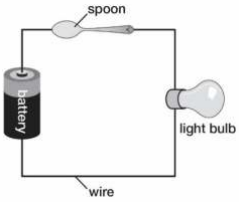
Sajid has four teaspoons made of different materials.
He used each spoon to close an electric circuit one by one.
Image

The table below shows if the light bulb glows for each spoon in the circuit.
Spoon in the circuit Does the light bulb glow?
Spoon $1$ No
Spoon $2$ No
Spoon $3$ Yes
Spoon $4$ Yes
$1.$ Which of these is supported by the results of Sajid’s activity$?$
$A.$ Spoon $1$ is made of metal and Spoon $2$ is made of non-metal
$B.$ Spoon $2$ is made of metal and Spoon $3$ is made of non-metal
$C.$ Spoon $3$ is made of metal and Spoon $4$ is made of non-metal
$D.$ Spoon $4$ is made of metal and Spoon $1$ is made of non-metal
$2.$ Will the results of the activity change if two batteries are used in the circuit in place of the single battery? Explain your answer.
Answer
$1. D.$ Spoon $4$ is made of metal and Spoon $1$ is made of non-metal
$2.$ Mentions that the results of the activity will not change as there will be no stoppage in the low of electricity in the circuit.
For example:
● No, because that would not affect the low of electricity in the circuit.
View full question & answer