Questions

3 Marks Question

Take a timed test

7 questions · self-marked practice — reveal the answer and mark yourself.

Question 13 Marks
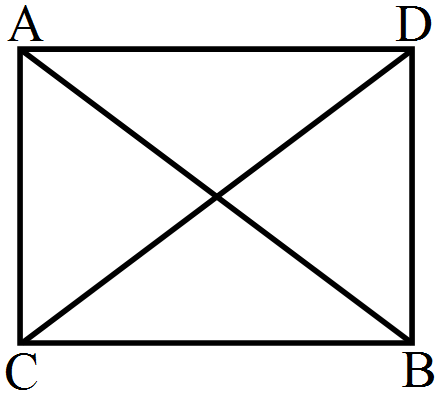
$ABCD$ is a rectangle. Prove that the centre of the circle through $A, B, C, D$ is the point of intersection of its diagonals.
Answer
$ABCD$ is a rectangle. Let $O$ be the point of intersection of the diagonals $AC$ and $BD$ of rectangle $ABCD.$
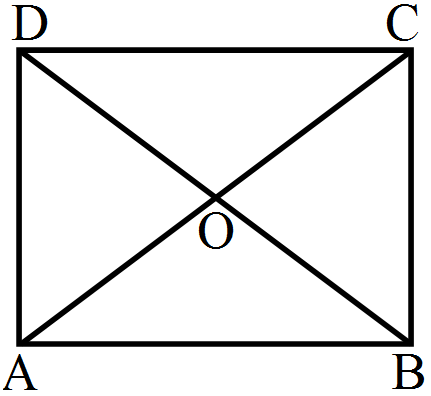
Since the diagonals of a rectangle are equal and bisect each other.
$\therefore OA = OB = OC = OD$
Thus, $O$ is the centre of the circle through $A, B, C, D.$
View full question & answer
Question 23 Marks
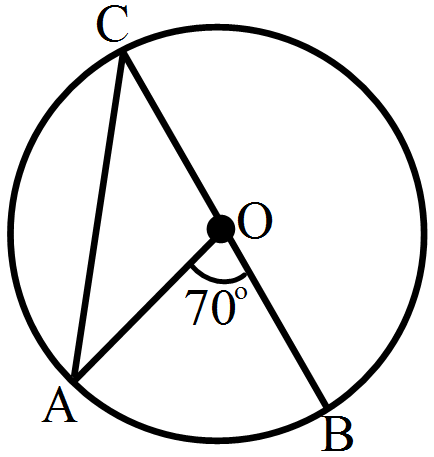
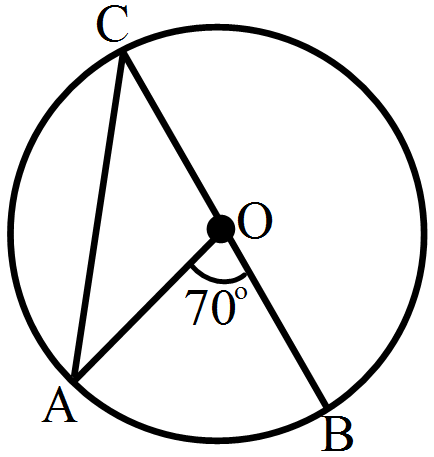
In the given figure, $O$ is the canter of the circle and $\angle\text{AOB}=70^\circ.$ Calculate the values of
$i. \angle\text{OCA}$
$ii. \angle\text{OAC}$
Answer

$i.$ The angle subtended by an arc of a circle at the centre is double the angle subtended by the arc at any point on the circumference.
Thus, $\angle\text{AOB}=2\angle\text{OCA}$
$\Rightarrow\ \angle\text{OCA}=\Big(\frac{\angle\text{AOB}}{2}\Big)=\Big(\frac{70^\circ}{2}\Big)$
$=35^\circ$
$ii. OA = OC [$Radii of a circle$]$
$\angle\text{OAC}=\angle\text{OCA} [$Base angles of an isosceles triangle are equal$]$
$=35^\circ$
View full question & answer
Question 33 Marks
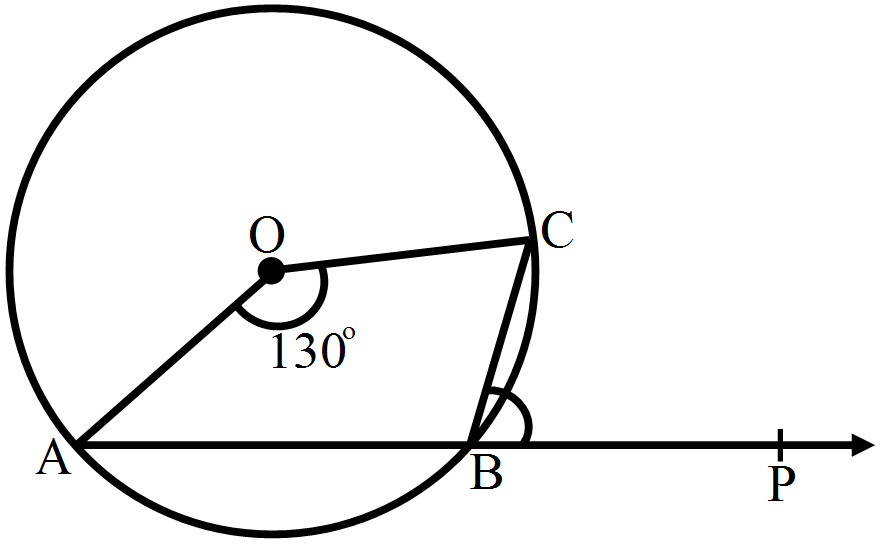
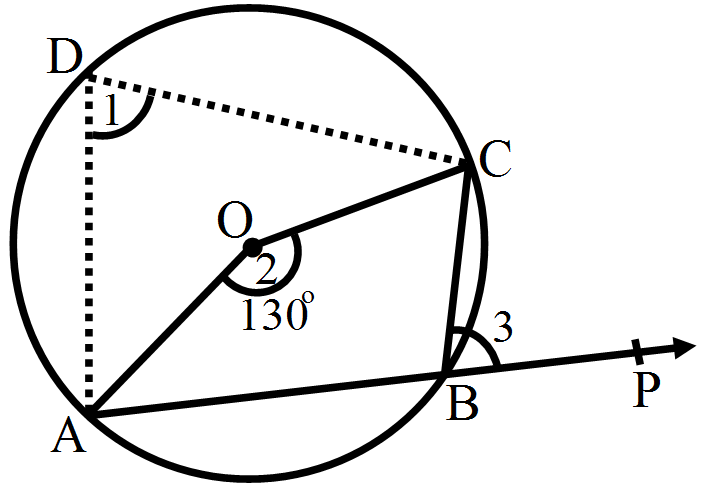
In the given figure, $O$ is the centre of the circle and arc $ABC$ subtends an angle of $130^\circ $ at the centre. If $AB$ is extended to $P,$ find $\angle\text{PBC}.$
Answer

Take a points $D$ on the major arc $CA$ and join $AD$ and $DC.$
​​​​​​​ $\therefore\ \angle{2}=2\angle{1}$ [Angle subtended by arc is twice the angle subtended by it on the circumference in the alternate segment] $\therefore\ 130^\circ=2\angle{1}$
$\Rightarrow\ \angle{1}=65^\circ\dots(\text{i})$
$\angle\text{PBC}=\angle{1}$
$[\because$ exterior angle of a cyclic quadrilateral interior opposite angle$]$
$\therefore\ \angle\text{PBC}=65^\circ$
View full question & answer
Question 43 Marks
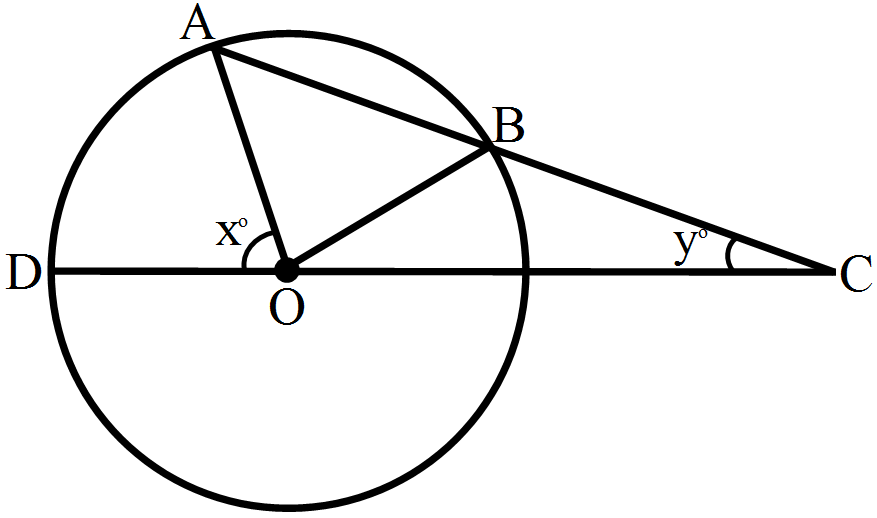
In the given figure, $AB$ is a chord of a circle with centre $O$ and $AB$ is produced to $C$ such that $BC = OB.$
Also, $CO$ is joined and produced to meet the circle in $D.$
If $\angle\text{ACD}=\text{y}^\circ$ and $\angle\text{AOD}=\text{x}^\circ,$ prove that $x = 3y.$
Answer
We have: $\text{OB}=\text{OC},$
$\angle\text{BOC}=\angle\text{BCO}=\text{y}$
External $\angle\text{OBA}=\angle\text{BOC}+\angle\text{BCO}=(2\text{y})$
Again, $\text{OA}=\text{OB},$
$\angle\text{OAB}=\angle\text{OBA}=(2\text{y})$
External $\angle\text{AOD}=\angle\text{OAC}+\angle\text{ACO}$ Or
$\text{x}=\angle\text{OAB}+\angle\text{BCO}$ Or
$\text{x}=(2\text{y})+\text{y}=32\text{y}$
Hence, $\text{x}=3\text{y}$
View full question & answer
Question 53 Marks
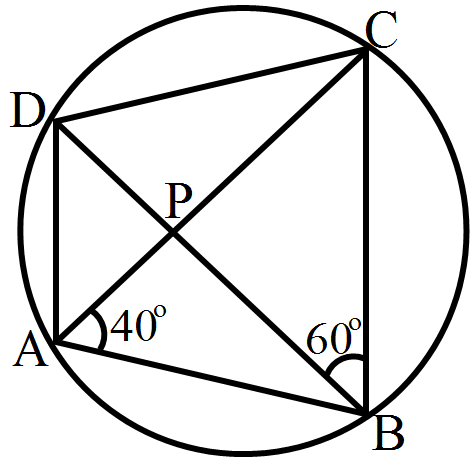
In the given figure, $\text{ABCD}$ is a cyclic quadrilateral whose diagonals intersect at $P$ such that $\angle\text{DBC}=60^\circ$ and $\angle\text{BAC}=40^\circ.$ Find
$i. \angle\text{BCD}$
$ii. \angle\text{CAD}$
Answer
$i. \angle\text{BDC}=\angle\text{BAC}=40^\circ [$Angles in the same segment$]$
In $\triangle\text{BCD},$ we have:
$\angle\text{BCD}+\angle\text{DBC}+\angle\text{BDC}=180^\circ [$Angle sum property of a triangle$]$
$\Rightarrow\ \angle\text{BCD}+60^\circ+40^\circ=180^\circ$
$\Rightarrow\ \angle\text{BCD}=(180^\circ-100^\circ)=80^\circ$
$ii. \angle\text{CAD}=\angle\text{CBD} [$Angles in the same segment$]$
$=60^\circ$
View full question & answer
Question 63 Marks
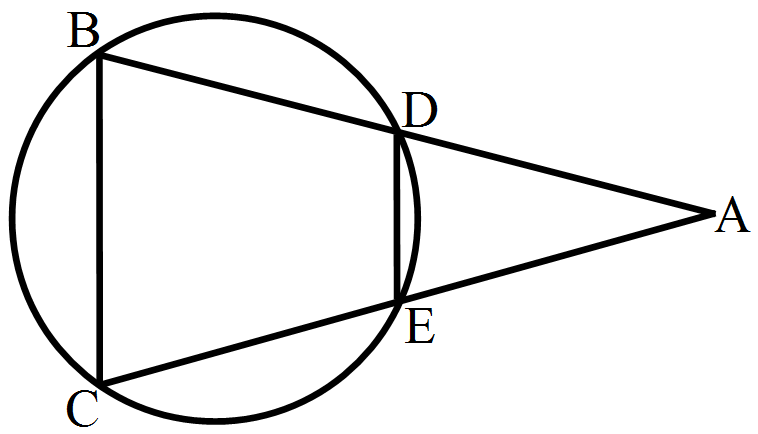
In the given figure $\triangle\text{ABC}$ is an isosceles triangle in which $AB = AC$ and a circle passing through $B$ and $C$ intersects $AB$ and $AC$ at $D$ and $E$ respectively. Prove that $DE || BC.$
Answer
$\triangle\text{ABC}$ is an isosceles triangle in which $AB = AC$ and circle passing through $B$ and $C$ intersects $AB$ and $AC$ at $D$ and $E$.
Since $AB = AC$
$\therefore\ \angle\text{ACB}=\angle\text{ABC}$
So, exterior $\ \angle\text{ADE}=\angle\text{ACB}=\angle\text{ABC}$
$\therefore\ \angle\text{ADE}=\angle\text{ABC}$
$\Rightarrow\ \text{DE }||\text{ BC}$
View full question & answer
Question 73 Marks
On a common hypotenuse $AB,$ two right triangles $ACB$ and $ADB$ are situated on opposite sides. Prove that $\angle\text{BAC}=\angle\text{BDC}.$
Answer

AB is the common hypotenuse of $\triangle\text{ACB}$ and $\triangle\text{ADB}.$
$\Rightarrow\ \angle\text{ACB}=90^\circ$ and $\angle\text{BDC}=90^\circ$
$\Rightarrow\ \angle\text{ACB}+\angle\text{BDC}=180^\circ$
$\Rightarrow $ The opposite angles of quadrilateral $ACBD$ are supplementary.
Thus, $ACBD$ is a cyclic quadrilateral.
This means that a circle passes through the points $A, C, B$ and $D.$
$\Rightarrow\ \angle\text{BAC}=\angle\text{BDC} [$angles in the same segment$]$
View full question & answer