Questions

True False[1 Marks ]

Take a timed test

10 questions · self-marked practice — reveal the answer and mark yourself.

Question 11 Mark
Write True or False and justify your answer in the following: $ABCD$ is a cyclic quadrilateral such that $\angle\text{A}=90^\circ,\angle\text{B}=70^\circ,\angle\text{C}=95^\circ$ and $\angle\text{D}=105^\circ.$
Answer
 In a cyclic quadrilateral, the sum of opposite angles is $180^\circ .$
Now, $\angle\text{A}+\angle\text{C}=90^\circ+95^\circ=185^\circ\neq180^\circ$ and $\angle\text{B}+\angle\text{D}=70^\circ+105^\circ=175^\circ\neq180^\circ$
Here, we see that, the sum of opposite angles is not equal to $180^\circ .$
So, it is not a cyclic quadrilateral.
View full question & answer
Question 21 Mark
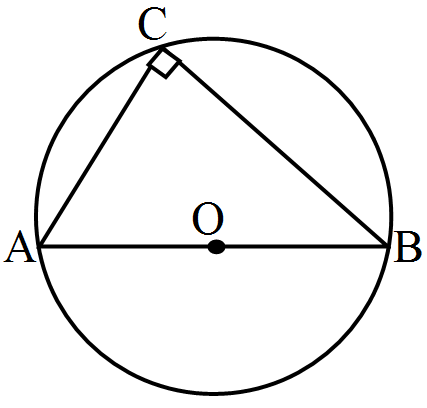
Write True or False and justify your answer in the following: If $AOB$ is a diameter of a circle and $C$ is a point on the circle, then $AC ^2+B C^2=A B^2$
Answer
True. Solution: Since, any diameter of the circle subtends a right angle to any point on the circle. If $AOB$ is a diameter of a circle and $C$ is a point on the circle, then $\triangle ACB$ is right angled at $C .$ In right angled $\triangle ACB$, [use Pythagoras theorem] $A C^2+B C^2=A B^2$
View full question & answer
Question 31 Mark
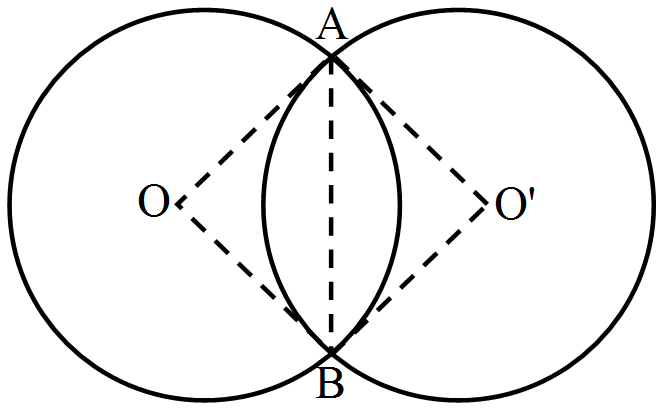
Write True or False and justify your answer in the following: Two congruent circles with centres $O$ and $O′$ intersect at two points $A$ and $B.$ Then $\angle\text{AOB}=\angle\text{AO'B}.$
Answer
 
 Join $AB$ and $OB, O'A$ and $BO'.$ In $\triangle\text{AOB}$ and $\triangle\text{AO'B,}$
$OA = AO' [$both circles have same radius$] OB = BO' [$both circles have same radius$]$ and $AB = AB [$common chord$]$ $\triangle\text{AOB}=\triangle\text{AO'B} [$by $SSC$ congruence rule$] \Rightarrow\angle\text{AOB}=\angle\text{AO'B} [$by $CPCT]$
View full question & answer
Question 41 Mark
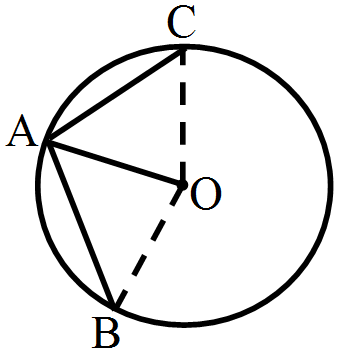
Write True or False and justify your answer in the following: Two chords $AB$ and $AC$ of a circle with centre $O$ are on the opposite sides of $OA.$ Then $\angle\text{OAB}=\angle\text{OAC}.$
Answer
In figure, $AB$ and $AC$ are two chords of a circle. Join $OB$ and $OC.$


In $\triangle\text{OAB}$ and $\triangle\text{OAC}, OA = OA [$common side$] OB = OC [$both are the radius of circle$]$
Here, we are not able to show that either the any angle or third side is equal and $\triangle\text{OAB}$ is,
​​​​​​​$\therefore\angle\text{OAB}\neq\angle\text{OAC}.$
View full question & answer
Question 51 Mark
Write True or False and justify your answer in the following: $A$ circle of radius $3\ cm$ can be drawn through two points $A, B$ such that $AB = 6\ cm.$
Answer
Suppose, we consider diameter of a circle is $AB = 66m.$ Then, radius of a circle $=\frac{\text{AB}}{2}=\frac{6}{2}=3\text{cm},$ which is true.
View full question & answer
Question 61 Mark
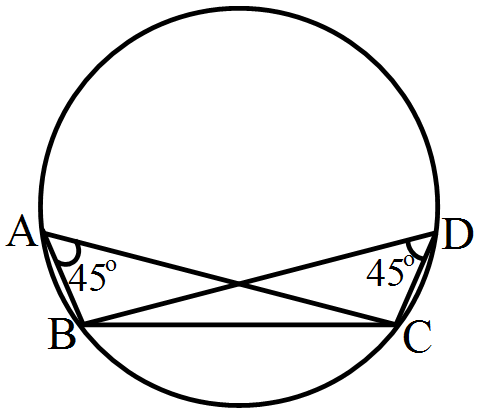
Write True or False and justify your answer in the following: If $A, B, C$ and $D$ are four points such that $\angle\text{BAC}=45^\circ$ and $\angle\text{BDC}=45^\circ,$ then $A, B, C, D$ are concyclic.
Answer
Since, $\angle\text{BAC}=45^\circ$ and $\angle\text{BDC}=45^\circ$

As we know, angles in the same segment of a circle are equal.
Hence, $A, B, C $ and $D$ are concyclic.
View full question & answer
Question 71 Mark
Write True or False and justify your answer in the following: Through three collinear points a circle can be drawn.
Answer
False. Solution: Because, circle can pass through only two collinear points but not through three collinear points.
View full question & answer
Question 81 Mark
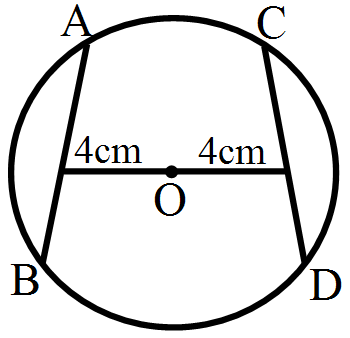
Write True or False and justify your answer in the following: Two chords $AB$ and $CD$ of a circle are each at distances $4\ cm$ from the centre. Then $AB = CD.$
Answer
Because, the chords equidistant from the centre of circle are equal in length.
View full question & answer
Question 91 Mark
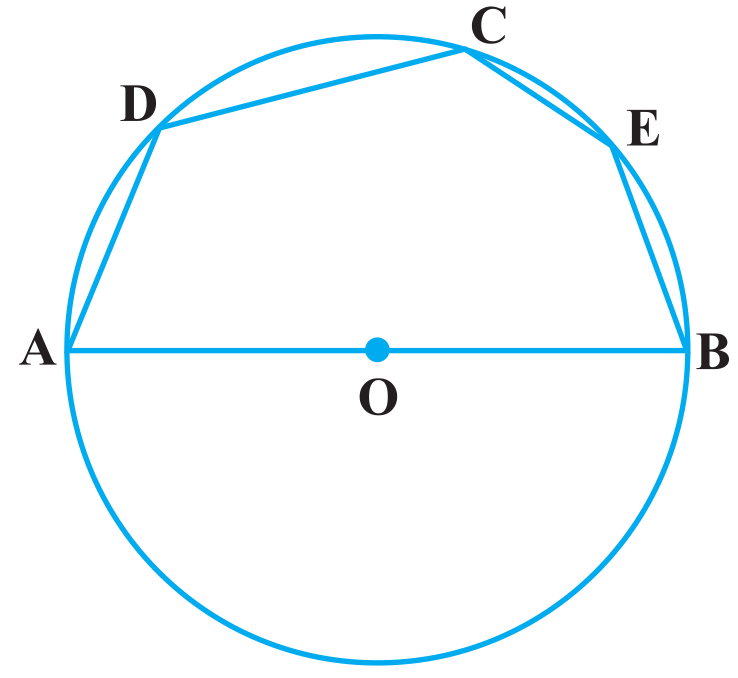
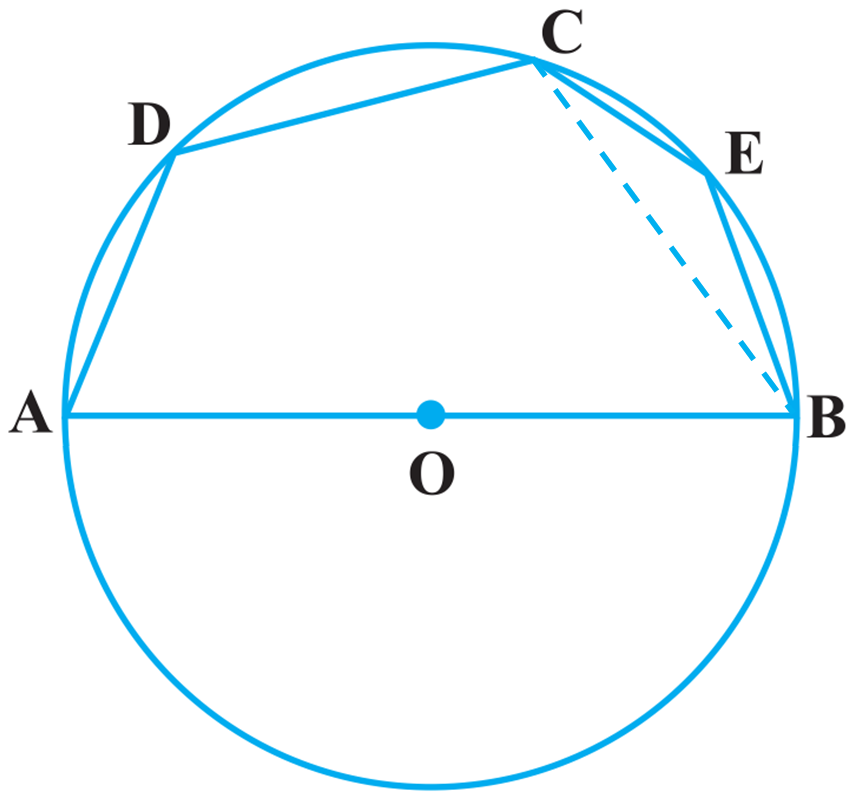
Write True or False and justify your answer in the following: In Fig. if $AOB$ is a diameter and $\angle\text{ADC}=120^\circ,$ then $\angle\text{CAB}=30^\circ.$
Answer
Join $CA$ and $CB.$

Since, $ADCB$ is a cyclic quadrilateral. $\angle\text{ADC}+\angle\text{CBA}=180^\circ [$sum of opposite angles of cyclic quadrilateral is $180^\circ ]$
$\Rightarrow\angle\text{CBA}=180^\circ-120^\circ=60^\circ\ \ [\therefore\angle\text{ADC}=120^\circ]$
In $\triangle\text{ACB,}\ \angle\text{CAB} + \angle\text{CBA} + \angle\text{ACB} = 180^\circ$
[by angle sum property of a triangle] $\angle\text{CAB}+60^\circ+90^\circ=180^\circ$
$\big[$triangle formed from diameter to the circle is 4
i.e., $\angle\text{ACB}=90^\circ\big]$
$\Rightarrow\angle\text{CAB}=180^\circ-150^\circ=30^\circ.$
View full question & answer
Question 101 Mark
Write True or False and justify your answer in the following: If $A, B, C, D$ are four points such that $\angle\text{BAC}=30^\circ$ and $\angle\text{BDC}=60^\circ$ then $D$ is the centre of the circle through $A, B$ and $C.$
Answer
Because, there can be many points $D,$ such that $\angle\text{BDC}=60^\circ$ and each such point cannot be the centre of the circle through $A, B$ and $C.$
View full question & answer