Questions

3 Marks Question

🎯

Test yourself on this topic

25 questions · timed · auto-graded

Question 13 Marks
Prove that two different circles cannot intersect each other at more than two points.
Answer
Suppose two circles intersect in three points $A, B, C$.
Then $A, B, C$ are non-collinear so a unique circle passes through these three points.
This is contradiction to the face that two given circles are passing through $A, B, C$.
Hence, two circles cannot intersect each other at more than two points.
View full question & answer
Question 23 Marks
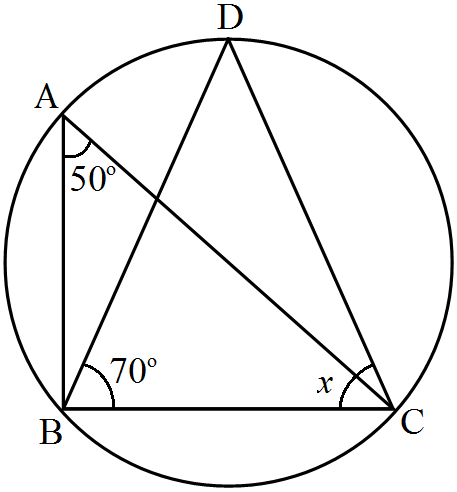
If $O$ is the centre of the circle, find the value of $x$ in the following figure:
Answer
We have$\angle\text{BAC}=50^\circ$ and $\angle\text{DBC}=70^\circ$
$\therefore\angle\text{BDC}=\angle\text{BAC}$ [Angle in same segment]
In $\triangle\text{BDC},$ by angle sum property
$\angle\text{BDC}+\angle\text{BCD}+\angle\text{DBC}=180^\circ$
$\Rightarrow50^\circ+\text{x}+70^\circ=180^\circ$
$\Rightarrow\text{x}=180^\circ-50^\circ-70^\circ=60^\circ$
View full question & answer
Question 33 Marks
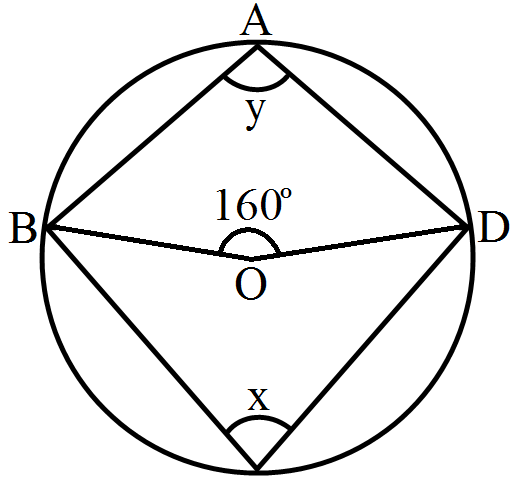
In the given figure, $O$ is the center of the circle. If $\angle\text{BOD}=160^\circ,$ find the value of $x$ and $y$.
Answer
We have, $\angle\text{BOD}=160^\circ$
By degree measure theorem $\angle\text{BOD}=2\angle\text{BCD}$
$\Rightarrow160^\circ=\text{2x}$ $\Rightarrow\text{x}=\frac{160^\circ}{2}=80^\circ$
$\therefore\angle\text{BAD}+\angle\text{BCD}=180^\circ$ [Opposite angles of cyclic quad.]
$\Rightarrow\text{y}+\text{x}=180^\circ$
$\Rightarrow\text{y}+80^\circ=180^\circ$
$\Rightarrow\text{y}=180^\circ-80^\circ=100^\circ$
View full question & answer
Question 43 Marks
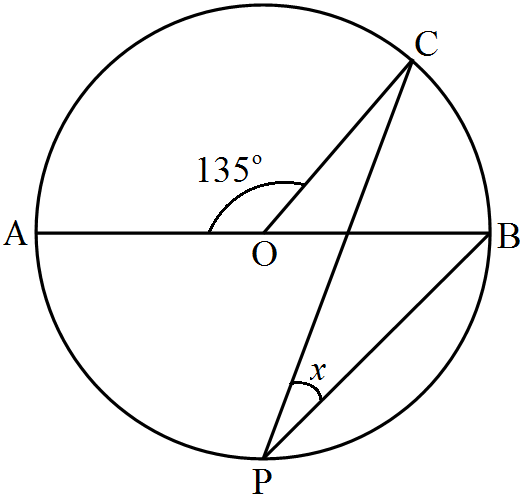
If $O$ is the centre of the circle, find the value of $x$ in the following figures:
Answer
$\angle\text{AOC}=135^\circ$
$\therefore\angle\text{AOC}+\angle\text{BOC}=180^\circ$ [Linear pair of angles]
$\Rightarrow135^\circ+\angle\text{BOC}=180^\circ$
$\Rightarrow\angle\text{BOC}=180^\circ-135^\circ$
$\Rightarrow\angle\text{BOC}=45^\circ$
By degree measure theorem$\angle\text{BOC}=2\angle\text{CPB}$
$\Rightarrow45^\circ=\text{2x}$
$\Rightarrow\text{x}=\frac{45^\circ}{2}=22\frac{1}{2}^\circ$
View full question & answer
Question 53 Marks
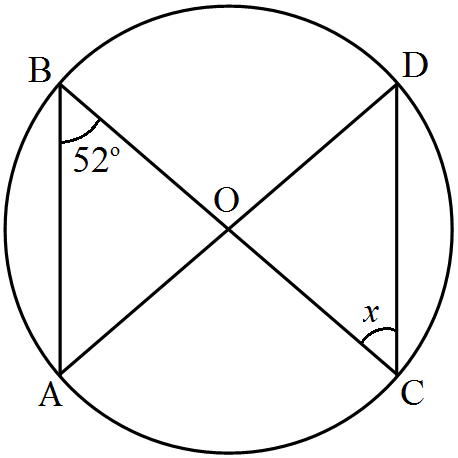
If $O$ is the centre of the circle, find the value of $x$ in the following figure:
Answer
Given that, $\angle\text{ABD} = 40^\circ$
Then $\angle\text{BDC}=\angle\text{BAC}=52^\circ$ [Angle in same segment]
Since $OD = OC$
Then $\angle\text{ODC}=\angle\text{OCD}$ [Opposite angle to equal radii]
$\Rightarrow\text{x}=52^\circ$
View full question & answer
Question 63 Marks
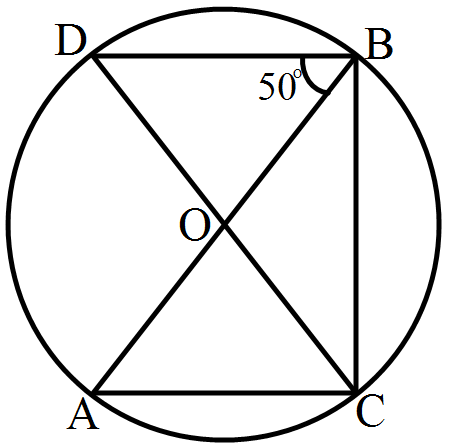
In the given figure, $AB$ and $CD$ are diameters of a circle with center $O$. if $\angle\text{OBD}=50^\circ,$ find $\angle\text{AOC}.$
Answer
We have, $\angle\text{OBD}=50^\circ$ Since, $AB$ and $CD$ are diameters of circle then $O$ is the center of the circle.
$\therefore​​\angle\text{DBC}=90^\circ$ [Angle in semicircle]
$\Rightarrow\angle\text{DOB}+\angle\text{OBC}=90^\circ$
$\Rightarrow50^\circ+\angle\text{OBC}=90^\circ$
$\Rightarrow\angle\text{OBC}=90^\circ-50^\circ=40^\circ$
By degree measure theorem $\angle\text{AOC}=2\angle\text{ABC}$
$\Rightarrow\angle\text{AOC}=2\times40^\circ=80^\circ$
View full question & answer
Question 73 Marks
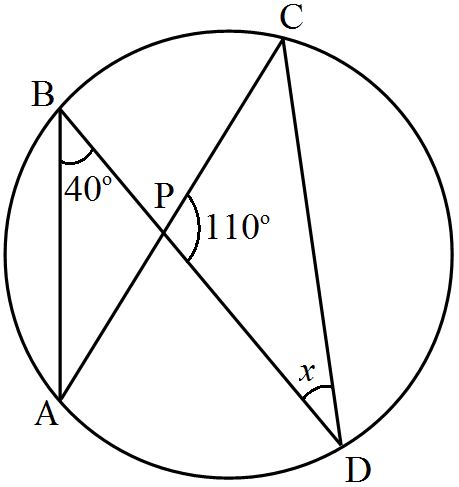
If $O$ is the centre of the circle, find the value of $x$ in the following figure:
Answer
We have,
$\angle\text{ABD} = 40^\circ$
$\angle\text{ACD}=\angle\text{ABD}=40^\circ$ [Angle in same segment]
In $\triangle\text{PCD},$ by angle sum property
$\angle\text{PDC}+\angle\text{CPO}+\angle\text{PDC}=180^\circ$
$\Rightarrow40^\circ+110^\circ+\text{x}=180^\circ$
$\Rightarrow\text{x}=180^\circ-150^\circ$
$\Rightarrow\text{x}=30^\circ$
View full question & answer
Question 83 Marks
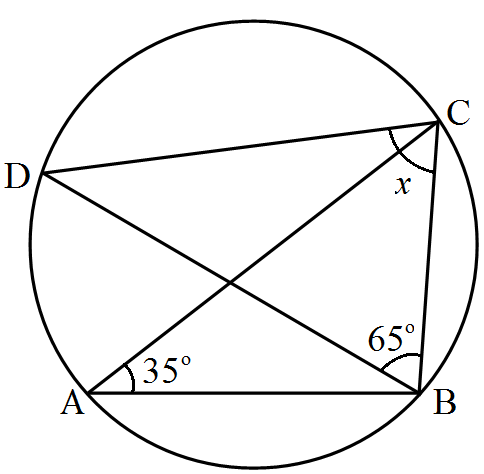
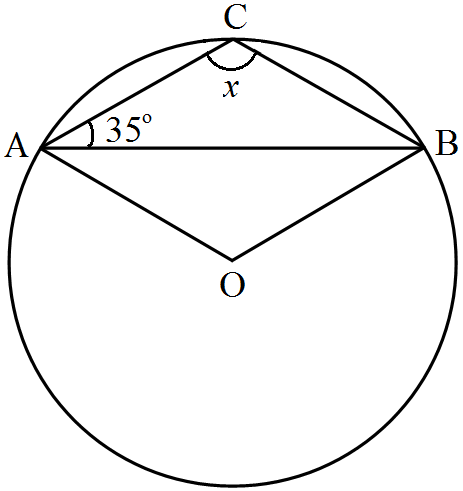
If $O$ is the centre of the circle, find the value of $x$ in the following figure:
Answer
We have, $\angle\text{BAC} = 35^\circ $
$\angle\text{BDC}=\angle\text{BAC}=35^\circ$ [Angle in same segment] In $\triangle\text{BCD},$
by angle sum property $\angle\text{BDC}+\angle\text{BCD}+\angle\text{DBC}=180^\circ$
$\Rightarrow35^\circ+\text{x}+65^\circ=180^\circ$
$\Rightarrow\text{x}=180^\circ-35^\circ-65^\circ=80^\circ$
View full question & answer
Question 93 Marks
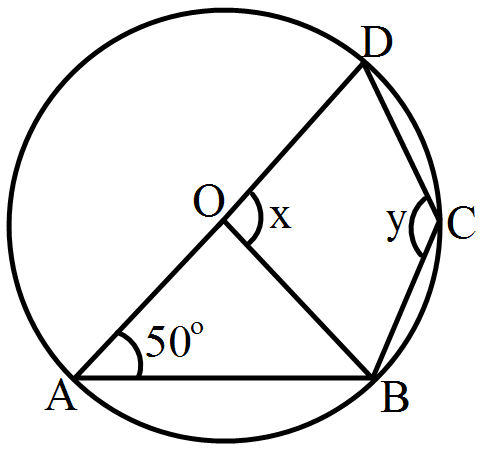
In the given figure, $O$ is the center of the circle and $\angle\text{DAB}=50^\circ.$ Calculate the values of $x$ and $y$.
Answer
We have, $\angle\text{DAB}=50^\circ$
By degree measure theorem $\angle\text{BOD}=2\angle\text{BAD}$
$\Rightarrow\text{x}=2\times50^\circ=100^\circ$
Since, $ABCD$ is a cyclic quadrilateral Then, $\angle\text{A}+\angle\text{C}=180^\circ$
$\Rightarrow50^\circ+\text{y}=180^\circ$
$\Rightarrow\text{y}=180^\circ-50^\circ=130^\circ$
View full question & answer
Question 103 Marks
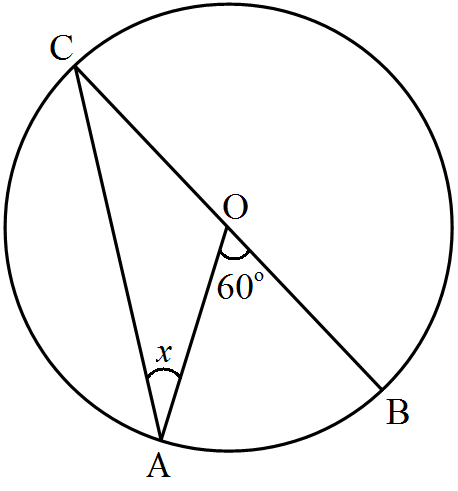
If $O$ is the centre of the circle, find the value of $x$ in the following figure:
Answer
We have $\angle\text{AOB}=60^\circ$
By degree measure theorem reflex $\angle\text{AOB}=2\angle\text{ACB}$
$\Rightarrow60^\circ=2\angle\text{ACB}$
$\Rightarrow\angle\text{ACB}=\frac{60^\circ}{2}=30^\circ$ [Angles opposite to equal radii]
$\Rightarrow\text{x}=30^\circ$
View full question & answer
Question 113 Marks
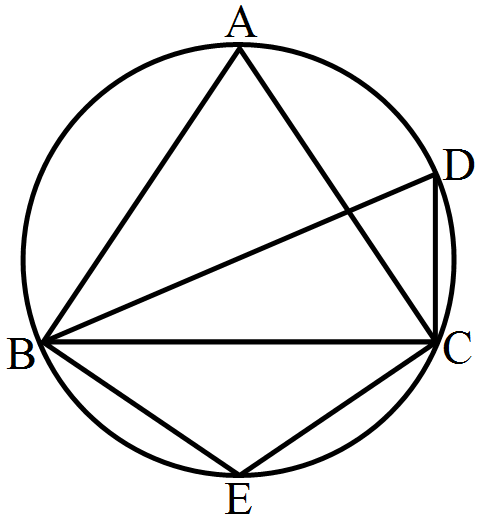
In the given figure, If $ABC$ is an equilateral triangle. Find $\angle\text{BDC}$ and $\angle\text{BEC.}$
Answer
Since, $\triangle\text{ABC}$ is an equilateral triangle
Then, $\angle\text{BAC}=60^\circ$
$\therefore\angle\text{BDC}=\angle\text{BAC}=60^\circ$ [Angles in same segment]
Since, quad. $ABEC$ is a cyclic quadrilateral.
Then, $\angle\text{BAC}+\angle\text{BEC}=180^\circ$
$\Rightarrow60^\circ+\angle\text{BEC}=180^\circ$
$\Rightarrow\angle\text{BEC}=180^\circ-60^\circ=120^\circ$
View full question & answer
Question 123 Marks
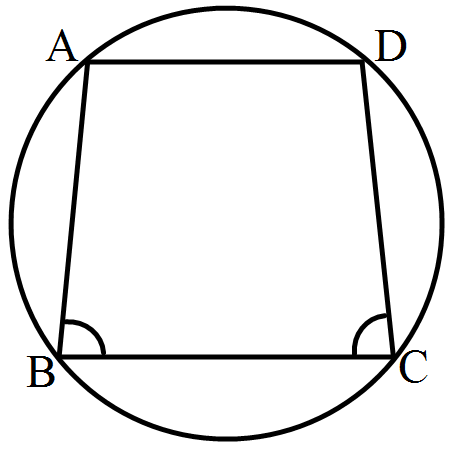
If $ABCD$ is a cyclic quadrilateral in which $AD\ ||\ BC$. Prove that $\angle\text{B}=\angle\text{C}.$
Answer
Since, $ABCD$ is a cyclic quadrilateral with $AD\ ||\ BC$ Then,
$\angle\text{A}+\angle\text{C}=180^\circ\dots(1)$ [Opposite angles of cyclic quad.] And,
$\angle\text{A}+\angle\text{B}=180^\circ\dots(2)$ [Co-interior angles] Compare equations $(1)$ and $(2)$
$\angle\text{B}=\angle\text{C}$
View full question & answer
Question 133 Marks
Prove that the perpendicular bisectors of the sides of a cyclic quadrilateral are concurrent.
Answer
Let $ABCD$ be a cyclic quadrilateral, and let $O$ be the centre of the corresponding circle.
Then, each side of quadrilateral $ABCD$ is a chord of the circle and the perpendicular bisector of a chord always passes through the centre of the circle.
So, right bisectors of the sides of quadrilateral $ABCD$ will pass through the center $O$ of the corresponding circle.
View full question & answer
Question 143 Marks
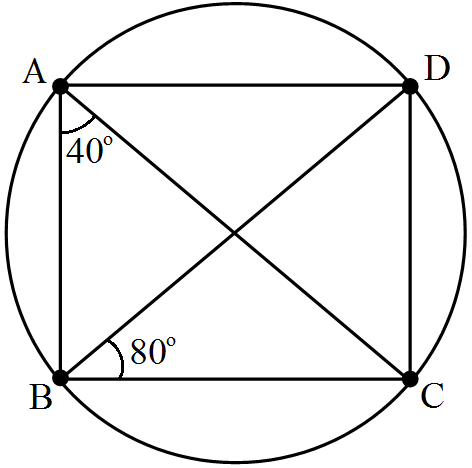
$ABCD$ is a cyclic qudrilateral in which: $ \angle\text{DBC}=80^\circ$ and $\angle\text{BAC}=40^\circ.$ Find $\angle\text{BCD}.$
Answer

$\angle\text{BAC}=\angle\text{BDC}=40^\circ$ [Angle in same segment]
In by angle sum property $\angle\text{DBC}+\angle\text{BCD}+\angle\text{BDC}=180^\circ$
$\Rightarrow80^\circ+\angle\text{BCD}+40^\circ=180^\circ$
$\Rightarrow\angle\text{BCD}=180^\circ-80^\circ-40^\circ=60^\circ$
View full question & answer
Question 153 Marks
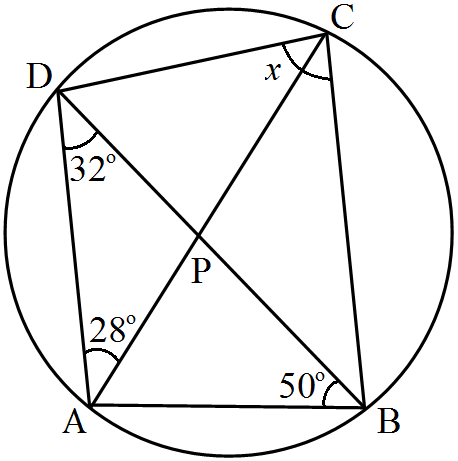
If $O$ is the centre of the circle, find the value of $x$ in the following figure:
Answer
In $\triangle\text{DAB},$ by angle sum property $\angle\text{ADB}+\angle\text{DAB}+\angle\text{ABD}=180^\circ$
$\Rightarrow32^\circ+\angle\text{DAB}+50^\circ=180^\circ$
$\Rightarrow\angle\text{DAB}=180^\circ-32^\circ-50^\circ$
$\Rightarrow\angle\text{DAB}=98^\circ+50^\circ$
Now, $\angle\text{OAB}+\angle\text{DCB}=180^\circ$ [Opposite angles of cyclic quadrilateral]
$\Rightarrow98^\circ+\text{x}=180^\circ$
$\Rightarrow\text{x}=180^\circ-98^\circ=82^\circ$
View full question & answer
Question 163 Marks
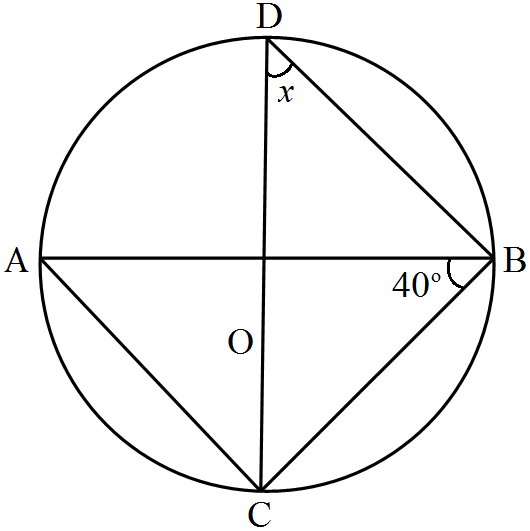
If $O$ is the centre of the circle, find the value of $x$ in the following figures:
Answer
We have $\angle\text{ABC}=40^\circ$ $\angle\text{ACB}=90^\circ$ [Angle in semi circle] In
$\triangle\text{ABC,}$ by angle sum property$\angle\text{CAB}+\angle\text{ACB}+\angle\text{ABC}=180^\circ$
$\Rightarrow\angle\text{CAB}+90^\circ+40^\circ=180^\circ$
$\Rightarrow\angle\text{CAB}=180^\circ-90^\circ-40^\circ$
$\Rightarrow\angle\text{CAB}=50^\circ$
Now, $\angle\text{CDB}=\angle\text{CAB}$ [Angle is same in segment]
$\Rightarrow\text{x}=50^\circ$
View full question & answer
Question 173 Marks
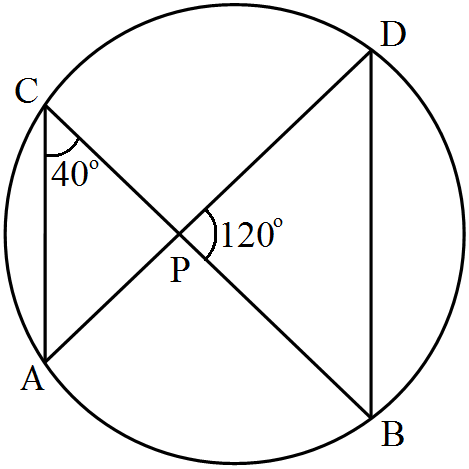
In figure, if $\angle\text{ACB} = 40^\circ, \angle\text{DPB} = 120^\circ,$ find $\angle\text{CBD}.$
Answer
We have, $\angle\text{ACB} = 40^\circ, \angle\text{DPB} = 120^\circ$
$\therefore\angle\text{APB}=\angle\text{DCB}=40^\circ$ [Angle in same segment] In
$\triangle\text{POB},$ by angle sum property $\angle\text{PDB}+\angle\text{PBD}+\angle\text{BPD}=180^\circ$
$\Rightarrow40^\circ +\angle\text{PBD}+120^\circ=180^\circ$
$\Rightarrow\angle\text{PBD}=180^\circ-40^\circ-120^\circ$
$\Rightarrow\angle\text{PBD}=20^\circ$ $\therefore\angle\text{CBD}=20^\circ$
View full question & answer
Question 183 Marks
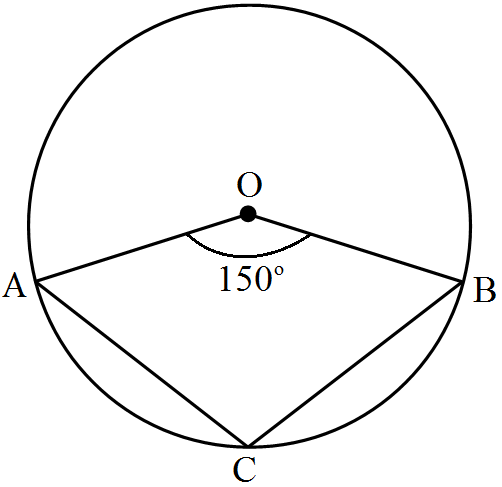
In figure, it is given that $O$ is the centre of the circle and $\angle\text{AOC} = 150^\circ.$ Find $\angle\text{ABC}.$
Answer
$\angle\text{AOC}=150^\circ$
$\therefore\angle\text{AOC}+\text{reflex }\angle\text{AOC}=360^\circ$ [complex angle]
$\Rightarrow150^\circ+\text{reflex }\angle\text{AOC}=360^\circ$
$\Rightarrow\text{reflex }\angle\text{AOC}=360^\circ-150^\circ$
$\Rightarrow\text{reflex }\angle\text{AOC}=210^\circ$
$\Rightarrow2\angle\text{ABC}=210^\circ$ [By degree measure theorem]
$\Rightarrow\angle\text{ABC}=\frac{210^\circ}{2}=105^\circ$
View full question & answer
Question 193 Marks
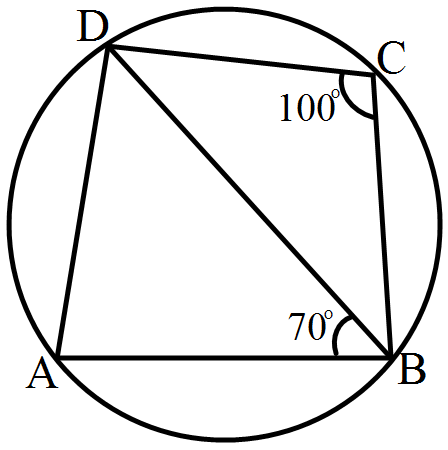
In the given figure $ABCD$ is a cyclic quadrilateral. If $\angle\text{BCD}=100^\circ$ and $\angle\text{ABD}=70^\circ,$ find $\angle\text{ADB}.$
Answer
We have, $\angle\text{BCD}=100^\circ$ and $\angle\text{ABD}=70^\circ$
$\therefore\angle\text{DAB}+\angle\text{BCD}=180^\circ$ [Opposite angles of cyclic quad.]
$\Rightarrow\angle\text{DAB}+100^\circ=180^\circ$
$\Rightarrow\angle\text{DAB}+180^\circ-100^\circ=80^\circ$ In
$\triangle\text{DAB},$ by angle sum property $
\angle\text{ADB}+\angle\text{DAB}+\angle\text{ABD}=180^\circ$
$\Rightarrow\angle\text{ADB}+80^\circ+70^\circ=180^\circ$
$\Rightarrow\angle\text{ADB}=180^\circ-80^\circ-70^\circ=30^\circ$
View full question & answer
Question 203 Marks
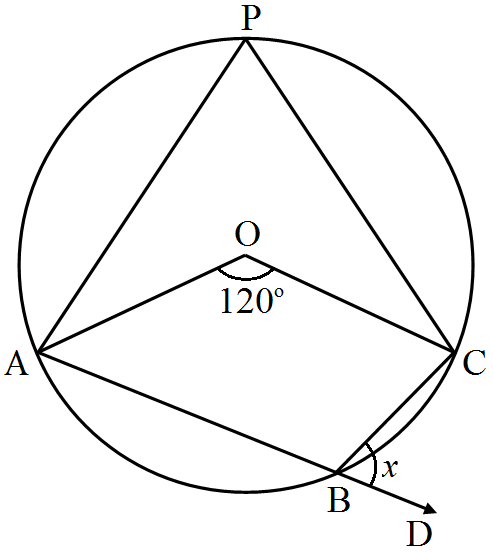
If $O$ is the centre of the circle, find the value of $x$ in the following figure:
 
Answer
We have$\angle\text{AOC}=120^\circ$ By degree measure theorem.
$\angle\text{AOC}=2\angle\text{APC}$
$\Rightarrow120^\circ=2\angle\text{APC}$
$\Rightarrow\angle\text{APC}=\frac{120^\circ}{2}=60^\circ$
$\angle\text{APC}+\angle\text{ABC}=180^\circ$ [Opposite angles of cyclic quadrilaterals]
$\Rightarrow60^\circ+\angle\text{ABC}=180^\circ$
$\Rightarrow\angle\text{ABC}=180^\circ-60^\circ$
$\Rightarrow\angle\text{ABC}=120^\circ$
$\therefore\angle\text{ABC}+\angle\text{DBC}=180^\circ$ [Linear pair of angles]
$\Rightarrow120^\circ+\text{x}=180^\circ$
$\Rightarrow\text{x}=180^\circ-120^\circ=60^\circ$
View full question & answer
Question 213 Marks
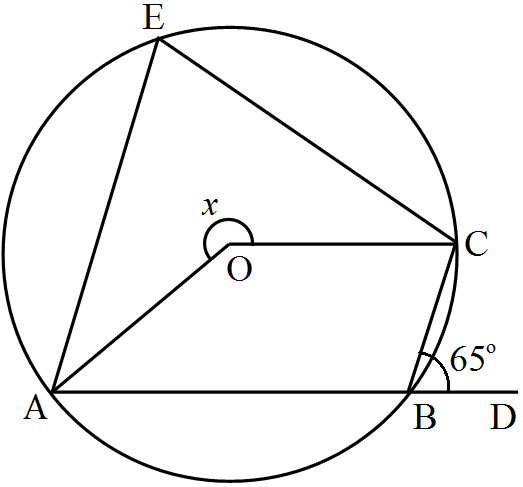
If $O$ is the centre of the circle, find the value of $x$ in the following figure:
Answer
We have$\angle\text{CBD}=65^\circ$
$\therefore\angle\text{ACB}+\angle\text{CBD}=180^\circ$ [Linear pair of angles]
$\Rightarrow\angle\text{ABC}=65^\circ=180^\circ$
$\Rightarrow\angle\text{ABC}=180^\circ-65^\circ=115^\circ$
$\therefore\text{reflex}\angle\text{AOC}=2\angle\text{ABC}$ [By degree measure theorem]
$\Rightarrow\text{x}=2\times115^\circ$
$\Rightarrow\text{x}=230^\circ$
View full question & answer
Question 223 Marks
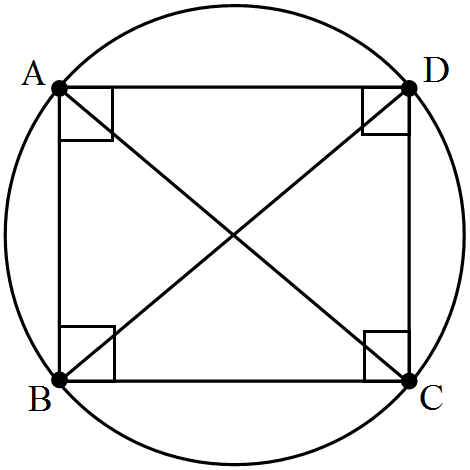
Prove that the centre of the circle circumscribing the cyclic rectangle $ABCD$ is the point of intersection of its diagonals.
Answer

 Let $O$ be the centre of the circle circumscribing the cyclic rectangle $ABCD$.
since $\angle\text{ABC}=90^\circ$ and $AC$ is a chord of the circle, so, $AC$ is a diameter of the circle.
Similarly, $BD$ is a diameter.
Hence, point of intersection of $AC$ and $BD$ is the center of the circle.
View full question & answer
Question 233 Marks
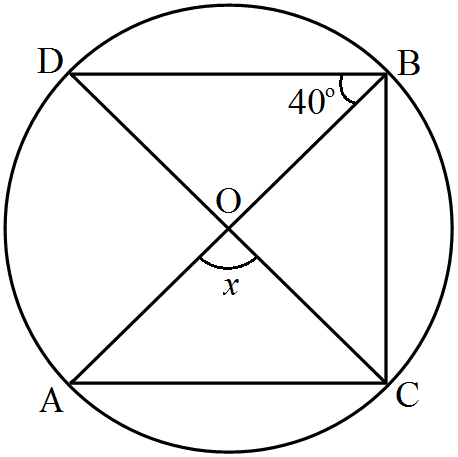
If $O$ is the centre of the circle, find the value of $x$ in the following figure:
Answer
We have$\angle\text{DOB}=40^\circ$ and $\angle\text{DBC}=90^\circ$ [Angle in a semicircle]
$\Rightarrow\angle\text{DOB}+\angle\text{OBC}=90^\circ$
$\Rightarrow40^\circ+\angle\text{OBC}=90^\circ$
$\Rightarrow\angle\text{OBC}=90^\circ-40^\circ=50^\circ$ By degree measure theorem
$\angle\text{AOC}=2\angle\text{OBC}$
$\Rightarrow\text{x}=2\times50^\circ=100^\circ$
View full question & answer
Question 243 Marks
If $O$ is the centre of the circle, find the value of $x$ in the following figure:
Answer
We have $\angle\text{OAB}=35^\circ$ then,
$\angle\text{OBA}=\angle\text{OAB}=35^\circ$ [Angles opposite to equal radii] In
$\triangle\text{AOB},$ by angle sum property
$\Rightarrow\angle\text{AOB}+\angle\text{OAB}+\angle\text{OBA}=180^\circ$
$\Rightarrow\angle\text{AOB}+35^\circ+35^\circ=180^\circ$
$\Rightarrow\angle\text{AOB}=180^\circ-35^\circ-35^\circ=110^\circ$
$\therefore\angle\text{AOB}+\text{reflex }\angle\text{AOB}=360^\circ$ [Complex angle]
$\Rightarrow110^\circ+\text{reflex }\angle\text{AOB}=360^\circ$
$\Rightarrow\text{reflex }\angle\text{AOB}=360^\circ-110^\circ=250^\circ$
By degree measure theorem reflex $\angle\text{AOB}=2\angle\text{ACB}$
$\Rightarrow250^\circ=\text{2x}$
$\text{x}=\frac{250^\circ}{2}=125^\circ$
View full question & answer
Question 253 Marks
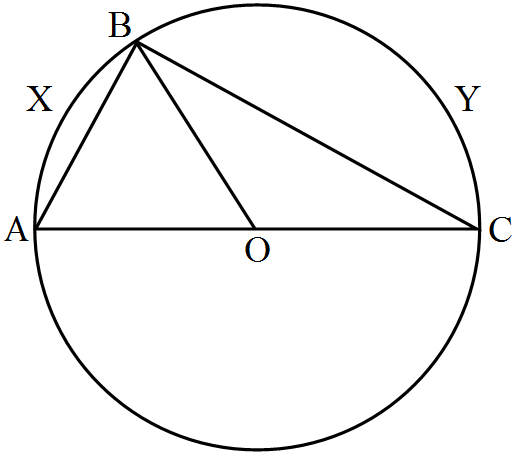
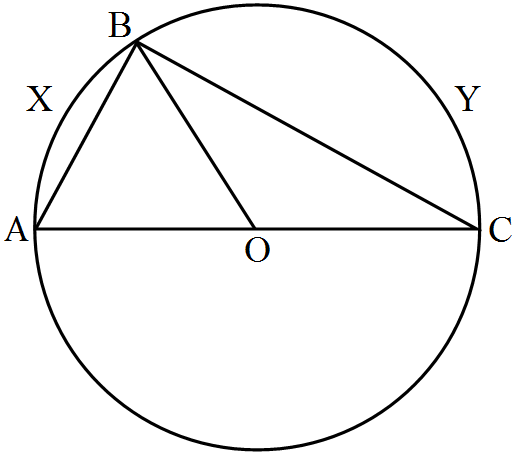
If the given figure, $AOC$ is a diameter of the circle and arc $\text{AXB}=\frac{1}{2}$ arc $BYC$. Find $\angle\text{BOC.}$
Answer
We need to find $\angle\text{BOC}$
$\text{arc}\ \text{AXB}=\frac{1}{2} \text{arc}\ \text{BYC},$
$\angle\text{AOB}=\frac{1}{2}\angle\text{BOC}$
Also $\angle\text{AOB}+\angle\text{BOC}=180^\circ$
Therefore, $\frac{1}{2}\angle\text{BOC}+\angle\text{BOC}=180^\circ$
$\Rightarrow\angle\text{BOC}=\frac{2}{3}\times180^\circ=120^\circ$
View full question & answer