Questions

True False[1 Marks ]

Take a timed test

15 questions · self-marked practice — reveal the answer and mark yourself.

Question 11 Mark
The following statements are true (T) and which are false (F):If the bisector of the verical angle of a triangle bisects the base, then the triangle may be isosceles.
Answer
False.Explenation:
The angular bisector of the vertex angle is also a mediam.
⇒ The tirnagle must be a isosceles and also may be an equilateral triangle.
View full question & answer
Question 21 Mark
The following statement are true $(T)$ and which are false $(F):$ Angles opposite to equal sides of a triangle are equal.
Answer
 Since the sides are equal, the corresponding opposite angles must be equal.
View full question & answer
Question 31 Mark
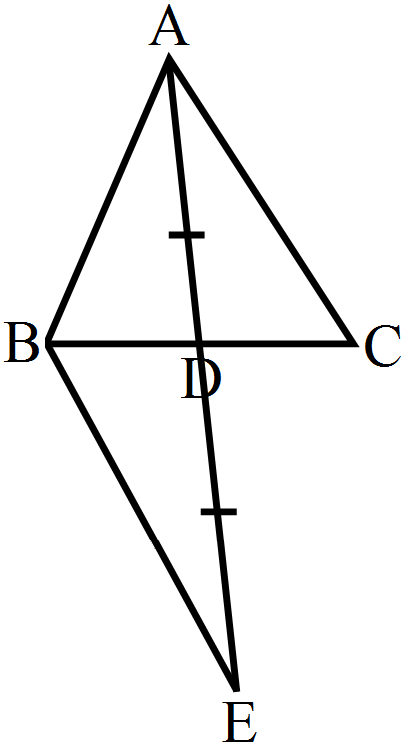
The following statements are true and which are false? Sum of any two sides of a triangle is greater than twice the median drown to the third side.
Answer

Given: In triangle $ABC, AD$ is the median drawn from $A$ to $BC.$
To prove: $AB + AC > AD$ Construction: Produce $AD $ to $E$ so that $DE = AD,$ Join $BE.$
Proof: Now in $\triangle\text{ADC}$ and $\triangle\text{EDB},$
$AD = DE ($by const$) DC = BD($as $D$ is mid-point$)$
$\angle\text{ADC}=\angle\text{EDB}$
$\big($vertically opp, $\angle\text{S}\big)$
Therefore, $\triangle\text{ABE}, ​​\triangle\text{ADC}\cong\triangle\text{EDB} ($by $SAS)$
This gives, $BE = AC. AB + BE > AE AB + AC > 2AD$
$\big(\therefore AD = DE$ and $BE = AC\big)$
Hence the sum of any two sides of a triangle is greater than the median drawn to the third side.
View full question & answer
Question 41 Mark
The following statements are true and which are false?
Of all the line segments that can be drawn from a point to a line not containing it, the perpendicular line segment is the shortest one.
Answer
True.
Explanation:
The perpendicular distance is the shortest distance from a point to a line not containing it.
View full question & answer
Question 51 Mark
The following statements are true $(T)$ and which are false $(F):$ The two alitutde corresponding to two equal sides of a triangle need not be equal.
Answer
Since two sides are equal, the triangle is an isosceles triangle. The two altitudes corresponding to two equal side must be equal.
View full question & answer
Question 61 Mark
The following statements are true $(T)$ and which are false $(F):$ The bisectors of two equal angles of a triangle are equal.
Answer
 Since it an isosceles triangle, the lenghts of bisectors of the two equal angles are equal.
View full question & answer
Question 71 Mark
The following statements are true and which are false$?$ Sum of the three sides of a triangle is less than the sum of its three altitudes.
Answer
 Sum of these sides of a triangle is greater than sum of its three altitudes.
View full question & answer
Question 81 Mark
The following statements are true and which are false? If two angles of a triangle are unequal, then the greater angle has the larger side opposite to it.
Answer
True. Explanation: The side opposite to greater angle is longer and smaller angle is shorter in a triangle.
View full question & answer
Question 91 Mark
The following statement are true $(T)$ and which are false $(F):$ Side opposite to equal angles of a triangle may be unequal.
Answer
 Side opposite to equal angles of a triangle are equal.
View full question & answer
Question 101 Mark
The following statements are true and which are false? Difference of any two sides of a triangle is equal to the third side.
Answer
False. Explanation: The difference of any two sides of a triangle is less than third side.
View full question & answer
Question 111 Mark
The following statement are true $(T)$ and which are false $(F):$ If the altitude from one vertex of a triangle bisects the opposite side, then the triangle may be isosceles.
Answer
Here the altitude from the vertex is also the perpendicular bisector of the opposite side. The triangle must be isosceles and may be an equilateral triangle.
View full question & answer
Question 121 Mark
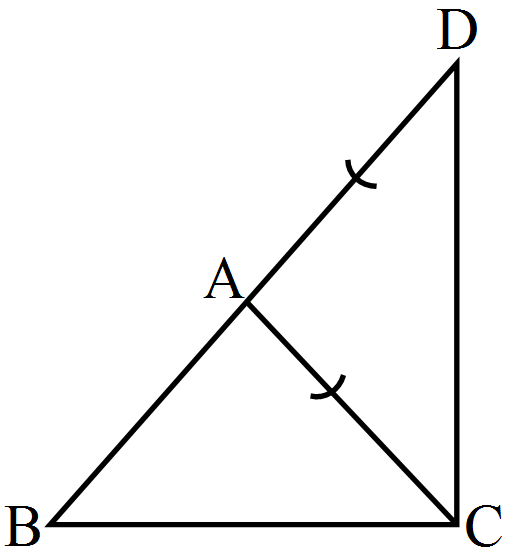
The following statements are true and which are false? Sum of any two sides of a triangle is greater than the third side.
Answer

Given $\triangle\text{ABC},$ extend $BA$ to $D$ such that $AD = AC.$
Now in $\triangle\text{DBC},$
$\angle\text{ADC} = \angle\text{ACD } [$Angles opposite to equal sides are equal$]$
Hence $\angle\text{BCD} > \angle\text{BDC}$
That is $BD > BC [$The side opposite to the larger $($greater$)$ angle is longer$]$
$⇒ AB + AD > BC$
$\therefore AB + AC > BC [$Since $AD = AC)$
Thus sum of two sides of a triangle is always greater than third side.
View full question & answer
Question 131 Mark
The following statements are true $(T)$ and which are false $(F):$ Two right triangles are congruent if hypoenuse and a side of the other trianlge.
Answer
According to $RHS$ congruence criterion the given statment is true.
View full question & answer
Question 141 Mark
The following statements are true $(T)$ and which are false $(F):$ If any two sides of a right triangle are respectively equal to two sides of other right triangle then the two triangle are congruent.
Answer
The two right triangles may or may not be congrunt.
View full question & answer
Question 151 Mark
The following statement are true $(T)$ and which are false $(F):$ The measure of each angle of an equilateral triangle $60^\circ .$
Answer
Since all the three angles of equilateral triangles are equal and sum of the three angles is $180^\circ $, each angle will be equal to $\frac{180^\circ}{3}=60^\circ.$
View full question & answer