Questions

3 Marks Question

Take a timed test

12 questions · self-marked practice — reveal the answer and mark yourself.

Question 13 Marks
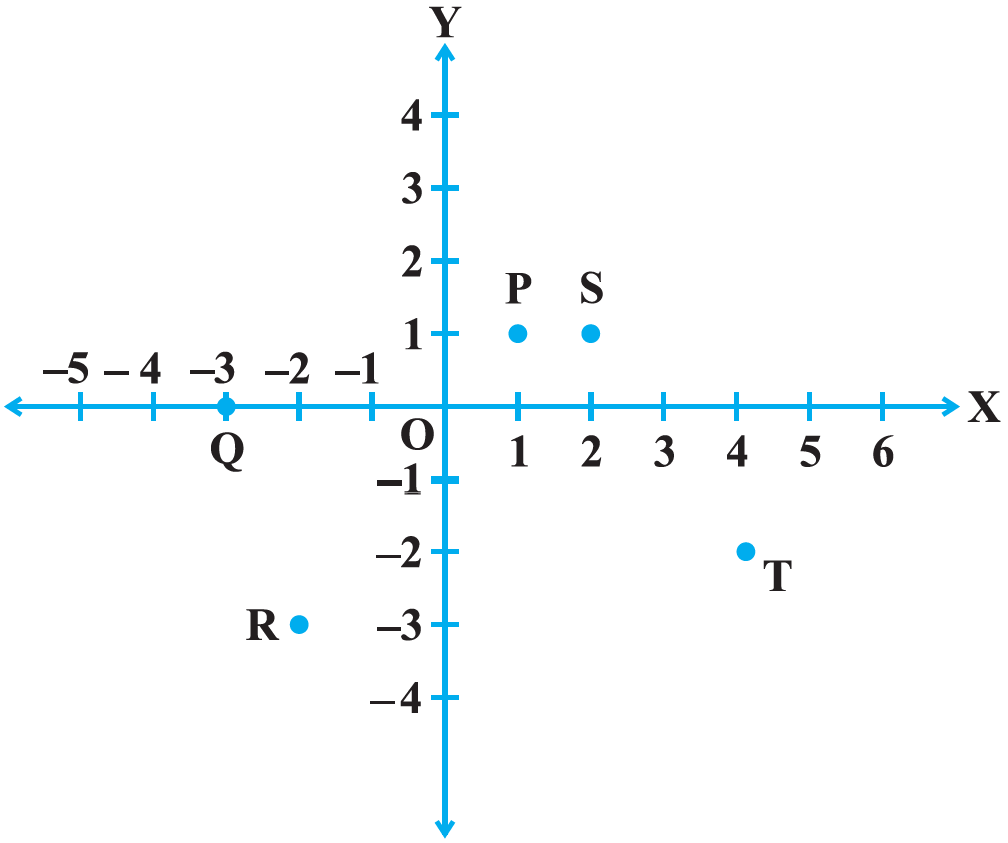
Write the coordinates of each of the points $P, Q, R, S, T$ and $O$ from the:
Answer
Thinking Process:
Firstly, draw the perpendicular lines from the point to the coordinates axes.
Further, measure the distance from intersecting points to the origin along their sign.
Finally, write the $x$ unit distance and $y$ unit distance in pair.
Sol. The coordinates of the points $P, Q, R, S, T$ and $O$ are $P(1, 1), Q(-3, 0), R(-2, -3), S(2, 1), T (4, -2)$ and $O(0, 0).$
View full question & answer
Question 23 Marks
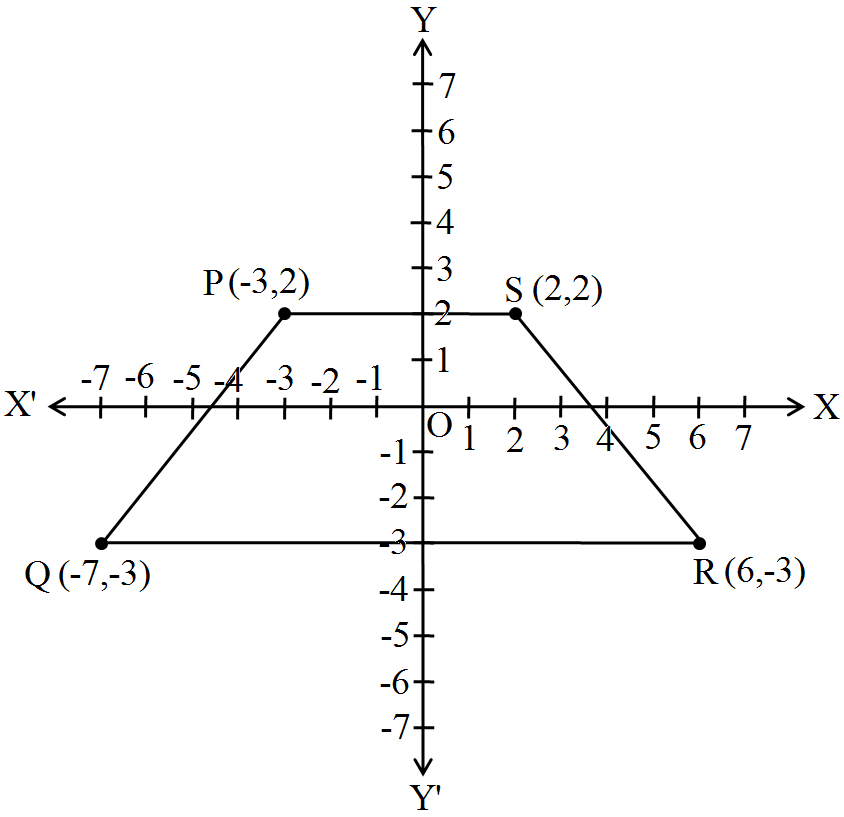
Plot the following points and write the name of the figure obtained by joining them in order: $P(-3, 2), Q(-7, -3), R(6, -3), S(2, 2).$
Answer
Let $X’ OX$ and $Y’ OY$ be the coordinate axes and mark point on it. Here, point $P(-3, 2)$ lies in II quadrant, $Q(-7, -3)$ lies in III quadrant, $R(6, -3)$ lies in $IV$ quadrant and $S(2, 2)$ lies in I quadrant. Plotting the points on the graph paper, the figure obtained is trapezium $PQRS.$
View full question & answer
Question 33 Marks
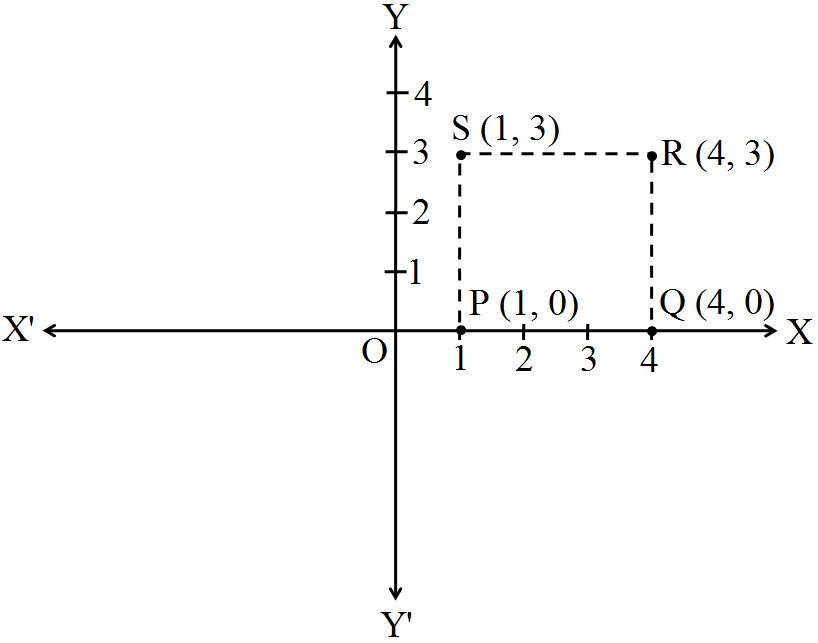
Plot the points $P(1, 0), Q(4, 0)$ and $S(1, 3)$. Find the coordinates of the point $R$ such that $PQRS$ is a square.
Answer
In point $P(1,0), y$-coordinate is zero, so it lies on $X$-axis. In point $Q(4,0), y$-coordinate is zero so it lies on $X$-axis. In point $S (1,3)$, both coordinates are positive, so it lies in I quadrant. On plotting these points, we get the following graph.

Now, take a point $R$ on the graph such that $PQRS$ is a square. Then, all sides will be equal i.e., $P Q=Q R=R S=P S$. So, abscissa of $R$ should be equal to abscissa of $Q$ i.e., $4$ and ordinate of $R$ should be equal to ordinate of $S$ i.e., 3 . Hence, the coordinates of $R$ are $(4,3)$.
View full question & answer
Question 43 Marks
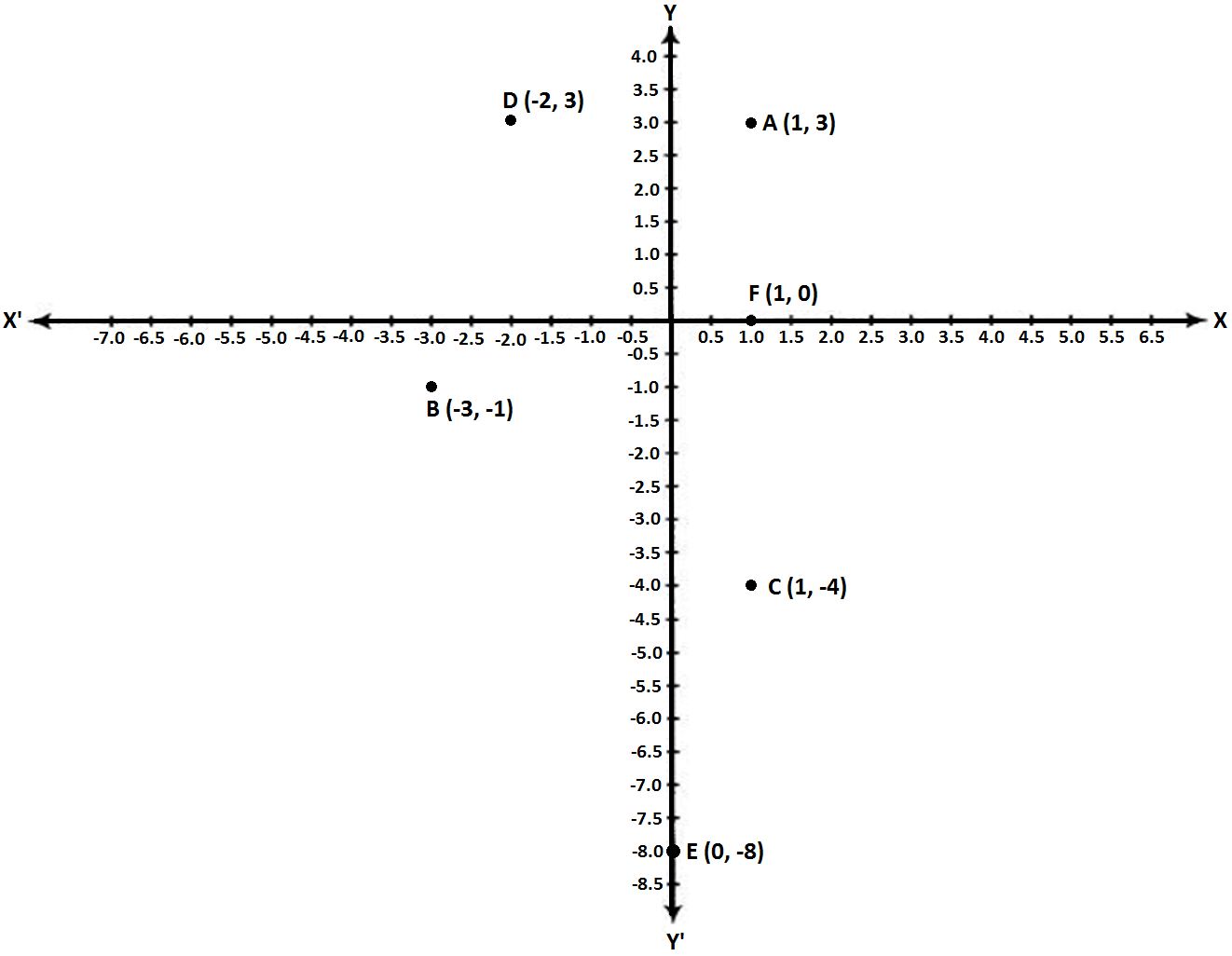
Taking $0.5\ cm$ as $1$ unit, plot the following points on the graph paper: $A(1, 3), B(-3, -1), C(1, -4), D(-2, 3), E(0, -8), F(1, 0)$
Answer
Here, in point $4(1,3)$ both $x$ and $y$-coordinates are positive, so it lies in $I$ quadrant. In point $8(-3,-1)$, both $x$ and $y$ coordinates are negative, so it lies in $III$ quadrant. In point $C(1,-4), x$-coordinate is positive and $y$-coordinate is negative, so it lies in $IV$ quadrant. In point $D (-2,3)$, $x$-coordinate is negative and $y$-coordinate is positive, so it lies in $II$ quadrant. In point $E(0,-8) x$-coordinate is zero, so it lies on $Y$-axis and in point $F(1,0), y$-coordinate is zero, so it lies on $X -$axis. On plotting the given points, we get the following graph.
View full question & answer
Question 53 Marks
Find the coordinates of the point:
$i.$ Which lies on $x$ and $y$ axes both.
$ii.$ Whose ordinate is $-4$ and which lies on $y-$axis.
$iii.$ whose abscissa is $5$ and which lies on $x-$axis.
Answer
$i.$ The coordinates of the point which lies on both the axes are $(0, 0)$.
$ii.$ The coordinates of the point whose ordinate is $-4$ and which lies on $y-$axis are $(0, -4)$.
$iii.$ The coordinate of the point whose abscissa is $5$ and which lies on $x-$axis are $(5, 0)$.
View full question & answer
Question 63 Marks
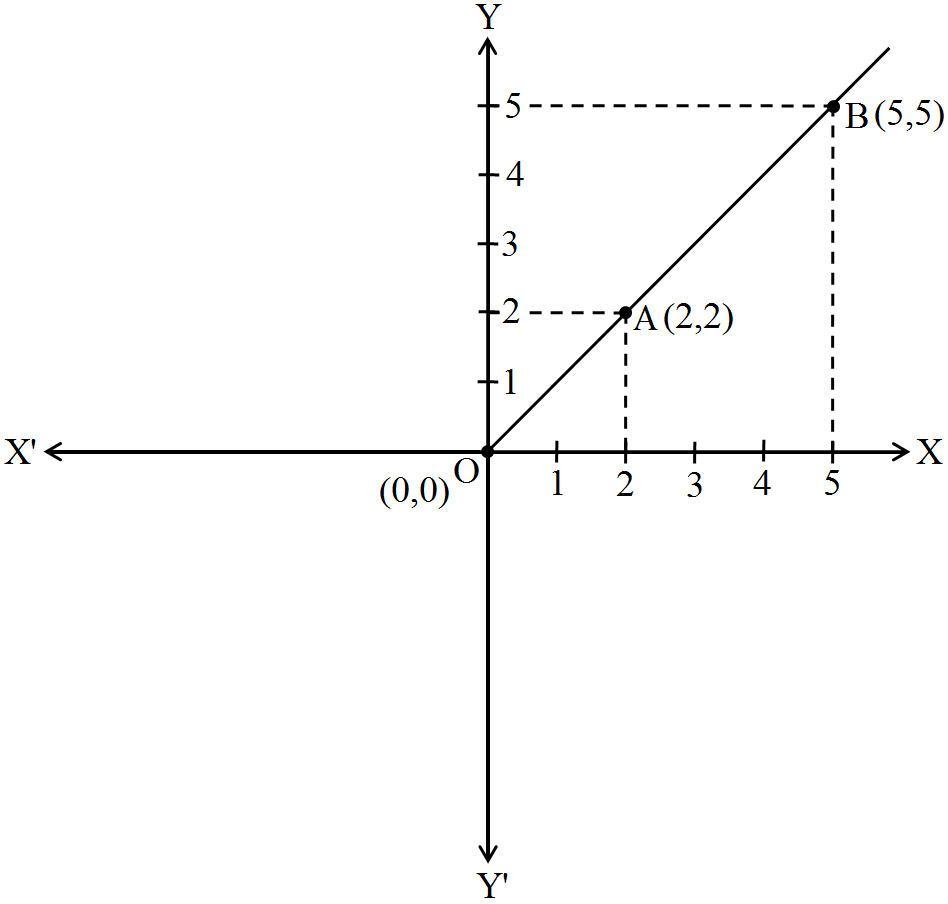
Plot the following points and check whether they are collinear or not: $(0, 0), (2, 2), (5, 5)$
Answer
Plotting the points $0 (0, 0), A (2, 2)$ and $6 (5, 5)$on the graph paper and join these points, we get a straight line. Hence, given points are collinear.
View full question & answer
Question 73 Marks
Plot the following points and check whether they are collinear or not:
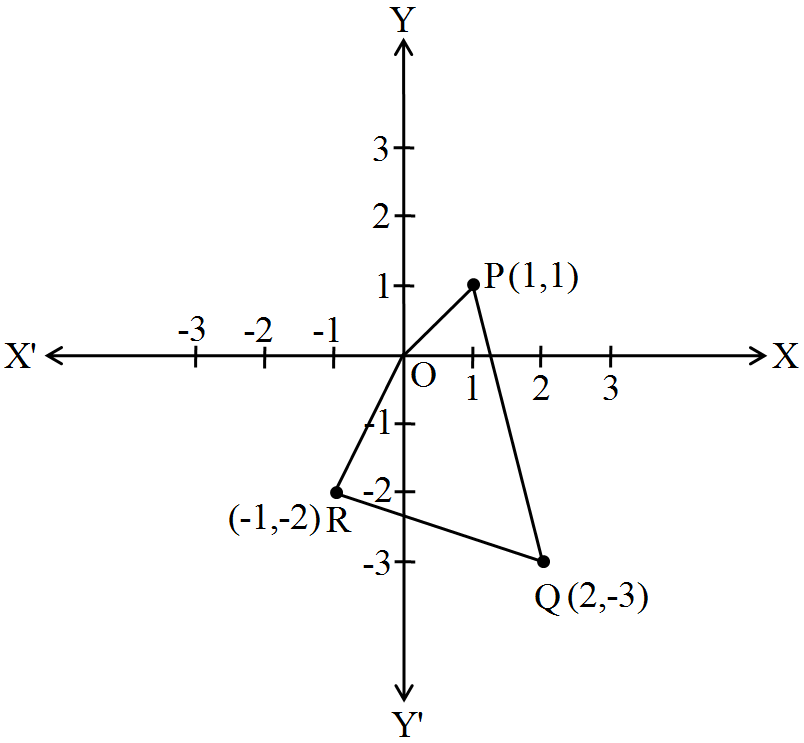
$(1, 1), (2, -3), (-1, -2)$
Answer
Plotting the points $P (1,1), 0 (2, -3)$ and $R (-1, -2)$ on the graph paper and join these three points, we get three lines i.e., the given points do not lie on the same line. So, given points are not collinear.
View full question & answer
Question 83 Marks
From the answer the following:

$i.$ Write the points whose abscissa is $0$
$ii.$ Write the points whose ordinate is $0$
$iii.$ Write the points whose abscissa is $-5$
Answer
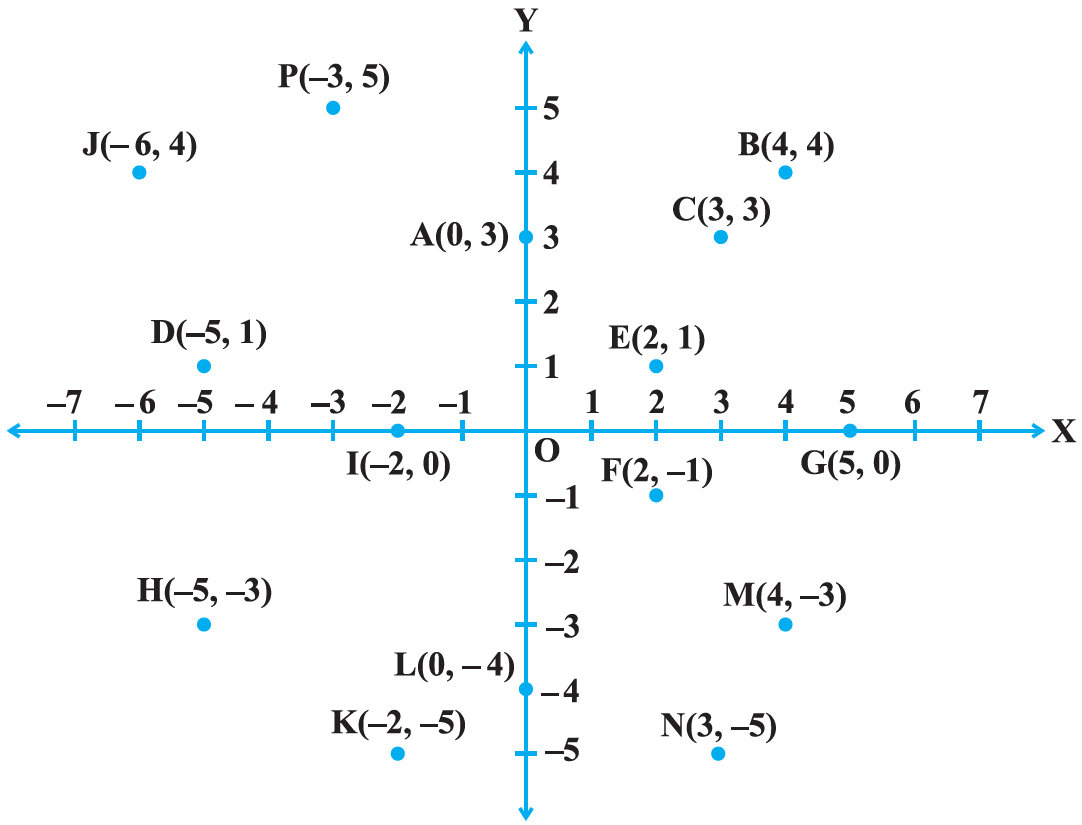
$i.$ Clearly, the distance of points $A, L$ and $O$ from $y$-axis is $0$ .
So, $A(0,3), L(0,-4)$ and $O(0,0)$ are the points whose abscissa is $0 .$
$ii.$ Clearly, the distance of points $G, I$ and $O$ from $x-$axis is $0$ .
So, $G(5,0), I(-2,0)$ and $O(0,0)$ are the points whose ordinate is $0 .$
$iii.$ Clearly, the distance of points $H$ and $D$ from $y -$axis is $5$ units and both lien in second and third quadrants respectively.
So, $(-5,-3)$ and $D(-5,1)$ are the points whose abscissa is $-5 .$
View full question & answer
Question 93 Marks
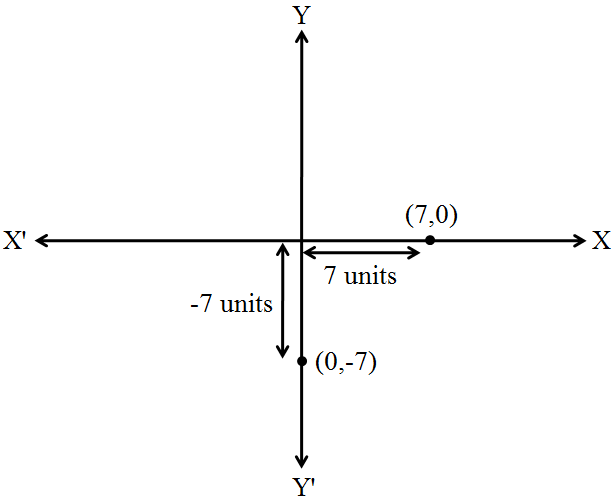
A point lies on the $x-$axis at a distance of $7$ units from the $y-$axis. What are its coordinates? What will be the coordinates if it lies on $y-$axis at a distance of $-7$ units from $x-$axis?
Answer
Given, point lies on the positive direction of $X$ -axis, so its $y$ -coordinate will be zero and it is at a distance of $7$ units from the $X$ axis, so its coordinates are $(7,0)$. If it lies on negative direction of $X$-axis, then its $x$-coordinate will be zero and its distance from $X$-axis is $7$ units, so its coordinates are $(0,-7)$.
View full question & answer
Question 103 Marks
Plot the following points and check whether they are collinear or not:
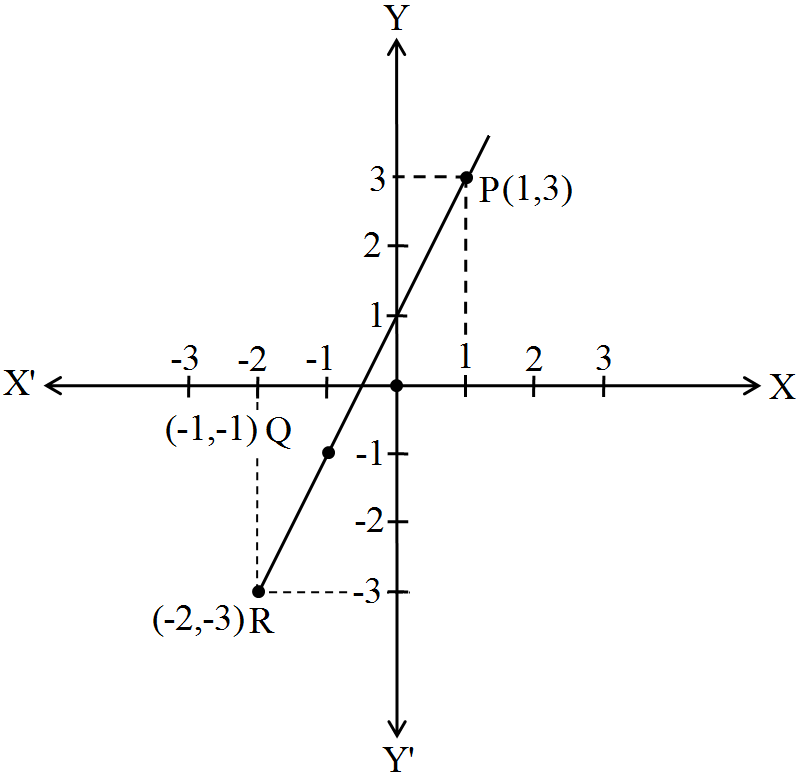
(1, 3), (-1, -1), (-2, 3)
Answer
Plotting the points P (1, 3), Q (-1, -1) and R (-2, -3) on the graph paper and join these points, we get a straight line. Hence, these points are collinear.

View full question & answer
Question 113 Marks
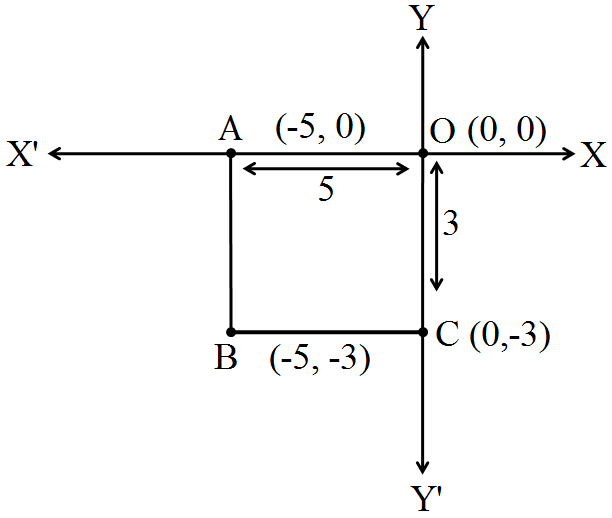
Write the coordinates of the vertices of a rectangle whose length and breadth are $5$ and $3$ units respectively, one vertex at the origin, the longer side lies on the $x$-axis and one of the vertices lies in the third quadrant.
Answer
Given length of rectangle $=5$ units Given breadth of rectangle $=3$ units One vertex is at origin i.e.., $D(0,0)$ and one of the other vertices lies in III quadrant. So the Length of the rectangle is $5$ units in the negative direction of $X$ -axis and then vertex is $A (-5,0)$.Also the breadth of the rectangle is $3$ units in the negative direction of $Y$ -axis and then vertex is $C(0,-3)$. The fourth vertex $B$ is $(5,-3)$.
View full question & answer
Question 123 Marks
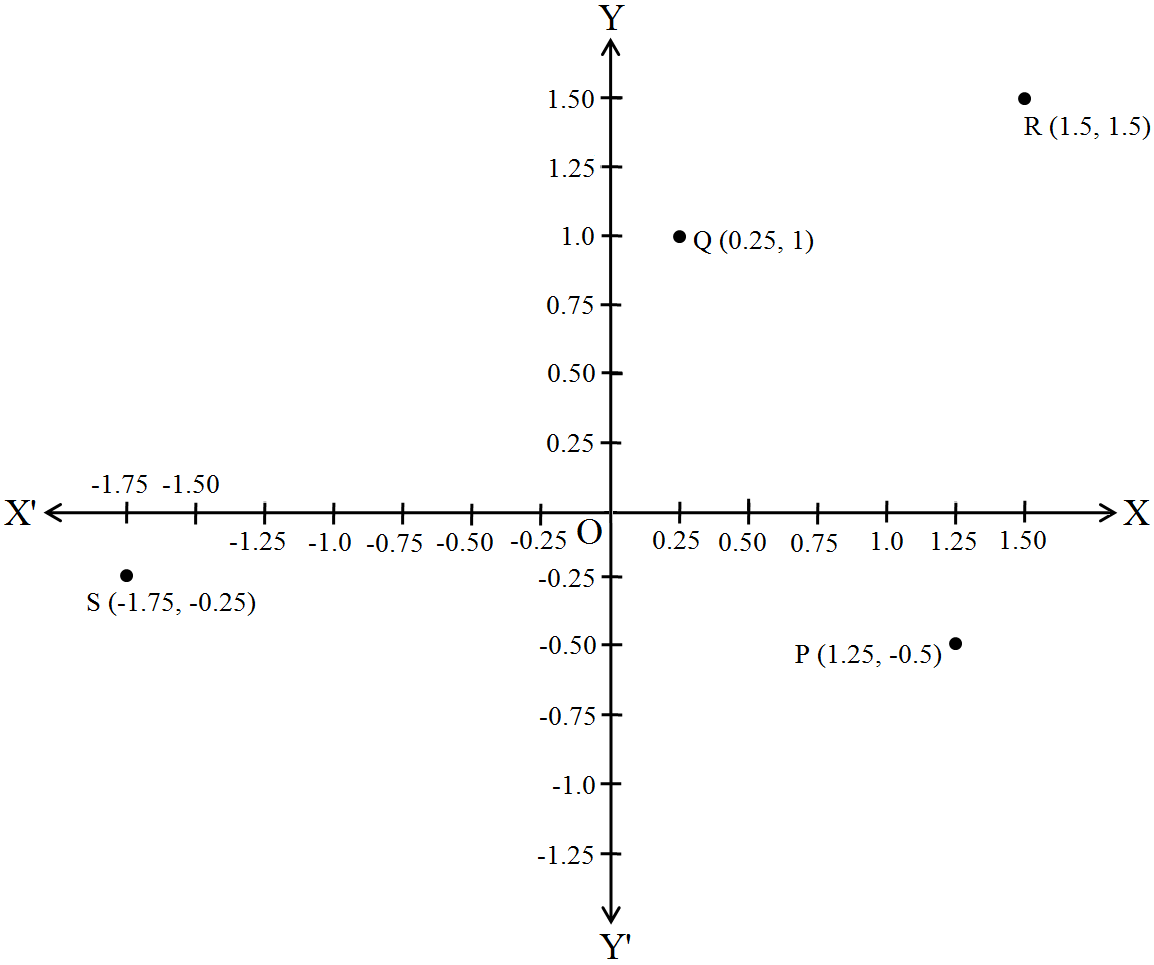
Plot the points $(x, y)$ given by the following table. Use scale $1\ cm = 0.25$ units.
$x$
$1.25$
$0.25$
$1.5$
$-1.75$
$y$
$-0.5$
$1$
$1.5$
$-0.25$
Answer
Let $X’OX$ and $X’ OX$ be the coordinate axes. Plot the given points $(1.25, -0.5), (0.25, 1), (1.5,1.5)$ and $(-1.75, -0.25)$ on the graph paper.
View full question & answer