MCQ 11 Mark
The area of the triangle formed by the points $A(2, 0), B(6, 0)$ and $C(4, 6)$ is:
- A
$24$sq. unit
- ✓
$12$sq. unit
- C
$10$sq. unit
- D
AnswerCorrect option: B. $12$sq. unit
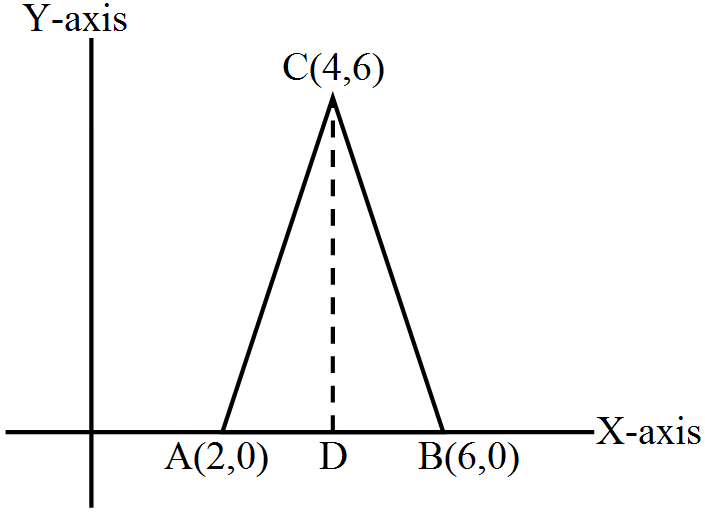
Let $CD$ be perpendicular drawn from $C$ to $AB$.
The length of the perpendicular will be equal to the ordinate of point $C$.
$\Rightarrow CD = 6$ unit
$AB = 4$ unit
Now, area of $\triangle\text{ABC}=\frac{1}{2}\times\text{Base}\times\text{height}$
$\triangle\text{ABC}=\frac{1}{2}\times\text{5}\times\text{6}$
$12\text{sq. units}$ View full question & answer→MCQ 21 Mark
A point whose abscissa is $-3$ and ordinate $2$ lies in:
AnswerIf absciss $= -3$
Intercept on $Y$ axis is $= 2$
$Y > 0$
So, Point is in Second Quadrant.
View full question & answer→MCQ 31 Mark
A point whose abscissa and ordinate are $2$ and $-5$ respectively, lies in:
AnswerAbscissa is = $2$(positive intercept on $X$-axis)
and ordinate = $-5$(negative intercept on $Y$-axis)
so $X$-value is positive and $Y$-value is negative, i.e. Fourth Quadrant.
View full question & answer→MCQ 41 Mark
The ordinate of any point on $x$-axis is:
AnswerOn $X$-axis, all points have their $Y$-intercept $= 0$
So their ordinate $= 0$
View full question & answer→MCQ 51 Mark
The abscissa of a point is positive in the:
- A
First and Second quadrant.
- B
Second and Third quadrant.
- C
Third and Fourth quadrant.
- ✓
Fourth and First quadrant.
AnswerCorrect option: D. Fourth and First quadrant.
Abscissa = Intercept on $X$-axis
If intercept on $X$-axis is positive, means First and Fourth quadrant
View full question & answer→MCQ 61 Mark
The area of the triangle formed by the points $P(0, 1), Q(0, 5)$ and $R(3, 4)$is:
- A
$16$sq. units
- ✓
$6$sq. units
- C
$4$sq. units
- D
$6$sq. units
AnswerCorrect option: B. $6$sq. units
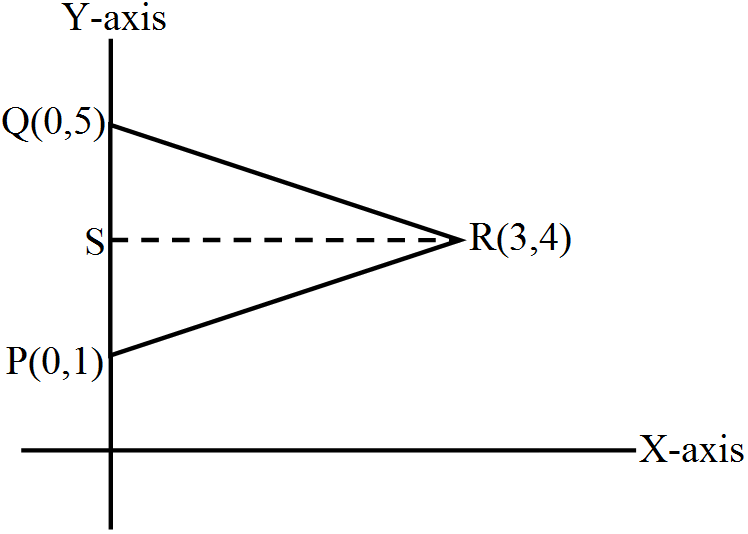
$PQ = 4$ units
Let $RS$ be perpendicular drawn from $R$ to $PQ$.
Lenght of $RS =$ abscissa of $(3, 4)$
$\Rightarrow RS = 3$ units
Area of $\triangle\text{RQP}=\frac{1}{2}\times\text{PQ}\times\text{RS}$
$=\frac{1}{2}\times\text{4}\times\text{3}$
$=6\text{sq. units}.$ View full question & answer→MCQ 71 Mark
The perpendicular distance of the point $P(4, 3)$ from $y$-axis is:
AnswerIf we draw a perpendicular from point $P(4, 3)$ to $Y$-axis, the measure of perpendicular is equal to abscissa of point $P$.
So perpendicular distance fprm $Y$-axis = abscissa $= 4$
View full question & answer→MCQ 81 Mark
Two point having same abscissae but different ordinates lie on:
AnswerCorrect option: C. A line parallel to $y$-axis
Let two points be $(a, b)$ and $(a, c)$.
If abscissa is same $= a$
and ordinate is different then all such points will lie on a line parallel to $Y$
axis because value of $X$-intercept
i.e. abscissa is fixed.
View full question & answer→MCQ 91 Mark
The abscissa and ordinate of the origin are:
- ✓
$(0, 0)$
- B
$(1, 0)$
- C
$(0, 1)$
- D
$(1, 1)$
AnswerCorrect option: A. $(0, 0)$
Absciss = intercept pon $X$ - axis $= 0$
Ordinate = intercept on $Y$ - axis $= 0$
$\Rightarrow (0, 0)$ is the answer.
View full question & answer→MCQ 101 Mark
The perpendicular distance of the point $P(4, 3)$ from $x$-axis is:
AnswerIf perpendicular drawn from $P$ to $X$-axis, then the perpendicular is equal to measure of ordinate of point $P$.
So, perpendicular distance of point $P$ form $X$-axis $= 3$
View full question & answer→MCQ 111 Mark
The measure of the angle between the coordinate axes is:
- A
$0^\circ$
- ✓
$90^\circ$
- C
$180^\circ$
- D
$360^\circ$
AnswerCorrect option: B. $90^\circ$
The angle between the co-ordinate axes is $90^\circ$ because $\text{X}-\text{axis}\perp\text{Y}-\text{axis}.$
View full question & answer→MCQ 121 Mark
Points $(-4, 0)$ and $(7, 0)$ lie:
- ✓
On $x$-axis.
- B
$Y$-axis.
- C
- D
AnswerCorrect option: A. On $x$-axis.
In $(-4, 0)$ and $(7, 0)$,
measure of ordinate $= 0$
That means, intercept on $Y$-axis $= 0$
So, points lies on $X$-axis.
View full question & answer→MCQ 131 Mark
The abscissa of any point on $y$-axis is:
AnswerEvery point on $Y$-axis have $X$-intercept = $0$
Thus, their abscissa = $0$
View full question & answer→MCQ 141 Mark
The point of intersect of the coordinate axes is:
AnswerThe point of intersection of co-ordinate axes i.e. $X$-axis and $Y$-axis is $(0, 0)$, which is called origin.
View full question & answer→MCQ 151 Mark
The distance of the point $P(4, 3)$ from the origin is:
AnswerPoint $P(4, 3)$ and Origin $O(0, 0)$
Required distance $=\text{OP}=\sqrt{(0-4)^2+(0-3)^2}$ (by distance formula)
$=\sqrt{16+9}$
$=\sqrt{25}$
$=5$
View full question & answer→MCQ 161 Mark
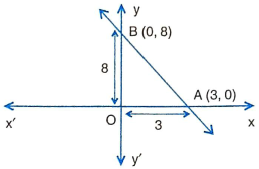
The line represented by the equation $8 x+3 y=24$ cuts the coordinate axes at $A$ and $B$. The area of the triangle $A O B$ is
AnswerB. 12 sq. units
The line $8 x+3 y=24$ cuts $x$-axis at $y=0$. Putting $y=0$ in $8 x+3 y=24$, we get $x=3$. So, the line cuts $x$-axis at $A(3,0)$. Similarly, it cuts $y$-axis at $B(0,8)$. Therefore, $O A=3$ and $O B=8$. Area of $\triangle O A B=\frac{1}{2}(O A \times O B)=\frac{1}{2} \times 3 \times 8=12$ sq. units
View full question & answer→MCQ 171 Mark
The image of a point $P$ under reflection in the $x$-axis has the coordinates $(7,-3)$. The coordinates of $P$ are
- A
$(7,3)$
- B
$(-7,3)$
- C
$(-7,-3)$
- D
$(-3,-7)$
AnswerA. $(7,3)$
The reflection of $Q(7,-3)$ in the $x$-axis is the point $P$ itself. Hence, the coorcmates of $A$ are $(7,3)$.
View full question & answer→MCQ 181 Mark
In example 15, the distance between $O$ and $R$ is
AnswerD. 10 units
It is evident from Fig. that $Q R=10$ units.
View full question & answer→MCQ 191 Mark
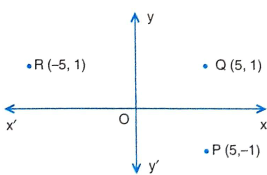
The point $P(5,-1)$ on reflection in $x$-axis is mapped as $Q$ and the point $Q$ on reflection in $y$-axis is mapped as $R$, the coordinates of $R$ are
- A
$(-5,-1)$
- B
$(-5,1)$
- C
$(5,1)$
- D
$(1,5)$
AnswerB. The reflection of $P(5,-1)$ in $x$-axis is point $Q(5,1)$ and its reflection in $y$-axis is the point $R(-5,1)$.
View full question & answer→MCQ 201 Mark
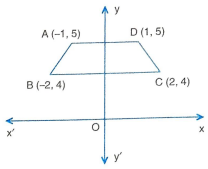
The area of the Fig. formed by joining points $A(-1,5)$ and $B(-2,4)$ and their reflections in $u$-axis is
AnswerA. 3 sq, units
SOLUTION Reflections of points $A(-1,5)$ and $B(-2,4)$ in $y$-axis are points $D(1,5)$ and $C(2,4)$ respectively. Clearly, $A B C D$ is a trapezium with $A D=2, B C=4$ and distance between parallel sides $A D$ and $B C$ is 1 unit. Therefore,
Area of trapezium $A B C D=\frac{1}{2}(A D+B C) \times 1$ sq. units $=\frac{1}{2}(2+4)=3$ sq. units.
View full question & answer→MCQ 211 Mark
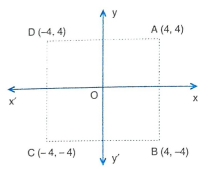
The area of the Fig. formed by joining the point $A(4,4) B(4,-4), C(-4,-4)$ and $D(-4,4)$ in order, then area of the figure formed is
AnswerC. 64 sq. units
By plotting the points $A, B, C$ and $D$, we obtain a square $A B C D$ such that $A B=8$ units, $\therefore$ Area of square $A B C D=8 \times 8=64$ sq. units.
View full question & answer→MCQ 221 Mark
If noints $P(3,0)$ and $O(a, 0)$ are equidistant from the origin, then $a=$
AnswerB. -3
Points $P$ and $Q$ are on $x$-axis and are equidistant from the origin. So, Q Ires on $O X$ at $a$ distance of 3 units from the origin. Therefore, coordinates of $Q$ are $(-3,0)$. Hence, $a=-3$.
View full question & answer→MCQ 231 Mark
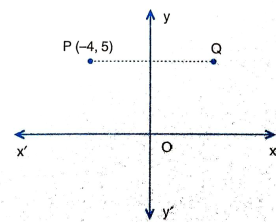
The reflection of the point $P(-4,5)$ in $y$-axis has the coordinates
- A
$(-4,-5)$
- B
$(4,5)$
- C
$(4,-5)$
- D
$(5,-4)$
AnswerB.(4,5)
The reflection of point $P(-4,5)$ is its mirror image in line mirror along $y$-axis. So, $P$ and $Q$ are equidistant from $y$-axis on its opposite sides. So, $x$-coordinate of $Q$ is 4 . Also, $P$ and $Q$ have same $y$-coordinates as $P Q$ is perpendicular to $y$-axis. Hence, the coordinates of $Q$ are $(4,5)$.
View full question & answer→MCQ 241 Mark
If points $P$ and $Q$ have coordinates $(-2,7)$ and $(-5,9)$ respectively, then the value of $($ abscissa of $P)-($ abscissa of $Q)$, is
AnswerA. 3
$\begin{array}{l}\text { Clearly, abscissa of } P=-2 \text { and abscissa of } Q=-5 . \\ \therefore \quad(\text { abscissa of } P)-(\text { abscissa of } Q)=-2-(-5)=3\end{array}$
View full question & answer→MCQ 251 Mark
If the point $P(x, y)$ lies in the fourth quadrant, then
AnswerA. $x>y$
If $P(x, y)$ lies in the fourth quadrant, then $x>0$ and $y<0 \Rightarrow x>y$.
View full question & answer→MCQ 261 Mark
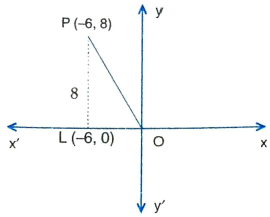
The distance of the point $P(-6,8)$ from the origin is
AnswerD. 10 units
Draw perpendicular PL from $P$ on $x$-axis. Clearly, $\triangle O L P$ is a right triangle with $O L=6$ units and $L P=8$ units. Applying Pythagoras theorem, we obtain$
O P^2=O L^2+L P^2 \Rightarrow O P=\sqrt{O L^2+L P^2}=\sqrt{6^2+8^2}=10 \text { units }
$
View full question & answer→MCQ 271 Mark
The perpendicular distance of the pomt $(3,-4)$ from $x$-axis, is
AnswerC. 4 units
The perpendicular distance of a point from $x$-axis is the absolute value of its $y$-coordinate. Hence, the distance of the point $(3,-4)$ from $x$-axis is 4 units.
View full question & answer→MCQ 281 Mark
The perpendicular distance of the point $(-7,4)$ from $y$-axis is
AnswerA. 7 units
The perpendicular distance of a point from $y$-axis is the absolute value of its $x$-coordinate. Hence, the distance of the point $P(-7,4)$ from $y$-axis is 7 units.
View full question & answer→MCQ 291 Mark
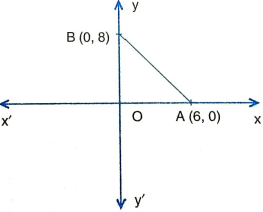
The area of the triangle the coordinates of whose vertices are $O(0,0), A(6,0)$ and $B(0,8)$ is
AnswerB. 24 sq. units
By plotting the points $O, A$ and $B$, we observe that these points are vertices of a right triangle having two legs $O A=6$ units and $O B=8$ units. $ \therefore \quad \text { Area of } \triangle O A B=\frac{1}{2}(O A \times O B)=\frac{1}{2}(6 \times 8)=24 \text { sq. units } $
View full question & answer→MCQ 301 Mark
If the coordinates of a point $P(x, y)$ satisfy the relation $x y>0$, then $P$ may lie
AnswerC. I or III quadrant
$x y>0 \Rightarrow(x>0$ and $y>0)$ or $(x<0$ and $y<0) \Rightarrow P$ lies either in I or in III quadrant.
View full question & answer→MCQ 311 Mark
If $|x|>0$ and $y<0$, then the quadrant in which the point representing $(x, y)$ can lie are
AnswerC. III, IV
Since $y<0$ and $x$ can be positive or negative. So, the point $(x, y)$ lies in III or IV quadrant.
View full question & answer→MCQ 321 Mark
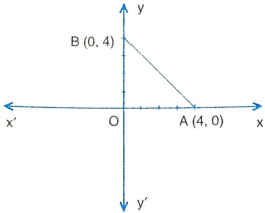
The points $O(0,0), A(4,0)$ and $B(0,4)$
- A
- B
- C
form an equilateral triangle
- D
form an isosceles right triangle
AnswerB. form a scalene triangle
Clearly, $O A=O B=4$ units and $\angle A O B=90^{\circ}$. Hence, $O, A, B$ form an isosceles right triangle.
View full question & answer→MCQ 331 Mark
If $x>0$ and $y<0$, Ihe point $(x,-y)$ lies in
AnswerA. I quudrant
As $y<0$, therefore $-y>0$. Thus, both the coordinates of point $(x,-y)$ are positive. Hence, it lies in the first quadrant.
View full question & answer→MCQ 341 Mark
If the point P (4, 2) is translated parallel to x-axis through 8 units, then the coordinates of new position of P are
MCQ 351 Mark
The distance of the point P (-6, 8) from the origin is
MCQ 361 Mark
The distance between the images of points P (-7, 4) and Q (7, 4) in x-axis is
MCQ 371 Mark
The distance between the points A (-5, 12) and (7, 12) is
MCQ 381 Mark
The area of the figure ABCD formed by joining A (-1, 1), B (5, 1), C (5, 6) and D (-1, 6) is
MCQ 391 Mark
The quadrilateral formed by joining the points A (0, 0), B (5, 0), C (3, 2) and D (0, 2) in order is a
MCQ 401 Mark
The distance between the reflections of the point P (-3, 4) in the coordinate axes is
MCQ 411 Mark
The area of the triangle formed by the point P (-3, 4) and its reflections in the coordinate axes is
MCQ 421 Mark
The area of the triangle formed by the points P (0, 1), Q (0, 5) and R (3, 4) is
MCQ 431 Mark
The area of the triangle formed by the points A (2, 0), B (6, 0) and C (4, 6) is
MCQ 441 Mark
The distance of the point P (4, 3) from the origin is
MCQ 451 Mark
If the mirror image of the point P(5, 2) in x-axis is the point Q and the image of Qin y-axis is R. Then, the coordinates of R are
MCQ 461 Mark
If the perpendicular distance of a point P from the x-axis is 5 units and the foot of the perpendicular lies on the negative direction of x-axis, then the point Phas
MCQ 471 Mark
The image of the point (-5, 7) in y-axis has the coordinates
MCQ 481 Mark
The image of the point (3, 4) in x-axis has the coordinates
MCQ 491 Mark
On plotting the points O (0, 0), A (3, 0), B (3, 4), C (0, 4) and joining OA, AB, BC and CO which of the following figure is formed?
MCQ 501 Mark
Abscissa of a point is positive in
MCQ 511 Mark
The points whose abscissa and ordinate have different signs will lie in
MCQ 521 Mark
Points (2, 2), (3, -3, (4, -5), (-3,-4)
- A
- B
- C
- ✓
do not lie in the same quadrant
AnswerCorrect option: D. do not lie in the same quadrant
View full question & answer→MCQ 531 Mark
A point whose abscissa and ordinate both are negative will lie in
MCQ 541 Mark
Ordinate of all points on the y-axis is
MCQ 551 Mark
Abscissa of all points on the x-axis is
MCQ 561 Mark
Signs of the abscissa and ordinate of a point in the second quadrant are respectively
MCQ 571 Mark
The points (other than origin) for which abscissa is equal to the ordinate will lie in
MCQ 581 Mark
The perpendicular distance of the point P (4, 3) from y-axis is
MCQ 591 Mark
The perpendicular distance of the point P (4, 3) from x-axis is
MCQ 601 Mark
Two points having same abscissae but different ordinates lie on
- A
- B
- ✓
a line parallel to y-axis
- D
a line parallel to x-axis
AnswerCorrect option: C. a line parallel to y-axis
View full question & answer→MCQ 611 Mark
A point whose abscissa is - 3 and ordinate 2 lies in
MCQ 621 Mark
The abscissa of a point is positive in the
- A
First and Second quadrant
- B
Second and Third quadrant
- C
Third and Fourth quadrant
- ✓
Fourth and First quadrant
AnswerCorrect option: D. Fourth and First quadrant
View full question & answer→MCQ 631 Mark
The abscissa of any point on y-axis is
MCQ 641 Mark
The ordinate of any point on x-axis is
MCQ 651 Mark
Points (-4, 0) and (7, 0) lie
MCQ 661 Mark
A point whose abscissa and ordinate are 2 and -5 respectively, lies in
MCQ 671 Mark
The measure of the angle between the coordinate axes is
- A
$0^{\circ}$
- ✓
$90^{\circ}$
- C
$180^{\circ}$
- D
$360^{\circ}$
AnswerCorrect option: B. $90^{\circ}$
View full question & answer→MCQ 681 Mark
The abscissa and ordinate of the origin are
MCQ 691 Mark
The point of intersect of the coordinate axes is