Questions

3 Marks Question

Take a timed test

16 questions · self-marked practice — reveal the answer and mark yourself.

Question 13 Marks
Verify whether the indicated numbers are zeros of the polynomials corresponding to them in the following case: $\text{f(x)}=2\text{(x)}+1,\text{x}=\frac{1}{2}$
Answer
$\text{f(x)}=2\text{(x)}+1,\text{x}=\frac{1}{2}$
We know that, $\text{f(x)}=2\text{(x)}+1$
Given that $\text{x}=\frac{1}{2}$
Substitute the value of $x$ and $f(x)$ $\text{f}\Big(\frac{1}{2}\Big)=2\Big(\frac{1}{2}\Big)+1$
$=1+1$
$=2\neq0$
Since, the result is not equal to zero $\text{x}=\frac{1}{2}$ is the root of $2x + 1$
View full question & answer
Question 23 Marks
Verify whether the indicated numbers are zeros of the polynomials corresponding to them in the following case:
$f(x) = x^2 - 1, x = 1, -1$
Answer
$f(x)=x^2-1, x=(1,-1)$
we know that, $f(x)=x^2-1$
Given that $x=(1,-1)$
substitute $x=1$ in $f(x) f(1)=1^2-1=1-1=0$
Now, substitute $x=(-1)$ in $f(x) f(-1)=(-1)^2-1=1-1=0$
Since, the results when $x=(1,-1)$ are $0$ they are the roots of the polynomial $f(x)=x^2-1$
View full question & answer
Question 33 Marks
Find the value of a such that $(x - 4)$ is a factors of $5x^3 - 7x^2 - ax - 28.$
Answer
Let $g(x) = x - 4, f(x) = 5x^3- 7x^2 - ax - 28$
$Let g(x) = 0$
$\Rightarrow x - 4 = 0$
$\Rightarrow x = 4,$
Since $(x - 4)$ is a factor of $f(x)$.
$\therefore$ $f(4) = 0 f(4)$
$= 5(4)^3 - 7(4)^2 - a(4) - 28 = 0$
$\Rightarrow 5(64) - 7(16) - 4a - 28 = 0$
$\Rightarrow 320 - 112 - 4a - 28 = 0$
$\Rightarrow 180 - 4a = 0$
$\Rightarrow 4a = 180$
$\Rightarrow\ \text{a}=\frac{180}{4}=45$
View full question & answer
Question 43 Marks
Find the remainder when $x^3 + 3x^3 + 3x + 1$ is divided by: $\text{x}+\pi$
Answer
Here, $f(x) = x^3 + 3x^2 + 3x + 1$ By remainder theorem $\text{x}+\pi=0$
$\Rightarrow\ \text{x}=-\pi$ Substitute the value of $x$ in $f(x)$ $\text{f}(-\pi)=(-\pi)^3+3(-\pi)^2+3(-\pi)+1$
$=(-\pi)^3+3(-\pi)^2+3(-\pi)+1$
View full question & answer
Question 53 Marks
Factorize the following polynomials: $4x^3 + 20x^2 + 33x + 18$ given that $2x + 3$ is a factor.
Answer
Let $f(x)=4 x^3+20 x^2+33 x+18$ be the given polynomial.
Therefore, $(2 x+3)$ is a factor of the polynomial $f(x)$.
Now, $f(x) = 2x^2(2x + 3) + 7x(2x + 3) + 6(2x + 3)$
$= (2x + 3)(2x^2 + 7x + 6) = (2x + 3)(2x^2 +4x + 3x + 6)$
$= (2x + 3)(2x + 3)(x + 2)$
Hence $(x+2),(2 x+3)$ and $(2 x+3)$ are the factors of polynomial $f(x)$.
View full question & answer
Question 63 Marks
If $x-2$ is a factor of the following two polynomials, find the values of a in case:
$x^3-2 a x^2+a x-1$
Answer
$x^3-2 a x^2+a x-1$
Let,
$x-2=0$
$\therefore x=2$
$\because x-2$ is a factor of $p(x)=x^3-2 a x^2+a x-1$
$\therefore p(2)=0$
$p(2)=2^3-2 a(2)^2+2 a-1=0$
$\Rightarrow 8-8 a+2 a-1=0$
$\Rightarrow 7-6 a=0$
$\Rightarrow 6 a=7$
$\Rightarrow a=\frac{7}{6}$
View full question & answer
Question 73 Marks
Find the value k if $x - 3$ is a factor of $k^2x^3 - kx^2 + 3kx - k.$
Answer
Let $g(x) = 0$
$\Rightarrow x - 3 = 0$
$\Rightarrow x = 3,$
Since $(x - 3)$ is a factor of $f(x)$
$\therefore$ $f(3) = 0 f(3) = k^23^3 - k3^2 + 3k(3) - k = 0$
$\Rightarrow 27k^2 - 9k + 9k - k = 0$
$\Rightarrow 27k^2 - k = 0$
$\Rightarrow k(27k - 1) = 0$
$\therefore$ $k = 0, 27k - 1 = 0 27k = 1$
$\text{k}=\frac{1}{27}$
Hence $k = 0$, $\text{k}=\frac{1}{27}$
View full question & answer
Question 83 Marks
Verify whether the indicated numbers are zeros of the polynomials corresponding to them in the following case: $\text{g(x)}=3\text{x}^2-2,\text{x}=\frac{2}{\sqrt{3}},\frac{-2}{\sqrt{3}}$
Answer
$\text{g(x)}=3\text{x}^2-2,\text{x}=\frac{2}{\sqrt{3}},\frac{-2}{\sqrt{3}}$
We know that $\text{g(x)}=3\text{x}^2-2$
Given that, $\text{x}=\Big(\frac{2}{\sqrt{3}},\frac{-2}{\sqrt{3}}\Big)$
Substitute $\text{x}=\frac{2}{\sqrt{3}}$ in
$g(x)$ $\text{g}\Big(\frac{2}{\sqrt{3}}\Big)=3\Big(\frac{2}{\sqrt{3}}\Big)^2-2$
$=3\Big(\frac{4}{3}\Big)-2$
$=4-2$
$=2\neq0$
Now, Substitute $\text{x}=-\frac{2}{\sqrt{3}}$ in
$g(x)$ $\text{g}\Big(\frac{-2}{\sqrt{3}}\Big)=3\Big(\frac{-2}{\sqrt{3}}\Big)^2-2$
$=3\Big(\frac{4}{3}\Big)-2$
$=4-2$
$=2\neq0$
Since, the results when $\text{x}=\Big(\frac{2}{\sqrt{3}},\frac{-2}{\sqrt{3}}\Big)$ are not $0$, they are roots of $3 x^2-2$
View full question & answer
Question 93 Marks
In the following, use factor theorem to find whether polynomial $g(x)$ is a factor of polynomial $f(x)$ or, not: $f(x)=3 x^3+x^2-20 x$ $+12, g(x)=3 x-2$
Answer
Let $g(x) = 0 \Rightarrow 3x - 2 = 0$
$\Rightarrow\ \text{x}=\frac{2}{3}$
$\text{f}\Big(\frac{2}{3}\Big)=3\Big(\frac{2}{3}\Big)^3+\Big(\frac{2}{3}\Big)^2-20\Big(\frac{2}{3}\Big)+12$
$=\frac{24}{27}+\frac{4}{9}-\frac{40}{3}+12$
$=\frac{24+12-360+324}{27}$
$=\frac{360-360}{27}$
$=\frac{0}{27}$
$=0$
$\because\ \text{f}\Big(\frac{2}{3}\Big)=0,$ by factor theorem, $3x - 2$ is a factor of $f(x)$.
View full question & answer
Question 103 Marks
Find the remainder when $x^3 + 3x^3 + 3x + 1$ is divided by:$5 + 2x$
Answer
Here, $f(x) = x^3 + 3x^2 + 3x + 1$ By remainder theorem $5 + 2x = 0 2x = -5$
$\text{x}=\frac{-5}{2}$ substitute the value of $x$ in $f(x)$ $\text{f}\Big(\frac{-5}{2}\Big)=\Big(\frac{-5}{2}\Big)^3+3\Big(\frac{-5}{2}\Big)+1$
$=\frac{-125}{8}+3\Big(\frac{25}{4}\Big)+3\Big(\frac{-5}{2}\Big)+1$
$=\frac{-125}{8}+\frac{75}{4}-\frac{15}{2}+1$
Taking $L.C.M$ $=\frac{-125+150-50+8}{8}$
$=\frac{-27}{8}$
View full question & answer
Question 113 Marks
For what value of a is $( x -5) a$ factor of $x ^3-3 x ^2+a x -10$ ?
Answer
Let, $x-5=0 x=5 \because(x-5)$ is a factor of
$x^3-3 x^2+a x-10 \therefore f(5)=0$
$f(5)=5^3-3(5)^2+a(5)-10=0$
$\Rightarrow 125-3 \times 25+5 a-10=0$
$\Rightarrow 125-85+5 a=0$
$\Rightarrow 40+5 a=0$
$ \Rightarrow 5 a=-40$
$\Rightarrow a=\frac{-40}{5}=-8$
View full question & answer
Question 123 Marks
If $x - 2$ is a factor of the following two polynomials, find the values of a in case:
$x^5 - 3x^4 - ax^3 + 3ax^2 + 2ax + 4$
Answer
$x^5 − 3x^4 − ax^3 + 3ax^2 + 2ax + 4 Let, x - 2 = 0$
$\therefore$ $x = 2$
$\because$ $x - 2$ is a factor of $p(x) = x^5 − 3x^4 − ax^3 + 3ax^2 + 2ax + 4$
$\therefore$ $p(2) = 0 p(2) = 2^5 - 3(2)4 - a(2)^3 + 3 \times a \times 2^2 + 2 \times 2 \times a + 4 = 0$
$\Rightarrow 32 - 48 - 8a + 12a + 4a + 4 = 0$
$\Rightarrow 8a - 12 = 0$
$\Rightarrow 8a = 12$
$\Rightarrow\ \text{a}=\frac{12}{8}=\frac{3}{2}$
View full question & answer
Question 133 Marks
In the following, use factor theorem to find whether polynomial $g(x)$ is a factor of polynomial f(x) or, not: $f(x) = 2x^3 - 9x^2 + x + 12, g(x) = 3 - 2x$
Answer
Let $g(x) = 0$
$\Rightarrow 3 - 2x = 0$
$\Rightarrow 3 = 2x$
$\Rightarrow\ \text{x}=\frac{2}{3}$
$\text{f}\Big(\frac{3}{2}\Big)=2\Big(\frac{3}{2}\Big)^3+\Big(\frac{3}{2}\Big)^2-\Big(\frac{3}{2}\Big)+12$
$=2\Big(\frac{27}{8}\Big)+9\Big(\frac{9}{4}\Big)-\Big(\frac{3}{2}\Big)+12$
$=\frac{27}{4}-\frac{81}{4}+\frac{3}{2}+12$
$=\frac{27-81+6+48}{4}$
$=\frac{81-81}{4}$
$=\frac{0}{4}$
$=0$
$\because\ \text{f}\Big(\frac{3}{2}\Big)=0,$ by factor theorem, $3 - 2x$ is a factor of $f(x)$.
View full question & answer
Question 143 Marks
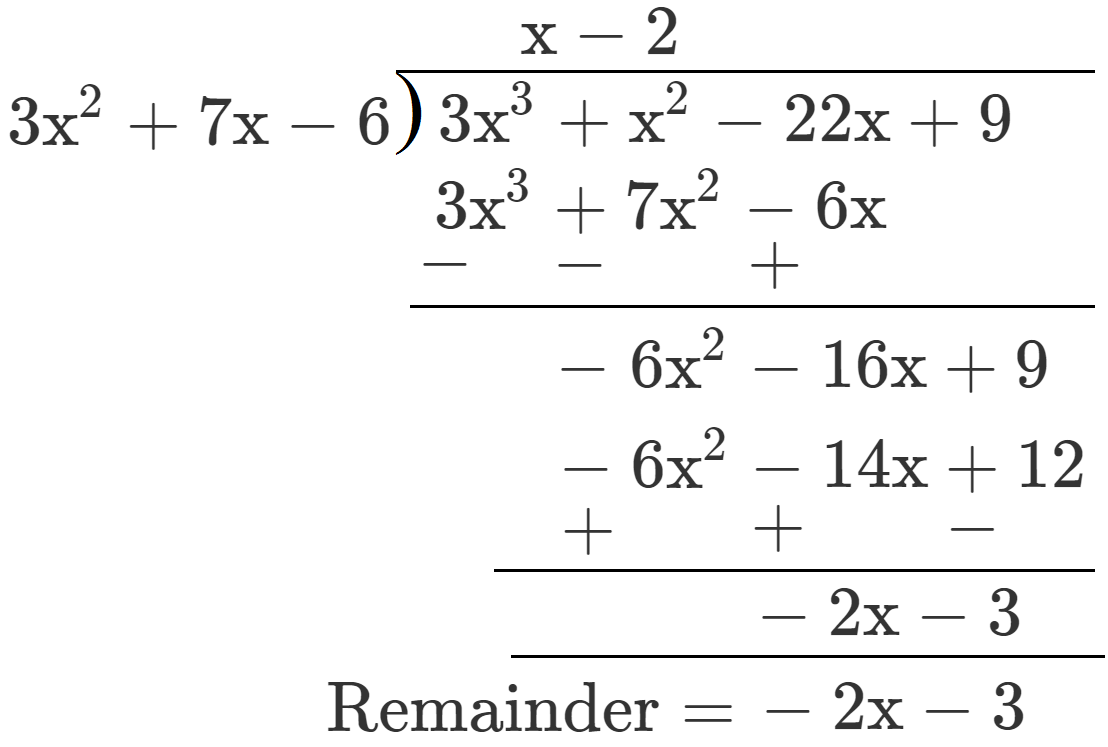
What must be added to $3x^3 + x^2 - 22x + 9$ so that the result is exactly divisible by $3x^2 + 7x - 6? $                                                   
Answer
We know that, Dividend = Divisor $\times $ Quotient + Remainder Dividend
$= 3x^3 + x^2 - 22x + 9$ Divisor $= 3x^2 + 7x - 6$

Remainder $= -2x - 3 So, -(-2x - 3) = 2x + 3$ should be added to $3x^3 + x^2 - 22x + 9$ to make it exactly divisible by $3x^2 + 7x - 6.$
View full question & answer
Question 153 Marks
In the following, using the remainder theorem, find the remainder when $f(x)$ is divided by $g(x)$ and verify the by actual division: $f(x) = 4x^3 - 12x^2 + 14x - 3, g(x) = 2x - 1$
Answer
Here, $f(x) = 4x^3 - 12x^2 + 14x - 3 g(x) = 2x - 1$ From, the remainder theorem when $f(x)$ is divided by
$\text{g(x)}=\Big(\text{x}-\frac{1}{2}\Big),$ the remainder will be equal to $\text{f}\Big(\frac{1}{2}\Big).$
Let, $g(x) = 0 $
$\Rightarrow 2x - 1 = 0 $
$\Rightarrow 2x = 1$
$\Rightarrow\ \text{x}=\frac{1}{2}$
Substitute the value of $x$ in
$f(x)$ $\text{f}\Big(\frac{1}{2}\Big)=4\Big(\frac{1}{2}\Big)^3-12\Big(\frac{1}{2}\Big)^2+14\Big(\frac{1}{2}\Big)-3$
$=4\Big(\frac{1}{8}\Big)-12\Big(\frac{1}{4}\Big)+4\Big(\frac{1}{2}\Big)-3$
$=\Big(\frac{1}{2}\Big)-3+7-3$
$=\Big(\frac{1}{2}\Big)+1$ Taking $L.C.M.$ $=\Big(\frac{2+1}{2}\Big)$
$=\Big(\frac{3}{2}\Big)$
Therefore, the remainder is $\Big(\frac{3}{2}\Big).$
View full question & answer
Question 163 Marks
Verify whether the indicated numbers are zeros of the polynomials corresponding to them in the following case: $\text{f(x)}=5\text{x}-\pi,\text{x}=\frac{4}{5}$
Answer
$\text{f(x)}=5\text{x}-\pi,\text{x}=\frac{4}{5}$
we know that, $\text{f(x)}=5\text{x}-\pi$ Given that, $\text{x}=\frac{4}{5}$
Substitute the value of $x$ in $f(x)$ $\text{f}\Big(\frac{4}{5}\Big)=5\Big(\frac{4}{5}\Big)-\pi$
$=4-\pi$
$\neq0$
Since, the result is not equal to zero, $\text{x}=\frac{4}{5}$ is not the root of the polynomial $5\text{x}-\pi$
View full question & answer