MCQ 11 Mark
The boundaries of the solids are:
AnswerA solid has shape, size, position and can be moved from one place to another. Its boundaries are called surfaces. They separate one part of the space from the other.
View full question & answer→MCQ 21 Mark
The basic facts which are taken for granted, without proof, are called:
AnswerAn axiom is a proposition regarded as self-evidently true without proof.
View full question & answer→MCQ 31 Mark
AnswerA point has no length and no breadth.
A point is that which has no part.
View full question & answer→MCQ 41 Mark
The number of end points a ray has:
AnswerA ray starts at a given point and goes off in a certain direction to infinity. The point where the ray starts is called the endpoint.
View full question & answer→MCQ 51 Mark
Write the correct answer in the following:
It is known that if $x + y = 10$ then $x + y + z = 10 + z$. The Euclid’s axiom that illustrates this statement is:
AnswerThe Euclid’s axiom that illustrates the given statement is second axiom, according to which. If equals are added to equals, the wholes are equal.
View full question & answer→MCQ 61 Mark
How many points can be common in two distinct straight lines?
MCQ 71 Mark
Which of the following is a solid?
AnswerAll the other figures are $2D$ except cylinder which is $3D$. Any $3D$ figure is considered to be a solid.
View full question & answer→MCQ 81 Mark
Write the correct answer in the following: The number of dimensions, a surface has:
AnswerBoundaries of a solid are called surfaces. A surface (plane) has only length and breadth. So, it has two dimensions.
View full question & answer→MCQ 91 Mark
The side faces of a pyramid are:
AnswerThe side faces of a pyramid are triangles.
View full question & answer→MCQ 101 Mark
If two line segments are equal then they are called:
AnswerIf two line segments are equal then they are called congruent segments.
View full question & answer→MCQ 111 Mark
Which of the following statements are true?
- A
Only one line can pass through a single point.
- B
There is an infinite number of lines that pass through two distinct points.
- ✓
A terminated line can be produced indefinitely on both sides.
- D
If two circles are equal, then their radii are unequal.
AnswerCorrect option: C. A terminated line can be produced indefinitely on both sides.
A terminated line can be produced indefinitely on both sides.
View full question & answer→MCQ 121 Mark
The number of line segments determined by three non-collinear points is:
AnswerYou need two points to draw a line segment. If the points $A, B$ and are non-collinear, we can draw the lines: $A B, A C$, $B A, B C, C A, C B$. Now, line $A B$ is the same as line $B A$, same for lines $A C$ and $C A$ and $B C$ and $C B$. So, the lines are $A B, B C$, and $AC 3$ lines only.
View full question & answer→MCQ 131 Mark
In this figure, if $AC = BD$, then:

- A
$AB \neq CD$
- B
$BC = CD$
- C
$AB = BC$
- ✓
$AB = CD$
AnswerCorrect option: D. $AB = CD$
We have, $AC = BD$
$\Rightarrow AB + BC = BC + CD$
$\Rightarrow AB = CD.$
View full question & answer→MCQ 141 Mark
A $.......$ is an exact location in space.
AnswerPoint is the basic building block of Geometry.
Every shape is made through combining the points.
A small dot marked by a pencil is a point.
A point has no length or width.
It has no thickness.
Point is a mark of position.
A point specifies the exact location.
Point is denoted by a dot $(.)$ and is named by an alphabet.
View full question & answer→MCQ 151 Mark
Which of the following is not a solid?
AnswerAny $3D$ figure is considered to be a solid. A circle is a $2D$ figure, so, it cannot be considered as a solid.
View full question & answer→MCQ 161 Mark
A pyramid is a solid figure, whose base is:
AnswerA pyramid is a solid figure, whose base is any polygon.
View full question & answer→MCQ 171 Mark
Which of the following is not a rectilinear figure?
AnswerA rectilinear figure is a figure all of whose edges meet at right angles.
A circle has no edge.
View full question & answer→MCQ 181 Mark
Three or more lines are called concurrent lines if they pass through $.........$ point.
View full question & answer→MCQ 191 Mark
Euclid’s Postulate $1$ is:
- ✓
A straight line may be drawn from any point to any other point.
- B
A terminated line can be produced indefinitely.
- C
All right angles are equal to one another.
- D
AnswerCorrect option: A. A straight line may be drawn from any point to any other point.
A straight line may be drawn from any point to any other point.
View full question & answer→MCQ 201 Mark
Two intersecting lines cannot be parallel to the same line is stated in the form of:
AnswerEuclid's fifth postulate can also be stated in the following form: Two distinct intersecting lines cannot be parallel to the same line.
View full question & answer→MCQ 211 Mark
The edges of the surface are:
MCQ 221 Mark
The number of lines passing through one point.
AnswerInfinite number of lines can pass through a single point.
View full question & answer→MCQ 231 Mark
Which of the following is a true statement?
- A
Only a unique line can be drawn through a given point.
- B
Infinitely many lines can be drawn through two given points.
- ✓
If two circles are equal, then their radii are equal.
- D
A line has a definite length.
AnswerCorrect option: C. If two circles are equal, then their radii are equal.
In option $(a)$, infinite number of line can be drawn to pass through a given point. So, it is not a true statement.
In option $(b)$, only one line can be drawn to pass through two given points. So, it is not a true statement.
In option $(c)$,
'If two circles are equal, then their radii are equal' is the true statement.
In option $(d)$, A line has no end points. A line has an indefinite length. So, it is not a true statement.
View full question & answer→MCQ 241 Mark
- A
Length, breadth and thickness
- ✓
- C
Length and thickness only
- D
Breadth and thickness only
View full question & answer→MCQ 251 Mark
Write the correct answer in the following: Greek’s emphasised on:
- A
- ✓
- C
Both $A$ and $B.$
- D
Practical use of geometry.
AnswerThe Greeks were interested in establishing the truth of the statements they discovered using deductive reasoning. A Greek mathematician, Thales is credited with giving the first known proof.
View full question & answer→MCQ 261 Mark
“Lines are parallel if they do not intersect” is stated in the form of:
AnswerEuclid gave the definition of parallel lines in Book I, Definition $23$ just before the five postulates.
View full question & answer→MCQ 271 Mark
The Sri yantra consists of $.........$ interwoven isosceles triangles.
AnswerThe Sri Yantra $('$great object$')$ belongs to a class of devices used in meditation, mainly by those belonging to the Hindu tantric tradition.
The diagram consists of nine interwoven isosceles triangles four points upwards, representing Sakti, the primordial female essence of dynamic energy, and five$-$point downwards, representing Siva, the primordial male essence of static wisdom The triangles are arranged in such a way that they produce $43$ subsidiary triangles, at the center of the smallest of which there is a big dot known as the Bindu.
View full question & answer→MCQ 281 Mark
Which of the following needs a proof?
AnswerTheorem $-$ a mathematical statement that is proved using rigorous mathematical reasoning.
In a mathematical paper, the term theorem is often reserved for the most important results.
Axiom/ Postulate $-$ a statement that is assumed to be true without proof.
These are the basic building blocks from which all theorems are proved $($Euclid’s five postulates, Zermelo$-$Fraenkel axioms, Peano axioms$)$.
Definition $-$ a precise and unambiguous description of the meaning of a mathematical term.
It characterizes the meaning of a word by giving all the properties and only those properties that must be true.
View full question & answer→MCQ 291 Mark
Write the correct answer in the following: ‘Lines are parallel if they do not intersect’ is stated in the form of:
Answer$'$Lines are parallel, if they do not intersect$’$ is the definition of parallel lines.
View full question & answer→MCQ 301 Mark
Write the correct answer in the following: The total number of propositions in the Elements are:
AnswerThe total number of propositions in the Elements are $465.$
Note: The statements that can be proved are called propositions or theorems. Euclid deduced 465 propositions in a logical chain using his axioms, postulates, definitions and theorems.
View full question & answer→MCQ 311 Mark
Two lines are said to be ________ if they intersect at right angles.
AnswerA line is perpendicular to another if it meets or crosses it at right angles $(90^\circ ).$
View full question & answer→MCQ 321 Mark
It is known that if $a + b = 4$ then $a + b - c = 4 - c$. The Euclid’s axiom that illustrates this statement is:
- ✓
$III$ axiom.
- B
$II$ axiom.
- C
$I$ axiom.
- D
$IV$ axiom.
AnswerCorrect option: A. $III$ axiom.
If equals be subtracted from equals, the remainder are equal.
View full question & answer→MCQ 331 Mark
The things which are double of same things are:
MCQ 341 Mark
The number of lines passing through two distinct points.
AnswerOnly one line can pass through two given distinct points.
View full question & answer→MCQ 351 Mark
Write the correct answer in the following: The three steps from solids to points are:
- ✓
Solids $-$ surfaces $-$ lines $-$ points.
- B
Solids $-$ lines $-$ surfaces $-$ points.
- C
Lines $-$ points $-$ surfaces $-$ solids.
- D
Lines $-$ surfaces $-$ points $-$ solids.
AnswerCorrect option: A. Solids $-$ surfaces $-$ lines $-$ points.
The three steps from solids to points are solids$-$surface$-$lines$-$points.
View full question & answer→MCQ 361 Mark
Two lines are said to be parallel if:
- A
They intersect each other at any point.
- ✓
They do not intersect each other at any point.
- C
The angle between these lines is 90 degree.
- D
AnswerCorrect option: B. They do not intersect each other at any point.
Two lines are said to be parallel if they do not intersect each other at any point.The angle between these lines is $180$ degree.
View full question & answer→MCQ 371 Mark
In ancient India, the shapes of altars used for household rituals were:
- A
- ✓
- C
Triangles and rectangles.
- D
AnswerSquares and circular altars were used for household rituals.
Whereas altars having shapes as combinatiotanglens of recs, triangles and trapeziums were used for public worship.
View full question & answer→MCQ 381 Mark
The total number of propositions in the Euclid’s Elements is:
AnswerEuclid's Elements is a mathematical and geometric treatise consisting of $13$ books attributed to the ancient Greek mathematician Euclid in Alexandria, Ptolemaic Egypt circa $300 \ BC$. It is a collection of definitions, postulates (axioms), propositions (theorems and constructions), and mathematical proofs of the propositions. There are $131$ definitions, $465 $propositions, $5$ Postulates and $5$ common notions in Euclid's Elements.
View full question & answer→MCQ 391 Mark
It is known that if $x + y = 10$ then $x + y + z = 10 + z$. Euclid’s axiom that illustrates this statement is:
AnswerBy using Euclid’s second axiom, if equals are added to equals then wholes are equal.
Hence, if $z$ has been added to both the sides of equation $x + y = 10$, then it becomes $x + y + z = 10 + z.$
View full question & answer→MCQ 401 Mark
Write the correct answer in the following: Boundaries of surfaces are:
AnswerThe boundaries of surfaces are curves.
View full question & answer→MCQ 411 Mark
Write the correct answer in the following: The number of interwoven isosceles triangles in Sriyantra $($in the Atharvaveda$)$ is:
AnswerThe number of interwoven isosceles triangle in Sriyantra $($in the Atharva Veda$)$ is nine.
View full question & answer→MCQ 421 Mark
Three or more lines intersecting at the same point are said to be:
AnswerWhen three or more lines intersect in one point, they are concurrent.
The point at which they intersect is the point of concurrency.
View full question & answer→MCQ 431 Mark
Euclid’s fifth postulate implies the existence of:
AnswerAccording to Euclid's fifth postulate, if a straight line falling on two straight lines makes the interior angles on the same side of it taken together less than two right angles, then the two straight lines, if produced indefinitely, meet on that side on which the sum of angles is less than two right angles.
View full question & answer→MCQ 441 Mark
Write the correct answer in the following:
Thales belongs to the country:
AnswerThales belongs to the country Greece.
The Greeks were interested in establishing the truth of the statements they discovered using deductive reasoning.
Thales, a Greeks mathematician, is credited with giving the first known proof.
View full question & answer→MCQ 451 Mark
If $p, q$ and $t$ are three straight lines such that $p \| q$ and $p \| t$, then.
- ✓
$q \| t$
- B
$q = t$
- C
$q \perp t$
- D
AnswerCorrect option: A. $q \| t$
When two lines are parallel to the same line, they are parallel to each other.
View full question & answer→MCQ 461 Mark
The first known proof that ‘the circle is bisected by its diameter’ was given by:
MCQ 471 Mark
Euclid stated that if equals are subtracted from equals, the remainders are equal in the form of:
AnswerThis is Euclid's third axiom stating subtraction of equals. An algebraic version of Euclid’s second axiom would read “if $x = y$, and if $a = b,$ then $x - a = y - b.”$
View full question & answer→MCQ 481 Mark
Which of the following needs a proof?
AnswerA statement that requires a proof is called a theorem.
View full question & answer→MCQ 491 Mark
Which of the following is a true statement?
- A
The floor and a wall of a room are parallel planes.
- B
The ceiling and a wall of a room are parallel planes.
- ✓
The floor and the ceiling of a room are parallel planes.
- D
Two adjacent walls of a room are parallel planes.
AnswerCorrect option: C. The floor and the ceiling of a room are parallel planes.
Two lines are said to be parallel, if they have no point in common.
Options $(a)$, $(b)$ and $(d)$ have a common point, hence they are not parallel.
In option $(c)$, the floor and the ceiling of a room are parallel to each other is a true statement.
View full question & answer→MCQ 501 Mark
The number of dimension, a point has:
AnswerBecause point has no part.
View full question & answer→MCQ 511 Mark
Euclid’s second axiom is:
- A
If equals be subtracted from equals, the remainders are equal.
- B
The things which are equal to the same thing are equal to one another.
- C
Things which coincide with one another are equal to one another.
- ✓
If equals be added to equal, the whole are equal.
AnswerCorrect option: D. If equals be added to equal, the whole are equal.
If equals be added to equal, the whole are equal.
View full question & answer→MCQ 521 Mark
Euclid stated that 'all right angles are equal to each other', in the form of:
AnswerEuclid stated that 'All right angles are equal to each other' in the form of a postulate.This is Euclid's Postulate $4.$
Note: The answer in the book is option $(a)$. But if you have a look at the Euclid's postulate, the answer is a postulate.
View full question & answer→MCQ 531 Mark
A line segment has definite:
AnswerA line segment is a piece, or part, of a line in geometry.
A line segment is represented by endpoints on each end of the line segment.
A line in geometry is represented by a line with arrows at each end.
A line segment and a line are different because a line goes on forever while a line segment has a distinct beginning and end.
View full question & answer→MCQ 541 Mark
- A
- ✓
Either intersect or parallel
- C
Always have two common points
- D
AnswerCorrect option: B. Either intersect or parallel
Either intersect or parallel
View full question & answer→MCQ 551 Mark
The line drawn from the center of the circle to any point on its circumference is called:
MCQ 561 Mark
- A
- B
- C
Universal truths specific to geometry
- ✓
Universal truths in all branches of mathematics
AnswerCorrect option: D. Universal truths in all branches of mathematics
Axioms are assumed universal truths in all branches of mathematics and no mathematical deduction is needed to prove them.
View full question & answer→MCQ 571 Mark
A point $C$ is said to lie between the points $A$ and $B$ if.
AnswerCorrect option: C. Point $A, C$ and $B$ are collinear.
If direction ratios of three vectors $a, b, c$ are proportional then they are collinear.
View full question & answer→MCQ 581 Mark
Write the correct answer in the following: The number of dimension, a point has:
AnswerA point is that which has no part i.e., no length, no breadth and no height. So, it has no dimension.
View full question & answer→MCQ 591 Mark
A polygon is a closed figure made up of:
- A
Three line segments only.
- B
- ✓
Three or more line segments.
- D
AnswerCorrect option: C. Three or more line segments.
Polygons are $2-$dimensional shapes. They are made of straight lines, and the shape is "closed" (all the lines connect up). Polygon comes from the Greek words, Poly-means "many" and gon means "angle".
View full question & answer→MCQ 601 Mark
Which of the following is a false statement?
AnswerCorrect option: C. $\text{Ray }\overrightarrow{\text{AB}}=\text{ray}\ \overrightarrow{\text{BA}}.$
Option $(a)$ is true, since we can pass an infinite number of lines through a given point.
Option $(b)$ is true, since a unique line can be drawn to pass through two given points.
Consider option $(c)$.
A ray is a line segment that extends indefinitely in one direction as shown below.
$\text{Ray }\overrightarrow{\text{AB}}=\text{ray}\ \overrightarrow{\text{BA}}$ is a false statement since clearly the lines extend indefinitely.
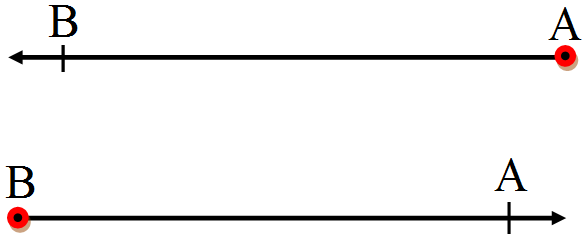
As shown in the above diagram, a ray has only one end-point. So, option $(d)$ is true.
Hence, the only false statement is option $(c)$. View full question & answer→MCQ 611 Mark
Boundaries of solids are:
AnswerBoundaries of solids are surfaces.
View full question & answer→MCQ 621 Mark
Given four distinct points in a plane. How many line segments can be drawn using them when no three of them are collinear?
AnswerIf the four points are $A, B, C$ and $D$, we can draw the lines: $A-B, A-C, A-D, B-C, B-D, C-D.$
View full question & answer→MCQ 631 Mark
Write the correct answer in the following: In ancient India, the shapes of altars used for house hold rituals were:
- ✓
- B
Triangles and rectangles.
- C
- D
AnswerIn ancient India, squares and circular altars were used for household rituals.
View full question & answer→MCQ 641 Mark
A line segment, when extended indefinitely in one direction is called $a:$
AnswerA ray is part of a line, has one fixed endpoint, and extends infinitely along the line from the endpoint.
View full question & answer→MCQ 651 Mark
The number of planes passing through 3 non-collinear points is:
AnswerThe number of planes passing through three non-collinear points is $1.$
View full question & answer→MCQ 661 Mark
Euclid first postulates is:
- ✓
A straight line may be drawn from any point to any other point.
- B
A terminated line can be produced indefinitely.
- C
All right angles are equal to one another.
- D
AnswerCorrect option: A. A straight line may be drawn from any point to any other point.
Euclid first postulates is:
A straight line may be drawn from any point to any other point
View full question & answer→MCQ 671 Mark
Which of the following is a true statement?
- A
A line has a definite length.
- B
Only a unique line can be drawn to pass through a given point.
- C
Infinitely many lines can be drawn to pass through two given points.
- ✓
If two circles are equal, then their radii are equal.
AnswerCorrect option: D. If two circles are equal, then their radii are equal.
Clearly, it is a true statement as if we consider any two equal circles, then their radii are equal.
View full question & answer→MCQ 681 Mark
The two lines which are parallel to the same line are _______ to each other.
AnswerThere are 3 lines $A B, C D, E F$, where $A B$ and $E F$ are parallel, and $C D$ and $E F$ are parallel.
Let line PQ cross $A B$ at $G, E F$ at $H, C D$ at $K$. On parallel lines, $A B$ and $E F$, angle $A G K=G H F$ (Alternate interior angles).
On parallel lines $A B$ and $E F$, angle $A G K=G H F$. (Alternate interior angles)
So, angle $A G K=G K D$. (Alternate interior angles)
So, $A B$ is parallel to $C D$.
View full question & answer→MCQ 691 Mark
A point C is called the mid-point of a line segment $\overrightarrow{\text{AB}}$ if.
AnswerCorrect option: C. $C$ is an interior point of $AB$ such that $\overrightarrow{\text{AC}}=\overrightarrow{\text{CB}}.$
A point $C$ is called the midpoint of a line segment $\overline{\text{AB}},$ if $C$ is an interior point of $AB$ such that $\overline{\text{AC}}=\overline{\text{CB}}.$

View full question & answer→MCQ 701 Mark
- A
- B
- C
Universal truths specific to geometry.
- ✓
Universal truths in all branches of mathematics.
AnswerCorrect option: D. Universal truths in all branches of mathematics.
Axioms are assumed as universal truths in all branches of mathematics because they are taken for granted, without proof.
View full question & answer→MCQ 711 Mark
The edges of a surface are:
AnswerThe edges of a surface are lines.
View full question & answer→MCQ 721 Mark
Write the correct answer in the following: Pythagoras was a student of:
AnswerPythagoras $(572 BC)$ was a student of Thales. Pythagoras and his group discovered many geometric properties and developed the theory of geometry to a great extent. This process continued till $300 BC$. At that time, Euclid, a teacher of mathematics at Alexandria in Egypt, collected all the known work and arranged it in his famous treatise.
View full question & answer→MCQ 731 Mark
Write the correct answer in the following: The side faces of a pyramid are:
AnswerThe side faces of a pyramid are always triangles.
View full question & answer→MCQ 741 Mark
Axiom and postulates are:
MCQ 751 Mark
Theorems are statements which are proved using definitions $............$ previously proved statements and deductive reasoning.
View full question & answer→MCQ 761 Mark
The two lines which are perpendicular to the same line are _______ to each other.
AnswerIf a transversal cuts two different lines and if the sum of the corresponding angles is equal to $180$ degrees. Then, the two given lines are parallel to each other and here, both the lines are perpendicular to the transversal. So, the sum of angles made by them on the transversal is 180 degrees. Hence, both the given lines are parallel to each other.
View full question & answer→MCQ 771 Mark
In Indus Valley Civilisation (about $BC 3000$), the bricks used for construction work were having dimensions in the ratio of:
- A
$5 : 3 : 2$
- ✓
$4 : 2 : 1$
- C
$4 : 3 : 2$
- D
$6 : 4 : 2$
AnswerCorrect option: B. $4 : 2 : 1$
In Indus Valley Civilization (about $300 BC$) the bricks used for construction work were having dimensions in the ratio is $4 : 2 : 1.$
View full question & answer→MCQ 781 Mark
Into how many chapters was the famous treatise, 'The Elements' divided by Euclid?
AnswerThe famous treatise 'The Elements' was divided into $13$ chapters by Euclid.
View full question & answer→MCQ 791 Mark
Boundaries of surfaces are:
AnswerBoundaries of surfaces are curves.
View full question & answer→MCQ 801 Mark
Which one of the following statements is false?
$A.$ Only one line can pass through a single point.
$B.$ Two circles are equal when their radii are equal.
$C.$ A figure formed by line segments is called a rectilinear figure.
$D.$ A terminated line can be produced indefinitely on both the sides.
AnswerInfinite number of lines can pass through a single point.
View full question & answer→MCQ 811 Mark
If $AB, AC, AD$ and $AE$ are parallel to a line $q$, then the points $A, B, C, D$ and $E$ are:
AnswerSince, $AB, AC, AD$ and $AE$ are parallel to the line $‘q’$, therefore, point A is outside $'q'$ and lines $AB, AC, AD$ and $AE$ are drawn through $A$ and each line is parallel to $'q'$. But by parallel line axiom one and only line can be drawn through A parallel to the line $'q'$. This is possible only when the points $A, B, C, D$ and $E$ all lie on the same line.
View full question & answer→MCQ 821 Mark
It is known that if $a + b = 4$ then $\frac{1}{2}(a + b) = 2$. The Euclid’s axiom that illustrates this statement is:
- A
$VI$ axiom.
- B
$V$ axiom.
- ✓
$VII$ axiom.
- D
$IV$ axiom.
AnswerCorrect option: C. $VII$ axiom.
Things which are halves of the same things are equal to each other.
View full question & answer→MCQ 831 Mark
A surface is that which has:
AnswerBecause the surface is a $2-$dimensional structure.
View full question & answer→MCQ 841 Mark
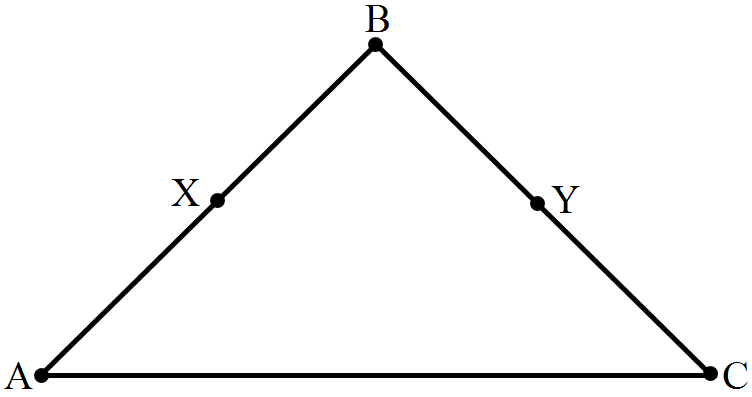
In the figure, if $AX = CY$ and $BX = BY$, then:
- ✓
$AB = BC$
- B
$AB < BC$
- C
$AB > BC$
- D
AnswerCorrect option: A. $AB = BC$
We have $AX = CY$ and $BX = BY$, then we can say that $AX + BX = CY + BY$ which means $AB = BC.$
View full question & answer→MCQ 851 Mark
Maximum numbers of points that can lie on a line are:
MCQ 861 Mark
A pyramid is a solid figure, the base of which is:
AnswerA pyramid is a polyhedron formed by connecting of polygonal base and an apex.
Each base edge and apex forms a triangle, called the lateral face.
It is a conic solid with polygonal base.
View full question & answer→MCQ 871 Mark
Euclid divided his famous treatise $“$The Elements$”$ into:
- A
$12$ chapters.
- B
$11$ chapters.
- C
$9$ chapters.
- ✓
$13$ chapters.
AnswerCorrect option: D. $13$ chapters.
Book $1$ contains Euclid's $10$ axioms.
Book $2$ is commonly called the $''$book of geometric algebra$''$.
Book $3$ deals with circles and their properties.
Book $4$ constructs the incircle and circumcircle of a triangle.
Book $5$ is a treatise on proportions of magnitudes.
Book $6$ applies proportions to geometry: similar figures.
Book $7$ deals with elementary number theory.
Book $8$ deals with proportions in number theory and geometric sequences.
Book $9$ applies the results of the preceding two books and gives the infinitude of prime numbers.
Book $10$ attempts to classify incommensurable $($in modern language, irrational$)$.
Book $11$ generalizes the results of books $1-6.$
Book $12$ studies volumes of cones, pyramids, and cylinders.
Book $13$ constructs the five regular Platonic solids.
View full question & answer→MCQ 881 Mark
A is of the same age as $B$ and $C$ is of the same age as $B$. Euclid's which axiom illustrates the relative ages of $A$ and $C?$
AnswerEuclid's first axiom states that 'Things which are equal to the same thing are equal to one another'.
That is,
$A's$ age $= B's$ age and $C's$ age $= B'$ age
$\Rightarrow A's$ age $= C's$ age
View full question & answer→MCQ 891 Mark
The boundaries of solid are called:
MCQ 901 Mark
If $C$ lies between A and B and $AB =10 cm, AC =3 cm$, then $BC ^2=$
- A
$13 cm^2$
- ✓
$49 cm^2$
- C
$9 cm^2$
- D
$7 cm^2$
AnswerCorrect option: B. $49 cm^2$
Since, $A B=10 cm, C=3 cm$, therefore $B C=A B-A C=10-3=7 cm$. Hence, $B C^2=49 cm^2$.
View full question & answer→MCQ 911 Mark
The number of end points a line has:
AnswerA line has no endpoint. It extends in both the directions endlessly.
View full question & answer→MCQ 921 Mark
The things which coincide with one another are:
Answer"The things which coincide with one another are equal" is one of the axioms given by Euclid.
Example: Segment $AB = $Segment BA, $\angle\text{A}=\angle\text{A}.$
View full question & answer→MCQ 931 Mark
Write the correct answer in the following: Euclid divided his famous treatise “The Elements” into:
- ✓
$13$ chapters.
- B
$12$ chapters.
- C
$11$ chapters.
- D
$9$ chapters.
AnswerCorrect option: A. $13$ chapters.
Euclid divided his famous treatise 'The Elements' into $13$ chapters.
View full question & answer→MCQ 941 Mark
In Ancient India, Altars with combination of shapes like rectangles, triangles and trapeziums were used for:
- A
- ✓
- C
Both Public worship and Household rituals.
- D
AnswerIn ancient India altars whose shapes were combinations of rectangles, triangles and trapeziums were used for public worship.
View full question & answer→MCQ 951 Mark
If a straight line falling on two straight lines makes the interior angles on the same side of it taken together less than $180^\circ$ then the two straight lines, if produced indefinitely, meet on that side on which the angles taken together are:
- A
$180^\circ$
- ✓
$< 180^\circ $
- C
$= 180^\circ$
- D
AnswerCorrect option: B. $< 180^\circ $
According to Euclid's fifth postulate, if a straight line crossing two straight lines makes the interior angles on the same side less than two right angles, the two straight lines, if extended indefinitely, meet on that side on which are the angles less than the two right angles.
View full question & answer→MCQ 961 Mark
A point $C$ is said to lie between the points $A$ and $B$ if:
AnswerCorrect option: B. Points $A, C$ and $B$ are collinear.
A point $C$ is said to lie between $A$ and $B$ if the points $A, C$ and $B$ are collinear.
View full question & answer→MCQ 971 Mark
Pythagoras was influenced by:
AnswerPythagoras of Samos is one of the most famous names in the history of mathematics and is recognized as the first true mathematician. When Pythagoras was $18$, he visited Miletus - an ancient Greek city on the western coast of Anatolia, where he met Thales - the first known Greek philosopher and scientist. By that time Thales was very old and is not believed to have taught Pythagoras a great deal. However, it was this meeting which triggered his interest in the science of mathematics and astronomy.
View full question & answer→MCQ 981 Mark
Two lines are said to be _______ if they intersect at a right angle.
AnswerPerpendicular lines are two or more lines that intersect at a $90-$degree angle or right angle.
View full question & answer→MCQ 991 Mark
The number of planes passing through $3$ noncollinear points is:
AnswerA unique plane passes through $3$ given noncollinear points.
View full question & answer→MCQ 1001 Mark
A is of the same age as $B$ and $C$ is of the same age as $B$. Euclid's which axiom illustrates the relative ages of $A$ and $C?$
AnswerHere $(A = B$ and $C = B), A = C$. First axiom states that the things which are equal to the same thing are equal to one another.
View full question & answer→MCQ 1011 Mark
Write the correct answer in the following: Euclid belongs to the country:
AnswerEuclid belongs to the country Greece. Euclid around $300 B.C$. collected all known work in the field of mathematics and arranged it in his famous treatise called Elements.
View full question & answer→MCQ 1021 Mark
- A
Two mid$-$points.
- B
Three mid$-$points.
- ✓
Only one mid$-$point.
- D
AnswerCorrect option: C. Only one mid$-$point.
The midpoint of a line segment divides it into two equal parts, therefore, a line can have only one mid$-$point.
View full question & answer→MCQ 1031 Mark
The edges of a surface are:
AnswerEdge is a line or border at which a surface terminates.
View full question & answer→MCQ 1041 Mark
The number of dimensions of a surface are:
AnswerA surface has $2$ dimensions.
View full question & answer→MCQ 1051 Mark
The edges of a surface are.
MCQ 1061 Mark
Euclid belongs to the country:
AnswerEuclid belongs to the country, Greece.
View full question & answer→MCQ 1071 Mark
The side faces of a prism are:
AnswerWhen the side faces of a polyhedron are rectangles then it is known as prism.
View full question & answer→MCQ 1081 Mark
- A
Universal truths specific to geometry.
- ✓
Universal truths in all branches of mathematics.
- C
- D
AnswerCorrect option: B. Universal truths in all branches of mathematics.
From ancient times, axioms have been acquired by man through the day to day experiences.
No mathematical deduction is needed to prove them.
So axioms are assumed universal truths in all branches of mathematics.
View full question & answer→MCQ 1091 Mark
The side faces of a pyramid are:
AnswerBecause when we connect base edge and apex it forms a triangle.
View full question & answer→MCQ 1101 Mark
It is known that if $x + y = 10$ then $x + y + z = 10 + z$. The Euclid’s axiom that illustrates this statement is:
AnswerThe Euclid’s axiom that illustrates the given statement is second axiom, according to which. If equals are added to equals, the wholes are equal.
View full question & answer→MCQ 1111 Mark
The whole is $..........$ the part.
AnswerThe whole is made up of its parts, hence, it will always be greater than the part.
View full question & answer→MCQ 1121 Mark
The three steps from solids to points are:
- A
Lines $-$ points $-$ surfaces $-$ solids
- B
Lines $-$ surfaces $-$ points $-$ solids
- C
Solids $-$ lines $-$ surfaces $-$ points
- ✓
Solids $-$ surfaces $-$ linepoint
AnswerCorrect option: D. Solids $-$ surfaces $-$ linepoint
Solids $-$ surfaces $-$ linepoint
View full question & answer→MCQ 1131 Mark
The things which are double of the same things are:
- A
- ✓
- C
Halves of the same thing.
- D
Double of the same thing.
AnswerAccording to an Euclidian axiom, The things which are double of the same things are equal to one another.Example: if $2x = 2y$, then $x = y.$
View full question & answer→MCQ 1141 Mark
Two lines are said to be parallel if:
- A
They intersect each other at any point.
- ✓
They do not intersect each other at any point.
- C
The angle between these lines is 90 degree.
- D
AnswerCorrect option: B. They do not intersect each other at any point.
Two lines are said to be parallel if they do not intersect each other at any point.
The angle between these lines is $180$ degree.
View full question & answer→MCQ 1151 Mark
If $C$ is the mid-point of the line segment $AB$ and $L$ is the mid-point of $AC$, then:
- A
$\text{AL}=\frac{1}{2}\text{AB}$
- B
$\text{AL}=\frac{3}{4}\text{AB}$
- C
$\text{AL}=\frac{1}{3}\text{AB}$
- ✓
$\text{AL}=\frac{1}{4}\text{AB}$
AnswerCorrect option: D. $\text{AL}=\frac{1}{4}\text{AB}$
If $C$ is the mid-point of the line segment $AB$, then, $AB = 2AC.$
Now, $L$ is the mid-point of $AC$, then, $AC = 2AL$. This follows that $AB = 4AL.$
Hence, $\text{AL}=\frac{1}{4}\text{AB}.$
View full question & answer→MCQ 1161 Mark
Euclid’s fifth postulate is:
- A
The whole is greater than the part.
- B
All right angles are equal to one another.
- ✓
If a straight line falling on two straight lines makes the interior angles on the same side of it taken together less than two right angles, then the two straight lines if produced indefinitely, meet on that side on which the sum of angles is less than two right angles.
- D
A circle may be described with any centre and any radius.
AnswerCorrect option: C. If a straight line falling on two straight lines makes the interior angles on the same side of it taken together less than two right angles, then the two straight lines if produced indefinitely, meet on that side on which the sum of angles is less than two right angles.
If a straight line falling on two straight lines makes the interior angles on the same side of it taken together less than two right angles, then the two straight lines if produced indefinitely, meet on that side on which the sum of angles is less than two right angles.
View full question & answer→MCQ 1171 Mark
The number of interwoven isosceles triangles in Sriyantra (in the Atharvaveda) is:
AnswerThe number of interwoven isosceles triangles in Sriyantra (in the Atharvaveda) is nine.
View full question & answer→MCQ 1181 Mark
AnswerThales, a Greek mathematician cum philosopher lived in Pre-Socratic times around $620-625 BC$. He is commonly known as Thales of Miletus as he belonged to Miletus in Asian region.
View full question & answer→MCQ 1191 Mark
The number of end points a line segment has:
AnswerA line segment has two end points.
View full question & answer→MCQ 1201 Mark
Which of the following is true statement?
- A
The ceiling and a wall of a room are parallel planes.
- B
Two adjacent walls of a room are parallel planes.
- C
The floor and a wall of a room are parallel planes.
- ✓
The floor and the ceiling of a room are parallel planes.
AnswerCorrect option: D. The floor and the ceiling of a room are parallel planes.
Clearly floor and the ceiling of a room are opposite to each other and do not intersect at any point, hence are parallel planes.
View full question & answer→MCQ 1211 Mark
The shape of the base of a Pyramid is:
MCQ 1221 Mark
How many dimensions does a point have?
AnswerA point has 0 dimensions.
View full question & answer→MCQ 1231 Mark
The things which are double of the same thing are:
AnswerThe things which are double of the same thing are equal.
According to the Euclidian axiom, the things which are double the same thing are equal to each other.
For example, if $2a = 2b$, then $a = b.$
View full question & answer→MCQ 1241 Mark
The number of dimensions, a solid has:
AnswerA solid shape also has a depth. solids by their nature have an inside and an outside separated by a surface. that's why solid is a three-dimensional struture. It has length, breadth, and depth.
View full question & answer→MCQ 1251 Mark
Euclid stated that if equals are added to equals, the wholes are equal in the form of:
AnswerThis is Euclid's second axiom stating addition of equals. An algebraic version of Euclid’s second axiom would read “if $x = y,$ and if $a = b$, then $x + a = y + b.”$
View full question & answer→MCQ 1261 Mark
It is known that if $a + b = 4$ then $a + b + c = 4 + c$. The Euclid’s axiom that illustrates this statement is:
- A
$I$ axiom.
- B
$III$ axiom.
- ✓
$II$ axiom.
- D
$IV$ axiom.
AnswerCorrect option: C. $II$ axiom.
If equals are added to equals, the whole are equals.
View full question & answer→MCQ 1271 Mark
The number of dimensions a solid has is:
MCQ 1281 Mark
The boundaries of solids are:
AnswerBecause solid has both inner and outer part separated by surface.
View full question & answer→MCQ 1291 Mark
The whole is $.........$ the part.
AnswerAccording to Euclid's common notions, the whole is greater than the part.
View full question & answer→MCQ 1301 Mark
The boundaries of solid are called:
MCQ 1311 Mark
Euclid stated that all right angles are equal to each other in the form of:
MCQ 1321 Mark
Euclid stated that all right angles are equal to each other in the form of:
AnswerEuclid's fourth postulate states that all right angles are equal to one another.
View full question & answer→MCQ 1331 Mark
Write the correct answer in the following: The number of dimensions, a solid has:
AnswerA solid has shape, size, position and can be moved from one place to another. So, a solid has three dimensions.
For example: cuboid, cube, cylinder, cone etc.
View full question & answer→MCQ 1341 Mark
$A$ and $B$ have the same weight. If they gain weight by $3\ kg$, then:
- A
Weight of $A <$ Weight of $B$.
- ✓
Weight of $A =$ Weight of $B.$
- C
Weight of $A >$ Weight of $B.$
- D
AnswerCorrect option: B. Weight of $A =$ Weight of $B.$
Let the weights of $A$ and $B$ be $x$ kgs. If both of them gain weight by $3$ kgs , their new weight would be ' $x+3$ ' kgs. According to Euclid's axiom if equals are added in equals, then whole are equal. Hence, Weight of $A = Weight of B$.
View full question & answer→MCQ 1351 Mark
The boundaries of surfaces are:
AnswerBecause surface has both length and breadth which are lines.
View full question & answer→MCQ 1361 Mark
There are $...........$ number of Euclid’s Postulates
View full question & answer→MCQ 1371 Mark
A statement whose truth can easily be deduced from a theorem is called:
AnswerA corollary is a proposition that follows from $($and is often appended to$)$ one already proved.
View full question & answer→MCQ 1381 Mark
AnswerEuclid, sometimes called Euclid of Alexandria to distinguish him from Euclides of Megara, was a Greek mathematician, often referred to as the $''$father of geometry$''$.
View full question & answer→MCQ 1391 Mark
The number of dimensions, a surface has:
AnswerThe surface is that which has length and breadth. ($1$ dimension $+ 1$ dimension $= 2$ dimension).
View full question & answer→MCQ 1401 Mark
If the angle between two lines is $180$ degree, then:
- ✓
Lines are parallel to each other
- B
Lines are perpendicular to each other
- C
Lines are parallel as well as perpendicular
- D
AnswerCorrect option: A. Lines are parallel to each other
If the angle between two lines is $180$ degree, then they are parallel to each other.
View full question & answer→MCQ 1411 Mark
If the point P lies in between $M$ and $N, C$ is the mid-point of $MP$ then:
- A
$CP + CN = MN$
- ✓
$MC + CN = MN$
- C
$MC + PN = MN$
- D
$MP + CP = MN$
AnswerCorrect option: B. $MC + CN = MN$
Since, $P$ lies between $M$ and $N, MN = MP + PN$
Now, $C$ is the mid-point of $MP,$
So, $MP = MC + CP$
$⇒ MN = MC + CP + PN$
$⇒ MN = MC + CN (CP + PN = CN).$
View full question & answer→MCQ 1421 Mark
The number of dimensions of a solid are:
AnswerA solid has $3$ dimensions.
View full question & answer→MCQ 1431 Mark
Into how many chapters was the famous treatise. The Elements divided by Euclid?
AnswerEuclid divided his book 'The Elements' into $13$ chapters.
View full question & answer→MCQ 1441 Mark
Write the correct answer in the following: Which of the following needs a proof ?
AnswerThe statements that were proved are called propositions or theorems.
View full question & answer→MCQ 1451 Mark
Directions: In the following questions, the Assertions $(A)$ and Reason$(s) (R)$ have been put forward. Read both the statements carefully and choose the correct alternative from the following:
Assertion: a sequence finite or infinite list of numbers
Reason: $1, 2, 3, 4 .........$ is the sequence an infinite sequence of natural no.
- ✓
Both Assertion and reason are correct and reason is correct explanation for Assertion.
- B
Both Assertion and reason are correct but reason is not correct explanation for Assertion
- C
Assertion is true but reason is false.
- D
Both Assertion and reason are false.
AnswerCorrect option: A. Both Assertion and reason are correct and reason is correct explanation for Assertion.
Both Assertion and reason are correct and reason is correct explanation for Assertion.
View full question & answer→MCQ 1461 Mark
Pythagoras was a student of:
MCQ 1471 Mark
If $a > b$ and $b > c$, then,
- A
$a = c$
- B
$a < c$
- ✓
$a > c$
- D
$a ≤ c$
AnswerCorrect option: C. $a > c$
$a > c$
View full question & answer→MCQ 1481 Mark
How many dimensions does a point have:
AnswerA point is an exact location. A fine dot represents a point. So, a point has $0$ dimensions.
View full question & answer→MCQ 1491 Mark
The line drawn from the center of the circle to any point on its circumference is called:
MCQ 1501 Mark
Which one of the following statements is true?
- A
A point determines always a unique line.
- ✓
Three lines are concurrent when they have only one point in common.
- C
A ray has two end points.
- D
A line has definite length.
AnswerCorrect option: B. Three lines are concurrent when they have only one point in common.
Lines which are concurrent have only one point in common and is called the point of concurrency.
View full question & answer→MCQ 1511 Mark
Thales belongs to the country:
AnswerThales belongs to the country, Greece.
View full question & answer→MCQ 1521 Mark
Write the correct answer in the following:
Euclid stated that all right angles are equal to each other in the form of:
AnswerEuclid stated that all right angles are equal to each other in the form of a postulate.
View full question & answer→MCQ 1531 Mark
A, B and C are three collinear points. How many lines can be determined by them?
AnswerSince the three points are collinear, they lie on the same line, so only one line can be determined by them.
View full question & answer→MCQ 1541 Mark
$'$Lines are parallel if they do not intersect$’ –$ is stated in the form of:
View full question & answer→MCQ 1551 Mark
In Indus Valley Civilisation, the bricks used for construction work were having dimensions in the ratio:
- A
$4 : 4 : 1$
- B
$4 : 3 : 2$
- ✓
$4 : 2 : 1$
- D
$1 : 3 : 4$
AnswerCorrect option: C. $4 : 2 : 1$
In Indus Valley Civilization, the bricks used for construction work were having dimensions in the ratio length : breadth : thickness $= 4 : 2 : 1.$
View full question & answer→MCQ 1561 Mark
If two line segments are equal then they are called:
AnswerIf two line segments are equal then they are called congruent segments.
View full question & answer→MCQ 1571 Mark
Euclid's which axiom illustrates the statement that when $x + y = 15,$ then $x + y + z = 15 + z?$
AnswerSecond axiom states that if equals be added to equals, then wholes are equal.
View full question & answer→MCQ 1581 Mark
Write the correct answer in the following:
In Indus Valley Civilisation (about $3000 B.C.$), the bricks used for construction work were having dimensions in the ratio:
- A
$1 : 3 : 4$
- ✓
$4 : 2 : 1$
- C
$4 : 4 : 1$
- D
$4 : 3 : 2$
AnswerCorrect option: B. $4 : 2 : 1$
Bricks used for construction work were having dimensions in the ratio are $4 : 2 : 1$
View full question & answer→MCQ 1591 Mark
If two circles are equal, then their radii are $...........$
View full question & answer→MCQ 1601 Mark
The shape of base of Pyramid is:
MCQ 1611 Mark
A solid has $..........$ dimensions.
View full question & answer→MCQ 1621 Mark
In ancient India, the shapes of altars used for household rituals were:
- ✓
- B
Triangles and rectangles.
- C
- D
AnswerIn ancient India, squares and circular altars were used for household rituals.
The geometry of the Vedic period originated with the construction of altars $($or voids$)$ and fireplaces for performing Vedic rites.
Square and circular altars were used for household rituals, while altars, whose shapes were combinations of rectangles, triangles and trapeziums, were required for public worship.
View full question & answer→MCQ 1631 Mark
If $\overline{\text{AB}}=\overline{\text{PQ}}$ and $\overline{\text{PQ}}=\overline{\text{XY}},$ then:
- ✓
$\overline{\text{AB}}=\overline{\text{XY}}$
- B
$\overline{\text{AB}}>\overline{\text{PQ}}$
- C
$\overline{\text{AB}}<\overline{\text{XY}}$
- D
AnswerCorrect option: A. $\overline{\text{AB}}=\overline{\text{XY}}$
According to Euclid's first axiom that thing which is equal to the same thing, are equal to one another.
Hence, If two lines are equal to a third line, they will be equal in length.
View full question & answer→MCQ 1641 Mark
The number of dimensions, a line has:
AnswerBecause a line is a breathless length.
View full question & answer→MCQ 1651 Mark
Write the correct answer in the following: Boundaries of solids are:
AnswerBoundaries of solids are called surfaces.
View full question & answer→MCQ 1661 Mark
The number of interwoven isosceles triangles in a Sriyantra is:
AnswerThe Sriyantra consists of nine interwoven isosceles triangles.
View full question & answer→MCQ 1671 Mark
In ancient India, altars with combination of shapes like rectangles, triangles and trapeziums were used for:
AnswerIn ancient India, altars with combination of shapes like rectangles, triangles and trapeziums were used for public rituals.
View full question & answer→MCQ 1681 Mark
Write the correct answer in the following: A pyramid is a solid figure, the base of which is:
AnswerA pyramid is a solid figure, the base of which is any polygon.
$($A pyramid is a solid figure, the base of which is a triangle or square or some other polygon$)$
View full question & answer→MCQ 1691 Mark
If point $C$ lies between two points $A$ and $B$ such that $AC = BC$, then:
- A
$\text{AC}=\frac{1}{4}\text{AB}$
- ✓
$\text{AC}=\frac{1}{2}\text{AB}$
- C
$\text{AC}=\frac{3}{4}\text{AB}$
- D
$\text{AC}=\frac{1}{3}\text{AB}$
AnswerCorrect option: B. $\text{AC}=\frac{1}{2}\text{AB}$
Point $C$ is the mid point of $AB$. Hence, $AB = AC + BC$ or, $AB = AC + AC = 2AC$ (since, $AC = BC).$
Hence, $\text{AC}=\frac{1}{2}\text{AB}.$
View full question & answer→MCQ 1701 Mark
In ancient India, the shapes of altars used for household rituals were:
MCQ 1711 Mark
The base of a Pyramid is:
MCQ 1721 Mark
A sentence which is either true or false but not both is called:
AnswerA sentence which is either true or false but not both is called the statement.
View full question & answer→MCQ 1731 Mark
The line segment with one endpoint at the centre and the other at any point on the circle is called $...........$
AnswerThe radius of a circle is the distance from the center of the circle to any point on its circumference.
View full question & answer→MCQ 1741 Mark
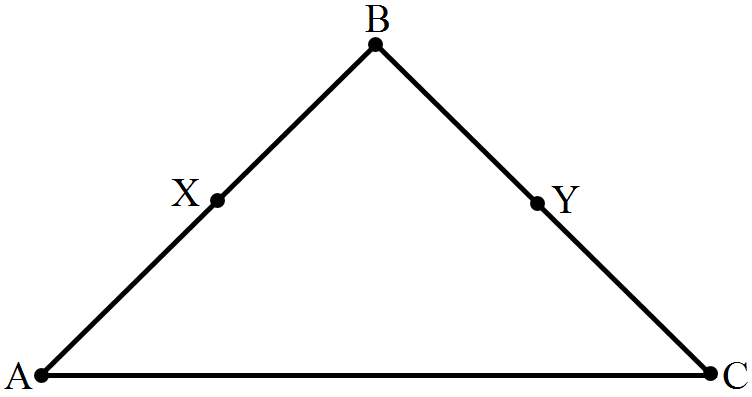
In the figure, if $AB = BC$ and $BX = BY,$ then:
- A
$AX > CY$
- B
$AX < CY$
- ✓
$AX = CY$
- D
AnswerCorrect option: C. $AX = CY$
Since, $AB = BC$, we have $AX + BX = CY + BY$
and we have, $BX = BY$, hence, we can say that $AX = CY.$
View full question & answer→MCQ 1751 Mark
Which of the following is a false statement?
AnswerCorrect option: C. Ray $\overrightarrow{\text{AB}}$ = ray $\overrightarrow{\text{BA}}.$
In ray $AB, A$ is fixed and in ray $BA, B$ is fixed.
View full question & answer→MCQ 1761 Mark
A point $C$ is called the midpoint of a line segment $\overrightarrow{\text{AB}}$ if:
- A
$\overrightarrow{\text{AC}}=\overrightarrow{\text{BC}}.$
- ✓
$C$ is an interior point of $AB$ such that $\overrightarrow{\text{AC}}=\overrightarrow{\text{BC}}.$
- C
$AC + CB = AB.$
- D
$C$ is an interior point of $AB.$
AnswerCorrect option: B. $C$ is an interior point of $AB$ such that $\overrightarrow{\text{AC}}=\overrightarrow{\text{BC}}.$
A point $C$ is called the midpoint of line segment $\overrightarrow{\text{AB}},$ if $C$ is an interior point of $\overrightarrow{\text{AB}}$ such that $\overrightarrow{\text{AC}}=\overrightarrow{\text{BC}}.$
View full question & answer→MCQ 1771 Mark
Euclid's which axiom illustrates the statement that when $x + y = 15$ then $x + y + 2 = 15 + z?$
AnswerEuclid's second axiom states that 'If equals are added to equals, the wholes are equal'.
Hence, when $x + y = 15$, then $x + y + z = 15 + z.$
View full question & answer→MCQ 1781 Mark
It is known that if $a + b = 4$ then $2(a + b) = 8.$ The Euclid’s axiom that illustrates this statement is:
- A
$I$ axiom.
- B
$IV$ axiom.
- ✓
$VI$ axiom.
- D
$III$ axiom.
AnswerCorrect option: C. $VI$ axiom.
Things which are double of the same things are equal to each other.
View full question & answer→MCQ 1791 Mark
The statement that 'the lines are parallel if they do not intersect' is in the form of:
AnswerLines are parallel if they do not intersect' is started in the form of a definition.
View full question & answer→MCQ 1801 Mark
Write the correct answer in the following: In Ancient India, Altars with combination of shapes like rectangles, triangles and trapeziums were used for:
- ✓
- B
- C
Both $A$ and $B.$
- D
None of $A, B, C.$
AnswerIn ancient India altars whose shapes were combinations of rectangles, triangles and trapeziums were used for public worship.
View full question & answer→MCQ 1811 Mark
Which of the following needs a proof?
AnswerThe theorem needs a proof.
Whereas definition, axiom and postulates are self $-$ evident and do not require any proof.
View full question & answer→MCQ 1821 Mark
The three steps from solids to points are:
- A
Solids - lines - points - surfaces.
- B
Solids - points - lines - surfaces.
- ✓
Solids - surfaces - lines - points.
- D
AnswerCorrect option: C. Solids - surfaces - lines - points.
In each step, we lose one dimension. solid$-3$ dimension. surface$-2$ dimension. lines$-1$ dimension. point - has no dimension.
View full question & answer→MCQ 1831 Mark
Which of these statements do not satisfy Euclid’s axiom?
- A
Things which are equal to the same thing are equal to one another
- B
If equals are added to equals, the wholes are equal.
- C
If equals are subtracted from equals, the remainders are equal.
- ✓
The whole is lesser than the part.
AnswerCorrect option: D. The whole is lesser than the part.
The whole is lesser than the part.
View full question & answer→MCQ 1841 Mark
‘Lines are parallel if they do not intersect’ is stated in the form of:
Answer$'$Lines are parallel if they do not intersect $’$ is stated in the form of definition.
The definition is a statement that gives the exact meaning of the word.
View full question & answer→MCQ 1851 Mark
Euclid’s Axiom $5$ is:
- A
The things which coincide with one another are equal to one another.
- B
If equals are subtracted from equals, the remainder are equal.
- ✓
The whole is greater than the part.
- D
AnswerCorrect option: C. The whole is greater than the part.
The whole is greater than the part.
View full question & answer→MCQ 1861 Mark
Boundaries of solids are:
MCQ 1871 Mark
The number of line segments determined by three collinear points is:
AnswerIf the points are collinear then only one line can pass through them as collinear means "on the same line".
View full question & answer→MCQ 1881 Mark
The edges of the surface are: