Questions

4 Marks Questions

Take a timed test

3 questions · self-marked practice — reveal the answer and mark yourself.

Question 14 Marks
What is the difference between a theorem and an axiom?
Answer
Axiom: An axiom is a basic fact that is taken for granted without proof. Examples:
$i.$ Halves of equals are equal.
$ii.$ The whole is greater than each of its parts.
Theorem: A statement that requires proof is called theorem. Examples:
$i.$ The sum of all the angles around a point is $360^\circ $.
$ii.$ The sum of all the angles of triangle is $180^\circ$ .
View full question & answer
Question 24 Marks
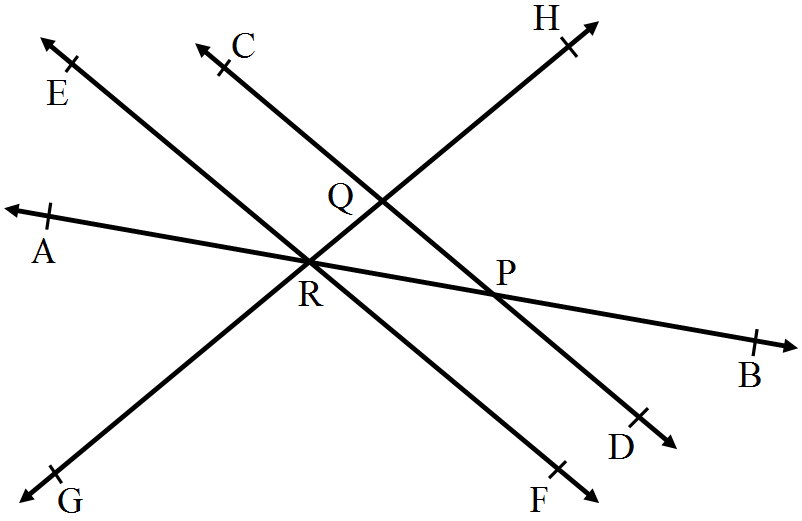
In the adjoining figure, name:
$i.$ Two pairs of intersecting lines and their corresponding points of intersection.
$ii.$ Three concurrent lines and their points of intersection.
$iii.$ Three rays.
$iv.$ Two line segments.
Answer
$i.$ Two pairs of intersecting lines and their point of intersection are.
$\bigg\{\overleftrightarrow{\text{EF}},\ \overleftrightarrow{\text{GH}}$point$\text{ R}\bigg\},\bigg\{\overleftrightarrow{\text{AB}},\ \overleftrightarrow{\text{CD}},$point$\text{ P}\bigg\}$
$ii.$ Three concurrent lines are.
$\bigg\{\overleftrightarrow{\text{AB}},\ \overleftrightarrow{\text{EF}},\ \overleftrightarrow{\text{GH}},\ $point$\text{ R}\bigg\}$
$iii.$ Three rays are.
$\bigg\{\overrightarrow{\text{RB}},\ \overrightarrow{\text{RH}},\ \overrightarrow{\text{RF}}\bigg\}$
$iv. $Two line segments are.
$\Big\{\overline{\text{RQ}}$ and $\overline{\text{RP}}\Big\}$
View full question & answer
Question 34 Marks
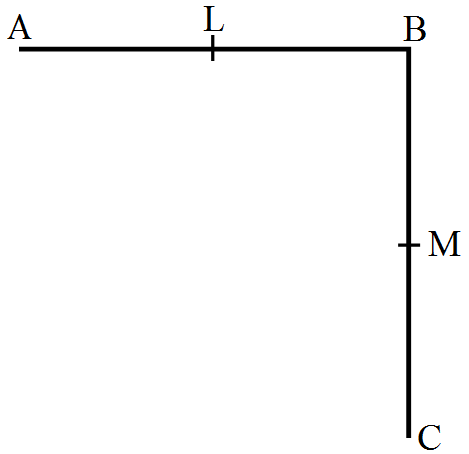
In the given figure, $L$ and $M$ are the mid$-$points of $AB$ and $BC$ respectively.
 
$i.$ If $AB = BC$, prove that $AL = MC$.
$ii.$ If $BL = BM$, prove that $AB = BC$.
Hint:
$i.\text{AB}=\text{BC}$
$\Rightarrow\frac{1}{2}\text{AB}=\frac{1}{2}\text{BC}$
$\Rightarrow\text{AL}=\text{MC}.$
$ii.\text{BL}=\text{BM}$
$\Rightarrow2\text{BL}=2\text{BM}$
$\Rightarrow\text{AB}=\text{BC}.$
Answer
$i.$ It is given that $L$ is the mid$-$point of $AB$.
$\therefore\text{AL}=\text{BL}=\frac{1}{2}\text{AB}\ .....(1)$
Also, $M$ is the mid-point of $BC$.
$\therefore\text{BM}=\text{MC}=\frac{1}{2}\text{BC}\ .....(2)$
$\text{AB}=\text{BC} ($Given$)$
$\Rightarrow\frac{1}{2}\text{AB}=\frac{1}{2}\text{BC} ($Things which are halves of the same thing are equal to one another$)$
$\text{AL}=\text{MC}$
$[$From $(1)$ and $(2)]$
$ii.$ It is given that $L$ is the mid$-$point of $AB$.
$\therefore\text{AL}=\text{BL}=\frac{1}{2}\text{AB}$
$\Rightarrow2\text{AL}=2\text{BL}=\text{AB}\ .....(3)$
Also, $M$ is the mid-point of $BC$.
$\therefore\text{BM}=\text{MC}=\frac{1}{2}\text{BC}$
$\Rightarrow2\text{BM}=2\text{MC}=\text{BC}\ .....(4)$
$\text{BL}=\text{BM} ($Given$)$
$\Rightarrow2\text{BL}=2\text{BM} ($Things which are double of the same thing are equal to one another$)$
$\Rightarrow\text{AB}=\text{BC}$
$[$From $(3)$ and $(4)]$
View full question & answer