Questions

3 Marks Question

🎯

Test yourself on this topic

6 questions · timed · auto-graded

Question 13 Marks
How many solution$(s)$ of the equation $2x + 1 = x – 3$ are there on the:
$i.$ Number line
$ii.$ Cartesian plane?
Answer
$i.$ The number of solution$(s)$ of the equation $2x + 1 = x – 3$ which are on the number line is one.
$2x + 1 = x - 3$
$ \Rightarrow 2x - x = -3 - 1$
$ \Rightarrow x = -4$
$\therefore x = -4$ is the solution of the given eqution.
$ii.$ As in the Cartesian Plane the equation can be written as $x + 0y = -4.$
And for infinitely many values of $y$ we have infinite values of $x.$
So the number of solution$(s)$ of the equation $2x + 1 = x – 3$ which are on the Cartesian plane are infinitely many solutions.
View full question & answer
Question 23 Marks
Determine the point on the graph of the linear equation $2x + 5y = 19$ whose ordinate is $1\frac{1}{2}$ times its abscissa.
Answer
Let x be the abscissa of the given line $2x + 5y = 19$, then by given condition, Ordinate $\text{(y)}=1\frac{1}{2}\times\text{Abscissa}$
$\Rightarrow\text{y}=\frac{3}{2}\text{x}\ ....(\text{i})$ On putting $\text{y}=\frac{3}{2}\text{x}$ in given equation, we get $2\text{x}+5\Big(\frac{3}{2}\Big)\text{x}=19$
$\Rightarrow4\text{x}+15\text{x}=19\times2$
$\Rightarrow4\text{x}+15\text{x}=38$
$\Rightarrow 19\text{x}=38$
$\Rightarrow\text{x}=\frac{38}{19}$
$\therefore\text{x}=2$ On substituting the value of x in Eq. $(i)$ we get $\text{y}=\frac{3}{2}\times2=3$
$\Rightarrow\text{y}=3$ Heanse, the required point is $(2, 3).$
View full question & answer
Question 33 Marks
Show that the points $A(1, 2), B(-1, -16)$ and $C(0, -7)$ lie on the graph of the linear equation $y = 9x - 7.$
Answer
For $A (1,2)$, we have $2=9(1)-7=9-7=2$ For $B (-1,-16)$,
we have $-16=9(-1)-7=-9-7=-16$ For $C(0,-7)$,
we have $-7=9(0)-7=0-7=-7$
We see that the line $y=9 x-7$ is satisfied by the points $A(1,2), B(-1,-16)$ and $C(0,-7)$.
Therefore, $A(1, 2), B(-1, -16)$ and $C(0, -7)$ are solutions of the linear equation $y = 9x - 7$ and therefore, lie on the graph of the linear equation $y = 9x - 7.$
View full question & answer
Question 43 Marks
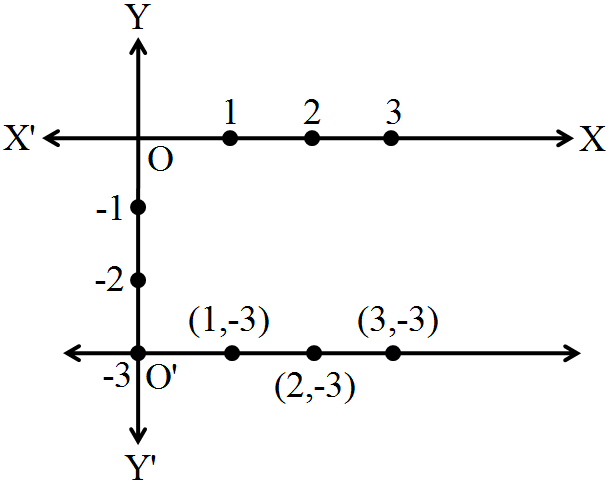
Draw the graph of the equation represented by a straight Line which is parallel to the $X-$axis and at a distance $3$ units below it.
Answer
The graph of the equation $y = -3$ is a line parallel to the $x$-axis and at a distance $3$ units below it. So, graph of the equation $y = -3$ is a line parallel to $x$-axis and passing through the point $(0, -3)$ as shown in the figure given below:
View full question & answer
Question 53 Marks
If the point $(3, 4)$ lies on the graph of $3y = ax + 7$, then find the value of a.
Answer
Since, the point $(x = 3, y = 4)$ lies on the equation $3y = ax + 7,$
then the equation will be , satisfied by the point.
Now, put $x = 3$ and $y = 4$ in given equation,
we get $3(4) = a(3) + 7 $
$\Rightarrow 12 = 3a + 7 $
$\Rightarrow 3a = 12 – 7 $
$\Rightarrow 3a = 5$
Hence, the value of a is $\frac{5}{3}$.
View full question & answer
Question 63 Marks
If the temperature of a liquid can be measured in kelvin units as $x^\circ K$ or in fahrenheit units as $y^\circ F$, the relation between the two systems of measurement of temperature is given by the linear equation. $\text{y}=\frac{9}{5}(\text{x}-273)+32$
$i.$ find the temperature of the liquid in fahrenheit, if the temperature of the liquid is $313K.$
$ii.$ If the temperature is $158^\circ F$, then find the temperature in kelvin.
Answer
The linear equation that converts kelvin $(x)$ to Fahrenheit $(y)$ is given by the relation $\text{y}=\frac{9}{5}(\text{x}-273)+32$
When the temperature of the liquid is $x = 313^\circ k \text{y}=\frac{9}{5}(313-273)+32=\frac{9}{5}\times40+32=72^\circ+32^\circ=104^\circ\text{F}$
When the temperature of the liquid is $x = 158^\circ F 158=\frac{9}{5}(\text{x}-273)+32$
$\Rightarrow\frac{9}{5}(\text{x}-273)=158-32$
$\Rightarrow\text{x}-273=126\times\frac{5}{9}=70$
$\Rightarrow\text{x}-273=70=273+70=343\text{k}$
View full question & answer
3 Marks Question - Maths STD 9 Questions - Vidyadip